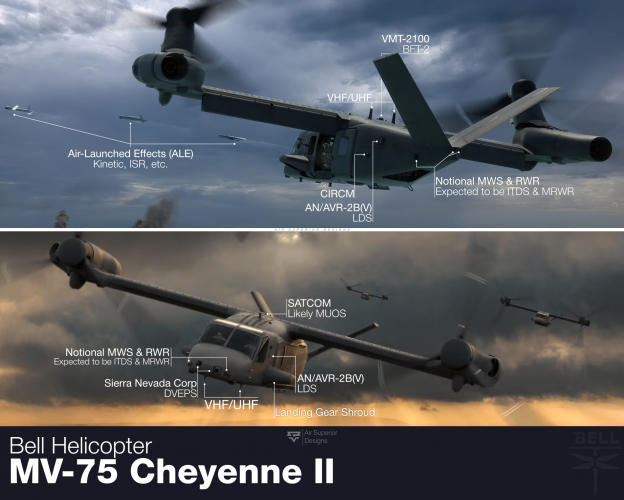
Here is Bell’s latest presentation for the Army Aviation Mission Solutions Summit 2026.
Source (X fka twitter):
View: https://x.com/i/status/2044523805536596096
Source (X fka twitter):
View: https://x.com/i/status/2044523805536596096
Only 400 Ospreys, vs. 5000+ Black Hawks.And yet statistically the V-22 has a mishap rate that is completely average amongst the DOD’s rotorcraft inventory, and lower than many types in the Marine Corps inventory - so your assertions here clearly miss the mark at a fundamental level if you want to invoke “statistics”.
As for being a solution to a non-existent problem, ask military leadership and troops if lack of range and speed are a “non-existent” problem that they don’t need solved.
There have been 12 V-22 mishaps since the type entered service, with a total of 32 fatalities. Contrary to your assertions, the majority of these mishaps have been - as is the case with most aircraft - due to pilot/crew error.
The anti-V-22 crusades that folks will go through gymnastic to embark on really get baffling after a while… this is a thread about the MV-75 Cheyenne II, feel free to go discuss the V-22 mishap rate in an Osprey thread if so eager to poorly regurgitate half truths that the press love to harp on…
Again - you display a misunderstanding of the statistics. They are adjusted to mishap per total flight hours, it doesn’t care if the installed fleet is 20 aircraft or 2,000 - this specifically serves to normalize for fleet size.Only 400 Ospreys, vs. 5000+ Black Hawks.
People forget just how troubled the V22 development was. During 15 years of development, it killed 30 men on test flights and was grounded several times before it was deployed. Of the 20 hull lossess incidents involving crashes. Also about 32 total have been disposed of written up as losses. Because it's composite fuselage which is essentially flammable and impossible to fix under heavy damage.
During those long 15 years, it was a running gag just how troubled the Osprey was, and everybody kinda thought it would go the way of the Comanche and Crusader, decade after people thought it would end up on chopping block like the Expeditionary fighting vehicle. It was so jacked up, it missed the invasion of both Iraq and Afghanistan. 4 lethal accidents in span 2 years,
When a supposedly advantageous piece of equipment is withheld from 2 largest wars recent memory....Iraq offered too much dust and enemy insurgent small arms fire for it's purpose soldier insertion. And Afghanistan' mountainous terrain offered too much wind shear to keep it stable for high altitude operations they wanted. Tiltrotors have not folded over to civilian applications because they are unstable and dangerous; the AW609 wont be FAA certified til late 2020s and idea any pilots and future civil aviation providers is sketchy. Accident's due "Pilot Error" what error's is really the difficulty of controlling an aircraft that's very prone to instability.

Here is a rendering depicting the MV-75 Cheyenne II configured for special operations and/or Combat Search and Rescue (CSAR).
Source (X fka twitter):
View: https://x.com/i/status/2044518903758430581
They don't show the SOAR variant in the video, sadly.
And that's how you can tell they don't have an honest argument. One aircraft crashes with its pilot onboard. Another crashes with 30 people onboard. So you count the people, not the crashes, so it makes it sound like the second aircraft has more problems than it does.Only 400 Ospreys, vs. 5000+ Black Hawks.
People forget just how troubled the V22 development was. During 15 years of development, it killed 30 men on test flights.
Great photo annotations. But a minor correction, the correct term is landing gear ‘sponson’ not ‘shroud’.
Your argument is fallacious due the number of inaccuracies presented.Only 400 Ospreys, vs. 5000+ Black Hawks.
People forget just how troubled the V22 development was. During 15 years of development, it killed 30 men on test flights and was grounded several times before it was deployed. Of the 20 hull lossess incidents involving crashes. Also about 32 total have been disposed of written up as losses. Because it's composite fuselage which is essentially flammable and impossible to fix under heavy damage.
During those long 15 years, it was a running gag just how troubled the Osprey was, and everybody kinda thought it would go the way of the Comanche and Crusader, decade after people thought it would end up on chopping block like the Expeditionary fighting vehicle. It was so jacked up, it missed the invasion of both Iraq and Afghanistan. 4 lethal accidents in span 2 years,
When a supposedly advantageous piece of equipment is withheld from 2 largest wars recent memory....Iraq offered too much dust and enemy insurgent small arms fire for it's purpose soldier insertion. And Afghanistan' mountainous terrain offered too much wind shear to keep it stable for high altitude operations they wanted. Tiltrotors have not folded over to civilian applications because they are unstable and dangerous; the AW609 wont be FAA certified til late 2020s and idea any pilots and future civil aviation providers is sketchy. Accident's due "Pilot Error" what error's is really the difficulty of controlling an aircraft that's very prone to instability.
Why did you neglect to include the fact that it went through the turmoils of the Peace Dividend, was slashed at multiple times by the likes of Dick Cheney and yet still birthed a capability unmatched anywhere else.People forget just how troubled the V22 development was. During 15 years of development, it killed 30 men on test flights and was grounded several times before it was deployed.
I think you also overstate the number of H-60 built.
MV-75 Cheyenne II
Would not have been my first choice.
I don't expect the USN to replace their H-60s with MV75s. Dipping sonar for ASW or hauling sling loads is better done by a helicopter than a tiltrotor.I think the MV-75 will be a success at the primary roles it's intended for but there are still tasks where modern H-60 variants are more economical/suitable. I hope the Army isn't going to pretend that "yeah, we're going to completely replace the H-60 with these."
Knowing the DoD and their love for futuristic buzzwords expect something like a "tranformative, unmanned, multidomain solution networked across the entire battlefield for maximum situational awareness and capability" or something like that, throw some space BS in as well and you got yourself a DoD press brief about the future procurement of [insert a given system]So what would be the definitive UH-60 replacement? Another helicopter on the scale of the UH-60?
There is a tiny bit differences between the basically one of its type bleeding edge super fighter that was the F22 in the late 90s to 2010 and the MV75 which is noted to use much off the shelf kit from other designs.A lack of suitable national disclosure policy for the F-22A obviously saw that type’s export fortunes effectively dashed entirely
I'd expect Europe to be the last holdout of the UH-60s for Active Army.If memory serves the U.S. Army has said that MV-75 would not completely replace UH-60. As was just pointed out above even if built at wartime levels and pace (whatever that means now) it would be likely over a decade to replace all of the UH-60.
I think it will. Especially if it can be acquired for less than an Osprey. The UK might be arm-twistable for buying a squadron or so, as would France (as much as they don't generally like buying US, it's either the MV-75 or the AW609 if they decide they must have a tilt-rotor).If the Cheyenne 2 can crack the export market then that would be good news for Bell.
Never underestimate the political clout of the National Guard. There is a big chunk of money that comes with a battalion of rotorcraft. Not to mention bragging rights. National Guard won't be in the top three to get MV-75, but I would put money of them being in the top six.Pacific-deployed or West Coast units getting the MV-75s first (well, after the 101st gets enough to develop doctrine with), then maybe SOAR so they can add all their High Speed Extra Drag stuff to it, then Europe, then National Guard.
Having a swarm of UAS tankers like the MQ-25 running AAR routes in/around the SCS would be a massive capability boost. I really hope they follow through with this vision. The Navy/Marines have proven the capability exists and works (even if still in testing).Army Eyes Drone Tankers To Refuel Its New MV-75 Cheyenne II Tiltrotors
![]()
Army Eyes Drone Tankers To Refuel Its New MV-75 Cheyenne II Tiltrotors
The Army and Bell have pointed to the U.S. Navy's MQ-25 Stingray drone tanker as an example of what could be on the horizon.www.twz.com
The Obey Amendment outright banning export was a rather greater challenge.A lack of suitable national disclosure policy for the F-22A posed a challenge for hypothetical exports of that platform, for example.
Okay, fair point.Never underestimate the political clout of the National Guard. There is a big chunk of money that comes with a battalion of rotorcraft. Not to mention bragging rights. National Guard won't be in the top three to get MV-75, but I would put money of them being in the top six.
While a CTOL like MQ-25 would be a immediate solution, it remains a fixed airfield aircraft if operated by the U.S. Army. As has been demonstrated innumerable times in the last few years, those facilities require significant resources to repel missiles and drones. I am more inclined to consider UH-60 or CH-47, perhaps in an unmanned role as a more practical method. Not to mention there is no "new" aircraft that require more operators and maintainers.![]()
Army exploring refueling requirement for Cheyenne II MV-75: Official - Breaking Defense
“We don’t have those organic to the Army. So I think we need to solve our own problems, and think about how do we do our own, let’s call it logistical resupply in the air, of an MV-75,” Maj. Gen. Clair Gill, PAE of Maneuver Air, said.breakingdefense.com