Beating or equaling the F-4 Phantom II, but just with one jet engine?

tomo pauk

ACCESS: Top Secret
Joined
1 May 2011
Messages
1,101
Reaction score
857
I know that the fighter, that I consider the golden standard of the 1960s, received quite a coverage here. This one should be about the plausible alternatives to it, timely designed around a single engine. A design should be capable for Mach 2+ speed clean, have crew of two, all-weather capability (includes the radar-guided missiles), and reasonable handling for the day. It does not need to be carrier capable if the country making it does not have the carriers.
Aircraft should be flying by the late 1950s or early 1960s, with full service capability no later than 1963. Engines - anything that the country makes, or can make if a licence-built engine does the job done. Missiles - same as for the engines; the modified domestic missiles will do, too; at least 4 radar-guided missiles and two IR missiles carried; gun is optional. Long range/endurance, with drop tanks as standard. Bomb-carrying ability. Designs can be either the historical ones, or the suitably-modified historical designs, or the plausible designs that never were, and you think it should've worked.

The closest real-world example was probably the MiG-23, but that one was with some flaws of it's own, as well as being too late in its full-capability version to emerge.
 
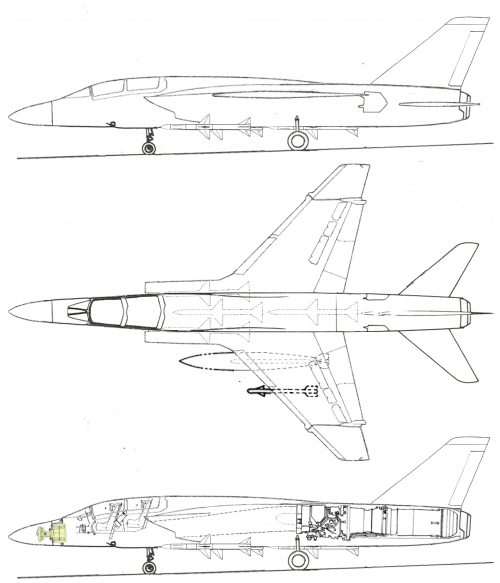
Grumman Super Tiger would also fit the bill. If the Swiss had chosen it over the Mirage for example, it likely would have saved them a lot of woe. And the Japanese would have chosen it if it weren't for some rather dodgy behind the scenes maneuvers. Likely the Canadians as well.
 
Grumman Super Tiger would also fit the bill.
I knew this would make the list. :D

All AH questions can be solved by just buying a Spey-powered Grumman Super Tiger. You never need anything else*.

*Occasionally a Hawker P.1121 but even Sir Sid can't fully compete with Bethpage even if he sticks an RB.106 Thames into it.
 
Hi Tomo,

I know that the fighter, that I consider the golden standard of the 1960s, received quite a coverage here. This one should be about the plausible alternatives to it, timely designed around a single engine. A design should be capable for Mach 2+ speed clean, have crew of two, all-weather capability (includes the radar-guided missiles), and reasonable handling for the day.
I think the crew of two needs to be emphasized :)

What is the most powerful engine with full service capability no later than 1963? Since you're not leaving much of the F-4's capabilities unrequested, that would have to go into the single-engine fighter. And keep your fingers crossed that the nation building that engine doesn't have any aircraft carriers! ;-)

Regards,

Henning (HoHun)
 
I think the crew of two needs to be emphasized
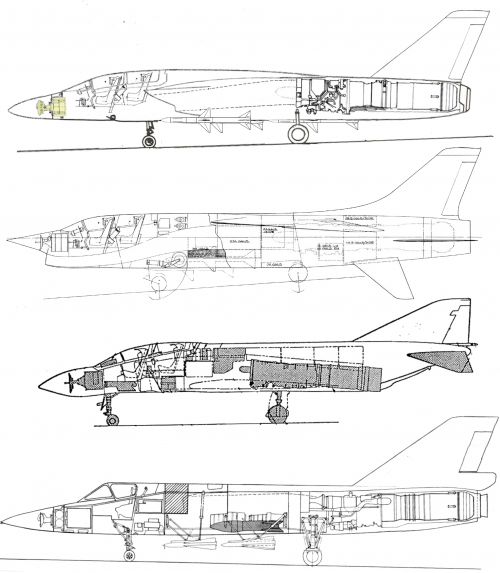
There was a proposed two seater though:
grumman-f-11f-1f-jpg.184739

(h/t the late circle-5 :()

super-tiger-98j7-jpg.4753


As well as a twin seat photo recon version:
super-tiger-98j7-photo-jpg.4755

(h/t overscan)
 
The closest real-world example was probably the MiG-23, but that one was with some flaws of it's own, as well as being too late in its full-capability version to emerge.
The JA Viggen, too, though both were single-seaters and so don't quite fit your criteria.

What is the most powerful engine with full service capability no later than 1963?
The P&W J75, up to 17,500 lbs dry and 26,500 lbs wet.
 
Most powerful turbojets (and early turbofans for Medway)
-J75, J58, J93 for the US.
-RB.106, Gyron, Olympus, Conway, Medway for the british. Perhaps RB.168 Spey, depends of the 1963 deadline.
-PS.13 Iroquois for the canadians

Now, about airframe ?
On the US front we need a mix of F-105 and F-106, and a two seater with that. F-105D ?
On the british side, the obvious answer is the Hawker P.1121 (or one of the closely related designs between 1103 and 1129).
For the canadians: the original CF-104, the one before the Arrow.

On the french side the Mirage III is too small and single seat. A better match would be one of the early Mirage IV designs, such as the IVC. But it will need a foreign turbojet as SNECMA can't get his head out of the Atar.
Good news: SNECMA took a J75 licence for the B-58 size Mirage IVB.
The Mirage IVC started as "a bigger Mirage III" hence just one engine, J75 class. Only later did it evolved into a Phantom, then into a Vigilante.
So, two-seat Mirage IVC with one powerful J75.
 
I knew this would make the list. :D

All AH questions can be solved by just buying a Spey-powered Grumman Super Tiger. You never need anything else*.

*Occasionally a Hawker P.1121 but even Sir Sid can't fully compete with Bethpage even if he sticks an RB.106 Thames into it.

This is so true.

The fact of the matter is the Phantom is an outlier, not only in capability but in how early it entered service. Matching it in capability and time is theoretically possible, but in practice nobody had anything in the pipeline to do it.
 
It's not a problem of design. It's a problem of trading weight and range. For CONUS this is out of the question. But for Europe where short ranged interceptors are acceptable it would be desireable.
That said Saab's Draken already fits the bill for a Mach 2 fighter that can rival in air combat.
 
F-102 with AIM-26B was a real killer potential. Turkey really bullied its neighbors with the F-102 until they got the full F-4 treatment. The F-106 would have been a natural fit for AIM-26B. F-106C was to have the scaled down AN/ASG-18 radar and fire control system from YF-12 (to steer AIM-47) but it never materialized. She actually was a looker: https://www.f-106deltadart.com/piwigo/_data/i/upload/2014/03/28/20140328180925-07ac1834-me.jpg

Does an F-16 with AIM-7 count as too late?

 
Last edited:
F5D had the radar and the capability to use Sparrow, low wing loading, and a big wing to load stuff on.
 
That said Saab's Draken already fits the bill for a Mach 2 fighter that can rival in air combat.

SAAB liked the image of the Draken going Mach 2, and didn't challenge it, but in practice it topped out around 1.7 due to wetted area, thrust and intakes.

So it was more similar to the likes of the F-8 than the F-4 generation.
 
Missiles - same as for the engines; the modified domestic missiles will do, too; at least 4 radar-guided missiles and two IR missiles

After my recent dive down the early AAM rabbit hole I think this might be the bridge too far. The Firestreak/Red Top and R530 were big weapons, thicker than the sparrow and there wasn't a small IR missile until the R550 Magic in 1968. An early 60s Phantom analogue would likely only carry 4 of those European AAMs, but likely backed up with guns.
 
Last edited:
That's where delta wing shines - plenty of room and attach points.

The F-106 had a wing area of 61 m2 but AIM-4 and internal bays did not exploited the full potential of that wing area.

Let's compare it with other delta-wing fighter jets.
-The Rafale has a wing area of only 45 m2 but up to 13 hardpoints.
-The much larger Mirage 4000 had a wing area of 72 m2 and up to 14 hardpoints.
-The Mirage IVA, contemporary of the F-106, had a wing area of 78 m2, more than twice than a Mirage III 35m2.
-Of course all of them are twin jets so the baseline fuselage is larger.
-The Draken with its double delta had a wing area of 49 m2, a bit more than the Viggen : 46 m2, how about that. Gripen is only 30 m2 !

-Mirage 2000 : 41 m2, a bit more than the III.
The Mirage 2000C can carry armament on nine hardpoints - with four under wing, four under the fuselage and one centerline.
With one-third additional wing area a F-106B (as OP wants a two seater) should be able to add a few hardpoints compared to a Mirage 2000 B/D/N. If J75 ain't enough anymore, get a downrated J58 or J93, I mean no Mach 3.

at least 4 radar-guided missiles and two IR missiles
Should be doable in a way similar to this. Of course MICA is much smaller than AIM-7 or R530 BUT our F-106B has one-third more wing area than the 2000, 61 m2 versus 41 m2.
9c567a52162728d9.jpg
 
Last edited:
I think a good place to start would be to take the Phantom 4*AIM-7 layout and check whether it fits under a F-106 belly, as per the Mirage 2000 picture above.
Sidewinders will go under the wings, F-15 style in double or even triple pylons. Same place as the 2000 big tanks.

trm01682f106bottomview.jpg


So, two AIM-7 conformal hardpoints in place of the Falcon bays; now the question is, can another pair of Sparrow go behind the undercarriage ?
 
Last edited:
That's where delta wing shines - plenty of room and attach points.
The delta will be even better in that regard if the undercarriage is retracted towards the nose rather than towards fuselage - a trick known to work at least by the time Douglas Skyrider materialized. Or, that U/C is 'anchored' at fuselage, thus leaving the wing real estate free.
(small Gripen E carrying a lot; the F-16XL)

Should be doable in a way similar to this. Of course MICA is much smaller than AIM-7 or R530 BUT our F-106B has one-third more wing area than the 2000, 61 m2 versus 41 m2.
Almost 50% more, not just 1/3rd more ;)
 
Hell yes, the F-16XL I had forgotten that one. And, guess what ? its wing area is exact same as a F-106.
https://en.wikipedia.org/wiki/General_Dynamics_F-16XL#Specifications_(F-16XL_number_2)

I think we have a winner with the F-16XL. We only need an equivalent with a J75 and before 1963. Two seater ? no problem.

So, which are the best candidates for a F-16XL two decades before ?
-Skylancer (52 m2 wing area, good !)
-F-106

A real winner would be a scaled-up Skylancer, tightly designed around a J93 or a J58 without Mach 3. There should be a ton of room below that delta wing, to hang a shit ton of AAMs.
 
Last edited:
What about the Phantom's ground attack capability? The RAAF considered the F4C in 1963 not as a fighter but as a strike aircraft, and the RAF bought it in 1965 as an attack aircraft. Changing an F106 get you close to the Phantom in air to air combat, but you'd need to add the capabilites of an F105 to match the Phantom in aggregate.
 
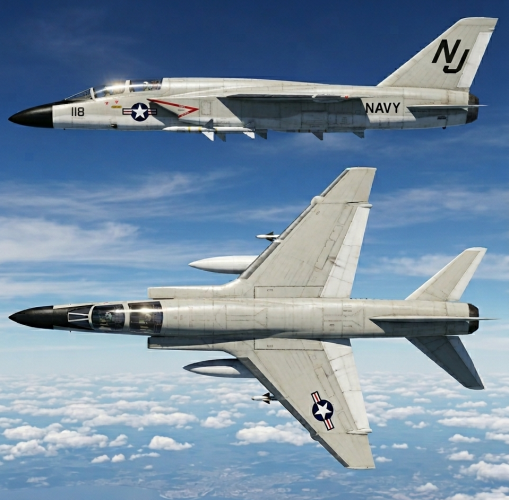
If we are looking for the single-engine F-4 analog, the obvious choice is the aircraft designed to the same specification as the original F4H, namely XF8U-3. It was to have the same weapon system (APQ-72 with a 32-inch dish), the same missiles (albeit 3 Sparrows III vs. 4 in the Phantom; the AIM-9 was also to be fitted, as indicated by SAC), considerably better range (for Sparrow-only configuration, 755 nm vs. 1126 nm using F-4B SAC data), comparable speed and rate of climb, and superior handling. The twin-seat configuration was already quite thoroughly evaluated, so it could be an option if needed, although Vought did not like the performance trade-off associated with it. Strap on the same wing pylons as those flying on the F-8E (2000 lbs each) by 1962, and it is probably the closest thing to F-4 performance-wise achievable by a single-engine airframe in this timeframe.


Regarding other options, I am sceptical about the F5D and F11F-1F, as they simply lack the size to offer the required performance. While I am a huge Skylancer fan, it has recently become slightly overrated. It was still a 17,000 lbs empty weight-class fighter, with 16,000 lbs of thrust and a 1135 nm range while carrying just 2× Sparrow II. The air-to-ground capabilities are not even mentioned in the late 1955 SAC. With a tested speed of Mach 1.63 and ~30,000 ft/min climb rate, it offered performance equivalent to the F-8C Crusader with better all-weather capability. I don't think the often-mentioned use of the J79 would really move the needle, as the late J57 versions actually offered nearly 2000 lbs more thrust, even when compared with the J79-GE-10B (19,600 vs. 17,800 lbs). Also, I'm not sure how close they actually were to fielding such a version, as, for example, Steve Ginter in his Skylancer book barely mentions it. The F11F-1F was certainly a much better performer, but it was still a relatively small and simple plane at 15,000 lbs empty weight, carrying 7,836 lbs of internal fuel (without guns) for a 1100 nm maximum internal fuel range. The plans were for fitting the APQ-50 radar known from Skyray, which, while sharing the same lineage as the APQ-72, was still much less capable, not to mention the smaller 24-inch dish. It had a respectable 9,000 lbs payload capability, but it was range-limited with little growth potential without significant airframe changes, as it was already an F-11F-1 squeezed to the maximum to fit all the improvements.


I think that, probably due to issues highlighted by Vietnam War engagements with MiGs, where Phantoms were severely handicapped by strict rules of engagement, the performance of the F-4 became really underappreciated. It took almost a decade before other fighters matched its level of performance and/or sophistication: AJ 37 Viggen (first flew in 1967; the JA-37 in 1974), Mirage F1 (1966), and MiG-23 (1967; 1972 for the MiG-23M, which was the first variant without major limitations). The true contemporaries of the F-4, such as the F-101, F-102, F-104, F-105, and F-106, were either severely compromised (F-102, F-104), lacked air-to-air performance (F-101, F-105), or were heavily specialized (F-106), lacking the versatility of the Phantom. Other contemporaries, such as the Mirage III, J-35, or MiG-21, were all significantly smaller aircraft which, while excellent in their respective areas, were simply not able to match the range/payload capabilities of the Phantom. Under specific circumstances, all of them could compete with the F-4, but it is really hard to view them as its direct replacements.
 
We could probably make some jokes about a Spey Twosader, but IMO the real next-closest-thing to the F-4 Phantom is the F8U-3 with some mods. Needs wing pylons and needs that second seat.

F5D Skylancer needs the F-102B or F-106 area ruling treatment, even with the J57 it's a M1.2 plane as it sits today.

F-106 would also need a second seat, and would need to lose the internal weapons bay for Sparrow carriage. Trade the bay for additional fuel, and "steal" the conformal Sparrow mounts from the Phantom. Steal the Navy Sidewinder mounts on the wing pylons, too, while you're at it. I'm pretty sure you could stagger 3x Sparrows across the 106 weapons bay in conformal mounts.
 
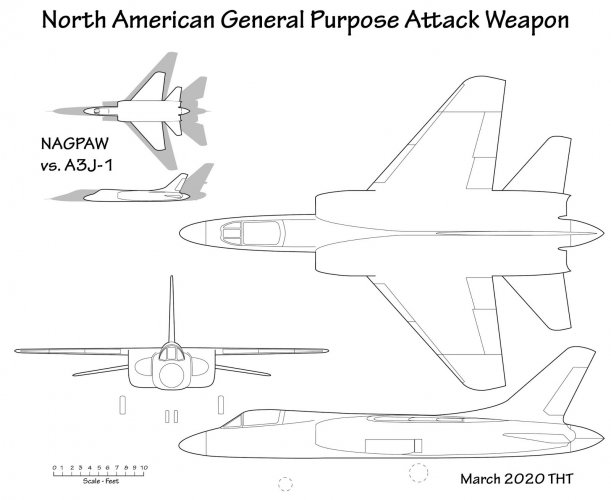
Take a Mirage IV airframe and mate it to an Orenda Iroquois as a single engined aircraft, instead of the twin Atars, maybe shrinking it a bit, on the reverse enlage Mirage III to fit but that was Mirage IV anyway. Your call it heavy-Mirage should have dimensions similar to a Phantom...
 
Take a Mirage IV airframe and mate it to an Orenda Iroquois as a single engined aircraft, instead of the twin Atars, maybe shrinking it a bit, on the reverse enlage Mirage III to fit but that was Mirage IV anyway. Your call it heavy-Mirage should have dimensions similar to a Phantom...
That's the 1957 Mirage IVC.
 
You could have stretched an F-106B, eliminated (or disabled) the internal bay and added fuel in there, then equipped Sidewinder and Sparrow in a 4+4 arrangement like the F-4. But the radar needs to be equipped for guiding specifically the AIM-7. What makes the F-4 better suited as a fighter is easy going throttle response which wasn't the strength of the J-75. The latter was a concern on the XF8U-3.

Or they could stick with the F-106C and AIM-47 plan for sniping targets at a distance using equipped designed for the role.
 
May I invite folks to review the TF75/JT4D engine, it was to be the turbofan companion to the J75/JT4C. Very similar to the J57/JT3A to TF33/JT3D relationship.

The slimmer JT4D-3 was aiming for 22,500 lbf of thrust, add on an afterburner and you're pushing 30-35k pounds of thrust. So I'm imagining the proposed F-105H with an enlarged wing area and the TF75 would make one heck of a strike fighter!
 
May I invite folks to review the TF75/JT4D engine, it was to be the turbofan companion to the J75/JT4C. Very similar to the J57/JT3A to TF33/JT3D relationship.

The slimmer JT4D-3 was aiming for 22,500 lbf of thrust, add on an afterburner and you're pushing 30-35k pounds of thrust. So I'm imagining the proposed F-105H with an enlarged wing area and the TF75 would make one heck of a strike fighter!
Oh, yeah, that beast.

I'm thinking F8U-3 or F-106 tune-up. F-105 honestly doesn't need any more power, it could run away from anything in any inventory at low altitude.

But an F8U3 or F-106 could use more horsepower. Crusader would need it for the extra weight of the RIO plus ~16,000lbs of whatever ordnance you plan on hanging under the wings. And the F-106? We can debate between potential to supercruise or just flat better range. Plus, the US might be persuadable to sell the older F-106s to Canada while ADC keeps the Super Sixes.
 
I'm inclined to argue the Iroquois variant I'm proposing would be actually superior to Mirage IVC as proposed?
Of course it would be, as SNECMA Super Atar remained a paper engine, making it a glider. Iroquois on the contrary was very real.
 
Back
Top Bottom