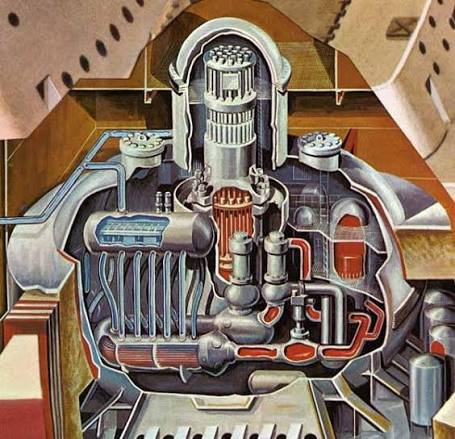
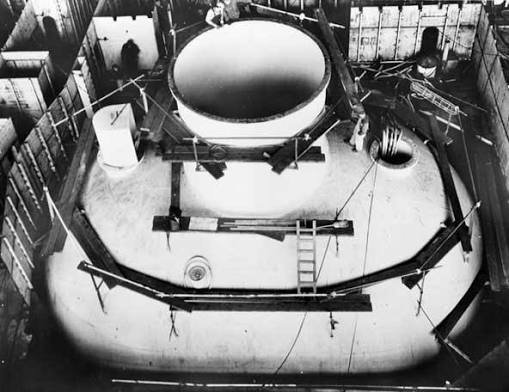
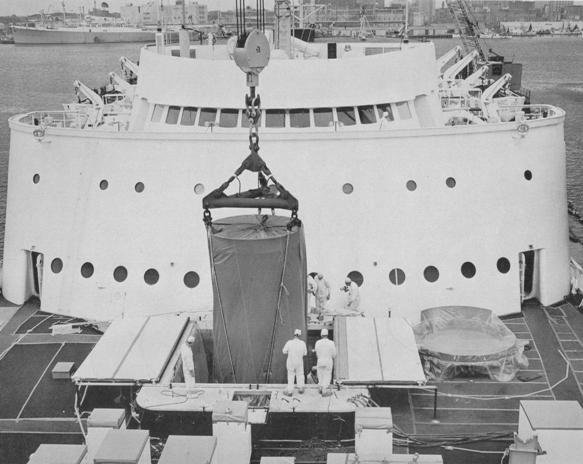
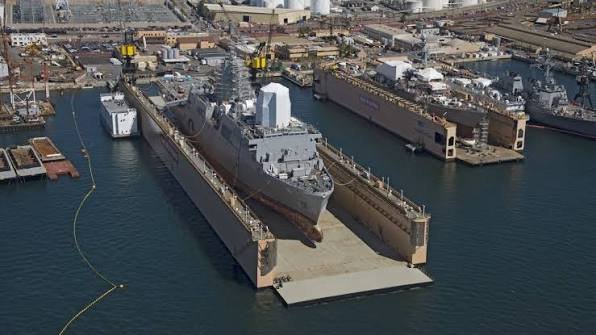
So to summarize: installing the reactor into assembled hull would not actually took much of shipyard resources, and likely could be performed without affecting carrier construction?
When NE Savannah was built the engineers made her as civilian friendly as possible. Her reactor was house top and machinery in engine deck was to the side. And reactor simply popped out by draining the pool
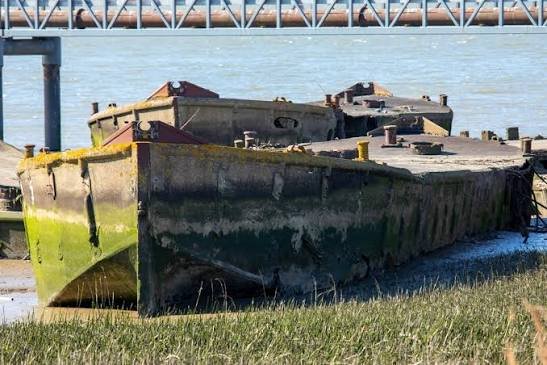
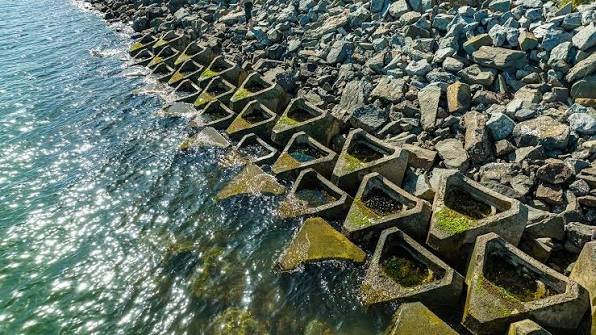
During World War II, the Allies used hundreds of ferro-concrete barges and massive concrete caissons to support D-Day creating artificial piers.
We could do same modern sense. Build large caissons fill them dredge muck and sink them. 2000 foot piers and support floating drydock built on site. Floating drydock better than no drydock. Gulfport in Louisiana and Near New Orleans ideal place, plenty of muck to dredge, it create thousands jobs and allow Navy already has offices and basing New Orleans. 10-20 piers and drydocks for ship repair.
Modern concrete has evolved to new mixture ph balance "Marine friendly" concrete that attract marine life thus mitigate environmental impacts.
Finally build floating drydocks out of concrete and sink them by filling cavities with dredge spoil.
The BBGN’s capacity for conventional missiles would also exceed that of most other Navy ships. The battle-ship is expected to carry 128 Mark 41 vertical launching system (VLS) cells in addition to four CPS missile tubes, each of which would contain 3 missiles, for a total of 12. (If the Navy were to forgo CPS on the battleship, it could substitute an additional 32 VLS cells.)
I thought the plan was for more VLS than a Tico, and 12 tubes for 3 missiles each. Seems to be quite limited now, and I wonder what launching system is required for nuclear cruise missiles. Seems like not much VLS growth from DDG(X) considering the growth of everything else.
The BBGN’s capacity for conventional missiles would also exceed that of most other Navy ships. The battle-ship is expected to carry 128 Mark 41 vertical launching system (VLS) cells in addition to four CPS missile tubes, each of which would contain 3 missiles, for a total of 12. (If the Navy were to forgo CPS on the battleship, it could substitute an additional 32 VLS cells.)
I thought the plan was for more VLS than a Tico, and 12 tubes for 3 missiles each. Seems to be quite limited now, and I wonder what launching system is required for nuclear cruise missiles. Seems like not much VLS growth from DDG(X) considering the growth of everything else.
In terms CIWS, I can imagine battleship with Two island/towers. Above/near consist CIWS guns embedded with most of it inside; thus mitigating most of the external exposure and maintenance. Also allows reloading indoors.
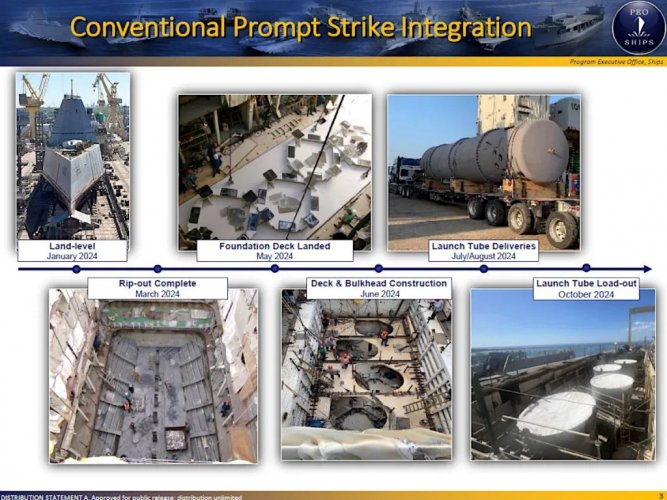
No. The gunhouse as I called it is a non-rotating piece that hid the front of the turret while the gun was stowed. The turrets proper are completely gone and were each replaced with a pair of Virginia-class Payload tubes. Magazine gutted and ripped out to make room for an 8ft diameter, 4"+ thick steel pipe hanging from the weather deck.
You've said this a couple of times, and you're wrong.
Both guns were removed, but the 4 CPS tubes were mounted in the space of the front gun, the aft gun reveived a little deck housing (The front gun tube cover left for whatever reason, maybe stealth requirments? Radar returns be funky, yo), and in front of the CPS tubes is a little breakwater deck hut.
My guess is that the aft gun was removed simply because it was effectively non-functional anyway (lack of ammo), and it maybe they needed to lose some weight without fucking with stability too much.
So there's space for EIGHT CPS tubes, but maybe not enough margins.
I think we're drifting from the topic of this thread. Much of the last 7 pages of discussion on CIWS systems could equally apply to any warship. I will split these posts into their own thread.
I think we're drifting from the topic of this thread. Much of the last 7 pages of discussion on CIWS systems could equally apply to any warship. I will split these posts into their own thread.
Would be helpful (at least to me while im stuck down a rabbit hole) if the app showed the thread title on the screen instead of having to scroll to top of the page.
On Nuclear Propulsion front, cruiser USS Truxton had a deckhouse forward of her superstructure that had two hatches on top to be able to access the reactor cores & keep from having to tear her apart. Rather innovative compared to casual and expensive method. View attachment 821021
Reactor safety takes precedence over combat capability. Another problem with the nuclear Cruisers was during the Gulf war, exposing them to return fire from shore, Had the vessels been sunk, what/how recover or if the reactor leak?
However Persian Gulf fairly shallow.
On other hand ship operating like that would have undoubtedly escorts galore beyond its own armament.
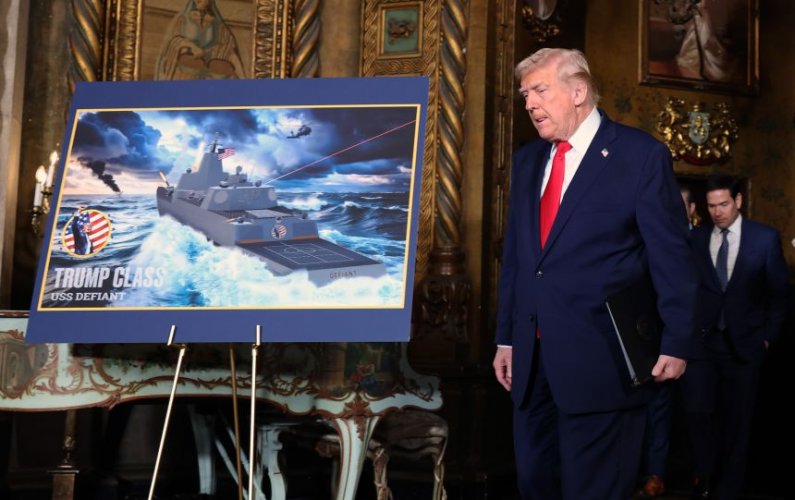
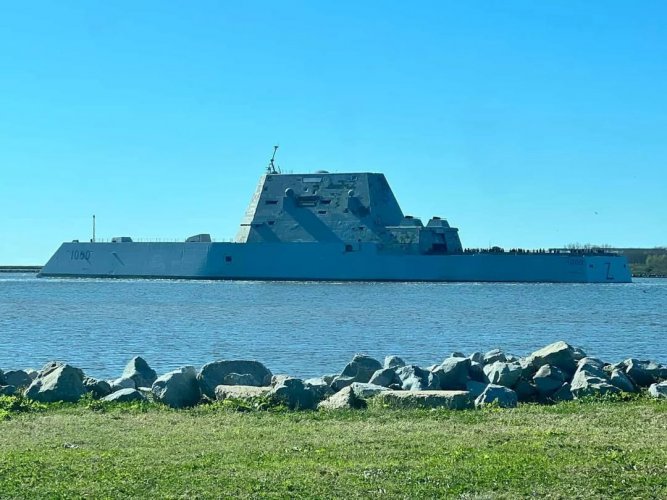
Or Trumps mind the battleship Infinity poops out array of frigates View attachment 821022
The North Carolina class fast battleships did 28 knots on 120khp. A single A1B reactor makes about 25% more power than the older A4Ws out of a Nimitz, so a BBGN with an A1B is looking at making about 168khp. That would be enough for well over 30 knots, maybe even 35! (Alaska-class with better L:B had 150khp and did 33 knots)
Another thought that popped into my head for this. They're recycling Nimitz class carriers. What if the BBGNs are taking Nimitz class reactors? That removes the need to build all the physical parts, the only thing needed would be a strength check of the reactor vessel proper and then to refuel it. Each Nimitz would be able to power two BBGNs, if the rest of the ship could be built quickly enough! A BBGN with a single A4W reactor out of a Nimitz makes about 140khp, plus another 100MW electrical delivery, plus whatever you do with all the extra steam that would go to the catapults (I'm assuming the extra steam would go to the main engines if we weren't talking IEP). 140khp on a NorCar hull will get you over 30 knots.
Size-wise, NorCars were 35ktons standard, roughly 45k heavy once all the AA upgrades happened; and are 728ft long, 108ft abeam, with have a draft of 35ft.
That is smaller than some of the early proposals, but I think those proposals were based more on the hulls of the Alaska-class or Iowa-class. Alaskas were 800ft long, 92ft abeam, 27ft average/32ft max draft, and 35ktons full load. Iowas are just flat not 35ktons standard displacement, they're ~50ktons!
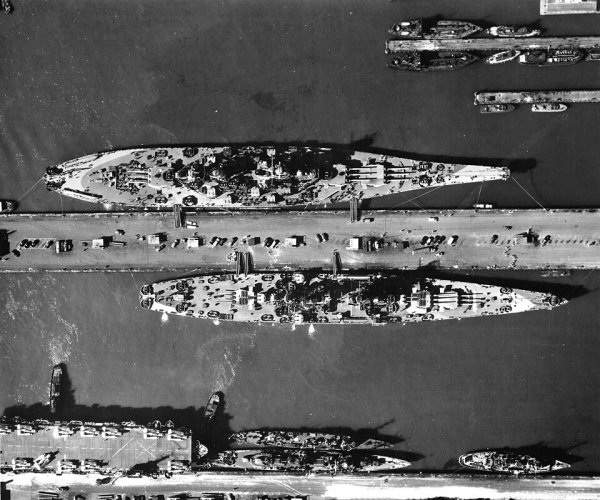
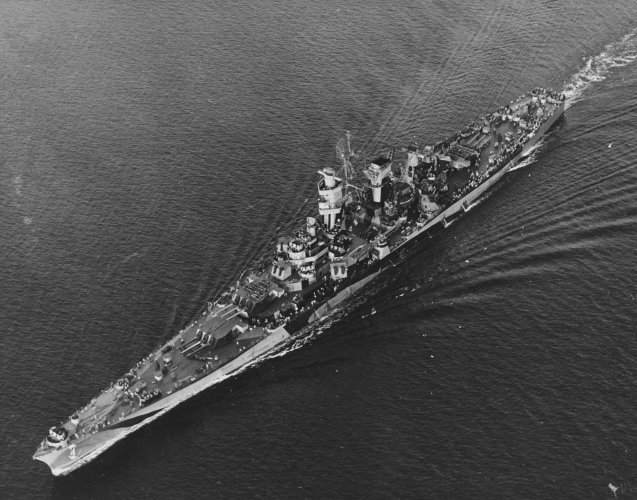
This picture shows USS Missouri tied up across the pier from USS Alaska in 1944. Norfolk Naval Base.
(img from wiki)
It shows just how much bigger an Iowa was compared to a 35,000ton ship. And the people talking about BBG(X) and BBGN(X) have been saying ~35,000 tons.
IF, for some insane reason the US decided to re-introduce ship armor, at least armored citadels, my preference is for the intenal arrangement of the (1939) South Dakota class. This packs the tightest armored citadel, but the missile armament complicates things a bit. At the very least, different barbette shapes around the missile bays as compared to the guns.
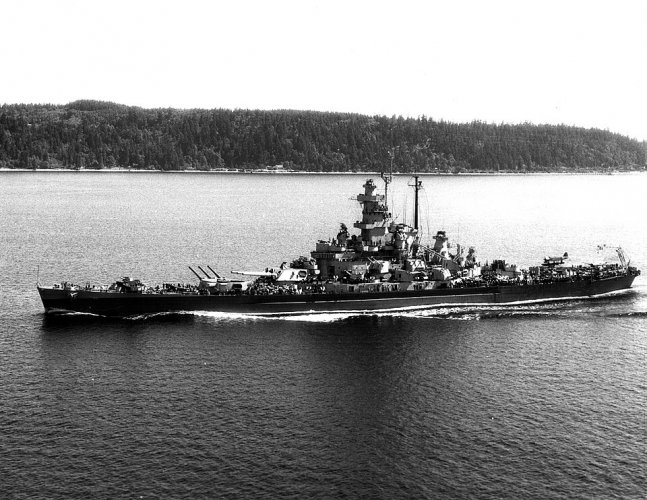
(img from wiki, USS Massachutsets in 1944.)
Very compact superstructure and armored citadel below it, but no hangar space for helicopters (because they weren't in service yet!)
Slap on a superstructure based on the Alaska class? Alaskas put the aircraft catapults amidships and would require adjustments. I'm thinking about a 64cell Mk41 amidships.
(img source from wiki, USS Guam in 1944)
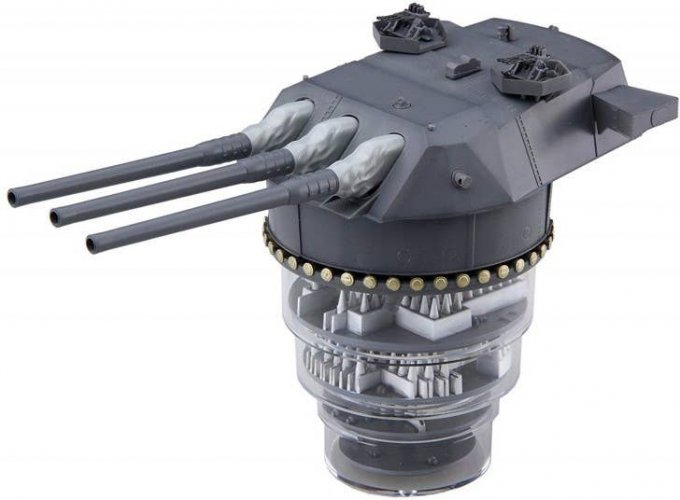
Each main turret gets replaced with missiles.
#1 turret gets the CPS tubes. I'm assuming more than 4x APMs like what the Zumwalts got, since the discussed numbers of Tomahawks per ship is more like ~24-36. Assuming CPS being a more or less 1-for-1 replacement of Tomahawk, that means ~8x APM or 12x APM to equal the load. Good news is that the APMs are basically the ultimate splinter protection as the outer tube is submarine hull thick, and made out of HY80. HY80 is a less-easily-corroded cousing of Special Treatment Steel aka battleship armor. Any damage that manages to breach a single APM has very little chance of breaching a second module.
#2 turret gets a 64 rack of Mk41s, and may get lowered to the weather deck instead of being superfiring.
#3 turret gets a very different arrangement. If we use Mk41 cells, the Mk41 is actually placed all the way aft like on Burkes and there will be a step down. If we use Mk57s down the side of the Helo Deck, it's going to be a really big Helo deck with 8x Mk57 modules per side
With no stack or amidships aircraft catapults (the tower things between the two broadside turrets) needed, we can stick a whole set of 64cell Mk41s and a Truxtun-style easy reactor access amidships, raising the load to
Forward Superstructure will still very much look like a Burke, but I'm going to add another deck below the radars.
There could be a re-discussion about vertical guns, now that the US has figured out trajectory shaping to drop a shell behind the gun without turning the gun around. That would allow dropping a single VGAS forward of the #1 turret location. Obviously, the other option is sticking a 5"/62 there. Hopefully with a stealthy gunhouse wrapped around it.
Aft superstructure would NOT look like a Burke, USN DDG(X) proposals split the radar arrays between forward and aft superstructure. So the top of the hangar looks more like the back side of a Burke's forward superstructure: 2 big arrays set at an angle plopped on top of the hangar, plus illumination radars and CIWS systems.
I would want the OTO 76mm Super Rapides with Strales/DART guided rounds in the places where the 5" turrets are on the Alaska. Part of the reason for including these guns is public perception of the ship being well-armed. The downside of VLS is that there's nothing really showing big bulky guns or missile tubes.
Place the 4x RAM launchers: one on top of the bridge, one on each broadside, and one on top of the radar block on the aft superstructure.
For the pointest of point defenses, CIWS/CIGS and C-UxV, needs at least 4, one on each corner. I'd prefer 4x CIWS and 4x C-UxV, CIWS at the top of the superstructure with C-UxV low on the weather deck. I want the two aft C-UxV guns stuck all the way aft like the quad Bofors mounts on the stern of WW2 cruisers and battleships. The two forward C-UxV guns sit just forward of the bridge. Caliber of the CIWS/CIGS/C-UxV we can debate in the other thread.
Lasers get interesting, in terms of positioning. You want the lasers as high as possible for distance to horizon, but you want guns above them so that there's minimal chance of the laser accidentally hitting the outgoing shells.
Would be helpful (at least to me while im stuck down a rabbit hole) if the app showed the thread title on the screen instead of having to scroll to top of the page.
The North Carolina class fast battleships did 28 knots on 120khp. A single A1B reactor makes about 25% more power than the older A4Ws out of a Nimitz, so a BBGN with an A1B is looking at making about 168khp. That would be enough for well over 30 knots, maybe even 35! (Alaska-class with better L:B had 150khp and did 33 knots)
Another thought that popped into my head for this. They're recycling Nimitz class carriers. What if the BBGNs are taking Nimitz class reactors? That removes the need to build all the physical parts, the only thing needed would be a strength check of the reactor vessel proper and then to refuel it. Each Nimitz would be able to power two BBGNs, if the rest of the ship could be built quickly enough! A BBGN with a single A4W reactor out of a Nimitz makes about 140khp, plus another 100MW electrical delivery, plus whatever you do with all the extra steam that would go to the catapults (I'm assuming the extra steam would go to the main engines if we weren't talking IEP). 140khp on a NorCar hull will get you over 30 knots.
Size-wise, NorCars were 35ktons standard, roughly 45k heavy once all the AA upgrades happened; and are 728ft long, 108ft abeam, with have a draft of 35ft.
That is smaller than some of the early proposals, but I think those proposals were based more on the hulls of the Alaska-class or Iowa-class. Alaskas were 800ft long, 92ft abeam, 27ft average/32ft max draft, and 35ktons full load. Iowas are just flat not 35ktons standard displacement, they're ~50ktons!
This picture shows USS Missouri tied up across the pier from USS Alaska in 1944. Norfolk Naval Base.
I've looked into this quite a while ago. It's not simple. First of the Nimitz lifetime is tied to the reactor meaning they are at design end of life. As a stopgap solution they could certainly remain in service for ~10 years afterall planned dismantling etc is projected to take up to ~20 years. The reactors need to be "functional" for that long anyway although not under load. This could buy enough time for new reactor production to catch up. Another problem is 100 MW comes short of what's needed according to my estimate ~110MW.
So at least one more 11.5-12 MW diesel needs to be added or a room of about 35-40 ft.
There's also competition from the techbros asking to get their hands on them for the AI centers. The issue here is the weapons grade fuel. I doubt this would be an issue under normal circumstance but anything goes these days.
Anyhow, the whole system likely weights about 6000 t. It's possible to weight less but under 3000 t is impossible.
Assuming the hull is at least around 25 kt the ship can't be less than 31kt. 35 kt seems very likely.
I've looked into this quite a while ago. It's not simple. First of the Nimitz lifetime is tied to the reactor meaning they are at design end of life. As a stopgap solution they could certainly remain in service for ~10 years afterall planned dismantling etc is projected to take up to ~20 years. The reactors need to be "functional" for that long anyway although not under load. This could buy enough time for new reactor production to catch up.
Correct, but you have some dudes do some testing to see if the reactor vessels are still sufficiently strong. After all, the current NRC allows commercial reactors to operate for 80 years. 40 year initial license, up to 2x 20yr extensions.
Another problem is 100 MW comes short of what's needed according to my estimate ~110MW.
So at least one more 11.5-12 MW diesel needs to be added or a room of about 35-40 ft.
That's the extra steam for the catapults. Grr. Who's the former Marine that is the carrier expert? I suspect all that extra steam generation capacity would be a good 25-50MW, but he'd have a much better answer for us.
Plus IIRC the carriers do have locomotive-sized diesels for when the reactor is down and needs power for controls.
There's also competition from the techbros asking to get their hands on them for the AI centers. The issue here is the weapons grade fuel. I doubt this would be an issue under normal circumstance but anything goes these days.
The AI guys would likely propose using LEU, but I don't know enough Nuclear Engineering to know if that'd be possible. I'm pretty sure 20% enriched would have a critical mass in the reactor.
Anyhow, the whole system likely weights about 6000 t. It's possible to weight less but under 3000 t is impossible.
Assuming the hull is at least around 25 kt the ship can't be less than 31kt. 35 kt seems very likely.
Correct, but you have some dudes do some testing to see if the reactor vessels are still sufficiently strong. After all, the current NRC allows commercial reactors to operate for 80 years. 40 year initial license, up to 2x 20yr extensions.
That's the extra steam for the catapults. Grr. Who's the former Marine that is the carrier expert? I suspect all that extra steam generation capacity would be a good 25-50MW, but he'd have a much better answer for us.
Plus IIRC the carriers do have locomotive-sized diesels for when the reactor is down and needs power for controls.
The AI guys would likely propose using LEU, but I don't know enough Nuclear Engineering to know if that'd be possible. I'm pretty sure 20% enriched would have a critical mass in the reactor.
Agreed. The BBG has always been said to be about 35kt.
Naval Reactors use higher enrichment levels for longevity. Pushing past 90%. But LEU is possible, especially regarding new reactor geometries and new reflectors.
Instead beryllium which is expensive, toxic, very rare. Zirconium alloys are not.
These ultra hard zirconium refractory materials allow escaping fast neutrons to reintroduce to accessory uranium-238. Thisnprobably what's being done new lifetime corr designs. Columbia subs have once thru reactor also 41 years.
General Atomics " waste-eating" reactor prospects allow reflector accommodate partial fast neutron interaction allowing fission byproducts to remain as new fuel bred to accommodate power.
Cost of a ship will greatly depend on its target weight. A 35,000 ton ship will be close to double the cost of a 17500 ton ship. If they are saying the BBGN is going to be x-amount in dollars, the ship a fraction of the weight should be relatively close in price in a similar fraction of cost. What is publicly expressed for cost on BBGN tells me that it is going to be significantly more packed with something than an Arleigh Burke.
I would want the OTO 76mm Super Rapides with Strales/DART guided rounds in the places where the 5" turrets are on the Alaska. Part of the reason for including these guns is public perception of the ship being well-armed. The downside of VLS is that there's nothing really showing big bulky guns or missile tubes.
Instead beryllium which is expensive, toxic, very rare. Zirconium alloys are not.
These ultra hard zirconium refractory materials allow escaping fast neutrons to reintroduce to accessory uranium-238. Thisnprobably what's being done new lifetime corr designs. Columbia subs have once thru reactor also 41 years.
Cost of a ship will greatly depend on its target weight. A 35,000 ton ship will be close to double the cost of a 17500 ton ship. If they are saying the BBGN is going to be x-amount in dollars, the ship a fraction of the weight should be relatively close in price in a similar fraction of cost. What is publicly expressed for cost on BBGN tells me that it is going to be significantly more packed with something than an Arleigh Burke.
So to summarize: installing the reactor into assembled hull would not actually took much of shipyard resources, and likely could be performed without affecting carrier construction?
Maybe? Problem is that building the steam system is going to have to happen in a nuclear-certified shipyard. And there are not many such shipyards remaining in the US.
Pearl Harbor and Bremerton are certified for nuclear repairs, but only EB/Groton and Newport News are the only yards certified for nuclear construction.
So if Newport News can build the BBGN outside the big carrier drydocks, it'll work. A better option would be to upgrade Bremerton to construction certification, and build the BBGNs there. Or better yet, build the BBGs there, no nuclear propulsion at all.
Cost of a ship will greatly depend on its target weight. A 35,000 ton ship will be close to double the cost of a 17500 ton ship. If they are saying the BBGN is going to be x-amount in dollars, the ship a fraction of the weight should be relatively close in price in a similar fraction of cost. What is publicly expressed for cost on BBGN tells me that it is going to be significantly more packed with something than an Arleigh Burke.
That has not been true since Guided Missiles took over as the primary ship weapons in the 1960s.
The primary driver of ship cost is just how many systems you pack into it. BBG has been described as 2x64 Mk41 and SPY6v1, plus 4x VPMs. At most it should cost maybe twice what a Burke does, not 10x.
Yes, hull size does drive engine costs to some level, but gas turbines are pretty unitized costs.
And yes, nuclear propulsion does greatly drive up the costs.
This site uses cookies to help personalise content, tailor your experience and to keep you logged in if you register.
By continuing to use this site, you are consenting to our use of cookies.