BBG(X) - DISCUSSION ONLY

That is a lot of eggs in one single basket, and it's ASW capabilities are nearly non-existent, heck the 30 year plan has almost no ASW capabilities.

AAW/BMD/C2 can be done on a much smaller and cheaper ship.

Right now we are just trying to recreate Yamato's final voyage...
 
That is a lot of eggs in one single basket, and it's ASW capabilities are nearly non-existent, heck the 30 year plan has almost no ASW capabilities.

AAW/BMD/C2 can be done on a much smaller and cheaper ship.

Right now we are just trying to recreate Yamato's final voyage...
Not exactly. The main bottlenecks for US shipbuilding is not money, but number of available facilities and production of high-tech components (like radars, computers, engines, weapon systems). The size of hull itself is not a major limtation, steel is cheap. So multiple smaller ships would be less cost-efficient than one big battleship - and would strain the industry more.
 
If BBG(X) adopts nuclear power, would Congress agree? I feel the US marine industry is relatively weak, so I disagree. If we're confronting a major power, it would be better to build low-cost small boats, carry a few missiles on them, and use a wolf pack strategy…
 
AAW/BMD/C2 can be done on a much smaller and cheaper ship.
Perhaps, but future growth with regards to weapons and subsystems is to be expected, so a certain growth margin has to be taken into account. Admittedly the projected displacement, crew size and dimensions seem a bit excessive. But it's doubtful that a vessel meant to fulfill all of these needs could end up as "small" as common DDGs.
 
The issue with that is that this greatly limits the capabilities of your missiles. They have to be easily transported to, handled and stored on a ships magazine. More importantly though they have to be small and light enough to be able to be launched by the carriers tactical aircraft. A Super Hornet being launched via catapult has only so much payload capacity and space underneath for ordnance. Sure F/A-XX, if it actually enters service some day, will have improved capabilities, but you most likely won't see large ALBMs or hypersonic Air breathers in it's internal bays. The Navy's tactical fighters are in that sense more limited than land based aircraft like the F-15E or MiG-31K which can carry such weapons.

Reload at sea certainly is an issue though.

F-18E/F can carry ten 500-1000# stores for several hundred miles sans refueling. There are currently several different subsonic cruise missile options that have ranges of 250-500 miles - AGM-188,-189, and RAACM. There likely will soon be a 1000 mi option (FAMM-BAR) that the USN can likely buy into with no development costs. MALD-N is already in service and be used as a penaid, and potentially even be carried on the fuselage stations. Hypersonics will benefit massively from being air launched - you note that air launched missiles are limited in size for the USN without mentioning the huge increase in size, cost and complexity necessary to get a weapon to 30,000 feet and 500 mph from a ship. There are a number of smaller ALBMs that could be carried by tactical naval aircraft (eg Ravage or possibly ROCs) and the USN and USAF already have programs for the same.

IMO ship based strike options always run up against magazine limitations and will require an at sea reload to remotely have the persistence and range of carrier strike operations. And I think loading CPS at sea is simply going to be impossible, so what you can fit into a mk41 is the upper size limit for any kind of sustained fire.

Basically I think BBGX solves nothing and spends a lot of money to reinvent an inferior wheel.
 
Large caliber guns seem like a pointless exercise unless they can achieve kills against hypersonic gliders or supersonic, plunging targets in the terminal phase. Otherwise, what are they shooting at? UAVs? Use a 57mm.

57mm barely has enough range to protect the ship it is mounted on. A larger gun able to hit OWAs and such out to the horizon with cheap and plentiful shells sounds like a great idea to me.
 
Gun based offensive solutions are a joke. There is no survival at those ranges, even if we are talking about ramjet assisted rounds, and if you are building a shore bombardment platform, there is no reason to make it an ABM escort as well.

Most post on this thread just keeps tacking on new missions and costs to this platform to fulfill child like fantasies, and apparently so has the administration, to the point where costs are now discussed in terms of how many Fords rather than Burkes.
It is no joke to have two 5 inch multipurpose guns. They are cost-effective and dependable. My only gripe with the 5 inchers is not going at least four. In my opinion the railgun will not be until proven ready. It currently is not. But the 5 inchers are proven.

Up until just a few days ago it was a BBG(X) proposal. Now it appears to be a BGN(X). To be frank, with large guns it is just a glorified CGN(X) proposal. But officially it is still BBG(X).
 
I heard a few people today compare this to the nuclear powered Kirov class battle cruiser.

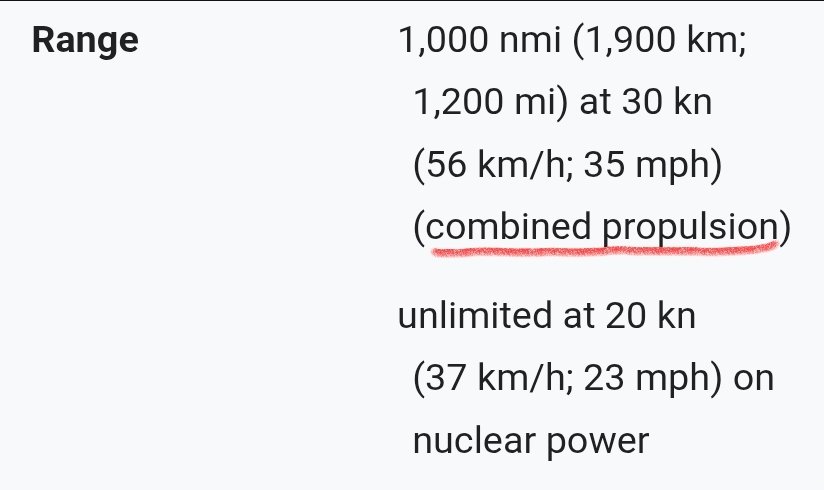
The Kirov is 28,000 ton full load. I was surprised when I noticed it use hybrid nuclear propulsion. It has two tiny nuclear reactors that put out less than 20MW of shaft power each. It can only reach 20 knots fully nuclear. It has two huge boilers running fossil fuel to allow the ship to sprint to 30 knots. It only has a range of 1,000nm at 30 knots but unlimited range at 20 knots. The normal boilers also provide redundancy.

https://en.wikipedia.org/wiki/Kirov-class_battlecruiser
Nothing surprising.
20 knots on nuclear power is more than enough for long cruise. The small ships arround, for local defense, were consumming a lot of fuel just to sustain this 20 knots.
30 knots in rush speed is only usefull for small distance.
 
What is the target set?

Anything 5" HVP can hit. In addition to drones/OWAs, that probably includes many of the less complex air breathing cruise missiles, and maybe the lower end of the SRBM threat as well. The main point is that it can cover at least some area for escort missions and the like rather than just point defense as with a 57mm.
 
you note that air launched missiles are limited in size for the USN without mentioning the huge increase in size, cost and complexity necessary to get a weapon to 30,000 feet and 500 mph from a ship.
That is true, but the ship has the means to support such large weapons, even with boosters. Thus range and payload are ultimately greater than any ballistic missile the Super Hornets could launch, which would have to sacrifice one or the other. CPS offers quite frankly tremendous range (stated to be larger than 2000 nmi) and a substantial warhead, while something like the Israeli Rampage has a very small warhead and much lower range, so it's usefulness and the usefulness of systems like it are questionable in a naval context, LORA is only marginally better. Even the massive Kinzhal, arguably the poster child of the modern ALBM and the one with the most extensive usage to date, doesn't boast such specifications. This obviously ignores the very fact that a weapon like Kinzhal or something of similar size, range and warhead couldn't be used on carrier launched F/A-18E/Fs. So you don't have an air launched ballistic missile for the Navy that could rival the ship launched CPS.

In general it's not like BBG(X) opting for CPS would be dentrimental in any shape or form. It doesn't mean that there will be subs without it as a consequence, in fact it increases commonality between the Virginia-Class, Zumwalt-Class and Trump-Class. So it should avoid the pitfalls of AGS in that regard. And having a ship that's able to defend itself, others and simultanously be able to shoot back or shoot at attackers that may not even have the range to retaliate, that's worth something. That also doesn't mean it's primarily a ship killer, that's a submarines job. But it has the capacity to dish out significant damage within a short time frame against high value targets over vast distances.

As for the general sentiment some shared regarding eggs and baskets, a CVN has near zero self defense capabilities, relies for offensive actions on tactical aircraft (which are certainly easier to engage and shoot down than ballistic missiles with hypersonic glide vehicles), ties up and relies completely on several high value surface combatants to protect it, is essentially a swimming city with tons upon tons of aviation fuel, bombs, aircraft, missiles, spares, rations and literal air traffic control on board, inhabited by God knows how many thousand people. You can't really put more eggs into a single basket than with a carrier, just that the carrier cannot defend itself, neither can it return fire, in fact it steals the eggs from the overarching big basket as it requires a substantial numbers of escorts. Now even if you want to use your BBGN not completely autonomously, but part of an action group, that would mean like one additional destroyer? Maybe a frigate and a submarine? Just that the BBGN can effectively contribute to AAW as well as long range precision strikes. Now, that doesn't mean that it can or should replace aircraft carriers. An aircraft carrier can lay down a proper beating, especially against far less sophisticated adversaries. And something like an E-2D provides tremendous benefits to a wider naval force. But it's still a lot of eggs in one basket. Which is why I don't think that argument really works for the far more independent BBGN which ties up less resources.

 
Anything 5" HVP can hit. In addition to drones/OWAs, that probably includes many of the less complex air breathing cruise missiles, and maybe the lower end of the SRBM threat as well. The main point is that it can cover at least some area for escort missions and the like rather than just point defense as with a 57mm.

What is BBGX escorting and why?
 
Weapons will fall into two classes: CPS, which will probably only be a dozen rounds in any vessel, due to size and cost, or mk41.

Anything you want to throw to high altitude from mk 41 is going to be at a kinetic disadvantage compared to air launch. Mk72 burn is like 6s and separation is at a few thousand feet, and a SM-6 is only modestly supersonic at that altitude. Release from 30,000 feet and 500 mph is going to give superior performance, and length in both cases is limited to ~15 feet. For the aircraft ordnance, that is the length of the elevator; for the ship munition that is the length of a strike cell minus a mk72 or equivalent.

There is no superior capability from surface launch, unless you go to CPS or create an entire new class of launch cell incompatible with the rest of the fleet purely for offensive mission.

So again, what is being gained by making a surface vessel into a strike platform? And why are we combining that new mission with ABM as well?

ETA: this idea effectively combines the two most magazine intensive missions - strike and ABM - on an extremely expensive platform with fundamentally limited magazine depth (reload at sea of mk41 possible but difficult; CPS no).
 
What is BBGX escorting and why?

It's a large surface combatant. It escorts whatever you want it to, for whatever reason you want it escorted.

Weapons will fall into two classes: CPS, which will probably only be a dozen rounds in any vessel, due to size and cost, or mk41.

Anything you want to throw to high altitude from mk 41 is going to be at a kinetic disadvantage compared to air launch. Mk72 burn is like 6s and separation is at a few thousand feet, and a SM-6 is only modestly supersonic at that altitude. Release from 30,000 feet and 500 mph is going to give superior performance, and length in both cases is limited to ~15 feet. For the aircraft ordnance, that is the length of the elevator; for the ship munition that is the length of a strike cell minus a mk72 or equivalent.

There is no superior capability from surface launch, unless you go to CPS or create an entire new class of launch cell incompatible with the rest of the fleet purely for offensive mission.

So again, what is being gained by making a surface vessel into a strike platform? And why are we combining that new mission with ABM as well?

Sounds like the weapon elevator on the ship can't handle a Tomahawk sized cruise missile then. I also wonder if a catapult launched fighter can carry a max sized Mk41 weapon with a 21" motor. Isn't SM-3 BlkII ~2400kg without the booster? What about future 21" weapons with HLG motors that are even heavier? Even if a future aeroballistic missile from a catobar fighter had slightly more performance than a maxed out MK41 weapon, it wouldn't have the response time of a VLS missile from a ship. Also, we can't have carrier air wings everywhere. The procurement and operating cost of the battleship is probably a third or maybe a quarter of a CVN, its escorts, and its air wing combined. If the BBG on its own can hold targets at risk that you might otherwise need the carrier group for, it frees the CVNs to go where they are needed.

Also, is there a difference in availability between a surface combatant and a carrier that also needs to spend a lot of time on air wing work ups?
 
It's a large surface combatant. It escorts whatever you want it to, for whatever reason you want it escorted.
Kinda the answer I expected, almost word for word - “whatever it wants”. Give me a specific situation where a 10 billion dollar asset that exists in single digits is going to usefully escort anything. Is it going to escort all the Fords that were cancelled to build it? Is it going to escort cargo ships to Taiwan that cost 1/100tg of what it does? Pitch deck me the use case for this ship escorting anything, when it is the strike, ABM, and flag platform whose production is basically predicated on ending CVNs.
 
Sounds like the weapon elevator on the ship can't handle a Tomahawk sized cruise missile then. I also wonder if a catapult launched fighter can carry a max sized Mk41 weapon with a 21" motor. Isn't SM-3 BlkII ~2400kg without the booster? What about future 21" weapons with HLG motors that are even heavier? Even if a future aeroballistic missile from a catobar fighter had slightly more performance than a maxed out MK41 weapon, it wouldn't have the response time of a VLS missile from a ship. Also, we can't have carrier air wings everywhere. The procurement and operating cost of the battleship is probably a third or maybe a quarter of a CVN, its escorts, and its air wing combined. If the BBG on its own can hold targets at risk that you might otherwise need the carrier group for, it frees the CVNs to go where they are needed.

Also, is there a difference in availability between a surface combatant and a carrier that also needs to spend a lot of time on air wing work ups?

The big differences I see are 1). Stand off range and 2). CVNs already exist now.

The SM-6 comparison points out that an F-18 can be about as effective of a first stage as a booster with similar length limits. But that ignores the fact that F-18 can also hundreds of miles closer to the target.

I suspect a surface ship is much, much cheaper to operate, but we are comparing an imaginary platform with zero real design work done with a fleet of existing ships in the water.

We can also add to that carriers are far more mission flexible, and their capabilities can be altered by changing what you fly off them.

As for response time - I do not see that as particularly necessary for the USN. I think they will have numerous sea based targets to hit that have little ability to hide, and if they get into the business of Scud hunting it is only because the US is already winning the war. In any case, I am not against CPS deployment, I just think they should be deployed on rational platforms: single mission large cheap hulks ships for stand off strikes at coastal targets or submarines for deep strike. Zoomies maybe fill a space in between.
 
Kinda the answer I expected, almost word for word - “whatever it wants”. Give me a specific situation where a 10 billion dollar asset that exists in single digits is going to usefully escort anything. Is it going to escort all the Fords that were cancelled to build it? Is it going to escort cargo ships to Taiwan that cost 1/100tg of what it does? Pitch deck me the use case for this ship escorting anything, when it is the strike, ABM, and flag platform whose production is basically predicated on ending CVNs.

It's going to escort anything that needs to be escorted whenever a smaller but adequately capable platform is unavailable for the task. Maybe or maybe not CVNs, I think that would depend on if we build anything smaller with similar BMD capability.

I see BBG(X) as being designed for operating close in where platforms without the same defensive capabilities would either be unsurvivable, or would have to lean heavily on limited and expensive high end interceptor missiles to defeat swarms of lower end threats. The proposed design has seven cannons, four ODIN lasers, two 300-600kw lasers, two RAM launchers, two CAUS systems, and all the latest EW and countermeasures. That should enable it to defeat such swarms with defenses that are relatively cheap per shot and have very deep magazines. That in my eyes would make it a good fit for conflicts like the current one with Iran, and likely a lot of future conflicts as I expect many adversaries to pursue drones/USVs/ect.

If we have to end CVN production to build them, then I agree they are a bad idea. I don't think it would end CVN production, but it might slow it down somewhat. At a minimum, I would expect us to be able to get ~3x BBGs built for every CVN that gets delayed or cancelled assuming you have to use the same drydocks as the CVNs. They have around a third the displacement after all, and two of them would fit side by side in some of the docks. If they are hybrid nuke/gas, some other yard could do most of the work, and then they could be moved to a nuke yard to have the reactor and the structure above it installed.
 
If we have to end CVN production to build them, then I agree they are a bad idea. I don't think it would end CVN production, but it might slow it down somewhat.
It depend on how much reactor production is a bottleneck. If US nuclear industry got reserves in reactor production that couldn't be used because carriers orders are limited due to lack of construction facilities - then building a nuclear battleships would not present much problem.
 
First, will BBG(X) receive congressional approval? And will it be approved during Trump's term? (Perhaps BBG(X) won't even have started construction by the time Trump leaves office.)

Furthermore, US Navy shipbuilding is indeed slow, and adding nuclear power to BBG(X) would be too expensive.


In the Navy's shipbuilding plan announced today, nearly $17 billion has been allocated for the construction of battleships (BBG(x)) in fiscal year 2028. This represents 26% of the Navy's shipbuilding budget for that yearView attachment 811948
Furthermore, disregarding Congress and Trump's influence, only the slow pace of naval industrial development and the rising costs associated with frequent modifications are concerning.
 
For CIWS work, yes. And maybe some flexibility with Vulcano ammo.


Area defense, my dude, not own-ship point defense.


Good luck with that. CPS tubes are 88" diameter and 30something feet long. That means a big ship is needed to carry them.


Japan relaxed their no-nuclear-powered-ships rule when the US retired the Kitty Hawk.


I don't see it getting nuclear power. Not when each BBGN produced is one less carrier.


Carrier groups, to start with. Especially if it gets the BMD-sized arrays.

Because it has space for the AAW Flag. (Same reason the USN used to have cruisers with flag spaces in them as carrier escorts)

It may also be the center of its own Surface Action Group, but I really doubt it.


BBGN and CVN have to be built in the same docks, and I'm not sure that the carrier drydocks are wide enough to hold 2x BBGNs. Depending on just how they shape the hull, we may be talking 108ft wide like the old PANAMAX battleships, or we may be going to 164ft for Suezmax.
Previous SECNAV made it clear that BBGX was intended as a carrier alternative and not another escort.
 
looks like USN or maybe Hegseth realised they might have to actually build this thing, so making it nuclear eliminates any chance of that. Thats easier than trying to convince Trump to cancel.
Maybe better to just be honest and offer to scale it back to the original DDG(X) with extra guns & lasers. Call the extended AAW commander version with extra VLS the "trump class" CCG(X) and convince him its better because eventually there will be 50 in the fleet. Try to keep the idea of having twin 57mm mounts forward and aft, so it kind of still looks good. Blame BBG(X) on Phelan.
 
Trump-class Battleship will get same nuclear reactor as Ford aircraft carrier

https://breakingdefense.com/2026/05...ame-nuclear-reactor-as-ford-aircraft-carrier/

The Ford Reactors are extremely large. A single reactor would be enough for a battleship to cruise at 30 knots. History shows that only nuclear submarines had a single reactor. Surface ship requires two reactors for redundancy.

Two Ford Reactors would explain the lack of VLS cells. The advantage of two reactors would be that the they would never need to be refuelled. 25 years powering an aircraft carrier would easily last 50 years powering a battleship.

The Ford class reactors would suggest it won't be using IEP propulsion.


The top speed is 30 knots
Please stop. Screenshot_20260513_231929.jpg
 
Last edited:
Forgive me if my questions are a bit naive, but isn't a carrier nuclear reactor (along with its various appendages and consumables) an extremely long lead item? Can industry handle an extra order in the short term, and even more importantly how disruptive will it be in the long term?
Dunno. US nuclear industry on its peak was able to produce two carrier-grade reactors every three years, so if we took into account much slower tempo of nuclear carrier construction by now, we could assume that they have reserves.
 
In the year 2026, I'd expect an IEP setup, in which case there's no need to trail any shafts.
Yes it might use IEP.

The Ford class uses a 13,800 volt electrical system and produces 3 times the electricity of the Nimitz class. This big boost in electricity should be enough to run electric motors on the props. So then a gas turbine generator can be a backup to turn the same electric motors.
 
IEP would be ideal, but so would an entirely new propulsion plant. If they are just lifting the CVN-78 plant design, then the nuke shafts are driven off reduction gears on the steam turbines. The non-nuke shafts could be IEP though. If it only has one reactor, then at least one diesel or gas turbine generator will always be running as well.
 
There are all sorts of things you can criticise the Soviet Navy* for, but bad reactors is not one of them.

*Criticism of all other navies and branches of service is also available.
My criticism of the Red Navy is lack of training and maintenance.

Their reactors needed well trained operators, and didn't always have them. Fortunately, they did have people willing to take a lethal dose to unstick things.


It looked like they were planning GVLS instead of the big tubes. Still, why try to put them on the AAW flag/BMD ship? Make it either BMD or CPS.
Because BMD and CPS are not mutually exclusive missions.


But not in production right? And almost pointless if you cant get a reasonable rate of fire.
How fast do you think you need to shoot a 5-6" gun for AA work?


Maybe better to just be honest and offer to scale it back to the original DDG(X) with extra guns & lasers. Call the extended AAW commander version with extra VLS the "trump class" CCG(X) and convince him its better because eventually there will be 50 in the fleet. Try to keep the idea of having twin 57mm mounts forward and aft, so it kind of still looks good. Blame BBG(X) on Phelan.
Nope, the Navy requires both CPS and guns in the same hull. Can't fit both CPS and guns into a 15-17kton ship!

So now we're talking about a ship on the order of 20,000 tons to make room for the CPS tubes and guns.

Good luck getting Congress to approve a 20,000 ton "destroyer"!

What I expect to happen is that the BBG gets cut down to a CG that's around 22ktons.
 
I wonder, Scott, what it would take for the USA to upgrade one of its' existing shipbuilding sites to be able to build nuclear-powered warships in addition to the current yard?
 
Looks like you are forgetting the necessary AI supercomputer that's needed for the future battle network of USV, UUV, UAV, etc. and it needs atomic power to run. I dunno if it can run a realtime AI recreation of Crysis but it surely does Doom.
 
I wonder, Scott, what it would take for the USA to upgrade one of its' existing shipbuilding sites to be able to build nuclear-powered warships in addition to the current yard?
It might be doable to upgrade Bremerton, Puget Sound Naval Shipyard. Or maybe Pearl Harbor. IIRC both of them are authorized to repair nuclear powered ships.

I'd recommend Bremerton, between those two.

I'd honestly prefer to have a shipyard re-established in California, however.
 
Is BBGX is meant to escort anything? It seems to be a bigger CPS carrier for forming offensive SAGs, like a Strike Cruiser, or the actual Iowas.
Some of the defenses/justifications put forward for it (including some Navy reps I think) involve having it escort CSGs—but this is the sort of huge, expensive, vulnerable asset that needs escorts, not the other way around.
 
Acting SECNAV Hung Cao at the HASC hearing today:

"It's got 200 VLS cells... Right now the ship as it is has 200 VLS cells that goes everything from Aegis and Block 2 to SM-6 and SM-3."

This is new, yes? I have seen 128 Mk. 41 cells as the highest listed cell count up until now.
 
Acting SECNAV Hung Cao at the HASC hearing today:

"It's got 200 VLS cells... Right now the ship as it is has 200 VLS cells that goes everything from Aegis and Block 2 to SM-6 and SM-3."

This is new, yes? I have seen 128 Mk. 41 cells as the highest listed cell count up until now.
That's definitely a sentence from someone who knows what he's talking about and not just babbling words that were highlighted in the most recent presentation he watched. Definitely.
 
This whole BBG(X) debacle has probably set the Burke replacements back another 10 years, so 24 may not be the last of them.
Replacing the Burke's with a high-end battleship & low-end frigate mix may be reasonable idea. It would avoid a massive headache of trying to make high-end ship cheap enough for low-end missions (what killed the DDX)
 
It’s only good for fully atmospheric targets and still bad for that as it has low range due to low muzzle velocity and no propulsion. I’m not even sure if it has a seeker
Obviously. I dont know about a seeker but some form of homing, but I was thinking HVP is the CIWS for anything hypersonic. In a 10sec window (for example) you would want to get 6 or so shots off.
Replacing the Burke's with a high-end battleship & low-end frigate mix may be reasonable idea. It would avoid a massive headache of trying to make high-end ship cheap enough for low-end missions (what killed the DDX)
But if your DDG budget starts rinning low you end up with a long term hollow fleet with the leftover Flt III being overworked once you finally start building a new version of DDG(X). Carriers may be down to 7 or 8 if Fords compete with nuclear battleships.
 
Back
Top Bottom