Jackonicko
ACCESS: Secret
- Joined
- 4 February 2009
- Messages
- 463
- Reaction score
- 1,151
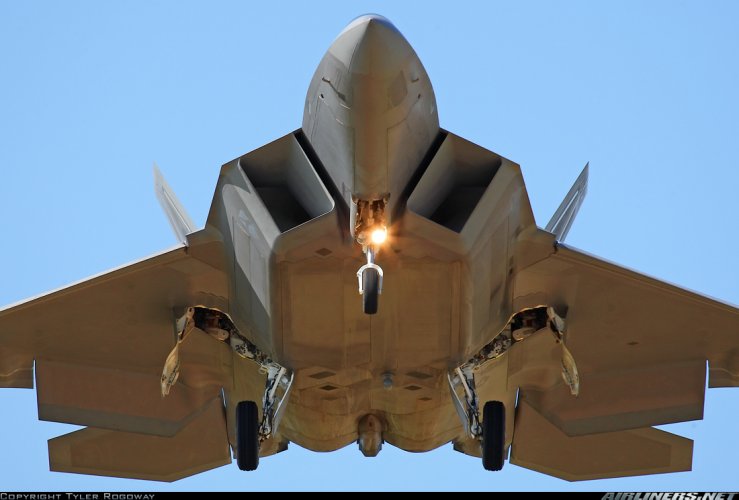
Twin EJ200 confirmed. Landing gear hinted at.Twin EJ200 I believe, also Typhoon landing gear.

Twin EJ200 confirmed. Landing gear hinted at.Twin EJ200 I believe, also Typhoon landing gear.
There will never be a production model of the demonstrator. It is "EAP" to GCAP's "Typhoon". Different designs.How much is likely to change from this demonstrator to the final production models? Others have said it'll grow in size significantly.

Demonstrators hardly ever use custom landing gear as its a costly subcontractor exercise for a one-off plane.Twin EJ200 confirmed. Landing gear hinted at.
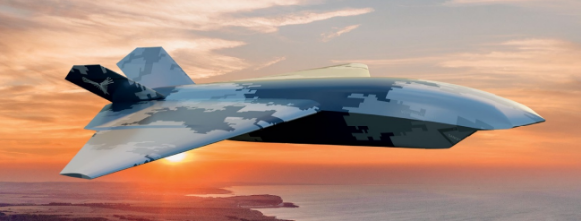
There's been some confusion created by the separation of the two threads - my comment above was in reference to the renders provided for GCAP last year, not for the demonstrator.Reuben. I think this render (and there is only one) is exactly 'the official design'.
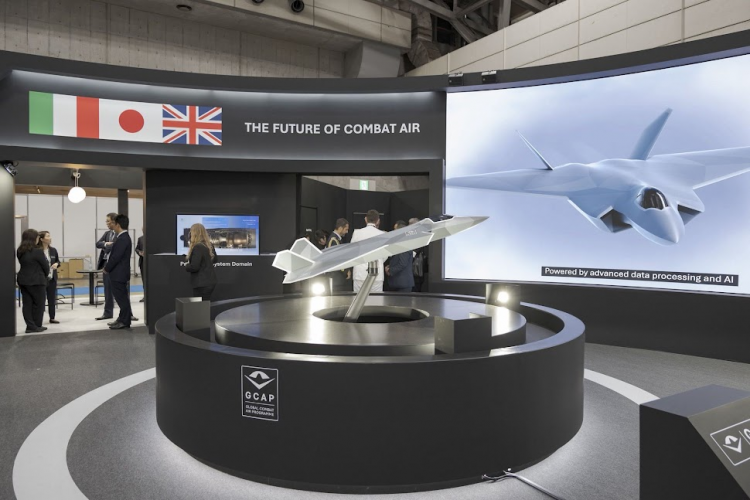

Is the write up something your able to share when completed, or at least the parts that are not requested to be non-disclosed.Haven't finished writing up the briefing we (Craig Hoyle, Gareth Jennings, Tony Osborne, Tim Robinson) received on Monday afternoon. This press release and image were embargoed until 2230 today...

Given it's the Guardian, I completely understand that - I don't normally read them for their defence coverage!Jaspar et al went to Warton for an 'overview' visit that included lots of stuff that the specialist media were already familiar with. That's why Craig, Gareth, Tony, Tim and I were given an in depth briefing.
I'd not actually expect size to be a major driver, it's still basically the same number of parts to plug together. Stealth, OTOH, might be an issue.I wonder how much their hoping to shorten the build time on the final GCAP design with the additive manufacturing, robotics etc. Given Eurofighter build is 3 years from what I'm aware & GCAP will be much bigger, LO, advanced.
I would have thought a forward retracting Tornado main gear would be better suited to a high wing design. The Typhoon retracts sideways towards the centreline….Twin EJ200 confirmed. Landing gear hinted at.
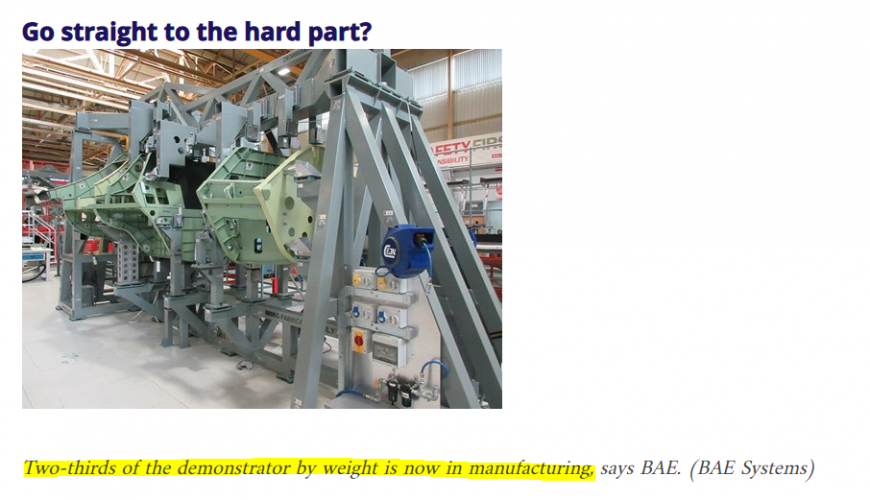
Here was the state of the demonstrator almost exactly 1 year ago, with the demonstrator having "more than 50% of aircraft by weight now in the build process." Can the size be estimated based off of these two photos?
 aviationweek.com
View attachment 778263
This is the design I was talking with the 'renders', not the design revealed for the demonstrator. Apologies for the confusion.
That is the current GCAP design, and there are lots of renders of it!View attachment 778263
This is the design I was talking with the 'renders', not the design revealed for the demonstrator. Apologies for the confusion.
I detect a renewed interest in a second manned platform within the FCAS family of systems, not least because ACPs with the required range, performance and capability threaten to be prohibitively expensive. The current US CCAs lack all of these things!Is the write up something your able to share when completed, or at least the parts that are not requested to be non-disclosed.
Any new info on the progress on the BAE tier 2 ACP, that last reporting is aiming for first flight early 2026. In terms of it being ready to fly with demonstrator for developing MUMT. Though so far reporting for MUMT tier 2 ACP has been with the Eurofighter mentioned as the stepping stone development platform. I wouldn't be surprised if this didn't come up in discussion given the focus on demonstrator.
I wonder how much their hoping to shorten the build time on the final GCAP design with the additive manufacturing, robotics etc. Given Eurofighter build is 3 years from what I'm aware & GCAP will be much bigger, LO, advanced. In a UK Defence Select Committee hearing a year or two ago, a member of the committee asked if faster build time could looked into for EF should circumstances become more pressing.
Welcome to the HMS Tempest...The EJ-200 is 4 metres long....and the intakes for the demonstrator add another 10 metres to that....according to this...plus the cockpit beyond that...
UK Advances Tempest Demonstrator Toward 2027 First Flight | Aviation Week Network
The UK is signaling Tempest’s lead over the European FCAS with advances in ground test rigs and engine aerodynamic work.
The original Pregnant Pelican, and not the current iteration.Guardian article image is the GCAP. mockup as previously seen not the CAFD. demonstrator


It's a quick refresh I did with Bill Sweetman so thoughts welcome. Like most stuff at the moment it is fairly speculative.The Quick and the Dead 2.0: Can a demonstrator speed up Britain’s next fighter? - Royal Aeronautical Society
The recent unveiling of Britain’s new fighter demonstrator should be an exciting moment with the first new UK combat jet in four decades. But can it help GCAP maintain its pace? Dr MICHAEL PRYCE looks at the mixed record of technology demonstrators.www.aerosociety.com
It's a quick refresh I did with Bill Sweetman so thoughts welcome. Like most stuff at the moment it is fairly speculative.
The X-2 was almost a decade ago so I guess it comes under Bill's comments about not having a gap or dispersing the team.Some quick initial (half-baked) observations and whatnot, in no particular order at all.
About Sweetman's notion about Gripen C/D and E being similar in airframe architecture - there's, as far as I have gathered, very little actual parts commonality between the two? This is not a criticism of his terminology, just something I've wondered about before - how much actual testing, validation, etc. was actually, demonstrably avoided by doing such an outwardly similar but still different jet? Going forward, because of the overlapping schedules (and presumably workforce) between the two, it'll be intriguing to see how dissimilar CAFD and GCAP end up being.
I'm not particularly read up on EAP history but it failing to de-risk carbon fibre durability brought current and emerging production methods to mind. Additive and related techniques (coupled with generative and parametric design) surely are more amenable to prototyping and, I presume, might prove to allow for more sustainably and affordably consumable parts and components for actual production models. One could argue that the very existence of these technologies is, on balance and used judiciously, somewhat de-risking. Many ramifications for maintenance, localization and interchangeability but unclear how a (singular?) prototype can prove related concepts.
Sweetman states that this is the first performance aircraft any of the GCAP participants has designed in decades but later on you do mention Shinshin too. The X-2 was the first association I had when learning about CAFD (and I mentioned as much here), I guess it has sort of in hindsight become a GCAP-related prototype as well. I tried to find out more about the entire arc of its testing (beyond the initial reporting around its first flights) but so far found little to nothing of interest.
As to integrating digital design data to airworthiness evaluation, information models are (/becoming) not only ubiquitous but obligatory in most design disciplines in inspecting compliance and getting permissions. Isn't there anything that could be carried over as is from the civilian aviation side which has more recent designs?
You can view Shinshin's post-project external evaluation here.Some quick initial (half-baked) observations and whatnot, in no particular order at all.
About Sweetman's notion about Gripen C/D and E being similar in airframe architecture - there's, as far as I have gathered, very little actual parts commonality between the two? This is not a criticism of his terminology, just something I've wondered about before - how much actual testing, validation, etc. was actually, demonstrably avoided by doing such an outwardly similar but still different jet? Going forward, because of the overlapping schedules (and presumably workforce) between the two, it'll be intriguing to see how dissimilar CAFD and GCAP end up being.
I'm not particularly read up on EAP history but it failing to de-risk carbon fibre durability brought current and emerging production methods to mind. Additive and related techniques (coupled with generative and parametric design) surely are more amenable to prototyping and, I presume, might prove to allow for more sustainably and affordably consumable parts and components for actual production models. One could argue that the very existence of these technologies is, on balance and used judiciously, somewhat de-risking. Many ramifications for maintenance, localization and interchangeability but unclear how a (singular?) prototype can prove related concepts.
Sweetman states that this is the first performance aircraft any of the GCAP participants has designed in decades but later on you do mention Shinshin too. The X-2 was the first association I had when learning about CAFD (and I mentioned as much here), I guess it has sort of in hindsight become a GCAP-related prototype as well. I tried to find out more about the entire arc of its testing (beyond the initial reporting around its first flights) but so far found little to nothing of interest.
As to integrating digital design data to airworthiness evaluation, information models are (/becoming) not only ubiquitous but obligatory in most design disciplines in inspecting compliance and getting permissions. Isn't there anything that could be carried over as is from the civilian aviation side which has more recent designs?
Twin EJ200. Landing gear NOT from Typhoon.Twin EJ200 I believe, also Typhoon landing gear.


I wonder if the Mitsubishi X-2 gear would work?So where does the landing gear come from that the Demonstrator has?

I believe the X-2's landing gears are taken right out of the T-2 trainersI wonder if the Mitsubishi X-2 gear would work?
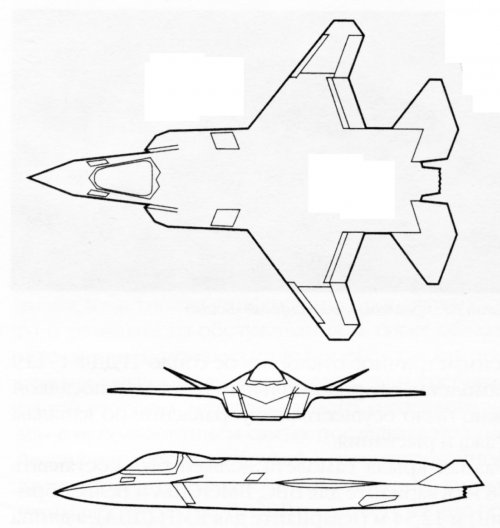
Just the new render.Do we have any new images on that demonstrator's current status? I think this is almost a year old?
View attachment 780454

Off topic posts - https://www.secretprojects.co.uk/threads/gcap-related-speculative-topic.48612/Maybe start a new thread in the 'Alternative' section for such speculative musings outwith the CAFD. thread ?
(Just for once it would be nice to see a linear thread without it being derailled by various thought exercises !)
The demonstrator has been planned for quite a while now. They've hardly decided 'just now'.If the GCAP program has just now decided they need a demonstrator vehicle then the actual GCAP platform is going to take much longer as compared to others.