BAC Lightning's radar cross section

datafuser

ACCESS: Secret
Joined
1 December 2006
Messages
364
Reaction score
886
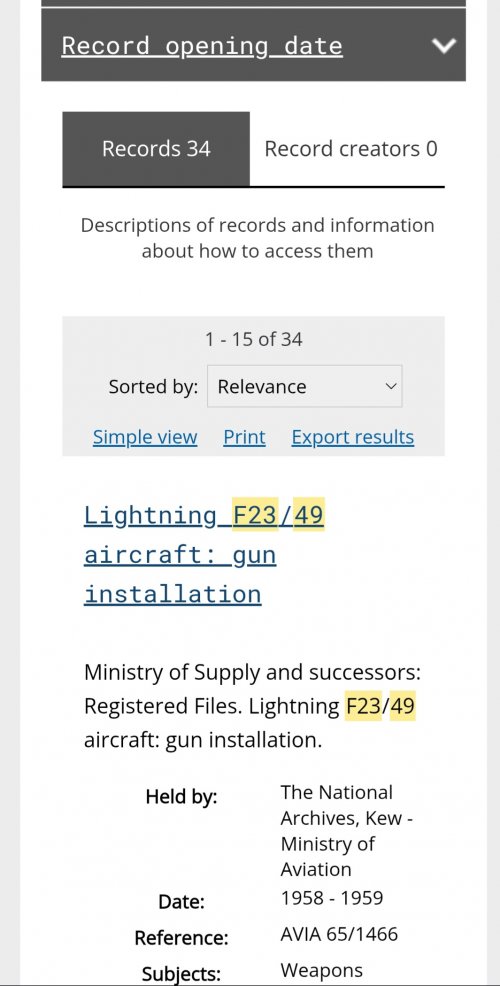
Try searching with "F23/49" rather than Lightning.

I've pulled loads of Lightning weaponry files but can't say I've seen anything on the radar cross-section. However, I wasn't looking for it.

Chris
 
Try searching with "F23/49" rather than Lightning.

I've pulled loads of Lightning weaponry files but can't say I've seen anything on the radar cross-section. However, I wasn't looking for it.

Chris

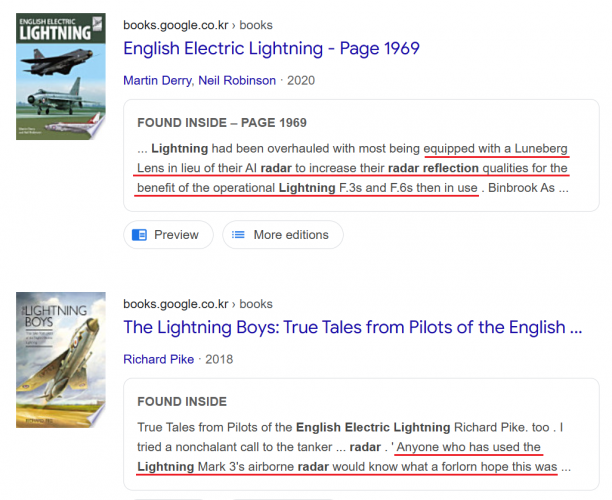
Thanks, I've searched with keywords "lightning", "radar", "reflection", "english electric" and found these two books shown below.

The first book says that from 1970 some Lightning F1s were fitted with a Luneberg lens in the nose cone to increase their RCS for Lightning F3s and F6s to detect them a little further away.

The second book says the Lightning F3's radar was really bad, so I suspect the RCS-enhancing Luneberg lens was fitted not because the Lightning's RCS was quite small, but because its radar was so poor.

radar.png
 
The second book says the Lightning F3's radar was really bad, so I suspect the RCS-enhancing Luneberg lens was fitted not because the Lightning's RCS was quite small, but because its radar was so poor.

View attachment 786878
How good does a radar need to be to intercept a Bear with Firestreak/Red Top/ADENs?

Chris
 
I would have thought it’s radar signature would be large—being slab sided.

From the beam aspect, I'm sure that is true. What datafuser was wondering about (implicitly) with engine face line-of-sight blockage and wing/tail edge alignment was head-on RCS, which is tactically more important, too.

The same thought has actually occurred to me in the past, and for exactly the same reasons.

Thanks, I've searched with keywords "lightning", "radar", "reflection", "english electric" and found these two books shown below.

I think what CJ was suggesting is to search official archives (not books) for documents referencing the aircraft's RCS, using the code rather than the colloquial name.

The second book says the Lightning F3's radar was really bad, so I suspect the RCS-enhancing Luneberg lens was fitted not because the Lightning's RCS was quite small, but because its radar was so poor.

If I had to guess it's not that the radar wasn't capable (for its time), but that the Lightning concept of operations with emphasis on supersonic head-on intercepts by a single-seat aircraft ran into serious man/machine interface limitations. The radar, according to many sources, was quite advanced on a purely technical basis, but the workload to acquire the target and complete an intercept was excessive for a single crew member who had to also worry about flying the aircraft in the first place.

Whether that invalidates the first source as a clue regarding the Lightning's RCS as you suggest is difficult to assess.
 
From the beam aspect, I'm sure that is true. What datafuser was wondering about (implicitly) with engine face line-of-sight blockage and wing/tail edge alignment was head-on RCS, which is tactically more important, too.

The same thought has actually occurred to me in the past, and for exactly the same reasons.


I think what CJ was suggesting is to search official archives (not books) for documents referencing the aircraft's RCS, using the code rather than the colloquial name.


If I had to guess it's not that the radar wasn't capable (for its time), but that the Lightning concept of operations with emphasis on supersonic head-on intercepts by a single-seat aircraft ran into serious man/machine interface limitations. The radar, according to many sources, was quite advanced on a purely technical basis, but the workload to acquire the target and complete an intercept was excessive for a single crew member who had to also worry about flying the aircraft in the first place.

Whether that invalidates the first source as a clue regarding the Lightning's RCS as you suggest is difficult to assess.

Oh I did try "F23/59" and "radar" at https://discovery.nationalarchives.gov.uk/, but found nothing.

As for man/machine interface limitations, thanks for sharing this important aspect.
 
Lightning and X-59’s intake got me to wondering if engines could be put in vertical stabilizers (tailfins) instead of wing roots.

The wing would be unencumbered and help hide the engines from the front.

The engines could pivot.
 
Last edited:
Thanks, I've searched with keywords "lightning", "radar", "reflection", "english electric" and found these two books shown below.
You want to search for "radar echoing area" which was the term being used at the time for radar cross section. I don't think I've come across mention of Lightning being measured or any relevant anecdotes.
 
You have to understand that aerial radar ranges in those days were really bad, barely larger than their weapons range so being detectable by allies was more important than avoiding detection by their opponent. They relied on ground stations to guide the interception so they weren't really worried about counter-detection.

I believe the initial Lightning versions the ability to lock enemy aircraft at a range of about 20 miles (compared to a weapons range of 4.5 miles initially and 7 miles with later weapons) which increased to around 40 mile detection range in later iterations. But their opposing Soviet bombers had a long range sea search radar/missile guidance beam and a jammer but no active defences and no escort fighters.
 

Similar threads

Back
Top Bottom