orlovsky
I really should change my personal text
- Joined
- 28 May 2016
- Messages
- 431
- Reaction score
- 851
I guess this is the right place - "historic... ships... not unbuilt projects".
I have a certain fascination with that old massive “analogue” technology: Audacious class, Clemenceau class, Essex class. The RN made Ark Royal fly Phantoms, the USN put large air wings on the Essexes, and the Clems look used way below potential, especially with the Crusaders finding no replacement.
The informations on the key aviation installations are piecemeal and murky. I will start with the steam catapults, especially on the Clemenceau class, in this first post.
Some interesting articles can be found in the JNE online:
The steam catapult (1953) https://library.imarest.org/record/10138?ln=en&p=steam+catapult
A steam catapult installation (1957) https://library.imarest.org/record/9939/files/v10b2p07a.pdf
Flight deck machinery (1965) https://library.imarest.org/record/9395/files/v18b1p08a.pdf
Development of the steam catapult (1966) https://library.imarest.org/record/9505/files/v16b3p04a.pdf
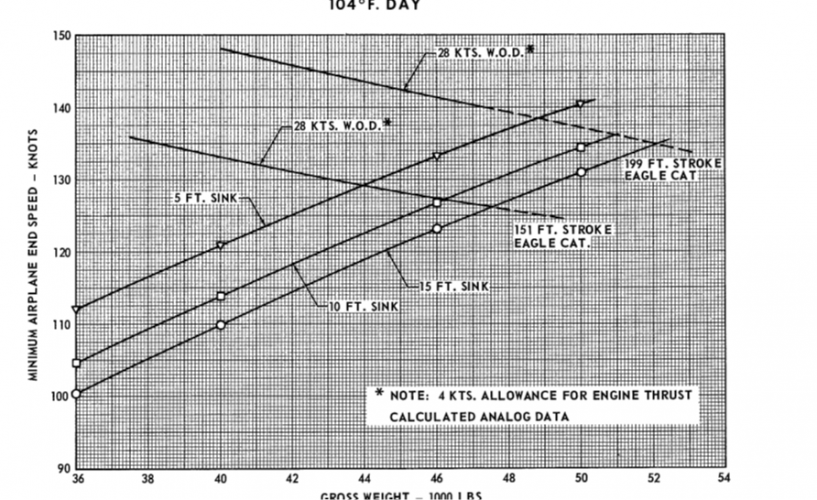
The catapults used were british BS4, BS5 and C-11 and the derived American C-11-1, being a rather close family. The end speeds for 1950s/60s fighter weights are:
33k lbs: short BS5 108?, long BS5 123?, C-11-1 133-137
40k lbs: short BS5 101, long BS5 116, C-11-1 125-129
44k lbs: short BS5 97, long BS5 111, C-11-1 120-126
50k lbs: short BS5 91, long BS5 105, C-11-1 115-120
BS5 details here, subtract 28 kts shipspeed and 4 kts engine.

Within the family, the differences are accounted for by about 0.3 kt per ft stroke length, and between the BS and C series additionally about 10 kts for difference in steam pressure.
As discussed several times, the nrs for the BS catapults in the Clems do not really fit. Actually, they are all over the place.
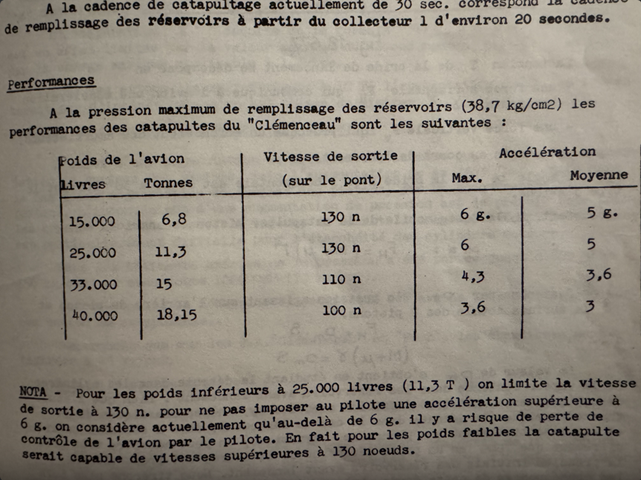
From French material around 1960 for the 157 ft catapults:

Despite the higher steam pressure and similar length, the end speeds align with the short RN BS5.
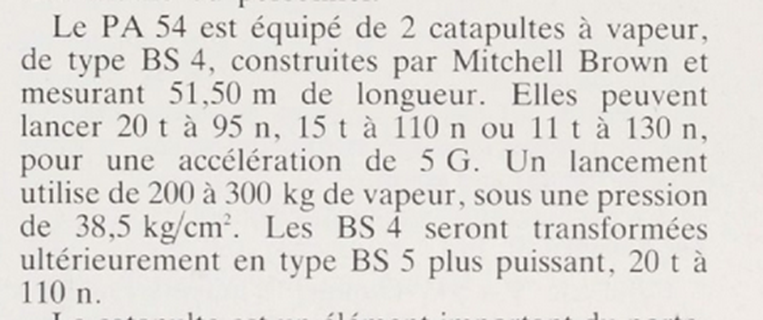
First edition (1980s) of Moulin's book on Clemenceau and Foch states a more powerful 51,5m (169 ft) bs5 with 110 kts @ 20 metric t replaced a bs4 with 95 kts @ 20t, 110 kts @ 15t and 130 kts @11t. He does not say when this happened, but the new figure would be 15 kts above the short RN BS5: ~5kts from length, ~10 kts from steam pressure. Makes sense.

This would also fit with the requirements for the F-8 operating smoothly and no big problems seen for the F-18. With the original numbers, both would be extremely marginal to impossible.
Unfortunately, the 2006 edition of Moulin found that the catapults had not been changed. Rather, there was a small change in the BS4, the RN decided to rename the later versions as BS5, and the MN followed.
(The author adds “...to avoid any confusion”, and in a footnote “Obviously, that did not turn out so well” – someone was not happy). Moulin then has figures for end speeds that look inconsistent and do not mention the timeframe or whether they are for maximum or mean g load. No mention of an improved version, 20t/44k lbs are suddenly just at 90 kts.
But as said, the original numbers have likely been improved for the F-8 and for consideration of the F-18. Moulin has the catapults at 51.5m (169 ft), so at least lengthened by the typical 12 ft increment. Should be worth 3-4 kts. Also, that on Foch the steam pressure was increased to 570 psi from 550 – probably a very small improvement.
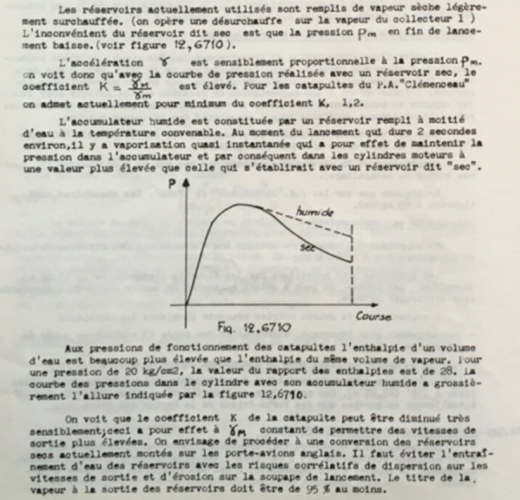
The french material from ~1960 also mentions a perspective: Changing from dry to wet accumulators, studied by the RN and foreseen as a change of the accumulators in RN carriers:

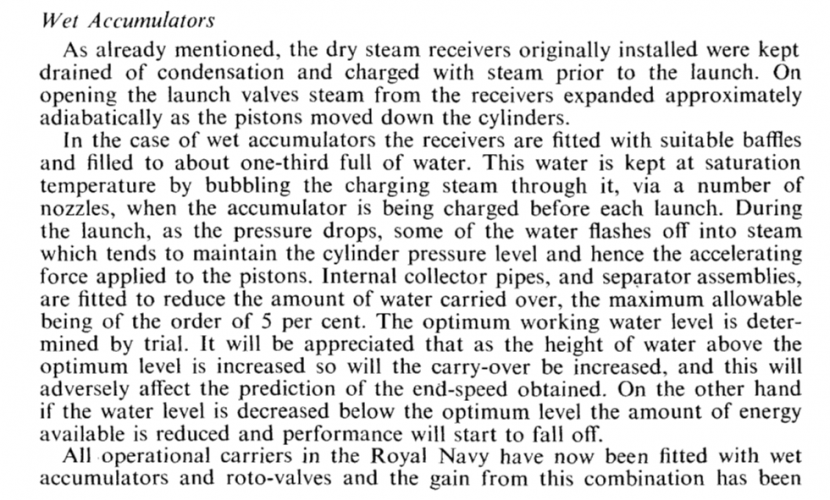
I had not seen any information on results from this, just numbers for the C-11 “dry” and “wet” with very little difference. But on the RN BS5, it was applied with substantial result by the early 1960s (DEVELOPMENT OF THE STEAM CATAPULT, cf above):


I consider it very likely that this has also been applied to the French BS5: The MN was aware of the development, it was needed for the Crusaders and it looks like a relatively simple change. At 44k lbs, this would give from the basic 95 kts +3-4 added length +8-10 wet accululators, and we are in the 105-110 kt range as mentioned in the initial edition of Moulin.
Only problem: I have not found confirmation that the accumulators on Clemenceau and Foch have been changed. It might be an issue too arcane even for specialized authors like Moulin (who initially fell victim to the BS5 renaming…)
I have a certain fascination with that old massive “analogue” technology: Audacious class, Clemenceau class, Essex class. The RN made Ark Royal fly Phantoms, the USN put large air wings on the Essexes, and the Clems look used way below potential, especially with the Crusaders finding no replacement.
The informations on the key aviation installations are piecemeal and murky. I will start with the steam catapults, especially on the Clemenceau class, in this first post.
Some interesting articles can be found in the JNE online:
The steam catapult (1953) https://library.imarest.org/record/10138?ln=en&p=steam+catapult
A steam catapult installation (1957) https://library.imarest.org/record/9939/files/v10b2p07a.pdf
Flight deck machinery (1965) https://library.imarest.org/record/9395/files/v18b1p08a.pdf
Development of the steam catapult (1966) https://library.imarest.org/record/9505/files/v16b3p04a.pdf
The catapults used were british BS4, BS5 and C-11 and the derived American C-11-1, being a rather close family. The end speeds for 1950s/60s fighter weights are:
33k lbs: short BS5 108?, long BS5 123?, C-11-1 133-137
40k lbs: short BS5 101, long BS5 116, C-11-1 125-129
44k lbs: short BS5 97, long BS5 111, C-11-1 120-126
50k lbs: short BS5 91, long BS5 105, C-11-1 115-120
BS5 details here, subtract 28 kts shipspeed and 4 kts engine.
Within the family, the differences are accounted for by about 0.3 kt per ft stroke length, and between the BS and C series additionally about 10 kts for difference in steam pressure.
As discussed several times, the nrs for the BS catapults in the Clems do not really fit. Actually, they are all over the place.
From French material around 1960 for the 157 ft catapults:
Despite the higher steam pressure and similar length, the end speeds align with the short RN BS5.
First edition (1980s) of Moulin's book on Clemenceau and Foch states a more powerful 51,5m (169 ft) bs5 with 110 kts @ 20 metric t replaced a bs4 with 95 kts @ 20t, 110 kts @ 15t and 130 kts @11t. He does not say when this happened, but the new figure would be 15 kts above the short RN BS5: ~5kts from length, ~10 kts from steam pressure. Makes sense.
This would also fit with the requirements for the F-8 operating smoothly and no big problems seen for the F-18. With the original numbers, both would be extremely marginal to impossible.
Unfortunately, the 2006 edition of Moulin found that the catapults had not been changed. Rather, there was a small change in the BS4, the RN decided to rename the later versions as BS5, and the MN followed.
(The author adds “...to avoid any confusion”, and in a footnote “Obviously, that did not turn out so well” – someone was not happy). Moulin then has figures for end speeds that look inconsistent and do not mention the timeframe or whether they are for maximum or mean g load. No mention of an improved version, 20t/44k lbs are suddenly just at 90 kts.
But as said, the original numbers have likely been improved for the F-8 and for consideration of the F-18. Moulin has the catapults at 51.5m (169 ft), so at least lengthened by the typical 12 ft increment. Should be worth 3-4 kts. Also, that on Foch the steam pressure was increased to 570 psi from 550 – probably a very small improvement.
The french material from ~1960 also mentions a perspective: Changing from dry to wet accumulators, studied by the RN and foreseen as a change of the accumulators in RN carriers:
I had not seen any information on results from this, just numbers for the C-11 “dry” and “wet” with very little difference. But on the RN BS5, it was applied with substantial result by the early 1960s (DEVELOPMENT OF THE STEAM CATAPULT, cf above):

I consider it very likely that this has also been applied to the French BS5: The MN was aware of the development, it was needed for the Crusaders and it looks like a relatively simple change. At 44k lbs, this would give from the basic 95 kts +3-4 added length +8-10 wet accululators, and we are in the 105-110 kt range as mentioned in the initial edition of Moulin.
Only problem: I have not found confirmation that the accumulators on Clemenceau and Foch have been changed. It might be an issue too arcane even for specialized authors like Moulin (who initially fell victim to the BS5 renaming…)