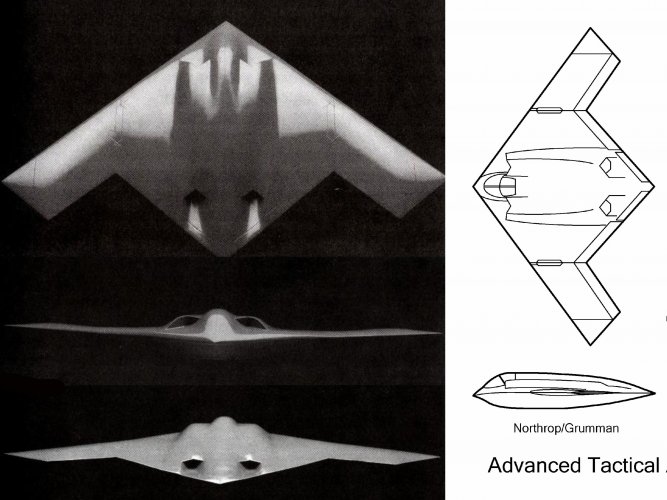
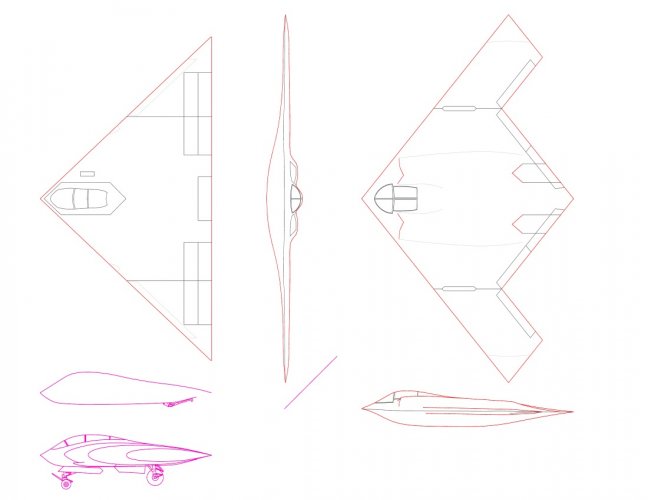
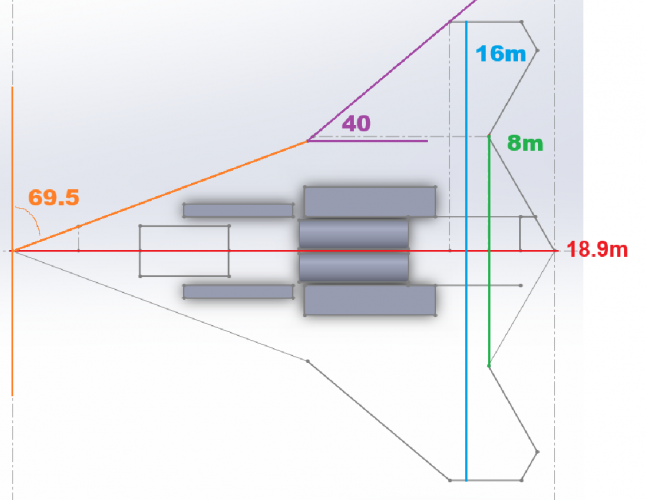
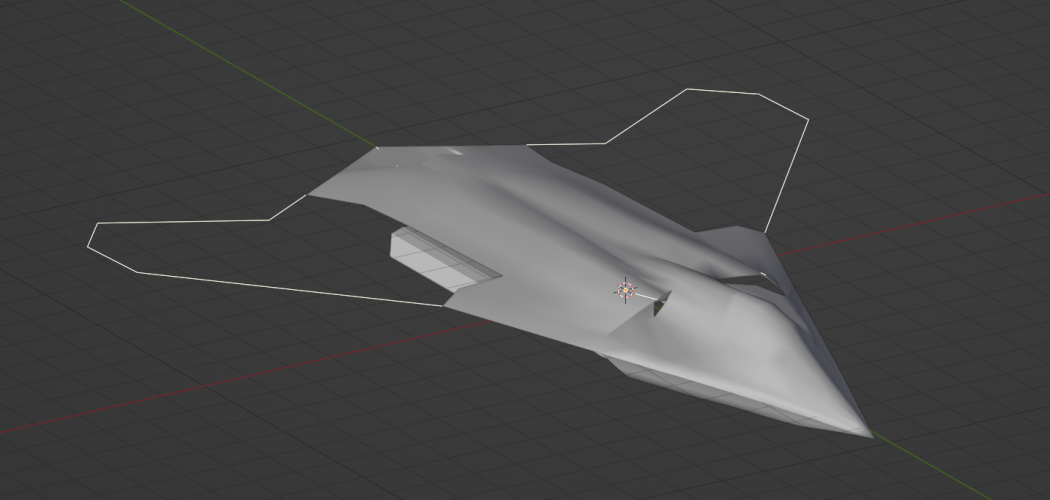
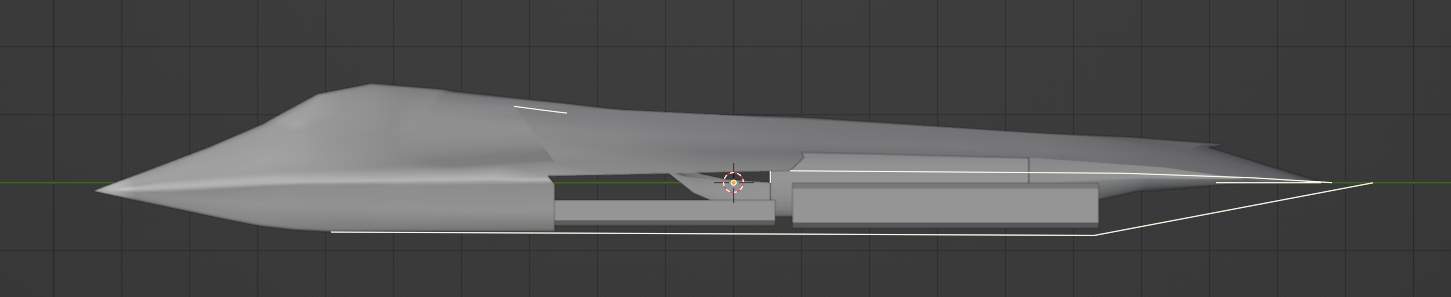
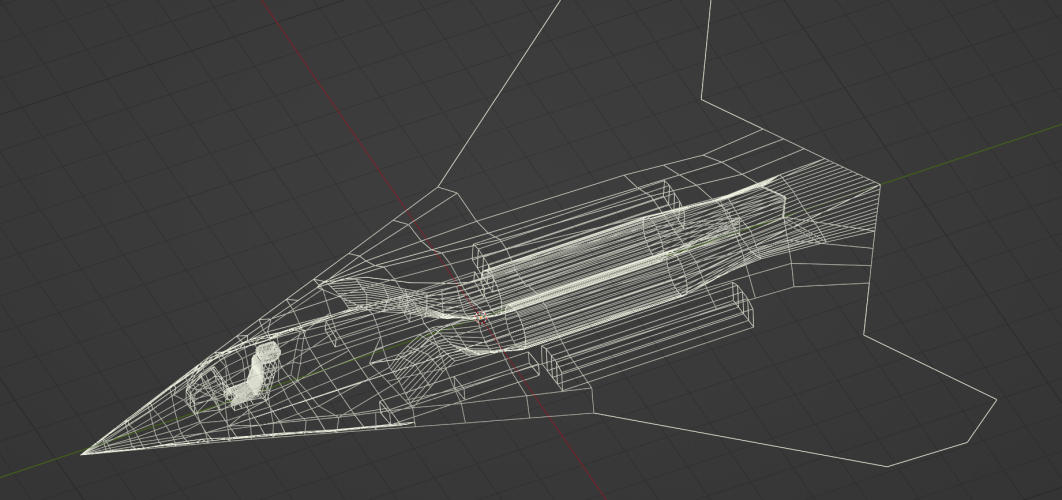
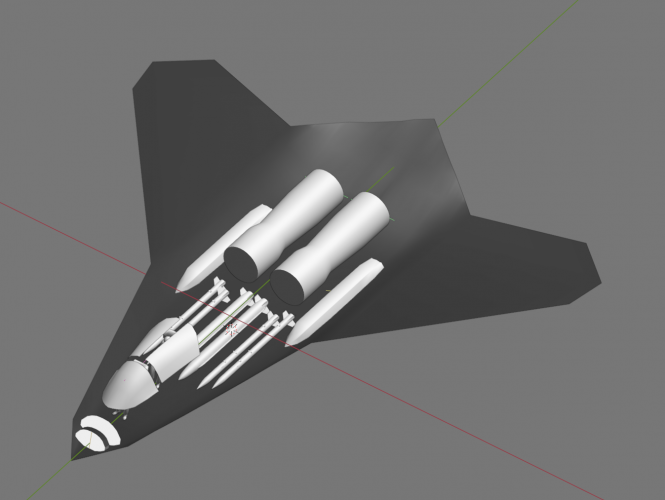
Artwork: possible configuration of the Northrop Grumman F/A-XX

Reddington777

ACCESS: Top Secret
Joined
23 March 2025
Messages
899
Reaction score
3,105
I don't know if there's gonna be an NG concept thread but since it's F/A-XX I'll post here @Scott Kenny :

2 LRASMs + 4 AAMs

4 SiAW + 4 AAMs

2x F110-129 or derivatives.

2 pilots

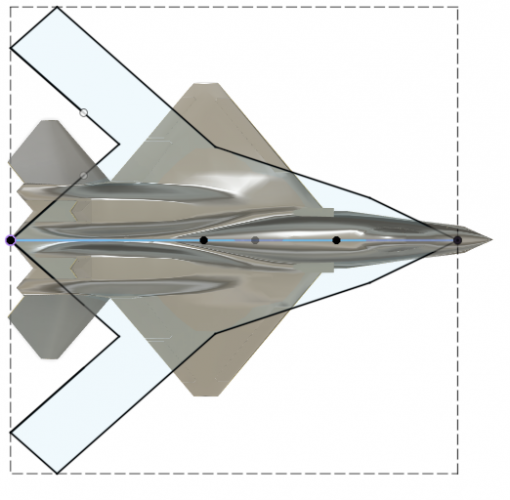
The planform is derived from the NG concepts / diagrams posted for ESAV / super sonic strike.

Volume wise, it's already in the high 80s and possibly spilling into the low 90s with a length of 16.8m.

I'm still trying to figure out what the spot factor will look like. Also I have no idea the maximum allowed height for wing folding. I expect the actual height required to open the wings to be higher than the wings in the stowed position.

1767910382629.png 1767910361562.png
1767910796019.png

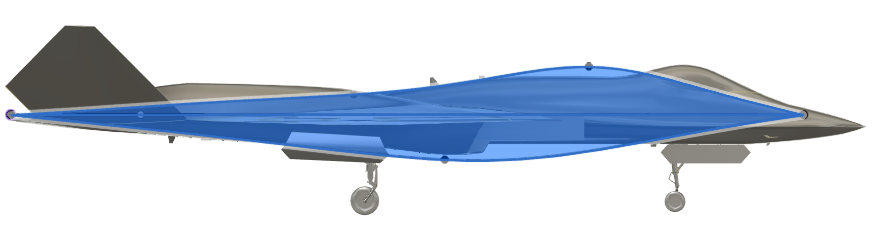
The engines are very wide apart - so much so that I'm not sure how to "end" the plane on the tail end yet. The concept behind the dorsal intakes is that at high-ish AoA, the intakes would rely on vortices generated by the nose chine. Otherwise, because the forebody chine points downwards, there's a significant ramp that pushes air towards the inlets. The ramp contour came from what seems to be depicted in the NG video:
1767910910768.png
 
Last edited:
I may have ultimately become blind, but am I the only one who sees a bit of the ATA in these commercial renderings/models? Albeit optimized towards supersonic flight. The side view and intake placement are what make it reminiscent in my eyes. And given that the F/A-XX is supposed to be a strike fighter first and foremost, why shouldn't Northrop Grumman look back at their previous effort into that direction. While the NATF was more so a Tomcat style fleet defense fighter, ATA is more in line with what has been outlined for a super hornet replacement. Except obviously having the airframe and engine being capable of super sonic flight and presumably supercruise as well.
retouch_2026010902142761.jpg
 
I may have ultimately become blind, but am I the only one who sees a bit of the ATA in these commercial renderings/models? Albeit optimized towards supersonic flight.
My thinking precisely. Thanks for this photo. This helps me determine how I'm going to end the tail - trench exhausts (yet again) it is.

I actually used an ATA line drawing by @Orionblamblam to help determine the fuselage profile:
A-12-Model2.jpg
It's kinda crazy that when this line drawing was made, I was in my mid teens just about to enter high school...
 
I may have ultimately become blind, but am I the only one who sees a bit of the ATA in these commercial renderings/models? Albeit optimized towards supersonic flight. The side view and intake placement are what make it reminiscent in my eyes. And given that the F/A-XX is supposed to be a strike fighter first and foremost, why shouldn't Northrop Grumman look back at their previous effort into that direction. While the NATF was more so a Tomcat style fleet defense fighter, ATA is more in line with what has been outlined for a super hornet replacement. Except obviously having the airframe and engine being capable of super sonic flight and presumably supercruise as well.
View attachment 797914
The ATA inlets and exhausts could be used for NG F/A-XX of course optimized for a fighter and our ATA design was from the 1980s. We probably could have developed an an advanced tailless fight back then, we had some pretty advanced designs in that era and some were also UFOs (Un-Funded Opportunites).
 
I don't know if there's gonna be an NG concept thread but since it's F/A-XX I'll post here @Scott Kenny :

2 LRASMs + 4 AAMs

4 SiAW + 4 AAMs

2x F110-129 or derivatives.

2 pilots

The planform is derived from the NG concepts / diagrams posted for ESAV / super sonic strike.

Volume wise, it's already in the high 80s and possibly spilling into the low 90s with a length of 16.8m.

I'm still trying to figure out what the spot factor will look like. Also I have no idea the maximum allowed height for wing folding. I expect the actual height required to open the wings to be higher than the wings in the stowed position.

View attachment 797905View attachment 797904
View attachment 797906

The engines are very wide apart - so much so that I'm not sure how to "end" the plane on the tail end yet. The concept behind the dorsal intakes is that at high-ish AoA, the intakes would rely on vortices generated by the nose chine. Otherwise, because the forebody chine points downwards, there's a significant ramp that pushes air towards the inlets. The ramp contour came from what seems to be depicted in the NG video:
View attachment 797907
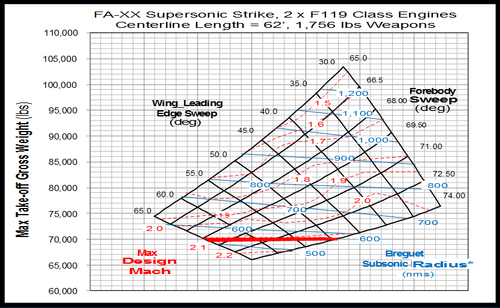
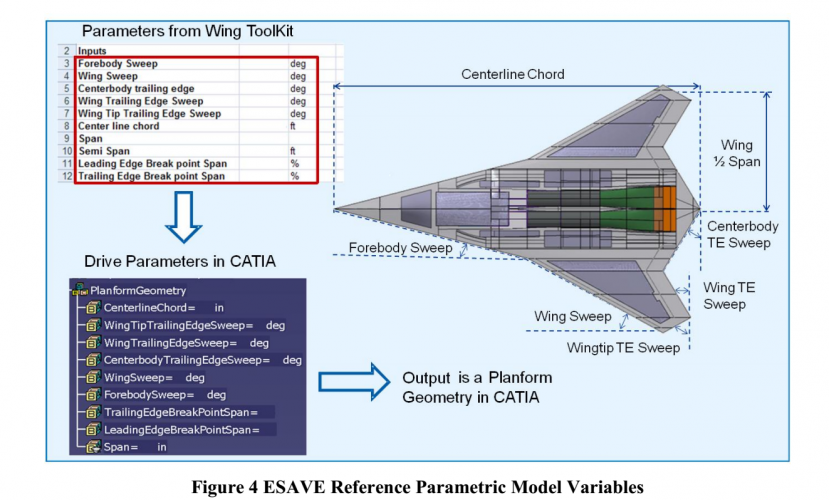
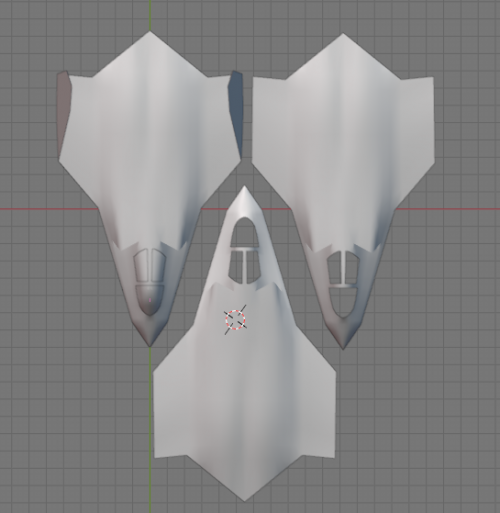
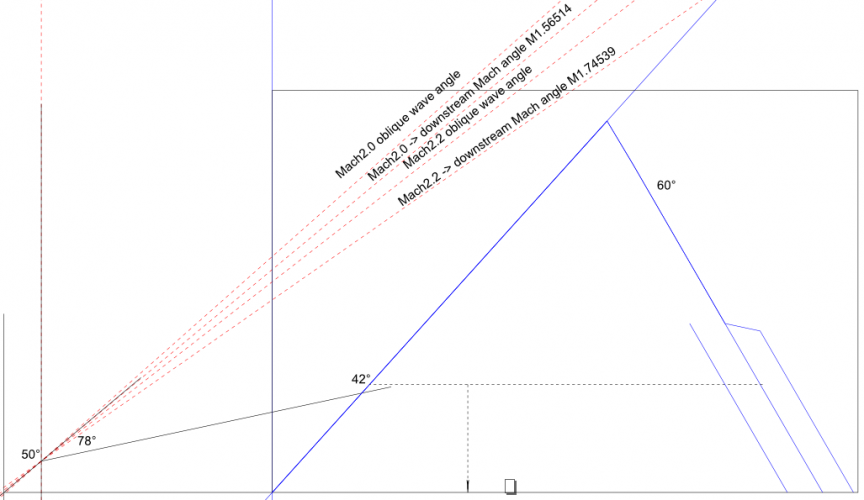
Based on these charts you've recently dug up, I tried to adhere to the chart and how the parameters of angle may affect the specifications of the platform.
1767932282440.png 1767932615525.png
I think the "forebody sweep from the horizontal" is wrong because that would only be 20 degrees.

Instead of a centerline weapons bay, the engines instead are coupled together in the center as close as possible with the weapons bays out on the side. This makes for quite a wide aircraft though with fat wings. I haven't gotten around to making the model as I've been modeling another aircraft, but I've created a rough sketch of what the planform I've chosen may appear to look like. I think this design can get away with a very flat fuselage.
1767932854916.png
 
@Nx4eu

The angles I chose were almost the same. My wing sweep is exactly the same but my forebody was 71 degrees from horizontal. I'm finding the wide engine tandem bay idea to be a little weird to work with though and may end up switching to this layout as well.
 
I don't know if there's gonna be an NG concept thread but since it's F/A-XX I'll post here @Scott Kenny :

2 LRASMs + 4 AAMs

4 SiAW + 4 AAMs

2x F110-129 or derivatives.

2 pilots

The planform is derived from the NG concepts / diagrams posted for ESAV / super sonic strike.

Volume wise, it's already in the high 80s and possibly spilling into the low 90s with a length of 16.8m.
I'm not sure that 2x LRASMs equal 4x SiAW in volume. In fact, I'm pretty sure that SiAW are about the same width as the AGM-158s, give or take a couple of inches. I've been using the width of the JSM, actually, on the grounds that the JSM is the largest object that can fit into an F35A/C bay, and the SiAW also has to fit into those bays. 19" wide.


I'm still trying to figure out what the spot factor will look like.
I have been assuming something between "Tomcat" and "F-111B", but possibly clear out to "A-3 Skywarrior." 1.5-1.75, with Legacy Hornet = 1.0

Hecking BIG bird.


Also I have no idea the maximum allowed height for wing folding. I expect the actual height required to open the wings to be higher than the wings in the stowed position.
The height of the E-2's radome is 18ft.

But don't forget that you could use the old Grumman Sto-Wing like the E-2 and rotate the leading edge parallel to the deck, if the wings would be too long folding the other way.


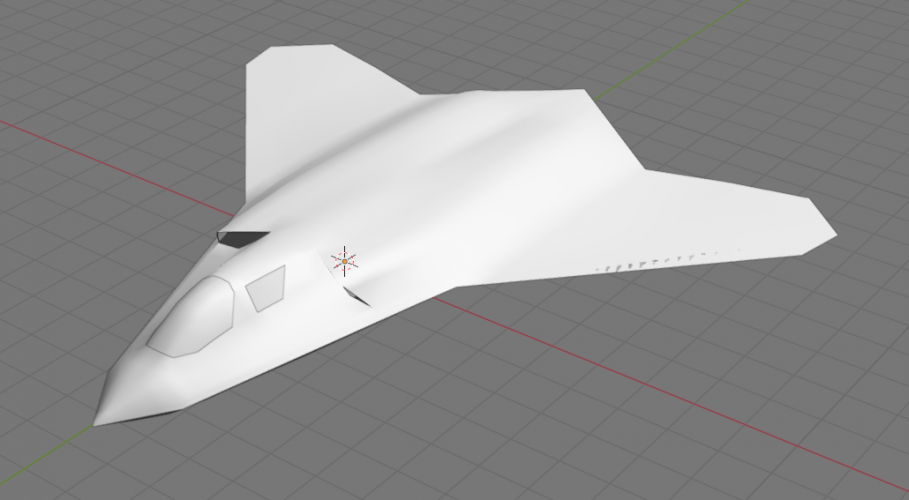
Overall I like it, but I think the cockpit/canopy needs to be different. The Back seater gets a full canopy, not a couple of windows.


The engines are very wide apart
That's good, it gives us space for a pair of weapons bays each ~60-65" wide and ~16.5ft long. Thankfully, this monster void is only about 25" deep!


I may have ultimately become blind, but am I the only one who sees a bit of the ATA in these commercial renderings/models? Albeit optimized towards supersonic flight.
Oh, I fully expect the basic design brief was "Take the ATA and make it supersonic"

My mental model was very much that. Two main weapons bays able to hold at least 2x (harpoon/SLAM replacements) and 2x (GBU-15 replacements), and since putting the bays in parallel made a plane too wide to be supersonic I went for tandem bays each big enough to hold AGM-158s as the widest weapon currently in service.

I also assumed that the bays would be long enough to hold the longest weapon that fits on the weapons elevators. At present, that happens to be the AIM-174B, though I personally doubt that the FAXX will carry AIM-174s in service. I am expecting a weapon comparable to ASALM as one of the weapons in use as a high-supersonic/hypersonic missile.

Also, the "Regaining the High Ground" UCAVs are likely to strongly resemble the ATA in size and shape.
 
Apologies Scott I was actually just writing a response to your pm.
I'm not sure that 2x LRASMs equal 4x SiAW in volume. In fact, I'm pretty sure that SiAW are about the same width as the AGM-158s, give or take a couple of inches. I've been using the width of the JSM, actually, on the grounds that the JSM is the largest object that can fit into an F35A/C bay, and the SiAW also has to fit into those bays. 19" wide.
I was thinking about making the center bay doing side by side packing for SiAW, which ensures a single LRASM per bay width wise.

The SiAW / AARGM-ER I'm working with is 158 x 16.4 x 16.4 inches (counting the tail fins). Side by side, with clearances, I end up at 40 inches wide weapon bays.
I have been assuming something between "Tomcat" and "F-111B", but possibly clear out to "A-3 Skywarrior." 1.5-1.75, with Legacy Hornet = 1.0

Hecking BIG bird.
The problem about this planform right now and the wide engine (for me) is a length problem. With engines that wide apart, your intake and exhuast ducting quickly runs into the sides of the planform before you reach the extremeties.

If I've understood correctly from reading other comments, a slower plane that doesn't need to go mach 2+ could do with shorter intake ducting with bigger curvature. But the wide engines also mean a shorter or more curved exhaust area. This leads me to believe that Nx4eu's arrangement makes a little more sense.

I could go with a longer planform, but you aren't going to be able to go that much flatter just because the engines and the frame rings still need to be contained well.
The height of the E-2's radome is 18ft.

But don't forget that you could use the old Grumman Sto-Wing like the E-2 and rotate the leading edge parallel to the deck, if the wings would be too long folding the other way.
Thanks for this idea! I completely forgot about this.
Overall I like it, but I think the cockpit/canopy needs to be different. The Back seater gets a full canopy, not a couple of windows.
Point taken. Going to use the NG ATA cockpit design then.
That's good, it gives us space for a pair of weapons bays each ~60-65" wide and ~16.5ft long. Thankfully, this monster void is only about 25" deep!
Yeah... I think maybe I'm going to change the arrangment then. That would create a lot more space for width without being constrained by engine and ducting. come to think of it, it might even let me go bigger for the same volume.
 
1767942073958.png
I ended up using the same arrangement too. It's just a much more efficient use of volume than tandem bays. At only 81 m3, there's so much real-estate.

I think your's is more likely to be what that render shows though.

This planform seems to also fit together pretty well on the deck:

1767943955915.png
 
Last edited:
I feel a bit bad having to join the NG crowd but B proof me wrong.

Since this is about striker the calculations differ from that of a (superiority) fighter where A2A weaponry is integral to it and its performance maxed out. For a striker only payload amount and minimum performance have to be met.
That said stealth and IWB moves the calculation perspective closer toward a fighter as IWB payload becomes integral.
I'm assuming A2A load for this as a compromise rather than the full load.

So first my spec expectations before going into the design math.
subsonic beast mode
M1.2 supercruise full loaded internal weapons bay
M1.5 supercruise A2A
max cruise/dash M1.8
max speed M2.0
basically closer to the F22 but not quite as fast.

GTOW ~70000 lb

From statements fleet operation range is now
11000000 km^2/5000000 km^2=2.2 x
sqrt(2.2)=1.4832396974191325897422794881601 x
or
Radius = sqrt(11000000/Pi)=1871 km = 1010 NM (with one refuel point)
with expected fuel efficiency & range improvement of 20%
so for the F35 single engine => 22248 lb (is useable fuel at 90%) rounded up to 22500 lb => total fuel (1/0.9)*22500=25000 lb
adjusted for dual engine 1.1x => ~28000 lb

Now to the design calculation.
Minimum A2A load 6x AIM120 ~2510.4 lb and this represents 3.5% GTOW
=> GTOW 71725.7 => 71750 lb
if 6x AIM260 ~3500 lb
=> GTOW 100000 lb hitting catapult limit... so yeah, can't get more than this

fuel amount:
71750*0.4=28700 lb rounded to 28500 lb ~16502 L => 16.5 m³
useable 90% => 25650 rounded to 25500 lb JP-8
nice match with above expectation

(operational) Empty weight 71750-28700-2510.4-(pilot)=40162.6 lb

internal payload:
4x AIM120 ~1673.6
or 4x AIM260 ~2241.6
4x GBU31 ~8896
=> 10569.6 lb to 11137.6 lb
=> 11000-11500 lb
external payload:
18000 lb
total payload: 11500+18000=29500

MTOW 29500+28500+(377)+40162.6=98539.6 lb => 98540 lb

Compared to my F47 (operational) Empty weight 40264 lb; GTOW 78571 lb; MTOW 98641 lb both are about the same.

if same as F22
A2A T/W 1.25 16xAIM120 50% fuel at 65724.8 lb => 41078 lb engine required
if same as F35
MTOW T/W 0.652 at 98540 lb => 32140 lb engine required

using F135 Engine Core Upgrade with 45 klb thrust is more than sufficient
Empty weight T/W 90000/40162.6=2.24
GTOW T/W 90000/71750=1.2543554
MTOw T/W 90000/98540=0.9133346

As for the planform, my preliminary math gave me a hard no ;_;
And the 2nd choice happens to be perfect for Navy but I'm not happy with it. I'll have to rethink the whole setup.

FA-XX-wing0.png
 
I look at the F-47 thread renderings and the renderings from this thread. If I went back 10 years ago on this forum and asked the question: "Which one is the Navy aircraft and which one is the USAF aircraft?"

100% of the forum members would say the F-47 design with canards is clearly the Navy aircraft. Members would say:
1) USAF fighters never had canards
2) Su-33 and Rafale have canards for carrier landing.
3) Delta wings without canards land with a high angle of attack.
4) Delta wings without canards have a high landing speed.
5) Landing slow at a high angle of attack would block airflow to the upper air intakes.

The NG rendering with the upper air intakes doesn't show the wings. I'm thinking it might not be a supercruising design. It might have less wing sweep to solve the landing speed issue.
 
My thinking precisely. Thanks for this photo. This helps me determine how I'm going to end the tail - trench exhausts (yet again) it is.

I actually used an ATA line drawing by @Orionblamblam to help determine the fuselage profile:
View attachment 797917
It's kinda crazy that when this line drawing was made, I was in my mid teens just about to enter high school...
It remember me the A12 Avenger project.
 
It remember me the A12 Avenger project.
Oh yeah that's not a coincidence. I specifically wanted to do what is essentially a supersonic northrop ATA, but mixed in with the ESAV concepts. The nose and cockpit are taken directly from the northrop ATA design.
 
Subsonic faxx.jpg

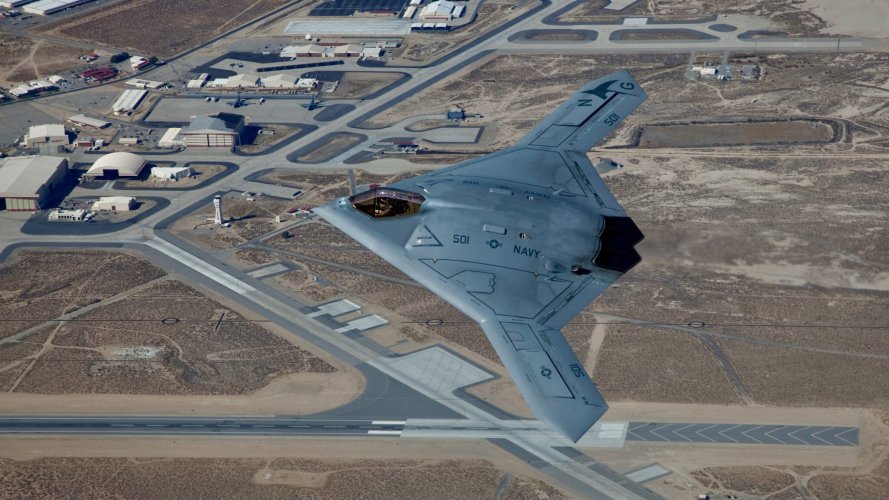
Northrop Grummans proposal that we saw in their rendering. Scaled up from the carrier capable X-47B design that had a single F110 engines.

Length: 60 feet
Wingspan: 80 feet
Wingspan folded: 40 feet
MTOW: 100,000lb

I believe members have seen a sneak peak of the NG design and assumed it was the supersonic F/A-XX. It was probably their submission for the Long range strike program that is both in the Navy and USAF budget.

It is worth noting the X-47 Wikipedia page has the following

X-47C
Proposed larger version intended for the Navy's UCLASS project or as an Air Force strategic bomber

This could be the X-47C with a F-35 cockpit in front.
 
Last edited:
It seems to me like UCLASS has been replaced at least for the near future by cheaper solutions like the Gambit family and optional unmanned version of F/A-XX. But decisions are still not made clear yet nor announced. It seems either the Navy hasn't figured out everything yet or rather things are still too fluid (politics aside). This is gonna be up in the air for quite some time.

X-47C would have been ideal as it was as good as done but... it wasn't meant to be. I don't think it will come back.
Design wise X-Bat is more desireable from a techological point of view but it's still underdeveloped and far from an aircraft (landing gear etc. let alone COTOBAR). We'll see.

Now that you mention LRS the weapons load requirement are similar so I'm raising internal load requirement from 11.5 to 12 klb to meet customer request.
 
X-47C would have been ideal as it was as good as done but... it wasn't meant to be. I don't think it will come back.
The X-47 coming back with a standard F-35 cockpit makes perfect sense.
1) It explains the Northrop rendering with the upper intakes.
2) It explains why the X-47 program suddenly went quiet despite everyone thinking it was a great concept.
3) We have an unknown long range strike program for both the USAF and Navy.
4) The USAF was interested in the X-47B

The Super Hornet currently provides air-to-air and fleet defense. This involves dog fighting. The renderings with the upper intakes are completely incompatible with this mission. The Northrop rendering was either fake or its not F/A-XX.

Now I can't see the Navy buying three new platforms at once.
1) Supersonic manned F/A-XX
2) Subsonic manned long range strike
3) F-35C

If the Navy had budget cuts I could see them cutting F/A-XX and putting the F-35C into the air-to-air role. Then have the subsonic long range strike platform become the primary strike aircraft.

Now that you mention LRS the weapons load requirement are similar so I'm raising internal load requirement from 11.5 to 12 klb to meet customer request.
I think the Navy needs a 1,000+nm combat radius with twice of the internal weapon capacity of the F-35. The only way this can fit on the carrier is with a subsonic design.

Many members have said the F/A-XX needs more range to keep the carrier safe. The quote of 25% more range had many members saying that is not far enough. I don't think a supersonic design can achieve more than that while staying within the weight limit.

Last year we had reports that only Boeing made a demonstrator for F/A-XX and LM made a demonstrator for NGAD. Now the podcast Defense and Aerospace report and resume of Dan Javorsek suggest Northrop made a demonstrator. We have the Long Range Strike program. One demonstrator aircraft per program. It makes sense for Northrop to get the long range strike demonstrator.

The X-47B had a single F110 with 15,00lb of thrust. It makes sense to move to a higher bypass ratio for a subsonic design. The B-21 uses two PW9000 which each has 27,000lb of thrust and a 4:1 bypass ratio. The MQ-25 and Global Hawk engine has a 5:1 ratio.

A single B-21 engine is a good fit. 80% thrust increase over the X-47B.
The X-47B had an empty weight of 28,837 lb and a MTOW of 44,501 lb. An 80% increase in weights come to 51,000lb empty weight and 80,000lb MTOW. Fairly substantial. With 10,000lb of internal payload that leaves 19,000lb of fuel which is sinilar to the F-35. The greater wingspan and more efficient engine would easily see it exceed the 1,000nm combat radius.
 
Last edited:
The rendering is mostly fake. The whole bottom was basically the F35 darken so you won't notice.

There's no doubt the F/A-XX will be funded.
Strike missions are definitely subsonic for all but CAP & F/A-XX. The supersonic is for defence as in counter air (cruise-/missiles; enemy CAP/shooters) or immediate counter strike response from BARCAP.
So it's probably cheap Gambit to MQ-25/28 like drones for the short term.

1000 NM radius for normal operation and 1300 NM radius for strike with one refuel point.
Unless for strike or refuel mission the F/A-XX will be clean and supersonic. I did say it could be M1.2 for full strike since that's less weight then for serving as a tanker. The report did say the escort could partially function for buddy refueling. So it would be subsonic until after the refuel point. I did add more fuel in my design to get to 1000 NM without. The desired internal fuel range is min. 800 NM but preferred 1000 NM. With expected 20% engine improvement that 800 NM target will be met. The rest is refueling. Supercruise can be more fuel efficient than ssubsonic but the speed and thrust point is specific and narrow. So it's only at a specific speed, hence, loadout. It's hard to say without engine data on hand.

Edit: the report did list 2 of the tankers as multirole so those two could serve as the escort for the strike mission. It's just not very clear in the document which aircraft actually does the buddy tanking.
 
Last edited:
The X-47 coming back with a standard F-35 cockpit makes perfect sense.
1) It explains the Northrop rendering with the upper intakes.
2) It explains why the X-47 program suddenly went quiet despite everyone thinking it was a great concept.
3) We have an unknown long range strike program for both the USAF and Navy.
4) The USAF was interested in the X-47B
1767994747260.gif
 
I feel a bit bad having to join the NG crowd but B proof me wrong.

Since this is about striker the calculations differ from that of a (superiority) fighter where A2A weaponry is integral to it and its performance maxed out. For a striker only payload amount and minimum performance have to be met.
That said stealth and IWB moves the calculation perspective closer toward a fighter as IWB payload becomes integral.
I'm assuming A2A load for this as a compromise rather than the full load.

So first my spec expectations before going into the design math.
subsonic beast mode
M1.2 supercruise full loaded internal weapons bay
M1.5 supercruise A2A
max cruise/dash M1.8
max speed M2.0
basically closer to the F22 but not quite as fast.

GTOW ~70000 lb
I am curious why you chose that when US catapults can handle up to 80k. Even the F-35 hits 70k.
 
No, it wasn’t.

The “program” you are referring to is a budget item for multiple acknowledged programs.

There can still be a manned aircraft as part of the Long Range Strike initiative just like with NGAD.

The F-47 was just the manned fighter component of NGAD. From wiki:

"The Next Generation Air Dominance (NGAD) is a United States Air Force (USAF) sixth-generation air superiority initiative with a goal of fielding a "family of systems"


We do not know if the Long Range Strike initiative also had a manned demonstrator. It is included in both the USAF and US Navy budgets. There is a fairly large budget that could pay for a demonstrator.

With the manned X-47C idea I would expect there to be an unmanned version eventually. For the USAF this then becomes the large CCA that can fly deep with the B-21 while carrying 2,000lb bombs. The ideal CCA to fly with the B-21 would need a 2,000nm combat radius. This points to a very large drone similar to the planned X-47C.
 
Last edited:
It seems to me like UCLASS has been replaced at least for the near future by cheaper solutions like the Gambit family and optional unmanned version of F/A-XX. But decisions are still not made clear yet nor announced. It seems either the Navy hasn't figured out everything yet or rather things are still too fluid (politics aside). This is gonna be up in the air for quite some time.

X-47C would have been ideal as it was as good as done but... it wasn't meant to be. I don't think it will come back.
Design wise X-Bat is more desireable from a techological point of view but it's still underdeveloped and far from an aircraft (landing gear etc. let alone COTOBAR). We'll see.

Now that you mention LRS the weapons load requirement are similar so I'm raising internal load requirement from 11.5 to 12 klb to meet customer request.
 
I am curious why you chose that when US catapults can handle up to 80k. Even the F-35 hits 70k.
partly based on the GCAP, FCAS information. I just assume it should be around that at minimum. As I also said multiple times in the NGAD thread there a weight savings coming 10-20%.
 
I am curious why you chose that when US catapults can handle up to 80k. Even the F-35 hits 70k.
I also happen to choose a similar MTOW between 71 - 77klb MTOW. I surveyed some typical modern day strike fighters and the list is topped by the J-16 at 77k and F-15E at 81k. Historically, the list is topped by F-111B and A-3 at 80k + MTOW.

For general purpose strike, it seems like the high 70s is typical. F-111's weight was in part due to forced commonality, and with what limited reading I did, the A-3 was built to carry nukes.

If 77k is enough to reach it's range requirements then what other reasons might you need a fighter that reaches 80+k in MTOW?
 
I am taking the under on dry weight for both XX and 47.
Sorry, it's not dry weight. I know germans usually refer to precise data but official American values are always operational wet weight which includes oil, other kinds of fluid (hydraulics, O2/LN etc), trapped fuel. It's part of the misinformation effort. Just look at people's confusion about the F22's official empty weight of 43340 lb and it's true empty weight 31670 lb
If you want empty weight this will have to be calculated separately.
The structure weight alone should be ~24(-26)% GTOW. ~17220 lb min. plus ~5000 engines ~7000 subs systems so about 29220 lb and some ~5%. That's about as close to the true empty weight you can get.

Edit: Btw. the calculation methode I used here is for navy aircrafts in case you were wondering. I just didn't show all the rest of rule of thumbs at my disposal.
 
I also happen to choose a similar MTOW between 71 - 77klb MTOW. I surveyed some typical modern day strike fighters and the list is topped by the J-16 at 77k and F-15E at 81k. Historically, the list is topped by F-111B and A-3 at 80k + MTOW.

For general purpose strike, it seems like the high 70s is typical. F-111's weight was in part due to forced commonality, and with what limited reading I did, the A-3 was built to carry nukes.

If 77k is enough to reach it's range requirements then what other reasons might you need a fighter that reaches 80+k in MTOW?
He'd mentioned 70k, which is what the F-35C tops out at. Made me wonder how he was going to get two engines, more speed, range, and payload, without increasing weight. Even assuming some material advances gives you a 20% drop in structural weight I wondered why he'd leave potential capability on the table.
 
There can still be a manned aircraft as part of the Long Range Strike initiative just like with NGAD

There is no Long Range Strike Initiative. There are no undisclosed new aircraft programs, manned or not, within those budget items.

The news reporting regarding those items within the budget bill(s) was clickbait uninformed speculation . It's not difficult to account for where that money went. The text of the bill should have sent up red flags to any moderately informed reader.
 
He'd mentioned 70k, which is what the F-35C tops out at. Made me wonder how he was going to get two engines, more speed, range, and payload, without increasing weight. Even assuming some material advances gives you a 20% drop in structural weight I wondered why he'd leave potential capability on the table.
To summarize:
F/A-XX
(operational) Empty weight 40162.6 lb without trapped fuel
GTOW 71750 lb; MTOW 98540 lb

F47
(operational) Empty weight 40264 lb without trapped fuel
GTOW 78571 lb; MTOW 98641 lb

The key difference is the F47 requires more fuel & range, And as mentioned the baseline calculation for superiority fighter differs from a striker. And the majority of weight contribution if not all to MTOW is external payload and mainly on drop tanks. GTOW is more important for superiority fighter while MTOW is for striker. Having IWB blurs this traditional difference.
 
There is no Long Range Strike Initiative. There are no undisclosed new aircraft programs, manned or not, within those budget items.

The news reporting regarding those items within the budget bill(s) was clickbait uninformed speculation . It's not difficult to account for where that money went. The text of the bill should have sent up red flags to any moderately informed reader.
Can you expand on that?

Screenshot_20250704_141040_Chrome.jpeg

How do you explain this 2025 budget bill screenshot?

Taken from the thread:

https://www.secretprojects.co.uk/th...y-long-range-strike-aircrafts-in-obbba.46875/
That Northrop teaser with the upper surface air intakes does not look like an aircraft that can be the primary air-to-air and air defense aircraft in the Navy.

Many sources have stated that the CCA aircraft with dorsal intakes have poor agility. Andural with their YFQ-44A has mentioned many times that they selected a lower intake similar to the F-16 because it is the best solution for a high agility, high G capable drone. Likewise Boeing is on record saying the MQ-28 uses side intakes to allow reasonable agility.

I laugh each time I see a F/A-XX rendering with intakes above the wing.
 
The key difference is the F47 requires more fuel & range.
It doesn't require more fuel to achieve the range.

Take a hypothetical shared design. The USAF version will have a 10% lighter empty weight. This increases range without adding more fuel. The F-35A has 10% greater range when in air-to-air configuration compared to in air-to-ground configuration.

Combining both of these points means a 800nm US Navy air-to-ground profile and 1,000nm USAF air-to-air profile could be satisfied by a shared design. The USAF version is flying at a lighter weight so it will also be faster, have a higher TWR and more agility.

No need for the USAF to have more fuel.
 
It doesn't require more fuel to achieve the range.

Take a hypothetical shared design. The USAF version will have a 10% lighter empty weight. This increases range without adding more fuel. The F-35A has 10% greater range when in air-to-air configuration compared to in air-to-ground configuration.

Combining both of these points means a 800nm US Navy air-to-ground profile and 1,000nm USAF air-to-air profile could be satisfied by a shared design. The USAF version is flying at a lighter weight so it will also be faster, have a higher TWR and more agility.

No need for the USAF to have more fuel.
It's easier to base range estimates on fuel amount because that only depends on specific fuel consumption which we can safely assume remains almost the same throughout the same mission (profile).
Estimating based on payload may work with rules of thumb at subsonic speeds but at supersonic speeds drag, lift, engine power levels each changes differently. A2G and A2A flight profile differ for speed and altitude further increasing complexity.
At best I can guess half but the rest needs measured data at each point of the whole envelope.
The USAF needs more fuel because their next landing opportunity is kind of more distant. Their tankers themselves need to be refueld by other tankers.
 
Can you expand on that?

Expand on what?

How do you explain this 2025 budget bill screenshot?

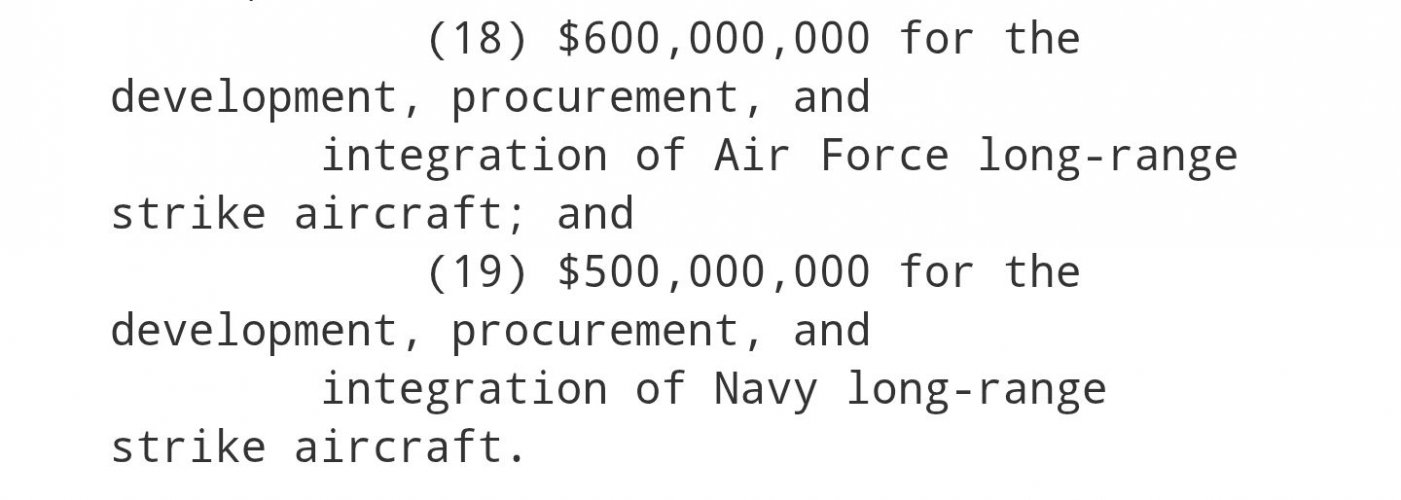
The relevant portions of the text are:

$600,000,000 for the development, procurement, and integration of Air Force long-range strike aircraft;

$500,000,000 for the development, procurement, and integration of Navy long-range strike aircraft.

I've been working with budget information from the executive and legislative branches for a long time but I can tell you (again) anyone with an even passing familiarity with the defense budget process will see the red flags here. It doesn't take any special experience to spot them. And just like with anything else in the budget, there are plenty of other documents that describe how these funds were actually used, even if they were reprogrammed into other things.

But there is - as you are clearly aware - a thread specific to the topic of those budget items, and this thread is not it. Discussion of those budget items belongs there, not in a Northrop F/A-XX thread. There is no logical nexus between those budget items and F/A-XX.
 
Back
Top Bottom