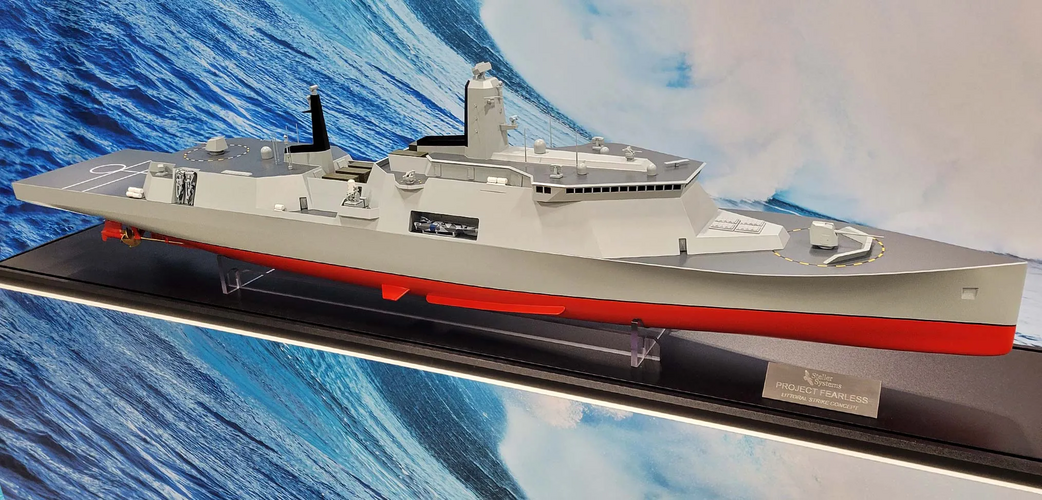
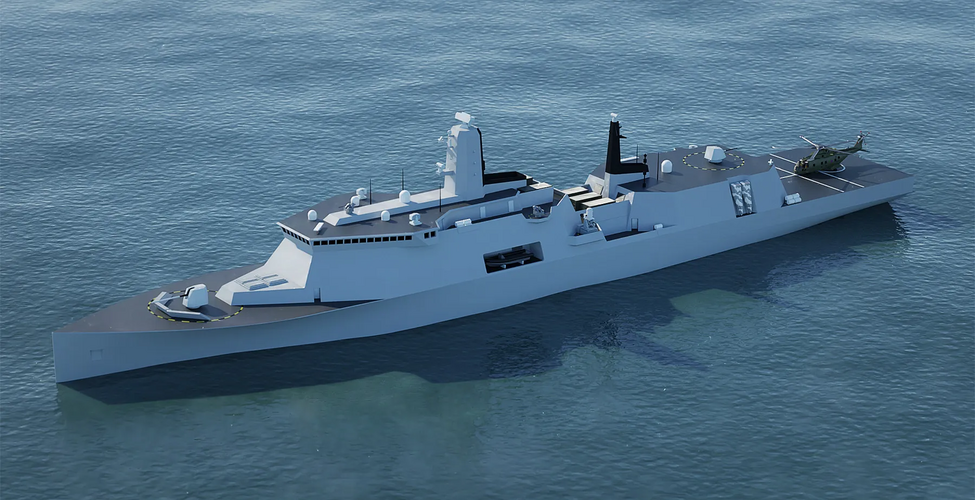
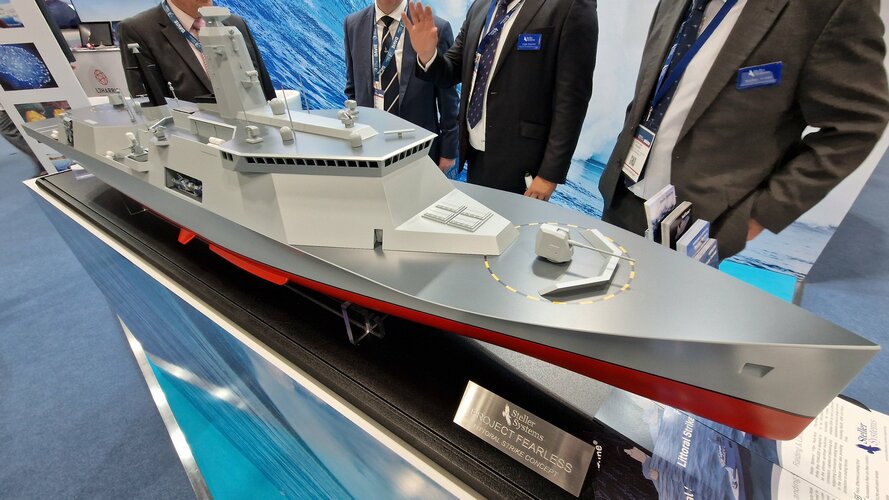
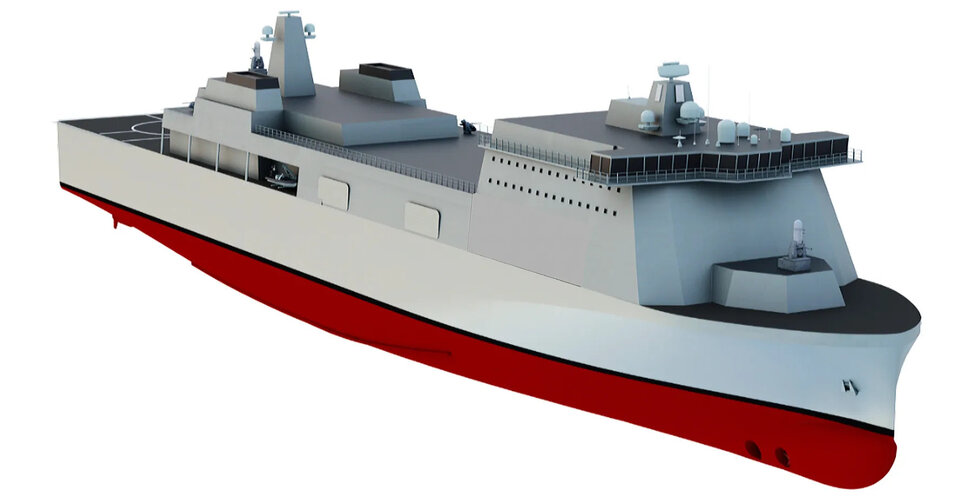
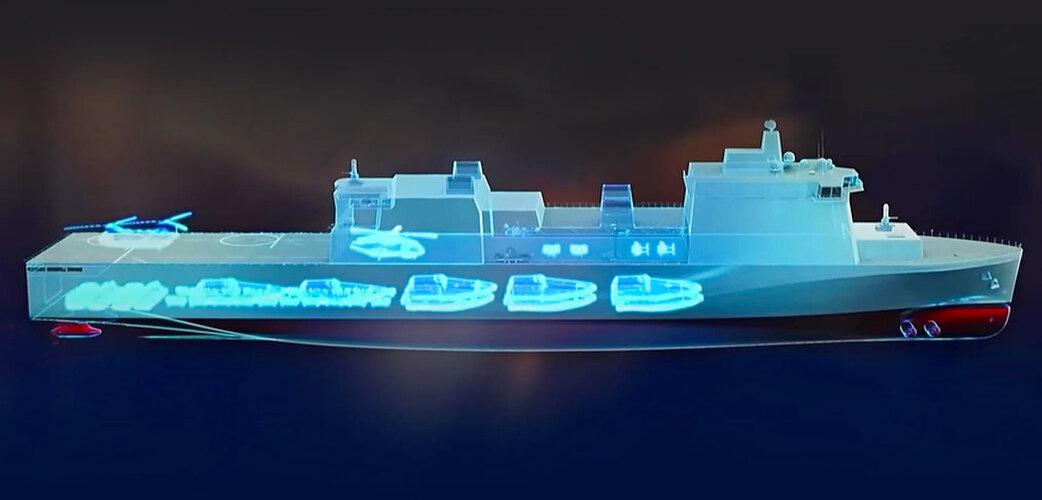
Yes, in the interview, the company rep says that while it carries less than, say the ELLIDA, survivability of the battalion overall is enhanced by distributing it over more than one vessel while the design's improved efficiency can allow a larger number to be built and deployed.

The fact that it has significant defensive and offensive capability of its own compared to others of the general concept might be an advantage, considering what's happening in the Red Sea now and its implications for procurement policy.
The problem is ensuring there are adequate numbers of amphibious hulls. A 6 unit program represents the bare minimum when each ship is essentially carrying only a single company. If you produce something the size of a cruiser, fully kitted out with the systems of a full on escort, affordability is a real issue. A likely scenario is a truncated 3 hull program with the availability of only a single operational unit at a time. The commando brigade will amount to the operational equivalent of an under equipped company. Maybe that’s all the UK will be able to field in any case?
 
Addendum.

https://www.navylookout.com/royal-navys-multi-role-support-ship-programme-to-go-ahead/
The MRSS project will develop a single design to replace the two LPDs HMS Albion and Bulwark, the three LSD(A)s RFA Mounts Bay, Cardigan Bay and Lyme Bay together with RFA Argus.

One type replacing three. The worrying bit is 'up to' instead of 'at least.'

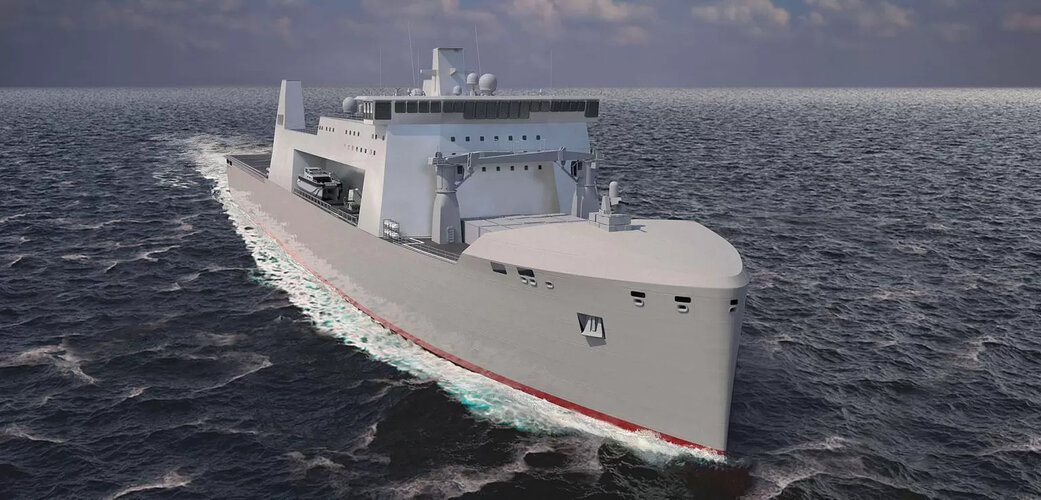
Photos and silhouettes of the vessels to be replaced are in the header graphic. The rendering is of BMT's ELIIDA.

View attachment 729946
With the increasing improbability of actual shipbuilding in Belfast, the RN might as well wrap the Fleet Solid Support requirement into MRSS as well.
 
Specific MRSS requirements in terms of overall force structure may affect or be affected by the Type 32 and Fleet Solid Support Ship.

This article dates from 2020, when the MRSS was still the Littoral Strike Ship.

https://www.navalnews.com/naval-new...navy-to-europes-most-powerful-maritime-force/
While the 8 Type 26 frigates (also known as the City-class) and 5 Type 31 frigates were already planned to be procured, the real surprise in today’s announcement is the mention for the first time of the “Type 32”. Early rumors associated the term with an export variant of Type 31, T4X (Type 45 destroyer replacement), the Littoral Strike Ship project (which appears to be abandoned) or even a typo. Naval News learned from a reliable UK source that this is in fact some sort of “pre program” put in place for budgetary reasons in anticipation of a future potential “Type 31 Batch 2”. The source added that this potential “Type 31 Batch 2” may not necessarily be based on the Type 31 design.

Since then, Babcock and BAE Systems have released concepts for the Type 32 but no formal requirement has been issued. The Babcock proposal is a modified Type 31 while the BAE design is a clean sheet, optimised for strike.

https://www.navylookout.com/babcock...ept-with-view-to-type-32-frigate-competition/
https://www.navylookout.com/in-focus-bae-systems-adaptable-strike-frigate-concept/
The National Shipbuilding Strategy as of 2022 was to have the Type 32 as a drone mothership while both Babcock and (even more so) BAE have emphasised littoral strike. If the MRSS is to take a more aggressive role rather than just delivering troops, as looks likely, then I expect some delay in formulating the exact Type 32 requirements until they've worked out how it's going to work with the MRSS. Probably the drone support role will be emphasised and both of the released design proposals will undergo some changes.

https://ukdefencejournal.org.uk/type-32-frigate-to-focus-on-operating-drones/
As for the Fleet Solid Support Ship, this is the latest article I found. Contracts are going out, so it looks certain to remain a separate programme, suggesting that the MRSS will indeed be less logistics-biased and tilt more to offence/defence of troops. ELLIDA only has weapons for self-defence ('Daleks'), while Fearless has proper guns and missiles. Under the scenario I've described, that design probably has the edge.

By the way, Albion and Bulwark are Royal Navy combat vessels and are 'HMS' while the other ships are Royal Fleet Auxiliary, 'RFA'. All MRSS's will be 'HMS' and the FSSS's 'RFA' I guess.

https://ukdefencejournal.org.uk/progress-on-fleet-solid-support-ships/
Now there is a general election imminent in the UK, and the polls strongly indicate a Labour victory. Barring divine/diabolical (depending on your opinion) intervention, Keir Starmer will be the UK's next prime minister. He's spent years making it clear that he's not Jeremy Corbyn, so I don't think that there will be any major upset in plans for the RN.

 
Last edited:
Specific MRSS requirements in terms of overall force structure may affect or be affected by the Type 32 and Fleet Solid Support Ship.

This article dates from 2020, when the MRSS was still the Littoral Strike Ship.

https://www.navalnews.com/naval-new...navy-to-europes-most-powerful-maritime-force/
While the 8 Type 26 frigates (also known as the City-class) and 5 Type 31 frigates were already planned to be procured, the real surprise in today’s announcement is the mention for the first time of the “Type 32”. Early rumors associated the term with an export variant of Type 31, T4X (Type 45 destroyer replacement), the Littoral Strike Ship project (which appears to be abandoned) or even a typo. Naval News learned from a reliable UK source that this is in fact some sort of “pre program” put in place for budgetary reasons in anticipation of a future potential “Type 31 Batch 2”. The source added that this potential “Type 31 Batch 2” may not necessarily be based on the Type 31 design.

Since then, Babcock and BAE Systems have released concepts for the Type 32 but no formal requirement has been issued. The Babcock proposal is a modified Type 31 while the BAE design is a clean sheet, optimised for strike.

https://www.navylookout.com/babcock...ept-with-view-to-type-32-frigate-competition/
https://www.navylookout.com/in-focus-bae-systems-adaptable-strike-frigate-concept/
The National Shipbuilding Strategy as of 2022 was to have the Type 32 as a drone mothership while both Babcock and (even more so) BAE have emphasised littoral strike. If the MRSS is to take a more aggressive role rather than just delivering troops, as looks likely, then I expect some delay in formulating the exact Type 32 requirements until they've worked out how it's going to work with the MRSS. Probably the drone support role will be emphasised and both of the released design proposals will undergo some changes.

https://ukdefencejournal.org.uk/type-32-frigate-to-focus-on-operating-drones/
As for the Fleet Solid Support Ship, this is the latest article I found. Contracts are going out, so it looks certain to remain a separate programme, suggesting that the MRSS will indeed be less logistics-biased and tilt more to offence/defence of troops. ELLIDA only has weapons for self-defence ('Daleks'), while Fearless has proper guns and missiles. Under the scenario I've described, that design probably has the edge.

By the way, Albion and Bulwark are Royal Navy combat vessels and are 'HMS' while the other ships are Royal Fleet Auxiliary, 'RFA'. All MRSS's will be 'HMS' and the FSSS's 'RFA' I guess.

https://ukdefencejournal.org.uk/progress-on-fleet-solid-support-ships/
Now there is a general election imminent in the UK, and the polls strongly indicate a Labour victory. Barring divine/diabolical (depending on your opinion) intervention, Keir Starmer will be the UK's next prime minister. He's spent years making it clear that he's not Jeremy Corbyn, so I don't think that there will be any major upset in plans for the RN.
The problem with FSSS is that treasury is balking at handing £200m to a seemingly defunct shipyard that is only worth £20m and mostly likely isn’t able to raise a skilled workforce from the local population of Belfast. I don’t see how FSSS will be able to pass the inevitable review of a new government. Even after a sweeping and historical win, I somehow doubt the new government will be eager to fund the predictable and inevitable embarrassment of delays and cost overruns. Unless Navantia can be allowed to get on with the job, I can’t see a future for FSSS aside from years of delays.
 
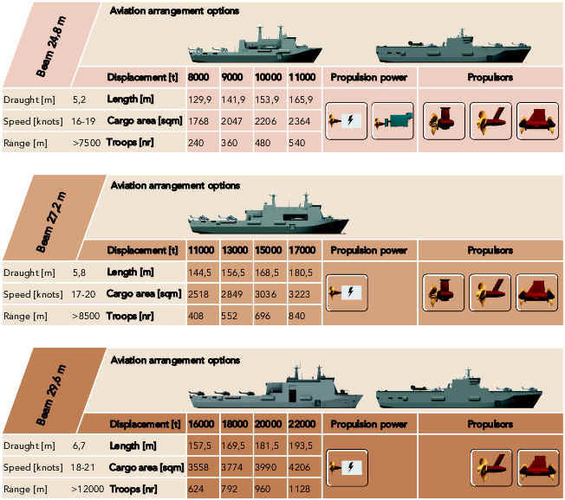
The MRSS project will develop a single design to replace the two LPDs HMS Albion and Bulwark, the three LSD(A)s RFA Mounts Bay, Cardigan Bay and Lyme Bay together with RFA Argus.

For what it’s worth, I ran some rough numbers on the level of capability each MRSS would need to match the existing fleet (assuming 6x MRSS hulls). Here’s what I got:

300 pax
650 lane meters
Aviation: 2x Merlin helos in hangar + 1x stowed on deck, 1 Chinook sized landing spot
Landing craft: 2 LCUs in dock + 2 LCVPs in davits

Maybe start there and discuss what capability needs to be added / removed?

Personally, I’m going to play around with a minimum sized flat deck (10,000-11,000 tons) similar to HDW’s MHD 10000 or Damen’s small Enforcer LHD concepts.
 
Last edited:
The Dutch are seeking to replace their 4 Holland class OPV commissioned 2012/13 AND their two LPD (Rotterdam & Johan De Witt) with a single class of 6 ships of a size lying somewhere between these two types, but we don't yet know where on that spectrum.
https://www.navalnews.com/naval-new...ace-opv-and-lpd-with-a-single-class-of-ships/https://swzmaritime.nl/news/2024/03/07/dutch-navy-gets-six-new-amphibious-transport-ships/
So maybe the Steller design will come nearer to meeting their needs.
No, it won't. By all accounts the Dutch are looking at something closer to the flat-top multi purpose vessel that Damen is constructing for the Portugese navy, only bigger. And hopefully better armed.

Apparently there's a serious push for extensive (fixed-wing) drone flight capabilities, and for that you need a flat top.
 
For what it’s worth, I ran some rough numbers on the level of capability each MRSS would need to match the existing fleet (assuming 6x MRSS hulls). Here’s what I got:

300 pax
650 lane meters
Aviation: 2x Merlin helos in hangar + 1x stowed on deck, 1 Chinook sized landing spot
Landing craft: 2 LCUs in dock + 2 LCVPs in davits

Maybe start there and discuss what capability needs to be added / removed?

Personally, I’m going to play around with a minimum sized flat deck (10,000-11,000 tons) similar to HDW’s MHD 10000 or Damen’s small Enforcer LHD concepts.

Do Damen still offer a 'through deck' LHD as on their website they all seem to be LPD type with a full width superstructure forward.
 
Also, just because the through-deck configurations of LHD are not shown on the Damen website doesn't mean they would not offer them if asked or the requirement called for it.

For reference, they had specs for quite a few different LHDs configured either with full-width superstructures or through decks.

View attachment 730083

Thats the one i'd seen many many many years ago, and have the JPEG, but couldn't find again in their current offerings.
 
Thats the one i'd seen many many many years ago, and have the JPEG, but couldn't find again in their current offerings.

I figured. Just thought I'd drop it here for posterity.
 
I figured. Just thought I'd drop it here for posterity.
Cannot really see why everyone went for the LPD option and didn't factor in possible changes over time....I assume costs.....something I didn't see on those graphics was the cost differences.
 
Cannot really see why everyone went for the LPD option and didn't factor in possible changes over time....I assume costs.....something I didn't see on those graphics was the cost differences.

The through-decks have a raised upper deck (presumably mostly for hangar) but they seem to lose a bunch of volume in the superstructure that could be used for other functions. It's a tradeoff.
 
Look, we have a general election on 4 July. The focus of all politicians is now on getting elected. The civil servants won't be able to get any decision on anything major before then. Whoever comes to power, except (probably?) the Tories will immediately order a Defence Review, so causing further delay to everything in the current plan!!! Who knows what the outcome will then be. So all speculation at present is a complete waste of time.

Cynical? Moi!!!!
Ah, but are you cynical enough? :)

Yes, reviews, delays and reorganisation are inevitable to serve various MPs delusions of relevance, but in the end I'd expect some part of this scenario come to pass. Albion and Bulwark are in urgent need of replacement and a 'strike frigate' isn't going to be adequate. To me, the fate of the Type 32 seems the most uncertain.

Anyway, speculation exercises the mind and it's fun.
 
Interesting choice. I suspect that the ship will end up pretty close to the size of the LPDs, though. Carrying ~200 Marines and the extra stuff to carry them to the objective.
The Stellar design is to large. There is little information but the length of 150 m is a rumor. It is also very possible that the Dutch will go for 6 small LHD's with a full deck for 2 helicopters (2 or 3 NH-90 will be carried in the hangar but capable of landing CH-47/V-22's on its deck) and a additional hangar voor UAV's. The amount of ~200 Troops is a almost confirmed number, the MOD announced that 3 of the new ships would be needed to replace the capacity of 1 of the current LPD's. This means dividing 6 helo's, ~600 marines, 4 LCVP's + 2 LCU's onto 3 new vessels.
 
Also, just because the through-deck configurations of LHD are not shown on the Damen website doesn't mean they would not offer them if asked or the requirement called for it.

For reference, they had specs for quite a few different LHDs configured either with full-width superstructures or through decks.

View attachment 730083
I know they still offer them but not publicly, a few years ago Damen confirmed they still had the LHD's in their catalogue.
 
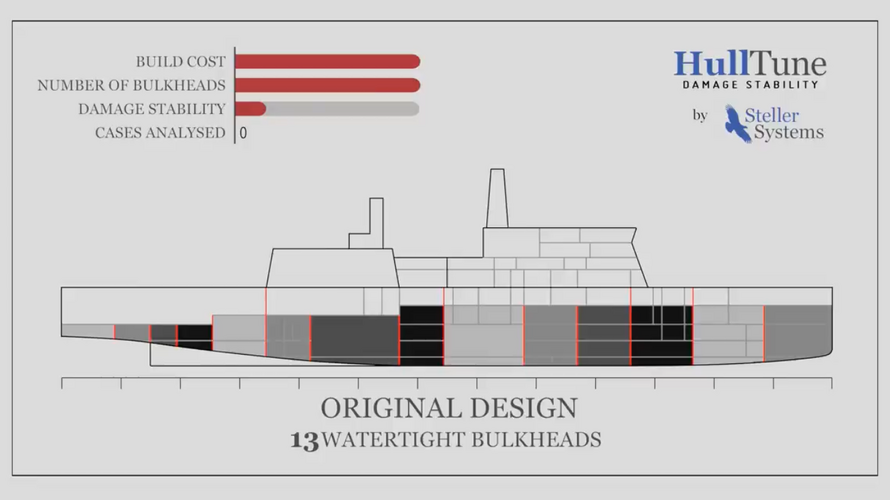
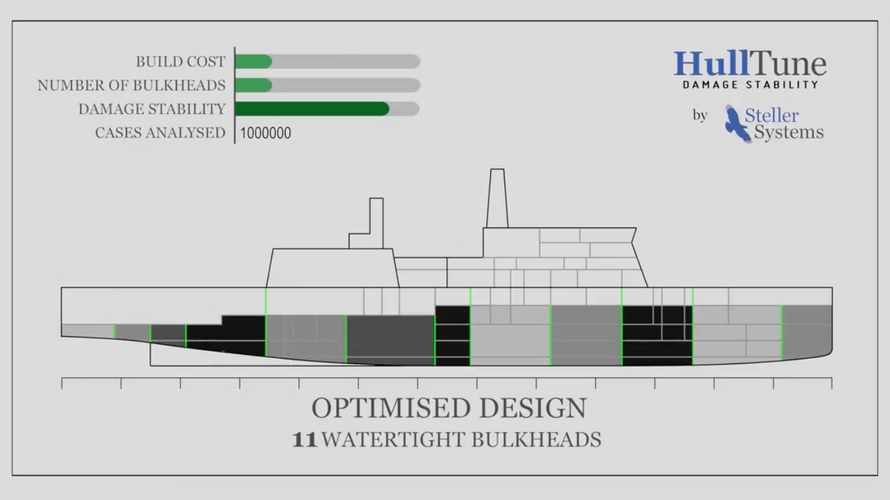
Suddenly, the Fearless concept starts to make sense. Steller Systems is really trying to sell their Hulltune software to the industry. Getting 30 knots on 32MW with a rather beamy 15,500 tonne hull is quite impressive. https://ukdj.imgix.net/2024/05/Render-9-Ortho-Top.png

Take away some of the excessive superstructure, which is no doubt devoted to accomodations, add more VLS cells, and this would be an impressive base for the Type 83 “destroyer.” Before anyone complains about the excessive size, someone has estimated that the most recent BAE concept scales out to 180 meters long!

In the end, I do think this is more about the software than the ship concept. The clever hull form is to be commended, though.
 

Attachments

  • IMG_1088.png
    IMG_1088.png
    221.1 KB · Views: 128
  • IMG_1087.png
    IMG_1087.png
    211 KB · Views: 127
Last edited:
Requirements are revealed.

https://www.navylookout.com/royal-navy-outlines-multi-role-support-ship-requirements/
What is immediately obvious is that the stated timeline for the programme is extremely tight. If the Bay class are not extended in service, then the MRSS first-of-class needs to enter service in 2031. Essentially this would mean there are about 4 years to develop the design and about 3 years to build the first ship.

MRSS will operate worldwide and be persistently deployed as part of Littoral Response Groups (LRG). They may be aggregated to form a larger Littoral Strike Group (LSG) or to be combined with a Carrier Strike Group (CSG) to form an Expeditionary Strike Force. Importantly the RN says the ship must have sufficient self-defence capability to operate independently in a medium-threat environment, although they would be protected by other assets in high-threat areas. The dividing line between threat levels is increasingly blurred and raised as non-state actors and sub-peer adversaries are now able to develop or obtain much more potent weapons. It is plain that the threats to surface ships are evolving fast, particularly in the littorals and survival will demand much-improved combat capability over existing RN amphibious ships.

The key role of MRSS will be to host, launch and recover Commando Force (and special forces) personnel, surface, aviation, vehicles and equipment for full-scale Littoral Strike amphibious operations. Just what this looks like is still somewhat sketchy although can be found outlined in the Commando Force operating model. The ships will also need to be able to sustain forces once they are ashore with logistic support.

MRSS will be an afloat command platform with the C3 facilities able to host staff up to the size of a NATO two-star headquarters. It will also provide a maritime-deployed hospital care facility to replace the PCRS capabilities of RFA Argus. This will be Role 2 Enhanced medical capability and when aggregated with another MRSS to form the LSG, this will be a Role 3 medical capability. (In simple terms, R2E provides advanced medical support including urgent surgery, basic inpatient care, and resuscitative care. R3 provides comprehensive medical support including extensive surgery and prolonged inpatient care.)

As an important caveat, the RN does not expect the C3 and medical capabilities to be carried on the ship concurrently and MRSS will designed to be modular so medical facilities can be swapped out for command facilities. This will most likely be achieved through PODS / containerised solutions inserted into a large internal deck area with a digital backbone, appropriate space, weight and power available. Loosely described as “a Type 26 frigate mission bay on steroids”, vehicle decks or other spaces will also be needed to host expeditionary off-board autonomous systems. These systems will also need facilities for launching, recovery and storage which implies a flight deck, hangar and possibly a well deck.
 
And that was before Labour came to power. Things are only going to get even worse, given things like the supposed 'Defence Review' and the new Chancellor of the Exchequer Reeves' £7.3 Billion pound sterling 'Green Gamble' plan (which said impending disaster is certain to cost a lot more when all is said and done).
Defense reviews invariably involve cuts, and quite frankly, there are enough problematic programs to cut. FSS is the most obvious candidate, as 2 of the 3 ships meant to be replaced were offloaded to Egypt and the Fort Victoria apparently couldn’t be manned by the RFA. Realistically, the RN needs a single FSS, preferably foreign built and with low manning requirements. Shipbuilding in Belfast is a hopeless fantasy. MRSS is looking like an expensive and ill defined requirement. The Bay class should be replaced by something cheaper and foreign built, with the Korean designed Makassar LPDs coming to mind. Perhaps it would be wiser to buy the Dutch JSS to replace the 2 LPDs and Fort Victoria, build the trio in Eastern Europe and fit them out in the UK, while at the same time ordering 4 to 6 Makassar class from Indonesia or South Korean.
 
And that was before Labour came to power. Things are only going to get even worse, given things like the supposed 'Defence Review' and the new Chancellor of the Exchequer Reeves' £7.3 Billion pound sterling 'Green Gamble' plan (which said impending disaster is certain to cost a lot more when all is said and done).
Given the current state of the British economy is in part because major global supplier of oil and gas started a war and had to be sanctioned, I think it would be a good idea to ween Britain off it, especially since few of the other global suppliers of those commodities seem particularly stable.

Last time Labour was in power they were responsible for beginning work on CVF, Type 45, Type 26 and Astute, whereas the previous Conservative Government was responsible for Type 31 (at the cost of the general-purpose Type 26s, so it's not like they've done any real force expansion).
 
Last edited:
Given the current state of the British economy is in part because major global supplier of oil and gas started a war and had to be sanctioned, I think it would be a good idea to ween Britain off it, especially since few of the other global suppliers of those commodities seems particularly stable.

Last time Labour was in power they were responsible for beginning work on and ins one cases ordering CVF, Type 45, Type 26 and Astute, whereas the previous Conservative Government was responsible for Type 31 (at the cost of the general-purpose Type 26s, so it's not like they've done any real force expansion).

The global supplies of lithium and rare earth elements are far more centralized than fossil fuels. It seems that the entire zero-emissions battery-electric/solar future is in the hands of China. Does this option offer greater energy independence than dealing with OPEC?

I should also point out that Type 45 and Astute programs took a very long time to be rectified, the CVFs are white elephants and it’s too soon to know what problems the Type 26 will face. What I do know is that the diesel powered Type 31s only became politically possible with Rolls Royce’s purchase of MTU, and buying a proven foreign design only came about because the Type 45s were disastrously unreliable before PIP.
 
The global supplies of lithium and rare earth elements are far more centralized than fossil fuels. It seems that the entire zero-emissions battery-electric/solar future is in the hands of China. Does this option offer greater energy independence than dealing with OPEC?

There's a significant source of lithium within the UK. We'll need emissions reduction regardless, and regardless whether the solar panels etc are built in China, they donat least have a significantly longer lifespan without needing to be replaced than stocks of oil.

I should also point out that Type 45 and Astute programs took a very long time to be rectified, the CVFs are white elephants and it’s too soon to know what problems the Type 26 will face.

The CVFs are hardly White Elephants, they are and will be a useful means of projecting power. Most of the problems faced by these programs have come as a result of the changes in procurement, and the very deliberate reduction in state capacity, I expect we will increasingly see a reversion back to in-house development over the coming years and decades, as financial resources allow, the complete failure of the post-1980s way of doing things is increasingly apparent to all.

What I do know is that the diesel powered Type 31s only became politically possible with Rolls Royce’s purchase of MTU, and buying a proven foreign design only came about because the Type 45s were disastrously unreliable before PIP.

Type 31s seem to be a procurement mistake, the Type 21s of the 21st century, with limited margins for future growth. IEP for the Type 45s was a technical risk, with some problems, but that gives them a degree of future-proofing that most ships in the Royal Navy currently lack, aside from CVF.
 
I hope they decide go two type see they go for 2 (or prefer 3) Fearless Class and 4 (or prefer 6) Elillda Class MRSS

Fearless for Med threat also for commando float base Littoral Response Groups (LRG) small float ramp to lunch stealth fast beach assault with heavy navy support gun/missiles.

Ellida for Low threat - also more flexible in peacetime the idea for swapping depend mission or permitting this class can operation as 1) mothership of Mine sweeper & layer / 2) Hospital / 3) UAV + Helicopter Carrier / 4) Retanker & Transport Ship / 5) Ampbilous Assualt - Low Threat Launch Tank transport sea big that fearless float ramp after clear beach. possible they can missiles launch using shipping containers as VLS? as cost saving. or use MRLS / MBDA iLauncher to fire Missiles on ship
 
I should also point out that Type 45 and Astute programs took a very long time to be rectified, the CVFs are white elephants and it’s too soon to know what problems the Type 26 will face. What I do know is that the diesel powered Type 31s only became politically possible with Rolls Royce’s purchase of MTU, and buying a proven foreign design only came about because the Type 45s were disastrously unreliable before PIP.
That sounds like incompetent engineers to me, not politicians. They just say what the policy is and release the funds, ultimately the armed forces write the requirements and industry actually designs and builds the stuff.
Likewise if RR's shareholders want to get fat off MTU profits who is the government to complain?

If British industry can't deliver than maybe we should buy from South Korea.
 
Importantly the RN says the ship must have sufficient self-defence capability to operate independently in a medium-threat environment, although they would be protected by other assets in high-threat areas. The dividing line between threat levels is increasingly blurred and raised as non-state actors and sub-peer adversaries are now able to develop or obtain much more potent weapons. It is plain that the threats to surface ships are evolving fast, particularly in the littorals and survival will demand much-improved combat capability over existing RN amphibious ships.

Keeping that in mind, how might the various proposals compare? What has been proposed so far are shots in the dark without a visible target but now that target's visible. I expect some substantial evolution to happen.

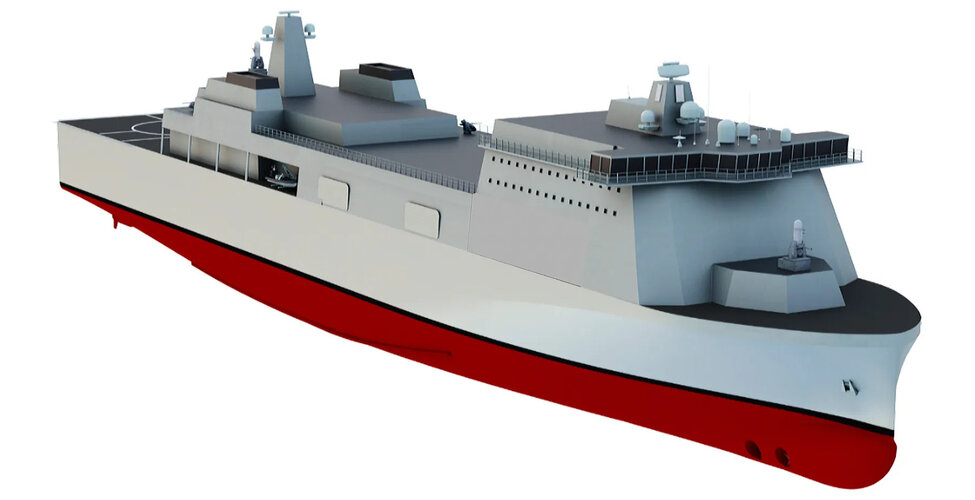
BMT's ELLIDA is arguably the most mature in terms of development but renders show a couple of CIWS and zero offensive armament. Likewise BAE's and neither design in their present form seem to have much facility for more to be added without a major redesign. In contrast Steller's is bristling with a variety of weapons. Maybe it even has a French Taunter.
 

Attachments

  • GOItiWzW4AA7UhQ.jpg
    GOItiWzW4AA7UhQ.jpg
    407 KB · Views: 199
  • BAE-MRSS-concept.jpg
    BAE-MRSS-concept.jpg
    141.8 KB · Views: 188
  • Ellida-2-Concept-1536x738.jpg
    Ellida-2-Concept-1536x738.jpg
    287.2 KB · Views: 232
Right. What are we considering a medium-threat environment, though?

I'm calling the Red Sea medium threat right now, with low threat being the various pirate-infested areas of the world. And high threat being near-peer warfare.

What are you calling medium threat? More importantly, what is the UK calling medium threat?

I agree. I'd add the harassment and intimidation that Iran has carried out as medium threat - brinksmanship, not outright war.

Steller's may be a bit overgunned, since it looks like it has a 5" forward, Bushmaster and CIWS amidships, and what I'm assuming is an OTO 76mm on top of the hangar. In addition, it's got a VLS of some type forward, which I am assuming is a CAMM "mushroom farm."

I think I'd drop the bow gun to another OTO 76mm. No sense in having both 5" and 76mm.

I'd rather give the CIWS wider arcs, so I'd want to swap the locations of the Bushmaster and CIWS. Can make a small deck extension/sponson to allow the Bushmaster wider arcs even if it is down on the main deck. And I might want 4x Bushmasters, honestly. One below each corner of the flight deck and the other two roughly amidships.

My concern is how capable CAMM is against AShBMs, even the low end ones that the Houthis are getting.

(edit) The other designs are inadequately protected for the Red Sea without escorts.

Generally agree, especially regarding the Bushmasters, though maybe the bow gun is considered necessary as offshore artillery support for commando groups when things get messy.

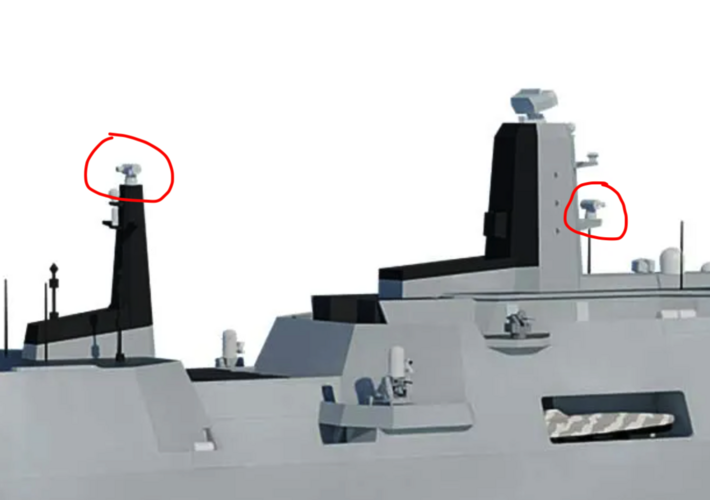
It appears to have a Dragonfire director on each mast too. They would be for drones and at least low end AShBMs.
Screenshot 2024-07-22 at 5.39.23 PM.png
 
Last edited:
Don't Bushmaster and KCB at least use the same ammunition?
They do. KCB entered service well before Bushmaster though, and will be retired in due course.

Mk41 gives you access to the American weapons. Specifically Tomahawk, and whatever other land attack missiles the USN cooks up.

US weapons are no use for the UK. We don't use US SAM's, and never will, Tomahawk is not used on surface ships by the UK and never will be with FCASW arriving c2028/2030. The only other operational missile is VL-ASROC which is old, short ranged and fitted with a inferior torpedo.

Excluding the Japanese Type 07 that was not for export there are zero non-US weapons integrated with Mk.41 after 40 years of service...for the UK its utterly pointless. Koreans have even gone and developed their own VL system to integrate their own missiles...
 
Good eyes on the Dragonfires!

The reason I'm comfortable with dropping a 5" for the OTO 76mm is the range on the Vulcano shells: 40km.

Going with the OTOBreda 127mm/64 and Vulcano rounds would give a 120km range, of course.

======

Though I guess I do have another question about that design: Why does it have at least one OTO 76mm Supraponte, which weighs just as much as a Phalanx CIWS system, in addition to a pair of Phalanx guns? Why didn't they put more Supraponte where the Phalanx guns are?

US weapons are no use for the UK. We don't use US SAM's, and never will, Tomahawk is not used on surface ships by the UK and never will be with FCASW arriving c2028/2030. The only other operational missile is VL-ASROC which is old, short ranged and fitted with a inferior torpedo.

Excluding the Japanese Type 07 that was not for export there are zero non-US weapons integrated with Mk.41 after 40 years of service...for the UK its utterly pointless. Koreans have even gone and developed their own VL system to integrate their own missiles...
Then why the HELL has RN specified Mk41 launchers in their new ships?!?
 
The reason I'm comfortable with dropping a 5" for the OTO 76mm is the range on the Vulcano shells: 40km.

Going with the OTOBreda 127mm/64 and Vulcano rounds would give a 120km range, of course.

======

Though I guess I do have another question about that design: Why does it have at least one OTO 76mm Supraponte, which weighs just as much as a Phalanx CIWS system, in addition to a pair of Phalanx guns? Why didn't they put more Supraponte where the Phalanx guns are?

Well, this might be ironed out if Steller gets the job and they start to take account of the mix and match they can do depending on the mission. A requirement for interoperability with systems commonly used by allies, which also has driven the Challenger 3 MBT design, would support you. Starmer's government has signalled that it wants to further collaboration with European forces, so standardisation with allies looks like a good course. I'm all for as much standardisation with allies as possible even if in individual cases might not be ideal, because in the real world there's going to be a lot of begging, borrowing, and trading when supplies run low.
 
Last edited:
Alas, Steller Systems has appointed liquidators. I'd have liked to have seen HMS Fearless and her sister ships, Reckless, Indifferent, Lackadaisical, Overenthusiastic, and Pyschotic.

https://m.facebook.com/MiddletonLaw...d-marine-engineering-firm-h/1004610005013764/
My personal opinion was that the Steller Systems MRSS concept would have been the best fit (well it was the best-looking...) for emerging requirements of the MRSS proposals we've seen so far, though to be fair, the requirement to have significant defensive and offensive weapons systems or to deploy drones was not written into the briefs for those proposals. BAE Systems now seems to be responding.

WatcherZero pointed this out:

https://www.secretprojects.co.uk/threads/stealth-landing-craft.27799/post-726628
The LSC design includes unconventional hull and superstructure shapes, reflecting the emphasis on stealth, speed, range, and seakeeping. This emphasis enables LSC’s ‘mothership’ to operate beyond A2/AD reach, with LSC then deploying towards and through that threat and on to the littoral region and shoreline.

The second half of the video covers a BAE Systems concept for an amphibious warship concept with an integrated welldeck and flightdeck. The 'mothership' in the article appears to be intended to stay further from shore than the Stellar Systems Fearless design, with these new landing craft taking on more offensive as well as logistic roles.

Q: Are you pitching this to the Royal Navy for MRSS?
A: It's a conversation that's ongoing...
 
Last edited:
New article looking at proposed landing craft etc.

https://www.navylookout.com/future-littoral-strike-enablers-being-developed-for-the-royal-navy/
At first glance, the [Littoral Operations Ship] has the appearance of a typical LPD but incorporates much greater flexibility and is able to change roles more quickly than legacy amphibious platforms. This is primarily achieved through spaces that can easily be reconfigured to accept different equipment. This could include command facilities, medical space or additional storage for PODS/containerised payloads.

The
[Littoral Strike Craft] is an LCVP replacement but is not seen as a ‘landing craft’ but a multirole vessel. With a length of up to 20m and between 30-50 tonnes displacement it can transport troops and/or vehicles and act as a weapons or ISR platform. It is designed from the outset to have the option to be used without a crew for some missions but more likely to be lean-crewed, frequently operating in pairs for mutual support.
 

Similar threads

Back
Top Bottom