There is an ongoing confusion over the model designations of US-built or US-marketed Fokker types. And with reason, too, since the commercial designations did not always match the inhouse numbers. Sometimes they echoed the Dutch system, sometimes they broke away from it.
[EDIT: I have removed the list and replaced it with a more accurate one in the next post]
NOTES:
General Aviation designations begin with AF-14, although the AF- aircraft sometimes appear as "Fokkers" in many documents.
U.S. Fokker designations normally used the Arab figures (1, 2, 3, 4...), contrary to the Dutch ones which used Roman figures (I, II, III, IV...).
The captions of the San Diego Air & Space Museum photo gallery contains mistakes over the Model numbers of the C-2 and LB-2, which they erroneously give both as "Model 2", which they are NOT.
Only the 1926 XHB-2 heavy bomber project does not seem to have received a Model designation.
Non-Fokker General Aviation designations started in GA- instead of AF-.
Somehow there were no GA-1 to GA-14 designations. Was that due to reflect the existence of the Fokker designs? Probably not, because General Aviation had at one point both an AF-15 and a GA-15 in its line of products. The unused numbers 1 to 14 might therefore have been assigned for record purposes to Berliner-Joyce models, as this company's assets became North American.
The GA-15 was the North American XO-47 for USAAC. The North American T-6 family's ancestor, the NA-16, followed, and from then onwards, all North American designs carried the NA- prefix.
The GA-43 was developed from the previous Fairchild Pilgrim design series and was in fact also known as the Pilgrim 150 at some point. Being designed by Clark, it sometimes also appears as the Clark GA-43. It apparently used a Fairchild number (Fairchild had Models 41, 42, 45 and 46, the latter being also a Clark design sometimes found as the GA-46).
After completing reviewing and updating my Fokker list of U.S. models and construction numbers (a project that has been going on for over 30 years now!), I realize that I made some mistakes, the biggest of which being to decide that the construction numbers series (400+, 600+, 700+, etc.) automatically determined corresponding model numbers (4, 6, 7, etc.) And because it is a well-known fact that you always see whatever you want to see, I concluded that there was a factory model number system that was different from Anthony Fokker's own (leading to series 900+ being what I called the "Model 9" and the Fokker F-11). Well... none of that nonsense anymore. I've decided to come clean in this matter and erase my previous assertions (which appear in Google searches and may mislead other researchers).
So what we know for sure is the following:
The Atlantic Aircraft Corp. only lasted a year and a half (March 1924-Sept.1925). Only four models are associated to it, apparently designated Models 1 to 4.
Once the Fokker Aircraft Corp. took over, most models got an F- designation followed by a number in Arabic figures (not Roman like the Dutch designations): F-7, F-9, F-10, etc.
The American F- series designations didn't necessarily have a Dutch F- series equivalent., and the same number could exist in both without necessarily corresponding to the same aircraft (F-XXXII was the American F-12, at least on paper, although it was marketed as the F-32).
When the Fokker Aircraft Corp. became the Fokker Corp. of America in 1927, nothing apparently changed.
Some American models used Americanized versions of the Dutch model numbers (S-3, C-4, B-3, F-7) and a couple of designations used the H- prefix (H-51, H-54), which indicated a Fokker-Hall design (at least for H-51).
When General Aviation (a division of General Motors) took over in 1929, the aircraft still in production and the new projects were redesignated with the AF- prefix (AF-10A, AF-32, AF-15, etc.) It is also around that time that construction number ceased to begin at 000, but at 001 instead.
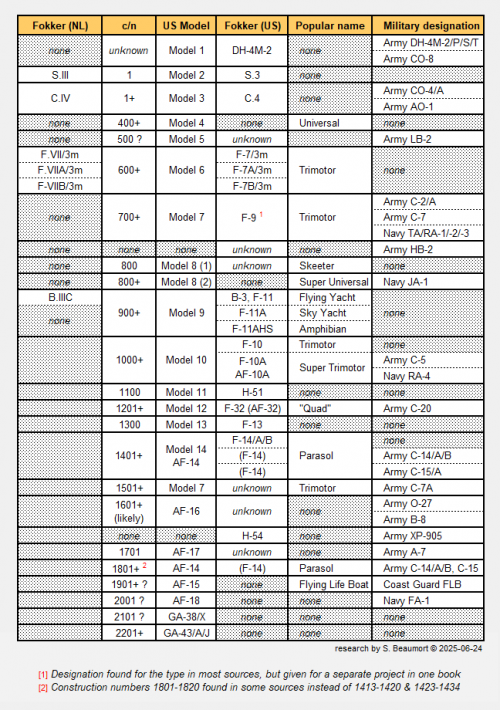
Here is a correspondence chart I made of the most accurate data so far.
As you'll see, I've added a question mark whenever there is guesswork on my part:
An unexpected twist: the very serious and highly documented website Fokker History (https://www.fokker-history.com/) features a list of the American models that looks EXACTLY like the version I removed from the previous post! (https://www.fokker-history.com/en-gb/fokker-in-de-usa) Does it mean that I was right after all, and that the construction numbers indicate an American model numbering system? Possibly... Except that I wonder if the author of the page may simply have found my list here at some point in the past and taken it for granted (in which case it would be just another case of wrong information being repeated from site to site). A lot of the info about U.S. Fokkers on that site is very well researched and detailed, even adding to (or at times contradicting) data found in authoritative books such as Fokker's own Fokker Commercial Aircraft. What makes me doubt is that 1°) there is no contemporary mention of those model designations in the press; 2°) there is no mention of ANY of those model designations in the Fokker photo archives; 3°) the site's list really looks a lot like the one I did here. So now I'm thinking of contacting the site's webmaster and asking him where he got the list from and if there are any contemporary documents to purport its validity...
Not included because it's not a Fokker-related project.
I suppose I should do a separate post for all GA- designations that have no Fokker connection.
(and if you wonder why the Clark-designed GA-43 is included in my chart, it's because of the 2201+ construction numbers which made it part of the Fokker sequence.
Known General Aviation Manufacturing Corp. designations (but non-Fokker-related) are as follows:
GA-15 Army Air Corps observation prototype XO-47 (c/n GA-15-1)
GA-37 High-speed mail carrier aircraft project
GA-43 Clark-designed former American/Fairchild X-150 (Pilgrim 150) prototype, acquired by General Aviation and redesignated. Included in the Fokker designation recap because of its 2201+ c/n numbers.
GA-46 Clark-designed low-wing aircraft of Duramold construction (became Fairchild 46)
GA-50 Mentioned as being related to Fairchild, possibly another Clark design, but no details.
If anyone knows more about the GA-50, or can add other GA- designations I failed to mention, please let me know. Some sources give the Fokker Flying Life Boat as the "GA-15", but that is not consistent with the company documents, which refer to it as the General Aviation AF-15 (or AF-XV). The only GA-15 was the XO-47. Moreover, the NA-16, next project in the Dundalk factory, was always a North American product and never called General Aviation (and was "NA-16" from the beginning).
NOTE 1: I'm beginning to wonder if the GA- prefix found in some of the Cunningham-Hall models may have originated in a possible General Aviation connection at some point, although I haven't found any yet. These include GA-21/M, GA-31, GA-36 (though this was post-General Aviation and merely indicated a 1936 release), GA-50 and GA-60. Of course it's only a hypothesis.
NOTE 2: not to be mistaken for General Aviation designations are the G & A Aircraft (formerly Pitcairn) designations, which are much later anyway (GA-45 to GA-50).
Known General Aviation Manufacturing Corp. designations (but non-Fokker-related) are as follows:
GA-15 Army Air Corps observation prototype XO-47 (c/n GA-15-1)
GA-37 High-speed mail carrier aircraft project
GA-43 Clark-designed former American/Fairchild X-150 (Pilgrim 150) prototype, acquired by General Aviation and redesignated. Included in the Fokker designation recap because of its 2201+ c/n numbers.
GA-46 Clark-designed low-wing aircraft of Duramold construction (became Fairchild 46)
GA-50 Mentioned as being related to Fairchild, possibly another Clark design, but no details.
I think those numbers are not random,and as Stargazer mentioned,that's
only we know from its series,for example,may there are GA-16 to GA-36,
and go on ?.
I think that if GA-15 (the XO-47) was allocated as a new, low GA- number, although AF-15 already existed, there must have been a good reason for this. According to my research, North American Aviation existed as a company years before the first North American aircraft came about. As early as 1930, NAA acquired the Berliner-Joyce Aircraft Corp. and merged it with the General Aviation Corp. to found its B/J Aircraft Corp. division in Dundalk, MD. The B/J Aircraft Corp. was then dissolved by NAA in 1933. The first North American product (the NA-16) appeared in 1934. My hunch is that the GA-15 and NA-16 followed up on Berliner-Joyce and B/J's own models, which must have amounted to 14 designs. Here is what I found:
Berliner Aircraft
1926: Berliner Aircraft Co., Inc., established at Alexandria, VA (fdr/pres: H. A. Berliner) > Some aircraft manufactured at Hoover Field, DC > 1927: Berliner and other investors purchase Hoover Field, DC; Berliner establishes Potomac Flying Service, which he intends to equip with airplanes built in his own factory > College Park, MD
Previous Berliner models were built before the Berliner Aircraft Co. was founded in 1926.
SCM-2 (1927) — Designed by H. A. Berliner and E. P. Warner and destined to be the "leading plane" of Berliner's Potomac Flying Service, it was a four-passenger monoplane resulting from a collaboration with the Assistant Secretary of the Navy for Aeronautics. It appears in civil register as both a Berliner and a Berliner-Joyce type. One built, registered either 242 or 2142 depending on sources, and is listed as c/n 2.
CM-3 (1928) — This was an open-cockpit high-wing monoplane with a 100hp Curtiss OXX-2 engine, likely a prototype for the CM-4 series. It was registered 4350, and is also listed as c/n 2, so it's either a typo or a re-registration (as was common in the early days).
CM-4 Parasol = Monoplane (1928) — This was a three-seat open-cockpit high-wing monoplane with a 90hp Curtiss OX-5 engine. Designed by H. A. Berliner, it was the first parasol design to earn an Approved Type Certificate (ATC 39). Known construction numbers are 3-6, 8-18 and 24.
CM-5 Parasol (1928) — A variant of the CM-4 with a 200hp Wright J-5 engine. Only one existed, registered 7199 (c/n 7).
CM-5W Parasol = Monoplane (1928) — A variant of the CM-4 with 220hp Wright J-5 engine. Both its registration 4000 and the c/n 1 suggest this may have been built as an early CM- series prototype then registered after modification to CM-5W.
CM-6 Dragon (1929) — A three-seat monoplane with a 110hp Warner Scarab engine. Tested by N.A.C.A., it was the first commercial airplane fitted with a N.A.C.A. integral cowling. As it does not appear in the civil register as such, one possibility is that it became the CM-4B.
Baby Dragon (1929) — An unspecified derivative announced in advertisements but likely not built or finished. (NOTE: the dragon was the emblem of the Berliner company).
Berliner-Joyce Aircraft - B/J Aircraft
1929: Berliner-Joyce Aircraft Corp., incorporated at Baltimore, MD; takes over entire assets of Berliner Aircraft Co.; starts work on new designs on Navy and Army contracts (pres: Major Temple Nash Joyce, a former Air Service pilot, previously with Chance Vought; vice-pres: H. A. Berliner)
CM-4B Parasol (1929) — A variant of Berliner CM-4 with a 110hp Warner Scarab engine. Registered 441 (c/n 20).
Model E (1929) — Prototype for the Model 29-1 with a LeBlond engine. Registered X618E (c/n 1).
29-1 "All-Vision" (1929 ) — A two-seat high-wing cabin monoplane with a 65hp LeBlond engine. Two built, one being registered as X247M (c/n A-1).
B/J Commercial (1930) — The same aircraft redesigned with a 113hp fove-cylinder Kinner engine, and a raised cockpit for improved pilot visibility. Registered as 618E and 247M (c/n 1, A-1).
Navy XOJ-1 (1931) — "U.S. Navy Two Seater Observation Airplane - Landplane and Seaplane (High Wing Design)", based on BuAer design No. 86, with a 400hp R-985-1 piston engine and full-span Zap flaps on both wings. Tried in both wheeled gear and seaplane configurations and later used for aerodynamic tests. One built, BuNo. A-8359.
Navy OJ-2 (1933) — Production variant of XOJ-1 with interchangeable floats or wheeled landing gear. 38 were built, receiving serials BuNo. 9187/9204, 9403/9411, and 9572/9583. The U.S. Army Air Corps also led some performance tests on an OJ-2 in 1934.
Navy XOJ-3 (1934) — Variant with single a .30 gun in the top wing; converted from an OJ-2 (BuNo. A-9196) and later reverted to it.
NAA Basic Trainer (1930) — No data. Registered 13934, possibly the former OJ-2 entered in a USAAC competition after returning to NAA.
Army XP-16 (1930) — A single-seat, open-cockpit prototype pursuit biplane (A.C. 29-326), with a supercharged Curtiss SV-1570A and a V-1570C (V-1570-25) engine, a gull top wing and a two-blade propeller (later tested with three-blade propeller).
TP-2 (Army Y1P-16 > P-16 > PB-1) (1932) — The production version of the XP-16, with a non-supercharged 600hp Curtiss V-1570 engine and a three-blade propeller. 25 were built (A.C. 31-502/515, -597, 32-221/230), with 32-229 used for various cowl and fastener tests, and 32-222 tested with a GIV-1570 engine and without silencer.
P-85 (nd) — Very similar to the P-16 except for a 575hp Curtiss Cyclone engine. Possibly an export demonstrator.
CM-9 (1931) — Small single-seat twin-boom flying boat with pusher propeller, registered 10595.
Navy XFJ-1 (1930) — A single-seat, open-cockpit prototype naval fighter biplane with a 450hp P&W R-1340C engine, built to Bureau of Aeronautics Design No 96 (BuNo. A-8288).
Navy XFJ-2 (1931) — Same aircraft rebuilt with a cowled 500hp P&W R-1340-92 engine and additional wheel pants. It was judged unstable and rejected.
Navy XF2J-1 (1934) — A two-seat, partly-enclosed cockpit prototype fighter biplane with a 625hp Wright XR-1510 engine (BuNo. A-8973).
Navy XF2J-2 (nd) — Variant found in mention, but no details (likely the same aircraft modified for tests).
Navy XF3J-1 (1935) — A single-seat, open-cockpit prototype fighter biplane with a 625hp Wright R-1510-26 engine (BuNo. 9224).
If we recapitulate the distinct models in the above lists, we DO have about 14 distinct designs...
This site uses cookies to help personalise content, tailor your experience and to keep you logged in if you register.
By continuing to use this site, you are consenting to our use of cookies.