Alternative new rifle cartridges

Just too much other stuff on my plate right now.

Got a Mk12SPR clone and a "Maxim-Lee Self-Loading Cavalry Carbine of 1894" in 6.5 Grendel to build first. Joke being with the Maxim-Lee that all the bits and pieces hoplophobes lose their minds about were invented and patented before 1900. Detachable Box Magazine was patented in 1877 by one James Paris Lee, and gas operation was patented in 1894 by one Hiram Maxim.
Now THAT is some niche comedy!
You American's get to have far too much fun.
 
Now THAT is some niche comedy!
You American's get to have far too much fun.
Wait till you meet a FB friend of mine. Dude has his kids working the 81mm mortar and a Maksim M1910 MG. And has a habit of trolling the Bureau of Alcohol Tobacco Firearms and Explosives.

He has open invites to shoot his full auto and cannons.
 
Wait till you meet a FB friend of mine. Dude has his kids working the 81mm mortar and a Maksim M1910 MG. And has a habit of trolling the Bureau of Alcohol Tobacco Firearms and Explosives.

He has open invites to shoot his full auto and cannons.
You'd better organise a SPF excursion!
 
If you want 4500+fps you need a case about the size of a 5.56. And that case to bore ratio is going to burn up barrels something fierce.
Or use the strategies involved with M855A1+ to use more aggressive reactants and bullet aerdynamics in small packages. Obviously they will not use a civilian round, which gives them a lot of flexibility. Modern science can make a sensible design over previous programs.
 

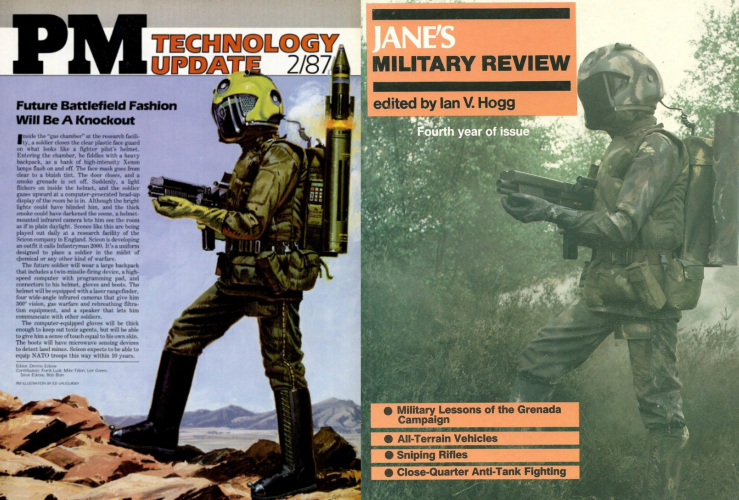
https://en.wikipedia.org/wiki/Infantryman_2000

1780856038443.png 1780856114418.png

Weapon

The weapon was intended as a 4.7mm caseless/10mm grenade launching rifle with an offset handle/scope. There are some reports two functioning prototypes were completed apart from the PR & ergonomic handling mockups.er

remember excitement when this debuted
 
Last edited:
Speaking of ammo, it seems confirmed that they're making 6.8x51mm versions of the Drone Round... uh, drone round. So add pseudo-shot to the capability bag, for whatever it's worth? The groupings seem surprisingly decent, though, and I guess that the larger version of the round might have larger and more effective fragments than the 5.56 version.

Weirdly, I could kinda see this mixing with the new CQB-ified M8 for anti-personnel work at short ranges on unarmored or lightly armored threats, although I'd defer to the professionals on the relative merits of what would I guess effectively be a 410-gauge auto-shotgun.
Drone Round has been developing specialized anti-drone ammunition for small arms since at least 2025. At the time of writing, the company offers two 5.56x45mm versions, the aforementioned L Variant and a K Variant. The L and K versions have projectiles designed to split into five and eight segments, respectively.

With their different loadings, the L and K Variants are effective out to around 328 and 164 feet (100 and 50 Meters), both of which are relatively short ranges, according to Drone Round. No special modifications are required to use the ammunition in existing guns, and the company says the rounds are “full-auto and suppressor capable.”
L and K Variants in 7.62x51mm have also been developed, but are still in testing. Work is underway on 6.8x51mm versions, which could be fired from the U.S. Army’s new M7 rifles, M8 carbines, and M250 light machine guns. Other calibers could be on the horizon, as well.
 

Rather than mortar this would be a good option to fire C-UAS munition.

Weapon

The weapon was intended as a 4.7mm caseless/10mm grenade launching rifle with an offset handle/scope. There are some reports two functioning prototypes were completed apart from the PR & ergonomic handling mockups.er

remember excitement when this debuted
As I've said gimme G11 (for magazine depth; short/medium range) or DMR with explosive rounds (long range).
 
The job infantry needs to do is suppress/pin other infantry so that other fires can hit them.

Effective small-calibre suppression is agreed to be one round within one metre of the target every three seconds. That's something that 7.62 and even 5.56 are quite capable of today, there's no need for chad maxxrounds that can penetrate neutronium if you're just trying to suppress.

The actual job of the infantry is to close with and destroy the enemy; the M7/8 makes that more difficult.
 
Speaking of ammo, it seems confirmed that they're making 6.8x51mm versions of the Drone Round... uh, drone round. So add pseudo-shot to the capability bag, for whatever it's worth? The groupings seem surprisingly decent, though, and I guess that the larger version of the round might have larger and more effective fragments than the 5.56 version.

Weirdly, I could kinda see this mixing with the new CQB-ified M8 for anti-personnel work at short ranges on unarmored or lightly armored threats, although I'd defer to the professionals on the relative merits of what would I guess effectively be a 410-gauge auto-shotgun.
I remain deeply unimpressed with their offerings in comparison to even traditional duplex. Notice (AIUI) they don't give pattern size at range, or the range on that pattern size.
 
One round within one meter of the target every three seconds out to the weapon's effective range.

As I understand it, effective range (particularly for suppression) is the overlap between potential accuracy and potential terminal effectiveness, i.e., "I think that they can hit me from here, and if they hit me it'll probably take me out." Both the big fancy scope and the big spicy round are intended to work from both angles to increase effective range.

As mentioned by whatismoo earlier, from WWI to this last weekend in Ukraine, small arms fire isn't doing most of the killing--explosives are doing most of the killing, whether they be hand grenades or FPV drones or long range fires. Assaulting a position using nothing but unsupported light infantry with rifles is a common enough Russian tactic in Ukraine, and guess how that tends to go?

In theory, good effective range on your suppression means you can stop assaulting/infiltrating infantry at a longer range, making it harder for them to get close enough to put grenades or shoulder-fired weapons on your position. And it means that when you're on the assault (although ideally your vehicles should be doing most of the heavy lifting), you can start suppressing the defenders before they suppress you, and hopefully get close enough for your own grenades or Carl Gustavs or whathaveyou.

The arguments that more ammo is better, and that you aren't likely to sense and engage infantry with rifles at farther than 300m anyway, might both be valid--but I don't think it's hard to understand the underlying theory.

 
Effective small-calibre suppression is agreed to be one round within one metre of the target every three seconds. That's something that 7.62 and even 5.56 are quite capable of today, there's no need for chad maxxrounds that can penetrate neutronium if you're just trying to suppress.

The actual job of the infantry is to close with and destroy the enemy; the M7/8 makes that more difficult.
Also they don't actually penetrate anything meaningfully better unless you have the tungsten ammo, which isn't being procured as standard.
 
Or use the strategies involved with M855A1+ to use more aggressive reactants and bullet aerdynamics in small packages. Obviously they will not use a civilian round, which gives them a lot of flexibility. Modern science can make a sensible design over previous programs.
I mean, 6.5CBJ, 5.7x28 and 4.6x30 all started as military only.

Your hotter reactants are going to burn up the barrels faster.


Yeah, I vaguely remember that. Interesting idea, but IMO the 10mm is way too small for a viable grenade.
 
One round within one meter of the target every three seconds out to the weapon's effective range.

As I understand it, effective range (particularly for suppression) is the overlap between potential accuracy and potential terminal effectiveness, i.e., "I think that they can hit me from here, and if they hit me it'll probably take me out." Both the big fancy scope and the big spicy round are intended to work from both angles to increase effective range.

As mentioned by whatismoo earlier, from WWI to this last weekend in Ukraine, small arms fire isn't doing most of the killing--explosives are doing most of the killing, whether they be hand grenades or FPV drones or long range fires. Assaulting a position using nothing but unsupported light infantry with rifles is a common enough Russian tactic in Ukraine, and guess how that tends to go?

In theory, good effective range on your suppression means you can stop assaulting/infiltrating infantry at a longer range, making it harder for them to get close enough to put grenades or shoulder-fired weapons on your position. And it means that when you're on the assault (although ideally your vehicles should be doing most of the heavy lifting), you can start suppressing the defenders before they suppress you, and hopefully get close enough for your own grenades or Carl Gustavs or whathaveyou.

The arguments that more ammo is better, and that you aren't likely to sense and engage infantry with rifles at farther than 300m anyway, might both be valid--but I don't think it's hard to understand the underlying theory.
The big bullet is basically a sham stemming from trying to solve the "threats" of Afghan PKMs at 800m and hypothetical Russian super body armor the dumbest way possible. That the British just went back to squad 7.62mm belt feds and it worked fine seems lost on the US Army. That we are planning to fight in basically everywhere but Afghanistan right now also seems lost on the Army.

It's basically forgetting every lesson that lead to the adoption of 5.56x45 which we learned in blood during WWII, Korea and Vietnam because hur dur beeg boolet shoot more gooder. Post 379, which you liked, runs the numbers and I don't see how it's anything other than damning. Assuming rifles are shooting 15 rpm each and SAWs shooting 50 rpm each the M7s run out of ammo in 11m40s and the M250s in 10 minutes, while a squad with M4s running typical combat loads (330R/1000S) would have 22 minutes and 20 minutes respectively. Of course ammo consumption in real combat is different, but it's really hard to argue that less ammo is better. Now that amount of 5.56 weighs 3kg more than the 6.8, but if you go to 210R/1000S there's still several minutes more endurance of fire, and even 210R/600S (the minimum basic load) has 14 minutes of rifle and 12 minutes of SAW, AND saves 16kg across the squad for, say, a 60mm commando mortar and 10 rounds or whatever.
 
It is refreshing to see a move away from cleaner, greener killing devices. Much of the previous two decades hss been counterproductive to actual weapon effects. Moving ahead with the M855A1 path certainly is progress.

Any improvement in bullet velocity is going to require an investment in accuracy. I have no problem with the pressures they are exploring. While M855A1+ is currently at over 80,000 psi, they should reconsider the bullet size to balance performance with wear. The gun industry can currently push 90,000 psi but it comes by dropping bullet diameters and a realization performance comes with a price. These high pressures shred barrels faster, but barrels are a wear item meant to be replaced with use. The bolt and mechanicals, however, you cannot afford to break in battle. The price of guns and their bullets will therefore increate. Rate of fire will suffer as pressures climb so accuracy depends on quality of aim. The flat shooting will get more quantity of bullets on target with greater bullet effects when used properly. But without increasing quality of aim, all of this is an exercise in futility.
855A1 isn't over 80ksi, it's like 62ksi.

I think I've really said my piece over the various posts in this thread and don't have much more too add other than there's a lot of foolishness thrown back and forth.

I would be interested in that Maxim-Lee carbine. If you ask me the answer is to run a gas piston on a Lee Navy action, but I don't know if that would work better than a Madsen 1896 or a Remington '08 or maybe a Browning-Lee .303 based on the Auto-5?
 
I would be interested in that Maxim-Lee carbine. If you ask me the answer is to run a gas piston on a Lee Navy action, but I don't know if that would work better than a Madsen 1896 or a Remington '08 or maybe a Browning-Lee .303 based on the Auto-5?
Oh, sorry, you're misunderstanding or I very poorly explained things. It's an AR in 6.5 Grendel (same power level as 6.5 Arisaka) traditional stock, wood handguards.
 
Jeez, the chemists really messed up the burn rate in the M855A1 if it's breaking parts like that. Way too much pressure at the gas port!

Needs a faster burn rate IIRC to reduce the pressure at the gas port.
 
There have been so many claims about different pressure levels of M855A1 because it has evolved. The numbers in my previous post were measured pressures. M855A1 is consistently claimed to be over 60,000 psi. The placard in your link understates it as 55,000 psi which is much closer to M855.
In the previous discussion about this your source already got debunked. And 82000 PSI is, to be blunt, fucking ridiculous.

That's OVER the pressure .277 Fury is running (80000 PSI), and it needs specialty cases to avoid blowing up the gun with each shot.

But Big Army has secretly been running that pressure in regular cases in the M4 without the case heads turning liquid? GTFO.
 
How many boxes could be ticked by reverting back to 20" barrels
More likely 18", but yeah.

Problem is the length limit, especially when the AR platform has that annoying buffer tube coming out the back. Stick a good suppressor, like the one used on the Mk12 SPR on there, and now you have a ~24" "barrel" with a 10" buffer tube out the back. And a roughly 8" long receiver.

Which is just a pain in the butt to deal with.

So the answer is something like the SIG MCX (or the AR-18!), without the buffer tube.
 
More likely 18", but yeah.

Problem is the length limit, especially when the AR platform has that annoying buffer tube coming out the back. Stick a good suppressor, like the one used on the Mk12 SPR on there, and now you have a ~24" "barrel" with a 10" buffer tube out the back. And a roughly 8" long receiver.

Which is just a pain in the butt to deal with.

So the answer is something like the SIG MCX (or the AR-18!), without the buffer tube.
Yes I am surprised there have been no(?) sintered titanium reflex suppressors marketed, the old AEM5 on a 14.5" is still quite short as you say.
Flash hiders have come a long way since the A2, I do wonder if giving every digger a suppressor is worth the extra weight.
 
Yes I am surprised there have been no(?) sintered titanium reflex suppressors marketed,
We're starting to see them civilian-side in the US. They're still really expensive, though.


Flash hiders have come a long way since the A2, I do wonder if giving every digger a suppressor is worth the extra weight.
It's about not blowing eardrums and reducing concussion when indoors. The US has run some events and found that grunts are a lot more functional while in an urban area with suppressors fitted.
 
In the previous discussion about this your source already got debunked. And 82000 PSI is, to be blunt, fucking ridiculous.
That's OVER the pressure .277 Fury is running (80000 PSI), and it needs specialty cases to avoid blowing up the gun with each shot.
But Big Army has secretly been running that pressure in regular cases in the M4 without the case heads turning liquid? GTFO.
Your statement is ridiculous. The Army seems to be pretty lukewarm to 6.8 x 51 mm now that the leadership pushing it retired and joined SIG. This new round was to get some people rich, not to fix anything. The solution pushed pressures and bullet weight to an edge case that wasn't already solved. Barrel life with M7 has already been poor. Not sure M7 will ever become mainstream beyond just another DMR as the weight is so high. XM8 is already being looked at to kill a mainstream M7 and its all about the rifle weight. M250 weight is a lot more reasonable, so it could work out well. But that means pushing out another supply chain to employ all this new kit. It is too early to call it a success.

The whole point of suggesting going smaller to something like .177 caliber (4.5 mm) was to avoid the weight problems associated with high pressure bullet systems. Burst fire, flat trajectory, low kick, and penetration. Insteading of tilting at windmills with a bigger round, go smaller. Increase penetration without losing total rounds carried. Try something novel like actually try to improve rifle total cost of ownership. Shift money to focus on improving aim rather than the size of bullets. And allow an attachment for a low velocity big bullet (.510 Beck) for edge cases where the penetration of the .177 is not working. Not everyone needs to carry every option. All this is unnecessary if they can make the M855A1+ work because it is a simpler solution to the penetration edge case.
 
Your statement is ridiculous. The Army seems to be pretty lukewarm to 6.8 x 51 mm now that the leadership pushing it retired and joined SIG. This new round was to get some people rich, not to fix anything. The solution pushed pressures and bullet weight to an edge case that wasn't already solved. Barrel life with M7 has already been poor. Not sure M7 will ever become mainstream beyond just another DMR as the weight is so high. XM8 is already being looked at to kill a mainstream M7 and its all about the rifle weight. M250 weight is a lot more reasonable, so it could work out well. But that means pushing out another supply chain to employ all this new kit. It is too early to call it a success.

The whole point of suggesting going smaller to something like .177 caliber (4.5 mm) was to avoid the weight problems associated with high pressure bullet systems. Burst fire, flat trajectory, low kick, and penetration. Insteading of tilting at windmills with a bigger round, go smaller. Increase penetration without losing total rounds carried. Try something novel like actually try to improve rifle total cost of ownership. Shift money to focus on improving aim rather than the size of bullets. And allow an attachment for a low velocity big bullet (.510 Beck) for edge cases where the penetration of the .177 is not working. Not everyone needs to carry every option. All this is unnecessary if they can make the M855A1+ work because it is a simpler solution to the penetration edge case.
While I flat out disagree that a .50 cal rifle would be of any use in counter-drone work, a Jeff Cooper 'thumper' may be a worthwhile idea, just a Westernised ShAK-12 issued sparingly.
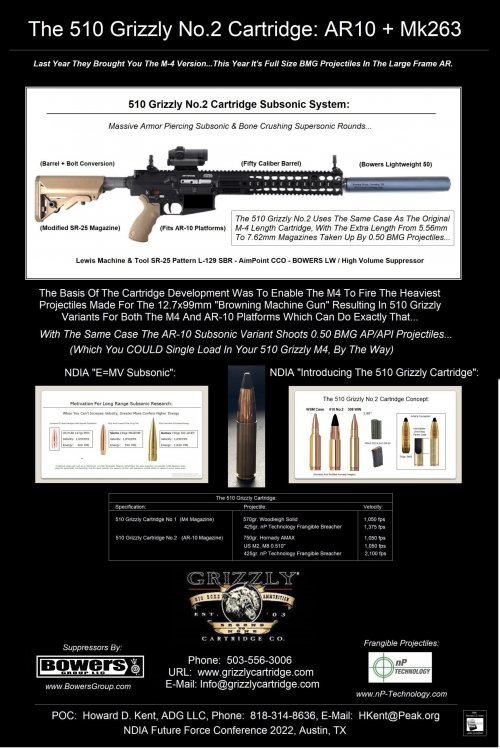
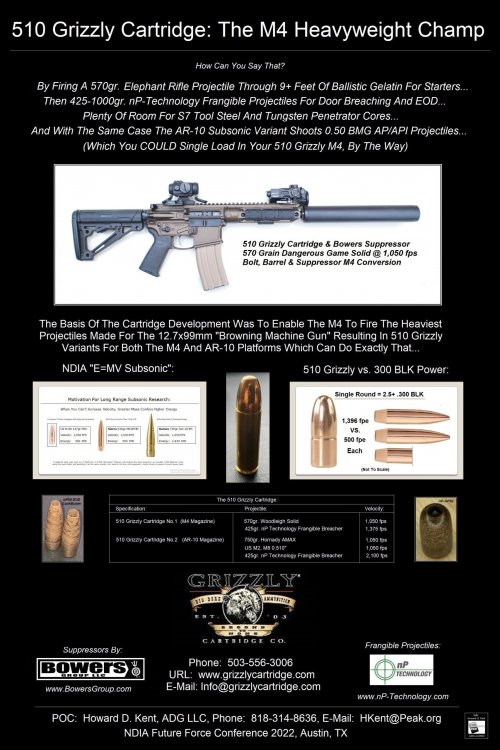
The .510 Grizzly has the interesting ability to be used in an AR-15 with shorter bullets, or in an AR-10 with .50BMG bullets.
 

Attachments

  • 510-grizzly-cartridge-with-bowers-ar10-scaled.jpg
    510-grizzly-cartridge-with-bowers-ar10-scaled.jpg
    488 KB · Views: 11
  • 24000-510-grizzly-cartridge-with-bowers-scaled.jpg
    24000-510-grizzly-cartridge-with-bowers-scaled.jpg
    488.3 KB · Views: 12
Your statement is ridiculous. The Army seems to be pretty lukewarm to 6.8 x 51 mm now that the leadership pushing it retired and joined SIG. This new round was to get some people rich, not to fix anything. The solution pushed pressures and bullet weight to an edge case that wasn't already solved. Barrel life with M7 has already been poor. Not sure M7 will ever become mainstream beyond just another DMR as the weight is so high. XM8 is already being looked at to kill a mainstream M7 and its all about the rifle weight. M250 weight is a lot more reasonable, so it could work out well. But that means pushing out another supply chain to employ all this new kit. It is too early to call it a success.

The whole point of suggesting going smaller to something like .177 caliber (4.5 mm) was to avoid the weight problems associated with high pressure bullet systems. Burst fire, flat trajectory, low kick, and penetration. Insteading of tilting at windmills with a bigger round, go smaller. Increase penetration without losing total rounds carried. Try something novel like actually try to improve rifle total cost of ownership. Shift money to focus on improving aim rather than the size of bullets. And allow an attachment for a low velocity big bullet (.510 Beck) for edge cases where the penetration of the .177 is not working. Not everyone needs to carry every option. All this is unnecessary if they can make the M855A1+ work because it is a simpler solution to the penetration edge case.
What are you even on right now?

You're answering a statement I did not make.

YOU are the one claiming ridiculous chamber pressures for the M855A1+, both on the post I quoted, and this one:
Too much is being asked of an old design. M855A1 jump from 67,000 psi to M855A1+ at over 80,000 psi was another big leap. I can see where they will need to manufacture different rifles for both.

A new gun will need to be designed and made for surviving another leap in the future. Also seems like progressive rifling will help solve barrel wear. The bolt endurance will be a liability.
To which I replied that that claim is ridiculous, because Big Army had to go to an entirely new kind of cartridge case just to make that kind of pressure work in the .277 Fury.

According to you, however, the Army is running case head liquifying presssures in M855A1+ all this time without the need for a boutique cartridge case.

I made NO statement about the usefullness of the M7 and it's associated round, but apparently that's all you can talk about all of a sudden.

I'd appreciate it if you could just answer the point I made, and not try to deflect things.
 
I'd appreciate it if you could just answer the point I made, and not try to deflect things.
It is pretty obvious, MihoshiK, that you are not reading the previous thread discussions. If the Army settles on a high pressure round for existing rifles (M855A1 or M855A1+) then there is no need to pivot towards 6.8 x 51 mm, or any other round. You are set that these pressures will liquify rifle parts, which is irrational. The M250 is the same cartridge as M7/XM8 in a light maching gun.
 
It is pretty obvious, MihoshiK, that you are not reading the previous thread discussions. If the Army settles on a high pressure round for existing rifles (M855A1 or M855A1+) then there is no need to pivot towards 6.8 x 51 mm, or any other round. You are set that these pressures will liquify rifle parts, which is irrational. The M250 is the same cartridge as M7/XM8 in a light maching gun.
SiG designed the M7 to withstand the extra pressure, M4s/M16s were designed around a much lower pressure.

You can run 5.56 pressure up as far as you want but eventually you will need to order a more robust rifle to withstand it - two-piece cases are not unique to .227 Fury.

Barrel wear will continue to be an issue, as will recoil etc.

https://shellshocktechnologies.com/technology/
 
Or use the strategies involved with M855A1+ to use more aggressive reactants and bullet aerdynamics in small packages. Obviously they will not use a civilian round, which gives them a lot of flexibility. Modern science can make a sensible design over previous programs.
I wish those were more available than they are now. Cha-ching. Wait. . ."+"?. . . Ho, ho want some of those. (But then are current barrels up to the task of 82ksi. . .)
 
I think Peak will succeed where others failed because it doesn't require upgrading the rifle like a blank slate cartridge. Troops can keep a generic backwards compatible M4, no weight penalty, and get a modest velocity boost.
 
… yeah, I’m sure running 80k PSI ammo through a legacy M4 receiver will introduce no problems whatsoever.
 
Steel cases, my dude.
… We already forget all the criticism about how 6.8x51mm runs at 60-80k PSI in order to get the required performance, and how it destroys barrels and receivers and risks bolt/chamber failures, and a big part of why the M7 is so heavy is because it had to be overbuilt specifically to fire high pressure rounds continuously? And additionally all the criticism laid at the M7 + 6.8mm combo about how high recoil the high pressure ammo is?
 
Federal has also licensed their Peak Alloy case technology to the Army for multiple calibers 50-cal and below.

Federal Signs Landmark Agreement with U.S. Army to Accelerate High-Performance Ammunition

May 27, 2026 - Federal Ammunition today announced it has executed an agreement that allows the United States Army to utilize its patented Peak Alloy ammunition case technology for use in multiple cartridges and weapon systems.

The new agreement specifies conditions necessary prior to granting Government Purpose Rights, such as the delivery of 40 million cases featuring the new technology.

Peak Alloy was first introduced in the commercial market in 2025 with the all new 7mm Backcountry. It is a high-strength, proprietary steel alloy casing that enables significantly higher chamber pressure — in excess of 80,000 PSI — than traditional brass for higher velocities in smaller, lighter, shorter-barreled rifles typically configured for suppressors. This case technology is also being evaluated by multiple allied European countries.

The agreement with the U.S. Army is inclusive of multiple chamberings including 50-cal and below.

“This is a historic agreement between the United States military and Federal Ammunition,” says Chairman and CEO Jason Vanderbrink. “As a 104-year-old American company, it further demonstrates our unwavering commitment to innovation. As the world’s most prominent manufacturer of small-caliber ammunition, I am particularly proud of the speed at which our team can develop a product with a purposeful application that improves the advanced systems our brave American warfighters use in the field of battle,” said Vanderbrink.
 
Back
Top Bottom