Alternative new rifle cartridges

You know what is cool about hypervelocity .177 caliber? The ability to resist the kick while moving while having immense penetration power. 5.56 mm was precise when braced on bipods and tripods, but not so much without Getting more rounds on target is driving the push for smaller higher velocity rounds than what is currently the mainstream rounds. A standing infantry can keep his barrel down in full automatic at 5.56 mm, but once you get up to 7.62 mm the barrel wants to rise. The infantry has to deploy the tripod and immobilize to lay effective precision fire. 5.56 mm was fine for suppression fire while moving, but not for precision while moving. If we can give moving infantry precision fire while moving that is a leap in capability. I believe you need more than a smaller caliber, which is why the computer is a must. But the secondary .510 caliber would come in handy when the .177 is not enough power to drop a target. In some cases the .177 might pass through targets without imparting much energy into what it hits. So when you do not see any effect you want Plan B.

I used to shoot large caliber muskets for fun. The 50s could poke through and in some cases actually split railroad ties. There is very little kick but the mass of the bullet obliterates what it hits. You may not penetrate a guy with heavy body armor. That guy hit by something over .50 caliber is going to be out of action for obvious reasons. They might even lose a whole limb.
 
Penetration power != incapacitation factor.

Doesn't matter how accurate that .177 is if it's not stopping the targets.
But the secondary .510 caliber would come in handy when the .177 is not enough power to drop a target. In some cases the .177 might pass through targets without imparting much energy into what it hits. So when you do not see any effect you want Plan B.
Plan B.
 
If ur MBR is that large clearing close potentially threating hide spaces like inside a basement window requires not ur MBR rds. A Flechett pistol/carbine suppresses or incapacitates anyone in there though you don't have los on tgt.
I do not know what you mean by "MBR" or why this is an improvement on hand grenades. As I mentioned previously the Ukrainians mention 4-6 hand grenades per person, while some units like Chosen Company bring satchels full of of extra hand grenades to close combat.
 
But 5.56 does the same thing without needing to carry two guns (even if they're welded together)! Or requiring very heavy 13mm ammunition! And if that doesn't work, hand grenades are great!

Everyone is trying to reinvent the wheel when we've known for almost 110 years that the best solution to close quarters battle is a great deal of hand grenades!
 
With all the drones flying around, maybe we should be looking at improved (longer range/higher accuracy) semi/fully-automatic shotgun rounds instead that can pull double duty in CQB. And bringing back the XM25 with guided anti-drone rounds as well.
 
With all the drones flying around, maybe we should be looking at improved (longer range/higher accuracy) semi/fully-automatic shotgun rounds instead that can pull double duty in CQB. And bringing back the XM25 with guided anti-drone rounds as well.
There's range limits with shotguns and they basically require tungsten buckshot to reliably hit drones, even then at best you can engage out to ~100m. Plus now you need the weight of a shotgun and the expense (just the tungsten projectiles are $2-$6.25 per shell).
 
I do not know what you mean by "MBR" or why this is an improvement on hand grenades. As I mentioned previously the Ukrainians mention 4-6 hand grenades per person, while some units like Chosen Company bring satchels full of of extra hand grenades to close combat.
A main battle rifle & hand grenades r simply too scarce to use on every space in complex environments where one put rd into to assure noone is waiting there for you to pass & then shoot you in the.
Even to Germans in WW 2 on their Eastern advance. officers reported that too many MG rds were being used on "possible' Russian ambush sites wo confirming an enemy presence. Recon by fire w small arns. In complex terrain like Vietnam, and Ukraine it is a window or door or room you just want something to preempt anything coming out if there & shooting you in the back. Waste all your grenades & large caliber rds on this & you have nothing left when a main battle breaks out. No unit can carry enough satchels full of grenades. Likewise, some close spaces r too close to pop a grenade w/o endangering you & your team.
 
People who never have thrown a hand grenade probably shouldn't talk about them.
 
If frangible bullet tech can be brought to flechettes then they could be considered non-maiming projectiles especially since impact would be from multiple projectiles simultaneously in the proposed wpn.
 
Everyone is trying to reinvent the wheel when we've known for almost 110 years that the best solution to close quarters battle is a great deal of hand grenades!
In the First World War, there was a backlash against this - British soldiers got so used to throwing grenades that they neglected the use of their rifles (to their detriment in defence) and use of the rifle had to be re-emphasized.
 
In the First World War, there was a backlash against this - British soldiers got so used to throwing grenades that they neglected the use of their rifles (to their detriment in defence) and use of the rifle had to be re-emphasized.
Yep! But this has been balanced in the ensuing ~115 years.
 
In the First World War, there was a backlash against this - British soldiers got so used to throwing grenades that they neglected the use of their rifles (to their detriment in defence) and use of the rifle had to be re-emphasized.
Getting used to throwing a hand grenade is a perilous journey.. it would be interesting to see the stats on mishaps related to the over use of grenades. Much of combat in WWI involved NLOS engagements in trenches. That is different operational focus than advancing in complex terrain.

Even the US Army had a separate Grenadier Branch w/ particular insignia while Europeans have had such...
 
A main battle rifle & hand grenades r simply too scarce to use on every space in complex environments where one put rd into to assure noone is waiting there for you to pass & then shoot you in the.
Even to Germans in WW 2 on their Eastern advance. officers reported that too many MG rds were being used on "possible' Russian ambush sites wo confirming an enemy presence. Recon by fire w small arns. In complex terrain like Vietnam, and Ukraine it is a window or door or room you just want something to preempt anything coming out if there & shooting you in the back. Waste all your grenades & large caliber rds on this & you have nothing left when a main battle breaks out. No unit can carry enough satchels full of grenades. Likewise, some close spaces r too close to pop a grenade w/o endangering you & your team.
Main Battle Rifle is not a term I've ever heard used, so you'll excuse me for not being familiar and not using it moving forwards. That said, rifle ammunition and hand grenades do not appear in any way scarce on the contemporary battlefield.

5.56 is not a large caliber round! And suppression isn't wasted ammunition! There's a reason a Ukrainian I was talking to the other day mentioned their unit SOP was >400 rounds of 5.56 (8x 30rd and 4x 40rd minimum) plus 6 grenades minimum. This seems absolutely to be enough to not run out of ammunition, especially given the availability of ground and air drones for resupply.

Also, if Ukraine is complex terrain so was the Nazi-Soviet war, which was fought in significant part in Ukraine!
 
Getting used to throwing a hand grenade is a perilous journey.. it would be interesting to see the stats on mishaps related to the over use of grenades. Much of combat in WWI involved NLOS engagements in trenches. That is different operational focus than advancing in complex terrain.

Even the US Army had a separate Grenadier Branch w/ particular insignia while Europeans have had such...
Training grenades are fairly common, and I've never heard much in the way of issues with grenades? There are occasional accounts of people being trained backwards, where they throw the grenade and then get up to bound forwards without waiting for the explosion (which is not clever).

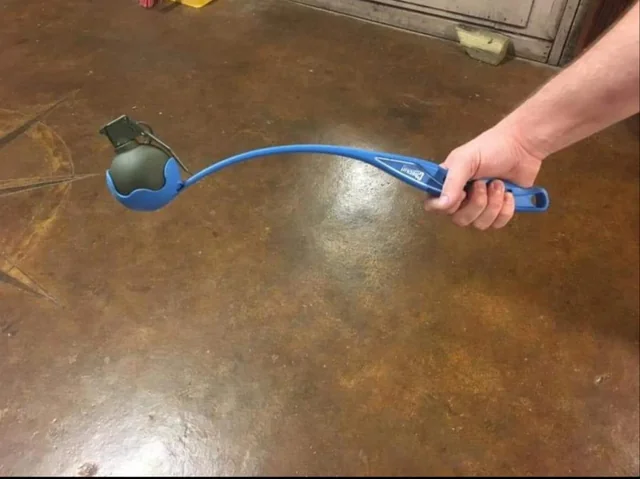
Again, my suggestion WRT grenades is that something of the sort pictured would help throwing them farther and more accurately. If you've ever used one of these throwing sticks to toss balls for a dog you'd know how much of an advantage it is.

In any case, hand grenades seem to have become so ubiquitous by the interwar period that they were standard issue for infantry, and you regularly see infantry in WWII and later carrying large numbers of grenades in canteen pouches, gas mask bags, even the ubiquitous USGI cloth bandolier was used to carry grenades. Even the most minimalist field kit, like the "ChiCom" chest rig is typically pouches for 3-8 magazines and 4 hand grenades! The standard ALICE magazine pouch was designed to hold 3x 30 round magazines and 2 grenades.

Circling back to more modern subjects, as I mentioned above 12+ magazines (~400 rounds) and 6+ grenades are typical among Ukrainians, which means a standard 7 soldier section would readily have ~40-60 hand grenades and 3000 rounds of ammunition, not including under barrel grenades, rockets, etc. I really think you're over-estimating ammunition consumption. The Ukrainians seem to do fine with their ~400-500 rounds and 6-8 hand grenades per person.

1778247559830.png


1778246851755.png
 
Much of combat in WWI involved NLOS engagements in trenches. That is different operational focus than advancing in complex terrain.
True. However, after the attempted German breakthrough in 1918, open warfare was restored. Also, even before this, the trench systems themselves could be quite complex in architecture, including pillboxes and other reinforced positions, incorporating cellars in wrecked towns etc. It wasn't just straight rows of ditches facing off against each other.

Main Battle Rifle is not a term I've ever heard used
A rifle, typically bolt but progressing to self-loading, firing any one of a number of full-power cartridges. For NATO in the Cold War, we're talking FN FAL, M-14, H&K G3 etc., firing the 7.62mm x 51 round. This is as opposed to what are commonly called assault rifles, firing reduced-power rounds such as 7.62mm x 39 or 5.56mm x 45.
 
A rifle, typically bolt but progressing to self-loading, firing any one of a number of full-power cartridges. For NATO in the Cold War, we're talking FN FAL, M-14, H&K G3 etc., firing the 7.62mm x 51 round. This is as opposed to what are commonly called assault rifles, firing reduced-power rounds such as 7.62mm x 39 or 5.56mm x 45.

Everyone knows what a battle rifle is, but you are the only person I've seen use the term main battle rifle.
 
True. However, after the attempted German breakthrough in 1918, open warfare was restored. Also, even before this, the trench systems themselves could be quite complex in architecture, including pillboxes and other reinforced positions, incorporating cellars in wrecked towns etc. It wasn't just straight rows of ditches facing off against each other
I would postulate that the contemporary battlefield is full of small structures including cellars. (The single family conpound w up to 3 separate cellars, as expressed by a Azov Senior commander, presents an issue which carrying a few extra grenade satchels will not address. The commander expressed as much. Likewise, the continuous shocks from nearby explosions presents all sorts issues for friendly dismounts. What is needed is something one can use maybe ten times on a single compound and then walk away. witn much less of a threat to being shot in the back of the head
 
Last edited:
Everyone knows what a battle rifle is, but you are the only person I've seen use the term main battle rifle.
Assault rifle was introduced exclusively as a Nazi title for the StG. 44. Young people should know their history before commenting.
 
Last edited:
Assault rifle was introduced exclusively as a Nazi title for the StG. 44. Young people should know their history before commenting.
Got to go with CastleBravo here, Battle Rifle is in (somewhat limited) use to distinguish full power weapons from intermediate power assault rifles, but 'main battle rifle' is not a commonly used term.

And much as I might wish otherwise, I don't qualify as young anymore.

As for the Germans, they used Sturmgewehr for the StG 44, literally storm rifle, though the English functional translation is assault rifle, but also Maschinenpistol (MP43/44) and, dropping back a generation, Maschinenkarabiner (MK42(H)). Machine pistol and machine carbine don't adequately cover the new category of intermediate calibre automatic weapons, so assault rifle became the generic term. Germany getting the first use is largely irrelevant.
 
Got to go with CastleBravo here, Battle Rifle is in (somewhat limited) use to distinguish full power weapons from intermediate power assault rifles, but 'main battle rifle' is not a commonly used term.
And much as I might wish otherwise, I don't qualify as young anymore.
The M7/8s are designed for long range 600 some yards. That is not an assault rifle that is a new focus along the lines of old school general utility or Main Battle Rifle.
As for the Germans, they used Sturmgewehr for the StG 44, literally storm rifle, though the English functional translation is assault rifle, but also Maschinenpistol (MP43/44) and, dropping back a generation, Maschinenkarabiner (MK42(H)). Machine pistol and machine carbine don't adequately cover the new category of intermediate calibre automatic weapons, so assault rifle became the generic term. Germany getting the first use is largely irrelevant.
Not sure any this applies. Storm means assault in this context and it was used first amongst a bunch of other general utility rifles ie main battle rifles.
 
Not sure any this applies. Storm means assault in this context and it was used first amongst a bunch of other general utility rifles ie main battle rifles.
As I understand it the German "sturm" means charge as in cavalry charge.

Trench like warfare and other short range engagement and suppression fire are suitable for PDWs. And seeing how the majority of personnel are in the back like logistics, mechanics, etc. that use PDW anyway and presumely in much greater amount.
I seems to me it would be easier to shuffle these when the battlefield calls for it. And switch back to the more heavy rifle when range or openfield are the case. Not need for more complications.
 
As I understand it the German "sturm" means charge as in cavalry charge.

Trench like warfare and other short range engagement and suppression fire are suitable for PDWs. And seeing how the majority of personnel are in the back like logistics, mechanics, etc. that use PDW anyway and presumely in much greater amount.
I seems to me it would be easier to shuffle these when the battlefield calls for it. And switch back to the more heavy rifle when range or openfield are the case. Not need for more complications.
Charging is assaulting. Semantics. Problem is national Armys won't even pay for a PDWs to equip rear area troops since the concept arose.As a secondary, the proposed wpn would be defined as a PDW. Assaulting troops would need to carry both. Troops would only be permanently assigned rhe Battle rifle and on assaults would be temporarily assigned this particular PDW.,yes. As for regular PDWs, they seem to be SOF & police relegated.
 
Problem is national Armys won't even pay for a PDWs to equip rear area troops since the concept arose.
About the only time they did was the US buying M1/M2 Carbines for everyone not line infantry and those infantry troops where carrying an M1 Garand would be impractical. Say, Mortars and Bazookas.

And every country who got carbines from the US post WW2.


As a secondary, the proposed wpn would be defined as a PDW. Assaulting troops would need to carry both. Troops would only be permanently assigned rhe Battle rifle and on assaults would be temporarily assigned this particular PDW.,yes.
Ew. No. Too much weight to carry.

If you're in open ground carry the battle rifle, if you're in urban/dense terrain carry the PDW. Either/or, not both.


As for regular PDWs, they seem to be SOF & police relegated.
Mostly because NATO declined to adopt a PDW with the MP7/P90, and when every grunt is packing an intermediate-cartridge rifle anyways there's much less immediate demand for a PDW in the MP7/P90/M1 Carbine class.
 
A rifle, typically bolt but progressing to self-loading, firing any one of a number of full-power cartridges. For NATO in the Cold War, we're talking FN FAL, M-14, H&K G3 etc., firing the 7.62mm x 51 round. This is as opposed to what are commonly called assault rifles, firing reduced-power rounds such as 7.62mm x 39 or 5.56mm x 45.
I know what a battle rifle is FFS, I've just never heard someone use the term "main battle rifle" or the abbreviation MBR!
 
About the only time they did was the US buying M1/M2 Carbines for everyone not line infantry and those infantry troops where carrying an M1 Garand would be impractical. Say, Mortars and Bazookas.

And every country who got carbines from the US post WW2.


Ew. No. Too much weight to carry.
Something around the Ares ACR/Ares Olin AiW form factior could be developed @ .5 the weight & w 65x multi flechette caseless .ie 4.5lbs loaded.
 
Don't forget the "guy" is in a fireteam and could be the only one carrying a specific weapon.
People tend to forget the team and single mindely talk about one for all.

If we can't have PDW then give me a G11 for the point/scout guy.
 
Problem is national Armys won't even pay for a PDWs to equip rear area troops since the concept arose.
That's because the Cold War went away and we're not looking at Spetsnaz ambushing supply convoys across Western European engagement ranges anymore. The ideal PDW in arid terrain is not the same as the ideal PDW in Europe - you want something much more akin to a rifle for the Gulf and Asia, whereas a machine-pistol with good armour penetration was optimum for the closer European ranges.
 
But 5.56 does the same thing without needing to carry two guns (even if they're welded together)! Or requiring very heavy 13mm ammunition! And if that doesn't work, hand grenades are great!

Everyone is trying to reinvent the wheel when we've known for almost 110 years that the best solution to close quarters battle is a great deal of hand grenades!
That 13mm ammunition could pack more power while subsonic and silenced that a full bridled 7.62 mm x 39 mm. And with a full power, supersonic load it has about four times the kinetic energy of 5.56 mm x 45 mm.

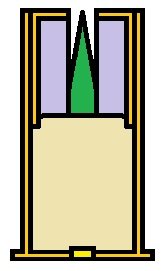
By carrying .177 (4.5 mm) you can pack twice the rounds using off the shelf technology to deliver a 25 g bullet at 3,375 ft/s muzzle velocity and 632 ft⋅lb. But with 30 year old technology you can reshape the cartridge into a .380 sized cartridge to put 50-75% or more energy into the casing. Get a 25 g bullet up to > 4,000 ft/s. Probably gets closer to 4,400 ft/s. But you can drop the bullet to a 20 g weight using a tungsten tip and easily break 4,500 ft/s that will not stop in kevlar or Level IV body armor. 75% of the kinetic energy with a bullet around 50% of the girth.
 

Attachments

  • HV177.jpg
    HV177.jpg
    12.1 KB · Views: 1
Surely you jest!
No, I'm not joking. And don't call me Shirley.

You said:
Assaulting troops would need to carry both. Troops would only be permanently assigned rhe Battle rifle and on assaults would be temporarily assigned this particular PDW.,yes.
And we currently do arm the assaulting troops mostly with carbines/PDWs.

The Army fireteam is: SAW gunner, SAW loader (w/ M4), grenadier (w/ M4+M203), and either DMR or Javelin gunner (w/ M4).
 
No, I'm not joking. And don't call me Shirley.

You said:

And we currently do arm the assaulting troops mostly with carbines/PDWs.

The Army fireteam is: SAW gunner, SAW loader (w/ M4), grenadier (w/ M4+M203), and either DMR or Javelin gunner (w/ M4).
Ha ha, & ur still wrong. I would prefer not to suffer continously from grenade blast effects trying to clear compounds, or alternatively be shot in the back of the head. Walking around a compound ain't gonna wear u out.

Noone in the US carries PDWs accept SOF, Secret Service & wealthy Metro Police.
Short ARs r not carbines they are shortened barrel assault rifles. The Army wanted to add mystique to shortened barrels so started calling the them 'carbines'. Absurd. They are assault rifles. The M7 is an MBR, and the M8 is an assault rifle.
 
Last edited:
Don't forget the "guy" is in a fireteam and could be the only one carrying a specific weapon.
People tend to forget the team and single mindely talk about one for all.

If we can't have PDW then give me a G11 for the point/scout guy.
G11 performed measurable worse than an M16A2 with iron sights in several parts of ACR, and at best (Phase 1 short range trials) was inferior to the Colt ACR firing duplex 5.56, albeit that neither rifle's improvement was statistically significant. See my post #32 in this thread.

I wish more people understood that the infantry rifle is essentially a solved problem, and the answer is a ±5.5mm assault rifle with an optic, low recoil, and decent ergonomics. Everyone wants to be too clever by half.

If you want a short and handy gun, then there's some good work going on with Al-Mag alloys for rails or receivers, and a 250-300mm (10-12") barrel, lighter non-brass cases for your ammo (which seems able to net about a 30% drop in mass per cartridge for 5.56) does a fair amount. Maybe 2-3kg total?
 
That's because the Cold War went away and we're not looking at Spetsnaz a mbushing supply convoys across Western European engagement ranges anymore. The ideal PDW in arid terrain is not the same as the ideal PDW in Europe - you want something much more akin to a rifle for the Gulf and Asia, whereas a machine-pistol with good armour penetration was optimum for the closer European ranges.
The PDW role has also ended up being better done by short barrel assault rifles, especially now that suppressors are more mature and inexpensive, and we have better institutional knowledge about how to make short barrel assault rifles run reliably with suppressors. And to be clear the suppressor is for hearing safety and to avoid the TBIs that firing very short rifles causes in confined spaces.

We found this in Vietnam with the XM-177 and GAU-5/A, and eventually the M4, but it took a while to circle back around. Red dot sights help too, since you just point and shoot.
 
Ha ha, & ur still wrong. I would prefer not to suffer continously from grenade blast effects trying to clear compound, or alternatively be shot in the back of the head. Walking around a compound ain't gonna where ne our.

Noone in the US carries PDWs accept SOF, Secret Service & wealthy Metro Police.
Short ARs r not carbines they are shortened barrel assault rifles. The Army wanted to add mystique to shortened barrels so started calling the them 'carbines'. Absurd. They are assault rifles. The M7 is MBR, and the M8 is an assault rifle.
*facepalm*
 
I wish more people understood that the infantry rifle is essentially a solved problem, and the answer is a ±5.5mm assault rifle with an optic, low recoil, and decent ergonomics. Everyone wants to be too clever by half.
Except the current leadership believes modern threats can not be met by 5.56 mm x 45 mm, hence the new rounds that deliver greater kinetic energy and have promised greater penetration.
 
That 13mm ammunition could pack more power while subsonic and silenced that a full bridled 7.62 mm x 39 mm. And with a full power, supersonic load it has about four times the kinetic energy of 5.56 mm x 45 mm.

By carrying .177 (4.5 mm) you can pack twice the rounds using off the shelf technology to deliver a 25 g bullet at 3,375 ft/s muzzle velocity and 632 ft⋅lb. But with 30 year old technology you can reshape the cartridge into a .380 sized cartridge to put 50-75% or more energy into the casing. Get a 25 g bullet up to > 4,000 ft/s. Probably gets closer to 4,400 ft/s. But you can drop the bullet to a 20 g weight using a tungsten tip and easily break 4,500 ft/s that will not stop in kevlar or Level IV body armor. 75% of the kinetic energy with a bullet around 50% of the girth.
Subsonic ammunition is notoriously hard to shoot. I don't know if you have much practical experience with shooting rifles, but when it comes to dynamic targets the easiest gun/cartridges to shoot are those which have a short time of flight and as little drop as possible. Big heavy bullets moving slowly give the target time to move from the point of impact and

25g at 3375 is a baffling choice. 6.5x25mm CBJ, which is based on the larger 9x19mm case, only manages 3000ft/s with a ±40 grain /2.5 gram bullet out of a 12" /300mm barrel. I don't think there physically is the case capacity to fit enough powder without using exotic propellant which has supply chain issues. 6.5mm CBJ had some impressive capabilities but all of these very small projectiles have very poor lethality due to insufficient fragment mass.

In any case, I think it's notable that there aren't complaints about 5.56 or 5.45 lethality coming out of Ukraine, certainly none significant enough to justify putting a .50-70 battle rifle on top of what is essentially an Interdynamics MKR (which notably went absolutely nowhere, alongside all the other ±4.5mm bullets that weren't 4.6x30).
 
Except the current leadership believes modern threats can not be met by 5.56 mm x 45 mm, hence the new rounds that deliver greater kinetic energy and have promised greater penetration.
Except that the "current threats" 6.8 was designed around were Dreadnought body armor and Afghans sitting on hilltops.

Nobody is fielding troops armored that heavy, not even the US.
And anyone stupid enough to want to fight in Afghanistan a second time needs a minder to be allowed out in public.
 
Back
Top Bottom