
You are using an out of date browser. It may not display this or other websites correctly.
You should upgrade or use an alternative browser.
You should upgrade or use an alternative browser.
Alternative fighter for Argentine AF & Navy during Falklands war.

Rule of cool
ACCESS: Top Secret
- Joined
- 16 January 2024
- Messages
- 3,567
- Reaction score
- 4,520
Including the generals, it appears?
IIUC nobody in power seriously thought of invading the Falklands, until Admiral Anaya made it a condition of the Navy's support for Galtieri's power grab. Surprisingly enough there doesn't seem to even be any tabletop or map exercises for the Falklands done by the Argentines, even if only for officer training. No wonder they lost.
- Joined
- 21 May 2006
- Messages
- 3,262
- Reaction score
- 2,885
Sorry Kiltonge, I'm assuming your comment was in relation to my previous post?
If so, your analogy
But the fact is, Argentina only has a very limited and hard-pressed C-130 Hercules fleet to facilitate such aerial refuelling. As I've also emphasised, the Mirage F1 does have greater performance parameters - critically in terms of range/endurance, when compared to the legacy Mirage III/Dagger's. This in itself would elevate a lot of pressure off the few C-130 Herc tankers, as well as going some way in eliminating the predictability of Argentinian attack paths, due to range limitations of the Mirage III/Dagger's
I've always championed that Australia/RAAF should have had such an arrangement within it's ORBAT....
Do you think the Argentinian Air Force/Aviation Industry would have had what it took to jerryrig other transport aircraft to act as aerial refuelling tanks?
Regards
Pioneer
If so, your analogy
does make a lot of sense in terms of its straightforward simplicity, as such.It does seem a lot of what-iffery versus just bolting-on a refuelling probe to the Mirage IIIs & Daggers. IAI already had one with the necessary plumbing for the Kfir.
But the fact is, Argentina only has a very limited and hard-pressed C-130 Hercules fleet to facilitate such aerial refuelling. As I've also emphasised, the Mirage F1 does have greater performance parameters - critically in terms of range/endurance, when compared to the legacy Mirage III/Dagger's. This in itself would elevate a lot of pressure off the few C-130 Herc tankers, as well as going some way in eliminating the predictability of Argentinian attack paths, due to range limitations of the Mirage III/Dagger's
I can't argue with that analogy of the Mirage III/Skyhawk mix mate.The Mirage and Skyhawk fleet is probably one of the best mixes that a nation on a tight budget could put together in that era.
I've always championed that Australia/RAAF should have had such an arrangement within it's ORBAT....
Do you think the Argentinian Air Force/Aviation Industry would have had what it took to jerryrig other transport aircraft to act as aerial refuelling tanks?
Regards
Pioneer
Rule of cool
ACCESS: Top Secret
- Joined
- 16 January 2024
- Messages
- 3,567
- Reaction score
- 4,520
I've always championed that Australia/RAAF should have had such an arrangement within it's ORBAT....
We did, it's just that the A4s were Kiwi owned.
- Joined
- 21 May 2006
- Messages
- 3,262
- Reaction score
- 2,885
Very cordial of the Kiwi's......We did, it's just that the A4s were Kiwi owned.
One has to admit, that camo on Kiwi Skyhawk's was both cool and very effective.
Regards
Pioneer
Rule of cool
ACCESS: Top Secret
- Joined
- 16 January 2024
- Messages
- 3,567
- Reaction score
- 4,520
Very cordial of the Kiwi's......
One has to admit, that camo on Kiwi Skyhawk's was both cool and very effective.
Regards
Pioneer
Once the British withdrew from EoS and the US to the Philippines they really didn't have much choice who to fly their Skyhawks with.
It was cool, I saw them at Avalon back in the day.
As for IFR and Mirage IIIs, it depends if they have single point, pressure refuelling like the Israelis or multi point unpressurised like the RAAF. The latter can't be fitted with IFR.

alejandrogrossi
ACCESS: Secret
- Joined
- 20 September 2019
- Messages
- 305
- Reaction score
- 546
Hi to all
at the time of the war, no IFR probe exits for the M-III.
The development, was past de War.
More early, I put the french model of M-III that France did.
The only M-III with IFr was this

M-IIIB-2RV (for traing the crews of M-IV bombers)
In a spanish forum (Argentine ) (talking about Air Superiority in the Malvinas War) this was said, about M-III IFR capacity:
"After reading a Mirage IIIE manual there are several points to highlight.:...-When we talk about in-flight refueling capability, by 1982 there was no MIII operator in the world with an in-flight refueling probe. There were several reasons that prevented its incorporation, the absence of internal space for additional pipes and pumps, the high minimum speed that the plane had to remain in flight and allow under these conditions an increase in weight and a change in the center of gravity and a liquid oxygen tank that, depending on the percentage of oxygen required by the pilot, could be extended to 3 hours and coins or less. For this reason, when some Mirages were modernized and equipped with a refueling probe, the incorporation of a higher capacity oxygen system was included in the work."
So you need a more oxigen capacity.
https://www.zona-militar.com/foros/threads/superioridad-aérea-en-malvinas.30478/page-49
at the time of the war, no IFR probe exits for the M-III.
The development, was past de War.
More early, I put the french model of M-III that France did.
The only M-III with IFr was this
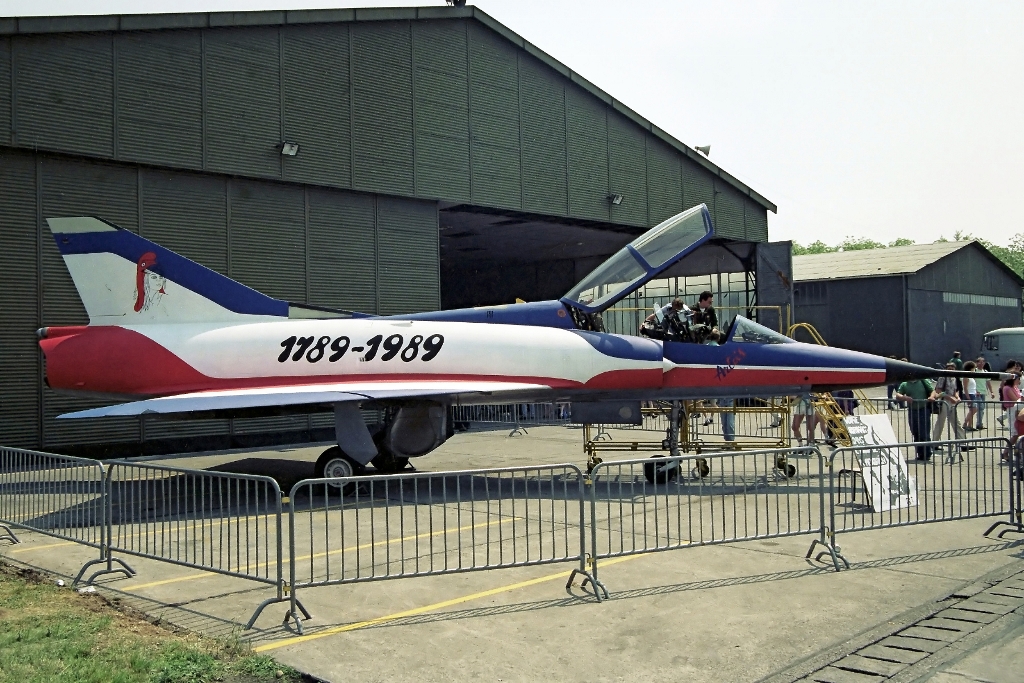

M-IIIB-2RV (for traing the crews of M-IV bombers)
In a spanish forum (Argentine ) (talking about Air Superiority in the Malvinas War) this was said, about M-III IFR capacity:
"After reading a Mirage IIIE manual there are several points to highlight.:...-When we talk about in-flight refueling capability, by 1982 there was no MIII operator in the world with an in-flight refueling probe. There were several reasons that prevented its incorporation, the absence of internal space for additional pipes and pumps, the high minimum speed that the plane had to remain in flight and allow under these conditions an increase in weight and a change in the center of gravity and a liquid oxygen tank that, depending on the percentage of oxygen required by the pilot, could be extended to 3 hours and coins or less. For this reason, when some Mirages were modernized and equipped with a refueling probe, the incorporation of a higher capacity oxygen system was included in the work."
So you need a more oxigen capacity.
https://www.zona-militar.com/foros/threads/superioridad-aérea-en-malvinas.30478/page-49

BlackBat242
OK, I changed my personal text ;)
- Joined
- 10 April 2013
- Messages
- 1,620
- Reaction score
- 5,022
Very cordial of the Kiwi's......
One has to admit, that camo on Kiwi Skyhawk's was both cool and very effective.
Regards
Pioneer
Once the British withdrew from EoS and the US to the Philippines they really didn't have much choice who to fly their Skyhawks with.
It was cool, I saw them at Avalon back in the day.
The Aussies operated A-4s until 1981 off HMAS Melbourne, then sold them to New Zealand in 1984.
UK withdrawal from EOS was done by 1971, and the US were in the Philippines since the 1950s (withdrawal from Vietnam/Cambodia was done by 1975).
The RAAF had had a "reserve" component called the Citizen's Air Force (CAF) that, until its flying squadrons were disbanded in 1964, flew the Vampires the active squadrons had gotten rid of long before. If the CAF's squadrons had been kept, they could have flown the Sabres until 1981, then taken the ex-RN A-4Gs (and gotten some surplus A-4Fs from the USN's storage yard) to keep on operating.
The whole affair leaves an impression that the Argentinean side had no shade of a plan in case there is a real attempt by Britain to retake the islands and everything they did was down to knee-jerk reactions. Almost as if they put all their chips into diplomatic pressure. Which didn't work.IIUC nobody in power seriously thought of invading the Falklands, until Admiral Anaya made it a condition of the Navy's support for Galtieri's power grab. Surprisingly enough there doesn't seem to even be any tabletop or map exercises for the Falklands done by the Argentines, even if only for officer training. No wonder they lost.
Last edited:
- Joined
- 21 May 2006
- Messages
- 3,262
- Reaction score
- 2,885
Ok, after further deliberation, I guess the only realistic option for an anti-ship missiles for the Argentinian Air Force, regardless of the type of fighter/fighter-bomber they employ, would have to be the Nord AS.30 or AGM-12 Bullpup (or derivatives of), if they choose to have a serious inventory. I guess there's nothing wrong with thinking Argentina licence-manufacturing either missile.
If given the choice, I'd probably be inclined to support the AS.30, for both reliability, effectiveness and geopolitical assurances (France having a better, yet dubious, track record to supply weapons/equipment in round about ways and means).
I fully appreciate that the AS.30 ain't no Exocet when it comes to anti-shipping, and it's radio command guidance system is somewhat clunky and antiquated (One would assume Argentina would see merit in aquiring the laser-guided AS.30L as well) but it does give some form of stand-off attack performance, and let's face it, anythings better than having to flying into a fleets area defence zone to drop 1000 Ib and 500 Ib dumb bombs, whilst exposing you to every weapon that can shoot at you, from 114mm, 20mm, and 7.62mm, once you've survived the Sea Dart's, Sea Wolf and Sea Cat SAM's....
Another consideration is that two AS.30's could be carried by either Mirage IIII/Dagger and Skyhawk......
Regards
Pioneer
If given the choice, I'd probably be inclined to support the AS.30, for both reliability, effectiveness and geopolitical assurances (France having a better, yet dubious, track record to supply weapons/equipment in round about ways and means).
I fully appreciate that the AS.30 ain't no Exocet when it comes to anti-shipping, and it's radio command guidance system is somewhat clunky and antiquated (One would assume Argentina would see merit in aquiring the laser-guided AS.30L as well) but it does give some form of stand-off attack performance, and let's face it, anythings better than having to flying into a fleets area defence zone to drop 1000 Ib and 500 Ib dumb bombs, whilst exposing you to every weapon that can shoot at you, from 114mm, 20mm, and 7.62mm, once you've survived the Sea Dart's, Sea Wolf and Sea Cat SAM's....
Another consideration is that two AS.30's could be carried by either Mirage IIII/Dagger and Skyhawk......
Regards
Pioneer
Rule of cool
ACCESS: Top Secret
- Joined
- 16 January 2024
- Messages
- 3,567
- Reaction score
- 4,520
...so it probably wasn't a hardware problem.
Make no mistake, Argentina had considerable materiel shortcomings. They had no counter to SSNs so couldn't use their navy without risk of total destruction. Their air force was at the very limit of its tactical range without the use of Port Stanley airport. Their maritime patrol capabilities were very marginal and recce capability in general although by being on the islands this might be manageable. Even with good planning and better use of available resources Argentina would struggle.
Rule of cool
ACCESS: Top Secret
- Joined
- 16 January 2024
- Messages
- 3,567
- Reaction score
- 4,520
The Aussies operated A-4s until 1981 off HMAS Melbourne, then sold them to New Zealand in 1984.
UK withdrawal from EOS was done by 1971, and the US were in the Philippines since the 1950s (withdrawal from Vietnam/Cambodia was done by 1975).
The RAAF had had a "reserve" component called the Citizen's Air Force (CAF) that, until its flying squadrons were disbanded in 1964, flew the Vampires the active squadrons had gotten rid of long before. If the CAF's squadrons had been kept, they could have flown the Sabres until 1981, then taken the ex-RN A-4Gs (and gotten some surplus A-4Fs from the USN's storage yard) to keep on operating.
The twists and turns of RAAF fleets are a thread of its own.

1635yankee
Recovering aeronautical engineer
- Joined
- 18 August 2020
- Messages
- 673
- Reaction score
- 1,028
The UK's domestic politics under Thatcher were a significant factor in Galtieri's junta's decision to attack the Falklands. One factor was the Nott's 1981 Defence White Paper, which would largely eliminate the RN's cap ability to perform amphibious assaults. The second was the Nationality Act of 1981, which made it far more difficult for residents of any British overseas territories to move to the UK. The junta's misogyny (both the head of government and the head of state of the UK were women) may have been a third factor.
One wonders whether a slightly different British defense policy -- not even a significantly more expensive one -- could have deterred the Argentinian government.
One wonders whether a slightly different British defense policy -- not even a significantly more expensive one -- could have deterred the Argentinian government.
Rule of cool
ACCESS: Top Secret
- Joined
- 16 January 2024
- Messages
- 3,567
- Reaction score
- 4,520
Not just that, Argentina occupied South Thule in 1976 and the British military response Op Journeyman ended without evicting the occupation. There was also the never ending negotiations about the Falklands, as opposed to saying "NO the matter is closed"!
Even with good planning and better use of available resources Argentina would struggle.
Of course they would, but they never even tried.
They squandered a month while the task force was at Ascension which they could have used for preparation and planning. They could have set up land defenses, bring better trained soldiers, shore artillery, mines. They totally missed the spec forces that were landed and did whatever they wanted on the islands. They knew about SSNs, but did nothing - Belgrano's escorts never switched their sonars on (if they even were functional).
It's a wonder they did get as much hits as they did, but think how painful that could have been if some coordination and planning was applied to those chaotic attacks. And all they actually needed was one hit on a carrier.
What I am trying to say - if you gave them better planes and better missiles, there is no guarantee they would have behaved differently, and thus the result would be the same.
Last edited:
- Joined
- 21 May 2006
- Messages
- 3,262
- Reaction score
- 2,885
Would be awesome if someone started such a thread Rule for cool - cough, cough......The twists and turns of RAAF fleets are a thread of its own.
Regards
Pioneer
Scott Kenny
ACCESS: USAP
- Joined
- 15 May 2023
- Messages
- 19,517
- Reaction score
- 27,965
Combined response:...so it probably wasn't a hardware problem.
But some relatively small hardware changes (and a few other things that were completely within Argentina's capabilities at the time) would have made it a lot more likely to succeed.Make no mistake, Argentina had considerable materiel shortcomings. They had no counter to SSNs so couldn't use their navy without risk of total destruction. Their air force was at the very limit of its tactical range without the use of Port Stanley airport. Their maritime patrol capabilities were very marginal and recce capability in general although by being on the islands this might be manageable. Even with good planning and better use of available resources Argentina would struggle.
I mean, every air force has a unit whose job is to fix and repair the runways. Send those guys to Port Stanley, and tell them you need another 2000ft of runway. Or however much more flat ground there is available there. Use some of the "instant set" concrete cure methods, so the runway is plane ready in a week.
Send those guys to Port Stanley
They squandered a month while the task force was at Ascension which they could have used for preparation and planning.
In the reluctance to send any additional guys to Port Stanley and give them some meaningful assignments lies a considerable part of the problem
Obtaining those things also required planning *welp*But some relatively small hardware changes (and a few other things that were completely within Argentina's capabilities at the time) would have made it a lot more likely to succeed.
Rule of cool
ACCESS: Top Secret
- Joined
- 16 January 2024
- Messages
- 3,567
- Reaction score
- 4,520
Combined response:
But some relatively small hardware changes (and a few other things that were completely within Argentina's capabilities at the time) would have made it a lot more likely to succeed.
I mean, every air force has a unit whose job is to fix and repair the runways. Send those guys to Port Stanley, and tell them you need another 2000ft of runway. Or however much more flat ground there is available there. Use some of the "instant set" concrete cure methods, so the runway is plane ready in a week.
I agree, Argentina had some potentially useful kit that wasn't used, 155mm guns spring to mind. However even these make the job harder rather than impossible, Britain's defence industry was just picking up speed as the 10 week conflict ended.
Darthmalgus
ACCESS: Restricted
- Joined
- 7 August 2025
- Messages
- 12
- Reaction score
- 2
It's difficult to believe that everyone on-board Invincible has been sworn to silence about damage to the carrier for the past 40 years. And where was it repaired? She looked fine when returning to PortsmouthThe Magic 1 was used in combat in the Falklands, Angola and Iraq. Argentine Mirage IIIEA fired the Magic at British Sea Harriers without success. Captain Gustavo Garcia Cuerva fired at a Sea Harrier head-on at 8km on 1 May 1982 without success. Another source cites a semi-active Matra 530EM fired without targeting. Argentina received a batch of 22 Magic 1 missiles in 1980. It also used the Shafrir Mk2 along with Dagger and R530. Other Magic and R530 missiles were received clandestinely from Libya during the conflict. From; Defence Force
https://aquellasarmasdeguerra.wordpress.com/2013/03/30/misiles-utilizados-en-la-guerra-de-malvinas/View attachment 754983
If that is true only 22 Magic now I think I start to understand, the FAA had so few Magic that they were assigned to the Dagger and Mirage III, so the A-4Cs were used as attackers, so that was a big problem in my opinion If Argentina would have had more Magic let us say 100 or 200 Magic and have been tested the A-4C with Magic in my opinion the war would have been different the Harriers were the key to the victory, No harriers and the FAA would have had air superiority and the disembark would had failed.
View: https://www.youtube.com/watch?v=cJycQh8ctGY
The irrefutable proof that the powerful aircraft carrier of the British Navy was hit by the Argentine air force, in the testimony of one of its attackers, the then Second Lieutenant Gerardo Isaac. El Halcón, interviewed by the war correspondent in Malvinas Nicolás Kasanzew, offers a vibrant, revealing and detailed account of that feat.
Camera and editing, Sil Bonfietti. Postproduction, Niki Kasanzew.
View: https://www.youtube.com/watch?v=vwCKFqLEOSc
Chapters
00:00 - Introduction
01:06 - Preparations for the attack
01:47 - The launch of the missile
02:03 - Sighting of the aircraft carrier
02:17 - Shooting down Vázquez's plane
03:13 - Explosion of Castillo's plane
04:21 - Return to the meeting point
05:47 - Meeting with Ureña's plane
08:02 - Post-flight report
After a carefully planned operation between the Argentine Navy and Air Force, a missile hit an emblematic British fleet. The second installment of a special on an attack that was never acknowledged by the British: the attack on the HMS Invincible (R05).
I hear Argentina claimed that they sunk the titanic aswell
There was an attempt to attack Invincible on May 30th 1982, which ran into HMS Avenger and Exeter instead, and two pilots were killed. The remaining two, Ernesto Ureta and Gerardo Isaac, had their report faked and were given medals and fame to seal their lips, because Argentina needed a propaganda story
Darthmalgus
ACCESS: Restricted
- Joined
- 7 August 2025
- Messages
- 12
- Reaction score
- 2
Better troops is just a different story line, same ending.Of course they would, but they never even tried.
They squandered a month while the task force was at Ascension which they could have used for preparation and planning. They could have set up land defenses, bring better trained soldiers, shore artillery, mines. They totally missed the spec forces that were landed and did whatever they wanted on the islands. They knew about SSNs, but did nothing - Belgrano's escorts never switched their sonars on (if they even were functional).
It's a wonder they did get as much hits as they did, but think how painful that could have been if some coordination and planning was applied to those chaotic attacks. And all they actually needed was one hit on a carrier.
What I am trying to say - if you gave them better planes and better missiles, there is no guarantee they would have behaved differently, and thus the result would be the same.
At best you get a protracted land campaign, but without a secure LOC to the mainland the Argentinian garrison would eventually fold.
Darthmalgus
ACCESS: Restricted
- Joined
- 7 August 2025
- Messages
- 12
- Reaction score
- 2
Much better troops then the Argies.I disagree with they have the enough resources for two simple realities of life.
A) that thesis claims the USA, France and England had bad intelligence services and they did not know when they sell weapons what are the customers are going to use them.
B) This also implies there was not a previous dispute to hint of a war coming with Argentina
That is not believable.
The other thing is not believable is the British soldiers were much better soldiers.
To prove you let us make a small imagination experiment.
Image it is not Argentina, but Frances versus the UK, let us suppose the USA still gives England AIM-9L but Israel supports France with Mirage V armed with Python 3
View attachment 757726
I ask you do you think England will win with that fleet they sent to the Falklands?
do you think once the harriers are gone and the carriers sunk the Royal marines will beat the french marines?
You know the answer the answer is England was in bad shape and the Falklands war show it, that they needed to rectify
No. Nine consecutive battles were fought and the Argentinian army lost every one. In most cases, within a night. They had all the strategic and numerical advantages, fighting from heavily fortified positions. The British infantry had to clear them by attacking up the mountains, facing heavy machine guns, ground radar, mortars, landmines and dug in rifle pits. They’ll make excuses that the British were better equipped but that’s not entirely true. In some cases, the Argentinian equipment was better, despite the apologist excuses coming from Argentinian keyboards.
Same with better planes.Better troops is just a different story line, same ending.

F-14ATomcat
ACCESS: Top Secret
- Joined
- 26 May 2024
- Messages
- 785
- Reaction score
- 1,694
War is narrative, thus people accept narratives according to their political views, from History I already expressed my point and I know you will not be flexible nor open to other Ideas, and here they do not want go in back in History, I will put it simple, I do not need to repeat my ideas, and you will be not open thus let us leave here you will not change my mind nor me, yours.Much better troops then the Argies.
No. Nine consecutive battles were fought and the Argentinian army lost every one. In most cases, within a night. They had all the strategic and numerical advantages, fighting from heavily fortified positions. The British infantry had to clear them by attacking up the mountains, facing heavy machine guns, ground radar, mortars, landmines and dug in rifle pits. They’ll make excuses that the British were better equipped but that’s not entirely true. In some cases, the Argentinian equipment was better, despite the apologist excuses coming from Argentinian keyboards.
Regards

Owens Z
quaerimus scientiam
- Joined
- 6 October 2023
- Messages
- 547
- Reaction score
- 817
21 pages of replies to what started as a poll whether MiG-21 would have been better against the Sea Harrier than what the Argentinian air force actually had during the Falklands war - answer a definite NO - leading to revisionist history, missiles and geopolitics discussions. To which I myself contributed as well
...You know the answer the answer is England was in bad shape and the Falklands war show it, that they needed to rectify
As it already was noticed, this thread got off quite far from the original topic. Maybe at least back to the theme, which consequences another fighter type for Argentina (perhaps not too unrealistic ?) would have had in that conflict ?
Archibal
A-4M is more moder version of our A-4B/ C/ Q. Of course the have 2 pylons per wing (like the C), but the have similar speed than the older A-4.
It does seem a lot of what-iffery versus just bolting-on a refuelling probe to the Mirage IIIs & Daggers. IAI already had one with the necessary plumbing for the Kfir. The Mirage and Skyhawk fleet is probably one of the best mixes that a nation on a tight budget could put together in that era. Certainly in terms of combining capability and maintainability. Spares were prolific and cheap, both were cleared for a range of accessible weapons.
...If [Australia's] CAF's squadrons had been kept, they could have flown the Sabres until 1981, then taken the ex-RN A-4Gs (and gotten some surplus A-4Fs from the USN's storage yard) to keep on operating.
But some relatively small hardware changes (and a few other things that were completely within Argentina's capabilities at the time) would have made it a lot more likely to succeed. I mean, every air force has a unit whose job is to fix and repair the runways. Send those guys to Port Stanley, and tell them you need another 2000ft of runway. Or however much more flat ground there is available there. Use some of the "instant set" concrete cure methods, so the runway is plane ready in a week.
I think the book I esteem most about the Falklands War remains 1983's informative and well-written Air War South Atlantic by Jeffrey Ethell and Alfred Price. To prep for my new thread 'Falklands War fought today?' in this Forum, I re-read among the volumes of 1990's bookazine Wings of Fame "Mirage and Dagger in the Falklands" by Salvador Mafé Huertas (Vol 6, pp4-27); "Super Etendard in the Falklands" by Huertas (Vol 8, pp22-29); "A-4 Skyhawk in the Falklands" by Huertas and David Donald (Vol 12, pp4-29); and "Canberra at War: April/June 1982" by Huertas (Vol 17, pp140-144); all researched from accounts of veteran Argentine pilots. I haven't yet read it, but author Salvador Mafé Huertas has a pertinent new book Argentine Skyhawks in the Falklands War (Casemate, 2025).
As you too might have seen, looking back on the war several in both Argentina and the UK publicly reflected that it might have been a better plan, rather than the hit-and-run strikes that in real history did sink several British ships with loss of life, to instead concentrate all Mirages, Super Etendards, and Skyhawks, and even FMA IA58 Pucarás and Aermacchi MB-339s, on the sole mission of aggressively shooting down the RN task force's few Harriers and Sea Harriers. As Nelson and Beatty had signaled, 'Engage the enemy more closely'. Despite the demonstrated superior skills of Fleet Air Arm/RAF pilots, and their unprecedently accurate US-supplied Sidewinder L-model AAMs, a relentlessly pressed weight of numbers would probably tell, especially since the task force lacked airborne early warning. With no more fighter cover, the task force would have been forced to retreat, marooning any landed British troops, on which the remaining Argentine planes could then go to work unhindered. For what it's worth, I find this possible alternate course of action credible, from my armchair.
This thread began with unlikely speculation about Argentina's air force operating MiG-21s and MiG-23s in 1982, fighters that didn't have the range to reach the Falklands anyway. Commenters have since weighed in with some other alternate-history choices of fighter planes, but reading the above, I don't see anyone suggesting what I think would have been the most realistic choice and (in hindsight) the most effective choice to defeat UK Harriers—the F-86 Sabre. In fact Argentina flew F-86Fs from 1960, but those had been retired prior to the Falklands War. In our reasonable alternate history, the Argentine air force continues those in service, with occasional supplements obtained cheaply from US boneyards before the arms embargo began in 1978. The Sabre was a legendary dogfighter, notably agile, diving supersonically, and not much slower in level flight than the subsonic Harrier. Maneuver to put a Harrier in the sights and pull the trigger on six 50-cal guns: impervious to British electronic warfare jamming and ejected flares/chaff.
Sabres in air-to-air configuration with drop tanks would have just a few minutes over the Falklands (clear days only), like the Mirages, Super Etendards, and Skyhawks did. Everyone agrees the extreme range was a severe limitation on Argentina's air effort, the actual hastily planned one of bombing ships in Falkland Sound, and the counterfactual one of obtaining air supremacy by downing every Harrier. But perhaps partial-fueled F-86s could have also been forward-deployed from the captured Port Stanley airport, as used by Pucarás and C-130 transports. Maybe even from the Pebble Island airstrip, in extremis? (With hindsight, the lack of a swift, determined effort to improve local runways by Argentina's equivalent of Seabees immediately after the invasion proved a mistake, as Scott Kenny mentions.)
Rule of cool
ACCESS: Top Secret
- Joined
- 16 January 2024
- Messages
- 3,567
- Reaction score
- 4,520
perhaps partial-fueled F-86s could have also been forward-deployed from the captured Port Stanley airport, as used by Pucarás and C-130 transports.
IIUC Argentina pulled a sqn of Sabres out of mothballs after the war to guard against Chile.
I was thinking that perhaps those Sabres might be activated in time for the war and stationed at Stanley, assuming Sabres can operate from 4,100' of runway. However, on reflection that wouldn't really address Argentina's problem because simple runway length isn't Port Stanley airport's only problem. It also lacks hardstand, dispersal apron and things like turning loops or taxiways that are required in a fighting airbase, let alone even the most basic hardening like revetments for aircraft and protection for fuel etc.
Scott Kenny
ACCESS: USAP
- Joined
- 15 May 2023
- Messages
- 19,517
- Reaction score
- 27,965
But proper invasion planning would let Argentina do much better regardless of fighters chosen.IIUC Argentina pulled a sqn of Sabres out of mothballs after the war to guard against Chile.
I was thinking that perhaps those Sabres might be activated in time for the war and stationed at Stanley, assuming Sabres can operate from 4,100' of runway. However, on reflection that wouldn't really address Argentina's problem because simple runway length isn't Port Stanley airport's only problem. It also lacks hardstand, dispersal apron and things like turning loops or taxiways that are required in a fighting airbase, let alone even the most basic hardening like revetments for aircraft and protection for fuel etc.
Send in the construction engineers on day 2 of the invasion and let them get to work on Port Stanley.
You make it sound so easy. But I don't think you appreciate the difficulties of building the runway extension at Port Stanley. Due to the nature of the terrain (peat bog etc) it was not just a question of levelling the ground and laying the aluminium planking / matting surface.But proper invasion planning would let Argentina do much better regardless of fighters chosen.
Send in the construction engineers on day 2 of the invasion and let them get to work on Port Stanley.
The British forces imported 9,000 tons of engineering stores and plant for airfield construction in the aftermath of Port Stanley being recaptured. In itself that took two weeks of round the clock working [edit - to unload]. It included 4 "enormous" rock crushers which proved difficult to unload with the equipment available. They were set to work in a quarry north of Stanley to produce enough material for a bed onto which the aluminium planking could be laid. I don't know how deep that bed would have required to have been to support the weight of a fully loaded C-130 landing on it, nor what tonnage of rock they produced for that purpose.
There is an magazine here looking at the role of the Royal Engineers in the Falklands. Page 238 onwards deals with the "aftermath".
https://www.nzsappers.org.nz/wp-content/uploads/2018/11/1982-December.pdf
I believe it took from 15th to 27th Aug 1982 for the runway extension to be laid. I don't know if that includes the time needed to crush the rock ready for it to be laid or not.
The MV Cedarbank transported the aluminium planking / matting from the USA to Southampton where they load was split between her and the MV Strathewe for shipment south to the Falklands. The latter was only requisitioned in early June. She also carried the rock crushing equipment and 2 x RCL.
If the UK had to source that airfield surfacing from the USA, it seems unlikely that Argentina had enough for the job, or the ability to source it quickly.
Last edited:
Thanks for the detailed explanation. Interesting.
- I mean exactly this https://en.wikipedia.org/wiki/Marston_Mat
For two reasons
-seems that Port Stanley ground was some soft shit that needed much more than PSP
-combat jets and C-130s are definitively not P-51 Mustangs nor Stinson L-4.
Quick Internet search "port stanley""Marston Mat" brought this from Wikipedia
-Fokker F-27s could fly out of a marston mat airstrip.
-But it was easily destroyed by just a single storm
-New airstrip was paved as result.
Wonder how long was that Hookers point airstrip made of PSP that could support Fokker F-27s. Albeit the point is academic since it was definitively destroyed by a storm.
(I'm tempted to add it made sense that fokkers and hookers go along well but instead, I'll see myself out...)
There is a subtely. Hookers point could fly Fokker F27 turboprops but not F28, which is hardly surprising.
https://www.zona-militar.com/foros/threads/pista-de-aterrizaje.10771/
This. Expanding that Port Stanley airstrip was decidely NOT akin to WWII PSP airstrips.it was not just a question of levelling the ground and laying the aluminium planking / matting surface.
- I mean exactly this https://en.wikipedia.org/wiki/Marston_Mat
For two reasons
-seems that Port Stanley ground was some soft shit that needed much more than PSP
-combat jets and C-130s are definitively not P-51 Mustangs nor Stinson L-4.
Quick Internet search "port stanley""Marston Mat" brought this from Wikipedia
Wikipedia is partly wrong, F27 from 1972 but F28 only from Port Stanley after 1975.In 1973, the United Kingdom signed a Communications Agreement with Argentina for funding an airstrip on the islands. Flights took place again from Comodoro Rivadavia, this time with Fokker F-28 twin jet aircraft. This service was maintained until 1982, representing the only connection to the islands. At first, these flights landed at a temporary airstrip at Hookers Point at the east end of Port Stanley, where the runway was constructed of Marston Mat (also known as pierced steel planking or PSP). This situation continued until 1978, when a storm tore up large areas of the PSP runway, rendering it unusable.
Damn interesting.By this time however, a permanent solution was in hand, and on 1 May 1979, a new airport was opened at Cape Pembroke by Sir Vivian Fuchs with a 4,000-foot (1,200 m) paved runway. It immediately became home to the Falkland Islands Government Air Service (FIGAS) with its Britten-Norman Islanders and de Havilland Canada DHC-2 Beavers.
-Fokker F-27s could fly out of a marston mat airstrip.
-But it was easily destroyed by just a single storm
-New airstrip was paved as result.
Wonder how long was that Hookers point airstrip made of PSP that could support Fokker F-27s. Albeit the point is academic since it was definitively destroyed by a storm.
(I'm tempted to add it made sense that fokkers and hookers go along well but instead, I'll see myself out...)
There is a subtely. Hookers point could fly Fokker F27 turboprops but not F28, which is hardly surprising.
https://www.zona-militar.com/foros/threads/pista-de-aterrizaje.10771/
After some delays starting in 1972, construction of the airfield in the Cape Pembroke area began. Nevertheless, it was inaugurated on November 15, 1972, after six months of intense work, despite the worst weather conditions experienced in the islands in the previous 20 years. The first aircraft to use it was a Fokker F-27. From then on, the link allowed for the fastest connection, and the frequency was increased to weekly, although the Friendship flights often flew empty. The aircraft used on that first flight was the T-43. With the addition of the Friendship flights, LADE's LD200/1 route was inaugurated.
In summary, between Jan/Nov72, 30 flights were carried out with Grumman Albatros, totaling 203 flight hours, the last of which was carried out on 15Nov72.
The aluminum runway, which was 720 meters long and 30 meters wide, was completed. The arrival of the first flight made it possible for the LADE agency to be inaugurated in the islands on November 20, 1972.
Due to the airfield's characteristics, the F-27s operated with the capacity to carry 22 passengers and a limited volume of mail and cargo. Even so, this represented a huge improvement in the efficiency of transport, which previously depended almost exclusively on a maritime service destined for Montevideo.
Last edited:
That said I think Port Stanley airfield could have been used to recover and refuel/rearm fighters operating from mainland bases... basically a shuttle operation to increase sortie rates and time on station.
The aircraft would need brake parachutes of course due to the short runway. The main logistical limitation would be fuel supply at Port Stanley and installing planking at each runway end for a rapid turnaround area for at least 4 jets. This could be used for A-4s after their bomb runs (before returning to the mainland) and whatever fighter they could find that could handle the short runway.
I'm not convinced Sabres would be the best choice, however. They had half the climb rate of a Harrier and would be significantly underpowered in the vertical, allowing Harrier pilots to engage/disengage at will using boom & zoom tactics... IMHO the ultimate fighter option would have been some ex-USN A-4E/Fs upgraded to "Mongoose"/Blue Angels standard with the 11,000lb thrust J52-P-408. That's what agressor squadrons used. The souped-up A-4 being perfect for Argentina in terms of fighter performance, fleet commonality, short TO runs, and brake chute availability.
You can compare aircraft performance here:
https://web.archive.org/web/20221004024209/http://www.alternatewars.com/SAC/SAC.htm
The aircraft would need brake parachutes of course due to the short runway. The main logistical limitation would be fuel supply at Port Stanley and installing planking at each runway end for a rapid turnaround area for at least 4 jets. This could be used for A-4s after their bomb runs (before returning to the mainland) and whatever fighter they could find that could handle the short runway.
I'm not convinced Sabres would be the best choice, however. They had half the climb rate of a Harrier and would be significantly underpowered in the vertical, allowing Harrier pilots to engage/disengage at will using boom & zoom tactics... IMHO the ultimate fighter option would have been some ex-USN A-4E/Fs upgraded to "Mongoose"/Blue Angels standard with the 11,000lb thrust J52-P-408. That's what agressor squadrons used. The souped-up A-4 being perfect for Argentina in terms of fighter performance, fleet commonality, short TO runs, and brake chute availability.
You can compare aircraft performance here:
https://web.archive.org/web/20221004024209/http://www.alternatewars.com/SAC/SAC.htm
Attachments
Last edited:
Scott Kenny
ACCESS: USAP
- Joined
- 15 May 2023
- Messages
- 19,517
- Reaction score
- 27,965
Oh, it would absolutely suck to do.You make it sound so easy. But I don't think you appreciate the difficulties of building the runway extension at Port Stanley. Due to the nature of the terrain (peat bog etc) it was not just a question of levelling the ground and laying the aluminium planking / matting surface.
But not doing it is beyond stupid.
Yes, that is about what I was expecting to need.The British forces imported 9,000 tons of engineering stores and plant for airfield construction in the aftermath of Port Stanley being recaptured. In itself that took two weeks of round the clock working [edit - to unload]. It included 4 "enormous" rock crushers which proved difficult to unload with the equipment available. They were set to work in a quarry north of Stanley to produce enough material for a bed onto which the aluminium planking could be laid. I don't know how deep that bed would have required to have been to support the weight of a fully loaded C-130 landing on it, nor what tonnage of rock they produced for that purpose.
Large rock crushers (or at least a whole lot of blasting compounds to make gravel), lots of hauling.
Maybe ask for some USN Seabees to teach a rapid runway building course for UNITAS 81?The MV Cedarbank transported the aluminium planking / matting from the USA to Southampton where they load was split between her and the MV Strathewe for shipment south to the Falklands. The latter was only requisitioned in early June. She also carried the rock crushing equipment and 2 x RCL.
If the UK had to source that airfield surfacing from the USA, it seems unlikely that Argentina had enough for the job, or the ability to source it quickly.
get materials, get training, etc. It's not like the overall invasion was a surprise event.
Rule of cool
ACCESS: Top Secret
- Joined
- 16 January 2024
- Messages
- 3,567
- Reaction score
- 4,520
FWIW Port Stanley and the Falkland stimulated my interest in fighting airbases, it's a fascinating topic. Little things like a turning loop at the end of the runway and hardstand with multiple access points can transform a meager strip into a fighting airbase capable of generating a lot of activity.
Given the magnitude of the work I suspect the best course of action for Argentina would have been to do the minimum work as well as possible, rather than attempt anything approaching what the British did postwar. Maybe add a 200-500' AM2 matting at one end of the runway and expand the aircraft parking and get the job done as completely as possible.
This is what I think it their best bet; do the bombing run and land at Port Stanley, refuel with minimum required to get home and fly home.
Fuel might not be too much of a problem given the quite impressive airlift that occurred 19-29 April, where C130 Hercules, of the FAA Grupo 1 Escuadrón I de Transporte Aéreo flew 91 missions into BAM Malvinas, Grupo 1 F-28s, 74 missions, Aerolíneas Argentinas 737’s, 36 flights, and BAC 1-11, 4 flights. Between them, in just 10 days, they transported 1,544 tonnes and 2,844 personnel. ........Turnaround times of 15 minutes were not unusual, and every single aircraft would carry their maximum fuel load, and not needed for the return flight would be decanted into pillow tanks and drums to build up stocks.
If shuttle missions were not too frequent, they'd have to be in order for the RN to get wise and use them as an opportunity to ambush these aircraft, there should be enough fuel.
Given the magnitude of the work I suspect the best course of action for Argentina would have been to do the minimum work as well as possible, rather than attempt anything approaching what the British did postwar. Maybe add a 200-500' AM2 matting at one end of the runway and expand the aircraft parking and get the job done as completely as possible.
That said I think Port Stanley airfield could have been used to recover and refuel/rearm fighters operating from mainland bases... basically a shuttle operation to increase sortie rates and time on station.
The aircraft would need brake parachutes of course due to the short runway. The main logistical limitation would be fuel supply at Port Stanley and installing planking at each runway end for a rapid turnaround area for at least 4 jets. This could be used for A-4s after their bomb runs (before returning to the mainland) and whatever fighter they could find that could handle the short runway.
This is what I think it their best bet; do the bombing run and land at Port Stanley, refuel with minimum required to get home and fly home.
Fuel might not be too much of a problem given the quite impressive airlift that occurred 19-29 April, where C130 Hercules, of the FAA Grupo 1 Escuadrón I de Transporte Aéreo flew 91 missions into BAM Malvinas, Grupo 1 F-28s, 74 missions, Aerolíneas Argentinas 737’s, 36 flights, and BAC 1-11, 4 flights. Between them, in just 10 days, they transported 1,544 tonnes and 2,844 personnel. ........Turnaround times of 15 minutes were not unusual, and every single aircraft would carry their maximum fuel load, and not needed for the return flight would be decanted into pillow tanks and drums to build up stocks.
If shuttle missions were not too frequent, they'd have to be in order for the RN to get wise and use them as an opportunity to ambush these aircraft, there should be enough fuel.
Owens Z
quaerimus scientiam
- Joined
- 6 October 2023
- Messages
- 547
- Reaction score
- 817
IIUC Argentina pulled a sqn of Sabres out of mothballs after the war to guard against Chile. I was thinking that perhaps those Sabres might be activated in time for the war and stationed at Stanley, assuming Sabres can operate from 4,100' of runway. However, on reflection that wouldn't really address Argentina's problem because simple runway length isn't Port Stanley airport's only problem. It also lacks hardstand, dispersal apron and things like turning loops or taxiways that are required in a fighting airbase, let alone even the most basic hardening like revetments for aircraft and protection for fuel etc.
You make it sound so easy. But I don't think you appreciate the difficulties of building the runway extension at Port Stanley. Due to the nature of the terrain (peat bog etc) it was not just a question of levelling the ground and laying the aluminium planking / matting surface.
The British forces imported 9,000 tons of engineering stores and plant for airfield construction in the aftermath of Port Stanley being recaptured. In itself that took two weeks of round the clock working [edit - to unload]. It included 4 "enormous" rock crushers which proved difficult to unload with the equipment available. They were set to work in a quarry north of Stanley to produce enough material for a bed onto which the aluminium planking could be laid. I don't know how deep that bed would have required to have been to support the weight of a fully loaded C-130 landing on it, nor what tonnage of rock they produced for that purpose.
There is an magazine here looking at the role of the Royal Engineers in the Falklands. Page 238 onwards deals with the "aftermath".
I believe it took from 15th to 27th Aug 1982 for the runway extension to be laid. I don't know if that includes the time needed to crush the rock ready for it to be laid or not.
The MV Cedarbank transported the aluminium planking / matting from the USA to Southampton where they load was split between her and the MV Strathewe for shipment south to the Falklands. The latter was only requisitioned in early June. She also carried the rock crushing equipment and 2 x RCL.
If the UK had to source that airfield surfacing from the USA, it seems unlikely that Argentina had enough for the job, or the ability to source it quickly.
Thanks for the detailed explanation. Interesting.
This. Expanding that Port Stanley airstrip was decidely NOT akin to WWII PSP airstrips.
- I mean exactly this https://en.wikipedia.org/wiki/Marston_Mat
For two reasons
-seems that Port Stanley ground was some soft shit that needed much more than PSP
-combat jets and C-130s are definitively not P-51 Mustangs nor Stinson L-4...
And yet history shows the captured airport, even without the quick-and-dirty improvement that a bit of reasonable foresight would have indicated, hosted transiting laden C-130s and a fighting detachment of Pucarás and MB-339s until almost the end of the war, despite repeated attentions from Black Buck raids and Sea Harrier strikes.
Author Salvador Mafé Huertas wrote ("A-4 Skyhawk in the Falklands", Wings of Fame Vol 12 p6) that one navy A-4Q "was seen some days after the 2 April occupation operating from Port Stanley airfield, performing trials to determine if the aircraft could be forward-deployed there. The runway proved too short for safe operations, especially with a war load and in wet or icy conditions. With the Falklands secured, [Argentine aircraft carrier] 25 de Mayo returned to its port and the A-4Qs flew back to their shore base at Espora".
Fair enough. I do point out that this judgment was made while Argentina (and most countries) disbelieved that Britain would really fight for the Falklands, and therefore it perhaps lacked full wartime urgency; that unlike A-4 Skyhawks against ships, Sabres need no bombload for the mission I spoke of; and that regarding wet or iced runways, a day fighter like the F-86F wouldn't fly during serious precipitation anyway. I believe that operational Sabres (considered more expendable than Mirages, Super Etendards, and Skyhawks) could have toughed it out from the unimproved captured airport, just as Pucarás and MB-339s did in real life.
Owens Z
quaerimus scientiam
- Joined
- 6 October 2023
- Messages
- 547
- Reaction score
- 817
...I'm not convinced Sabres would be the best choice, however. They had half the climb rate of a Harrier and would be significantly underpowered in the vertical, allowing Harrier pilots to engage/disengage at will using boom & zoom tactics... IMHO the ultimate fighter option would have been some ex-USN A-4E/Fs upgraded to "Mongoose"/Blue Angels standard with the 11,000lb thrust J52-P-408. That's what agressor squadrons used. The souped-up A-4 being perfect for Argentina in terms of fighter performance, fleet commonality, short TO runs, and brake chute availability.
You can compare aircraft performance here:
You don't quite say so H_K, but it appears you agree with the view that all-out aerial attack against the task force's few Harriers and Sea Harriers might have changed the course of the Falklands War. You put forward the A-4 Skyhawk as best to accomplish that. A much more realistic plane for Argentina than MiGs. I like the A-4 too. As you mention, the nimble warplane was chosen for dissimilar air-to-air combat training at Top Gun.
For your alternate history plan, in addition to a prewar expansion of numbers the existing Argentine Skyhawks would have needed work. Navy A-4Qs were armed with Sidewinder AAMs, but in 1982 only the elderly B-model missile. And both navy and air force Skyhawk pilots complained repeatedly about their 20mm guns jamming after just a few rounds shot at a British target.
Rule of cool
ACCESS: Top Secret
- Joined
- 16 January 2024
- Messages
- 3,567
- Reaction score
- 4,520
How would an all out attack on the RNs Sea Harriers and GR3s take place, its not as if they were all in the air at once for most of the war? After the initial May 1 strikes on Port Stanley and Goose Green airfields the RN settled into proving a CAP or 2 for the daylight hours. This is a big ask for 10 pairs of aircraft, declining to 8.5 pairs, with a 75 minute flight endurance.
@Owens Z Argentina’s Mirage IIIs came with a stock of Magic 1s which might have been adapted to the A-4. That’s the best missile they had access to, and close enough to the Aim-9L in terms of performance.
Unreliable guns and the early underpowered Skyhawks were their main problem (A-4B/Cs with 7,700lb thrust J65s). The extra thrust and lower fuel consumption of the later models’ J52 would have been helpful in so many ways… extra play time for the land based strikers, higher catapult launch weights off 25 de Mayo, improved climb rate in the fighter role. All of which could have made a big difference had they received A-4E/Fs.
Unreliable guns and the early underpowered Skyhawks were their main problem (A-4B/Cs with 7,700lb thrust J65s). The extra thrust and lower fuel consumption of the later models’ J52 would have been helpful in so many ways… extra play time for the land based strikers, higher catapult launch weights off 25 de Mayo, improved climb rate in the fighter role. All of which could have made a big difference had they received A-4E/Fs.
- Joined
- 21 May 2006
- Messages
- 3,262
- Reaction score
- 2,885
Yeah, I have a tendency to think the same thing F.L..Other aircraft of the FAA AAR capabilitiy, a field modification might have been possible like on the F-102.
View attachment 697428View attachment 697429
Given the nature of Israel willingness to sell weapons to some of South America's most brutal regimes during the 1970s and 1980s. I couldn't see why, if Argentina was serious and smart enough about going to war over a few remote Islands for strategic reasons vs. that of populism/demestic distraction, against an adversary explicitly known as one of the most tenacious county's/militaries in modern history. I can't see why such money and effort couldn’t/wouldn't be spent in such a force multiplier. Israel had developed a range of reasonably simple, affordable, and easy to retrofit air refuelling systems versus that of specialised, expensive and purpose built systems. Such an air refuelling capability being retrofitted to existing Argentinian aircraft (combat aircraft or otherwise) wouldn't have to be pretty or complicated. As exemplified by F.L.'s post, most of the plumbing could be externally to save both time and $$$$.
Perhaps, using what it already has, the Argentinian junta could utilise civilian aircraft as makeshift airborne tankers - Fokker F.27 Friendships, for example. This would free up critical Argentinian Air Force aircraft like the C-130 Hercules....
And, whilst talking about the swapping of spit between Argentina and Israel, let's not forget the real geopolitical tensions between Britain and Israel leading up to and during the Falklands War:
- Argentina was able to acquire over twenty Nasher fighter jets from Israel in 1982, the year of the Falklands war, with more Israeli weapons and supplies secretly transferred through Peru;
-Israeli-supplied Skyhawk jets to sink four British warships;
-Declassified files revealed how Israel repeatedly misled the UK government about its military support to Argentina, provoking a diplomatic crisis between both countries;
-Key motivation for Israel’s support to Argentina was clear.
“The present crisis” in the Falklands offered Israel “an extremely attractive opportunity to develop the arms market in Argentina and Latin America, with great potential long-term benefit to Israel”, one Israeli diplomat in London confessed.
The Israeli government also viewed arms sales to Argentina as a “bargaining chip to exert pressure on Britain to halt its own sale of weapons to Israel’s Arab adversaries” and loosen London’s arms restrictions on Tel Aviv.
(Source: https://www.declassifieduk.org/how-israel-secretly-armed-argentina-during-the-falklands-war/)
- Israel, together with Peru, Venezuela, Libya, Ecuador, and Brazil, offered key assistance that allowed the Argentine Armed Forces to remain in combat against a military power like the United Kingdom.
- from Jerusalem did supplies worth more than 87 million dollars at the time arrive.
The first shipments included spare parts, mines, turbines for Dagger aircraft, military overcoats, and encryption equipment. However, as the conflict progressed, Israel had to modify its strategy to avoid diplomatic reprisals. Mossad recommended triangulating deliveries through Peru, whose government provided blank purchase orders and falsified end-user certificates to cover up the operations.
The shipments departed from Tel Aviv to Lima, and from there were forwarded to Argentina on Aerolíneas Argentinas flights. Between May 10 and May 30, 1982, five flights were carried out with Shafrir missiles, 1,700-liter (449-gallon) auxiliary fuel tanks, and other vital materials for the Argentine fighter-bombers.
(Source: https://derechadiario.com.ar/us/argentina/malvinas-war-key-military-aid-that-israel-gave-argentina)
So, perhaps, if Argentina used its brain a little more and insight further geopolitical tensions between Britain and Israel, Argentina could benifit even further from Israel.....
Perhaps, if Argentina's decision to go to war over the Falklands was more rational and thought out, Argentina might have been more wise to have purchased Israeli weapons like:
- Gabriel anti-ship missiles (air, ship and ground launched variants), instead of messing about with trying to acquire Exocet's. Fit Gabriel missiles to A-4 Skyhawk's and Argentina doesn't have to worry about acquiring and maintaining Dassault Super Etendard's.
Perhaps, Argentina could have clandestinely obtained the likes of 9K32 Strela-2 MANPADS and 9K31 Strela-1's from Libya? Imagine the havoc the Argentinian's on The Falklands could have caused against British Sea Harriers/GR.3 Harriers and helicopters.
Regards
Pioneer
Last edited:
How about Argentina getting Kfir C.1 or Kfir C.2 ? instead of all those second-hand Mirages. https://en.wikipedia.org/wiki/IAI_Kfir#Variants
Kfir C.9: Proposal for Argentina powered by Atar 9K50. Cancelled. Later developed as South Africa's Atlas Cheetah
But Argentina had been interested in Kfir since a long time ago. First time was in the end of 1970s but Carter administration vetoed engines J79 sale to any South American countries. Argentina bought Nesher planes fron Israel. In 1984, Argentina explored the possibility to locally manufacture Kfir C7, to be done by Fábrica Militar de Aviones Sociedad del Estado (FMASE). Periodically it was again negotiated but other programs frustrated the sale.
- Joined
- 21 May 2006
- Messages
- 3,262
- Reaction score
- 2,885
Yeah, I'm hearing you F.L.How about Argentina getting Kfir C.1 or Kfir C.2 ? instead of all those second-hand Mirages. https://en.wikipedia.org/wiki/IAI_Kfir#Variants
If you could get Israel or Argentina to copy/pirate [maybe with the cooperation of South Africa] the Atar 9K50 to power an Argentinian Kfir derivative, then I think you'd have something.
In doing so, retire the existing Mirage III fleet or zero-life them after the Kfir's are delivered, incorporating Kfir components in them during the process.
Whilst on the subject of South Africa, maybe Argentina could get its hands on some V3B Kukri AAM's.
Regards
Pioneer
Last edited:
Similar threads
-
 Some questions about the modification of Argentine aircraft carrier ARA Veinticinco de Mayo
- Started by PreMars
- Replies: 6
-
 AX-04: Last Torpedo Bomber development of the 20th Century?
- Started by Grey Havoc
- Replies: 14