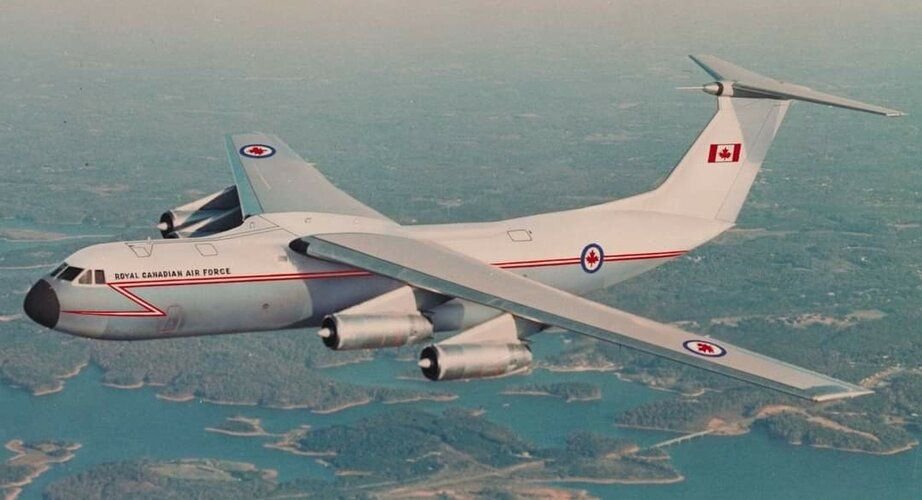
Alternate Canadian Armed Forces procurement 1970s

You missed my key point in that sentence: more or less in one lift.

RCAF would need to have enough air transport capacity to haul some 10k troops at one time. All 10k in the air at the same time (more or less). Not multiple trips unless the unload&refuel timing makes it viable. One trip over and get that plane out of the way for the next one incoming, Berlin Airlift style. For argument sake, half an hour between wheels-down and wheels-up on the way back, and the C130s are going to be landing in Wales or Cornwall (3800km range and it's 3780 Gander-Heathrow).

A contract with Air Canada etc flying 707s or 747s would be a lot less sketchy on the range and would haul double the personnel per flight for 707s, 4x for any 747s. But still only ~200 troops per plane for a 707. So that's ~50 flights you'd need available. Let's call it a 13hr round trip including turn time at both ends in 707s, so 39 hours would get you 3 flights per plane. No, you'd be better off getting 50 birds and flying them all in a single go.


=============

4CMBG was intended to be the reserve units of either BAOR or the US, depending on year, and I know the big boss would want troops on hand to stop the Soviet sprint for Rotterdam. So that's a serious operational argument against 4CMBG-in-Canada plans.

Why would you need that?

IIUC 4CMBG peaked at about 6,500 troops before it was basically cut in half, and CAST was about 5,500 troops which included 3 fighter sqns so the Army component, meaning the ground component was considerably less. I'd guess ~3-4,000 troops would be enough to bring 4CMBG up to the full mid 60s troop numbers after the 1968 re-rog if that's the path that was chosen.

As for the airlift, it took 37 C130 sorties to move 2,400 troops from Darwin 3,700km to Vung Tau SthV, an 11-hour flight. The RAAF only used 3 x C130Es, in a looming WW3 Canada would allocate more than 3 x C130s to the task which would speed up the process considerably.

With a week to get to assembly points it would only take another week to fly 3-4,000 troops to Germany. Presumably this process would start prior to the shooting war. The point being that with prepositioned heavy equipment, and existing CDF resources with some extra beefing up Canada could do its own mini REFORGER rather than stand up CAST with all the problems it entailed.
 
Why would you need that?

IIUC 4CMBG peaked at about 6,500 troops before it was basically cut in half, and CAST was about 5,500 troops which included 3 fighter sqns so the Army component, meaning the ground component was considerably less. I'd guess ~3-4,000 troops would be enough to bring 4CMBG up to the full mid 60s troop numbers after the 1968 re-rog if that's the path that was chosen.
I'm talking moving the entire 1st Canadian Division, not just 4CMBG. We gotta move all of 4CMBG, all of 5CMBG, and half of 1CMBG!


With a week to get to assembly points it would only take another week to fly 3-4,000 troops to Germany. Presumably this process would start prior to the shooting war. The point being that with prepositioned heavy equipment, and existing CDF resources with some extra beefing up Canada could do its own mini REFORGER rather than stand up CAST with all the problems it entailed.
If you have 2 weeks warning on the ball going up, sure.

I'm planning around "Zukov-4"[1] or whatever the instant-mobilization plan the Soviets had is actually called. All their units in Germany and Czechoslovakia west face and forward march, no notice.

[1] hat tip to Tom Clancy in Red Storm Rising.
 
I'm talking moving the entire 1st Canadian Division, not just 4CMBG. We gotta move all of 4CMBG, all of 5CMBG, and half of 1CMBG!

What scenario are you picturing? 1st Div disbanded in 1958 and was reformed in 1988 and 4CIBG was the main formation in Germany until 1968 when it was shrunk and 5CMBG was stood up for CAST. I'm thinking of how to better discharge the policy of shrinking 4CMBG in 1968 and send troops to Europe that CAST planned to do, poorly.

If you have 2 weeks warning on the ball going up, sure.

I'm planning around "Zukov-4"[1] or whatever the instant-mobilization plan the Soviets had is actually called. All their units in Germany and Czechoslovakia west face and forward march, no notice.

[1] hat tip to Tom Clancy in Red Storm Rising.

IIRC the RSR scenario was a mobilisation exercise and deception operation, the instant mobilisation plan was mentioned but not undertaken. In any case not every case can be prepared for, they had to choose something as a benchmark.
 
I knew back in the late 70s that our mobilization plans were literally someone's fantasy.Even with several months advanced notice it would been....ugly.
We were supposably a" swing force " depending on who needed us Although Norway seemed to be our best bet followed by Home Defence. Germany for some reason being last.
Defence of the country would fall into FMC's lap and they the remaining Canadian Army would fall under the Command of the XVIIIth Airborne Corps , United States Army.
May still do as far as I know .
 
I knew back in the late 70s that our mobilization plans were literally someone's fantasy.Even with several months advanced notice it would been....ugly.

I needn't be, if the requirement was thought out in advance. As it was it seems the Government came to a solution to station forces and then told everyone to build a plan around that, without providing any resources for the actual capability.
 
The Canadian military used to have some serious planning chops at one time. However time and the 3 services that oddly enough never went away no matter what the org charts say.
Google I believe EX Rampant Lion in 89 and OP Broadsword in 91. As well Im trying to remember the name of Operation in Africa.
Where basically we sent in a bunch of people into a Country without telling anybody in that Country that we were coming.
Not surprisingly they got arrested, tossed into jail and in the quaint custom of such countries were badly beaten.
 
...Where basically we sent in a bunch of people into a Country without telling anybody in that Country that we were coming.
.

Incorrect operational approach. It is the diplomats who request permission for entrée.

To gain DFAIT's attention, you needed to lay out 3-course lunches with French Service ;)
 
A division of what exactly? Canada bought 114 Leopard 1s, enough for 2 tank regiments for 2 Mechanised brigades. Another order of the same size could provide the tanks for an Armoured brigade for a powerful division of 3 brigades. Canada is rich enough that another 114 Leapard 1s will not break the bank.
Wealth had nothing to do with the size and composition of the Canadian military it had more to do with the Ideological bent of both a major faction of the Liberal Party and more then a few senior civil servants.
Their basic goal was turning the Canadian military into a paramilitary force. Primarily to deal with civil disorder and overseas peace keeping.
It's always been my contention that the Canadian Government was effectively blackmailed by the Europeans into a purchase of new tanks.
We wanted to trade more with Europe in order to lower our economic dependence on the United States ( For some reason that seems oddly familiar?)
The Europeans demanded some concrete examples of of action. This happened with a delay in the the withdrawal of the Canadian brigade and the purchase of new tanks.
The purchase of only 114 gun tanks wasn't really sufficient to equip two regiments the Armour School and a small pool of replacement vehicles.
In little more the 10 years we drove those vehicles into the ground.By the time we did a rebuild and reset a decade later there were tank hulls where you could literally see daylight in cracks.
 
I've since learned that the Canadian Armoured regiment waa pretty big, 59 gun tanks. 114 tanks is enough for a 4th sqn within the Armoured regiment, but not a 2nd 59 tank regiment.

However if the government that was in power for most of the Cold War had no interest in doing much then there's not much wriggle room for alternative history.
 
... However if the government that was in power for most of the Cold War had no interest in doing much then there's not much wriggle room for alternative history.

I disagree. Your statement stands only if you believe that alternative history is a solely a vehicle for creating larger imaginary forces without budgetary or other policy restraints.

I prefer the challenges of realistic constraints. If one also curtails the temptation of 20/20 hindsight, you get to re-run past procurement choices in an environment that is artificially similar to that experienced by RW procurement officers whose choices are being critiqued.
 
I disagree. Your statement stands only if you believe that alternative history is a solely a vehicle for creating larger imaginary forces without budgetary or other policy restraints.

I prefer the challenges of realistic constraints. If one also curtails the temptation of 20/20 hindsight, you get to re-run past procurement choices in an environment that is artificially similar to that experienced by RW procurement officers whose choices are being critiqued.

I prefer the challenges of realistic constraints, but I like to get better results within such constraints and believe in virtuous circle outcomes where good decisions can set up the circumstances for more good decisions.

The fact of the matter is that Canada is fundamentally secure, to the point where defence is a very low priority for politicians and the aims of Defence policy are very unfocused.
 
I prefer the challenges of realistic constraints, but I like to get better results within such constraints and believe in virtuous circle outcomes where good decisions can set up the circumstances for more good decisions.

Understood. The notion of a virtuous circle is uplifting ... but also reflects management bizspeak. The real question is how much genuine predictive power does it have? Idk.

The fact of the matter is that Canada is fundamentally secure, to the point where defence is a very low priority for politicians and the aims of Defence policy are very unfocused.

Ironically, in the '70s, the exact opposite was true for Canadian politicians. From a CAF PoV, the Sept 1969 NATO draw-down was simply a brutal force reduction by a GoC that didn't understand the most basic Canadian military priorities. (Which was probably true.)

But, you could argue, that DND wasn't paying sufficient attention to GoC priorities. And it behooved them to ... hate them or not, these were the people who would be signing off on all of your spending. And those coming changes in GoC priorities weren't secret - they had been made clear by then-MND Léo Cadieux in 1969. And its worth noting that the force reduction were overseen by his successor, retired-Brigadier Charles Drury.

With the benefit of hindsight, it is easy to see that 1970 GoC defence priority changes were barmy ... even somewhat paranoid. So, what were they? PET's new priorities were:

1: Defence of Canada (but better expressed as maintaining 'internal security'). [1] This was a major factor in driving the AVGP programme - 'job one' was meant to be crowd control (making the later disposal of Grizzly and Cougar AVGPs to police forces ironic).

2: Co-operating and co-ordinating with the US military on continental defence - mainly through the joint NORAD treaty, Defence Production Sharing Agreement, and the like.

3: Fulfilling the European NATO commitment (with fewer troops). In reality, the force reduction was focused on West Germany. [2] (PET toyed with withdrawing completely from NATO before recognising the deleterious effects that would have on trade.) [2]

4: Providing forces to man UN peacekeeping missions. (This one also puzzles me more. I cannot tell if this was a genuine priority or whether PET was simply paying lip-service to Mike Pearson's dream.)

My point here is that the 1970s Canadian defence decisions weren't just happening in a vacuum. But they were happening within an active polity ... even if, with hindsight, the GoC's decisions and choices made might feel more like by-products of a fever dream.

_________________________________

[1] Like a lot of 'progressives' of those years, PET was actually a control freak at heart. Trudeau became convinced that late-1960s US disorder - race riots, student protests, etc. - would inevitably spill over our common border. (More realistically, PET worried about radical action by Québec separatists - which proved prophetic but short-lived.)

[2] In contrast with Land Forces and Air Command, the Canadian priority for ASW in the North Atlantic was retained. I'm not quite sure of how or why - but it was demonstrated through the continued DDH 280 and AOR builds along with upgrade programmes like DELEX and SOUP. I've no idea how that dovetailled with the overall policy priorities.
 
My point here is that the 1970s Canadian defence decisions weren't just happening in a vacuum. But they were happening within an active polity

That's my point. There was little to no political will to replace the leased USN submarine on the west coast in 1974, or to make CAST a militarily effective force for example.

Canada isn't alone in that regard, in post-Vietnam Australia Defence was pretty much just going through the motions. The threat had evaporated as had the political will to do much with existing or potential capabilities.
 
That's my point. There was little to no political will to replace the leased USN submarine on the west coast in 1974, or to make CAST a militarily effective force for example.

Canada isn't alone in that regard, in post-Vietnam Australia Defence was pretty much just going through the motions. The threat had evaporated as had the political will to do much with existing or potential capabilities.

We may be defining 'political will' slightly differently. I was trying to illustrate that there was a political will at play in Canadian defence in the 1970s. With hindsight, it became clear that the policy choices and decisions made were was based upon errant nonsense.

To me, that is far worse than "just going through the motions". ('Lazy' might have a cure, fixing 'delusional' is rather more difficult.)

If there was some "going through the motions," your example of CAST is probably the best one. But submarines are a separate issue. So I will address them ... separately.
 
A minor note, HMCS Rainbow had been purchased not "leased". It served out its time, was decommissioned in 1974, and was later returned to the US to be scrapped.

As always, things are not as simple as they seem. The Canadian navy is based in Halifax and nothing reveals their Atlantic bias better than Canada's submarine history. The three Oberons were bought for ASW work with MARLANT (done in concert with MPAs).

Politically, it is worth noting that a Tory government announced the O boat purchase but then never funded it. Instead, it was Pearson's Cabinet that spent on the Oberons and Trudeau's which launched the SOUP programme just before losing power. Take that for what it is worth.

HMCS Rainbow had served to train Canadian submariners and had no other real purpose. Operating Oberons gave Maritime Command the opportunity to exchange crews with the RN. And that provided more relevant experience than could be gleaned on the West Coast.

IOW, political will had little to do with the choices being made. If the Admirals had been given sufficient funding to buy additional Oberons, the surplus wouldn't have ended up in Esquimalt to replace Rainbow. The Navy would have just added the new boats to MARLANT - the only operational area they truly considered important.
 
We may be defining 'political will' slightly differently. I was trying to illustrate that there was a political will at play in Canadian defence in the 1970s. With hindsight, it became clear that the policy choices and decisions made were was based upon errant nonsense.

To me, that is far worse than "just going through the motions". ('Lazy' might have a cure, fixing 'delusional' is rather more difficult.)

Delusion and errant nonsense in security/defence politics are luxuries reserved for the highly secure. Cold War West Germany, South Korea or Israel couldn't entertain the sort of politics in the security realm that Canada entertained during the later decades of the era due to the immediacy and magnitude of the threat to them. If the Soviets regularly were poking around in Canada's backyard, sending planes, subs and ships into Hudsons Bay for example during the 60s and 70s then such delusions likely would have been reduced and defence planning become far more serious.
 
I
I prefer the challenges of realistic constraints, but I like to get better results within such constraints and believe in virtuous circle outcomes where good decisions can set up the circumstances for more good decisions.

The fact of the matter is that Canada is fundamentally secure, to the point where defence is a very low priority for politicians and the aims of Defence policy are very unfocu

A minor note, HMCS Rainbow had been purchased not "leased". It served out its time, was decommissioned in 1974, and was later returned to the US to be scrapped.

As always, things are not as simple as they seem. The Canadian navy is based in Halifax and nothing reveals their Atlantic bias better than Canada's submarine history. The three Oberons were bought for ASW work with MARLANT (done in concert with MPAs).

Politically, it is worth noting that a Tory government announced the O boat purchase but then never funded it. Instead, it was Pearson's Cabinet that spent on the Oberons and Trudeau's which launched the SOUP programme just before losing power. Take that for what it is worth.

HMCS Rainbow had served to train Canadian submariners and had no other real purpose. Operating Oberons gave Maritime Command the opportunity to exchange crews with the RN. And that provided more relevant experience than could be gleaned on the West Coast.

IOW, political will had little to do with the choices being made. If the Admirals had been given sufficient funding to buy additional Oberons, the surplus wouldn't have ended up in Esquimalt to replace Rainbow. The Navy would have just added the new boats to MARLANT - the only operational area they truly considered important.
Talking to my friends in the RCN and reading any thing I could find on the Pacific side of things . You very much get the impression that they were only vaguely aware the the Soviets had a Pacific fleet.
That and the of the attitude of the Navy types who often referred to the MARCOMPAC as " the Yacht Squadron"
 
Talking to my friends in the RCN and reading any thing I could find on the Pacific side of things . You very much get the impression that they were only vaguely aware the the Soviets had a Pacific fleet.
That and the of the attitude of the Navy types who often referred to the MARCOMPAC as " the Yacht Squadron"

Yeah, aka The YAG Squadron ('Ah, summer cruises in Georgia Strait!'). Some of that is just the Halifax-centric culture. But it also stems from a curve-of-the-earth thing - you can't see coastal BC from Ottawa, let alone from Halifax.

For non-Canadians, remember that our population is concentrated in the 'centre' - the original Upper and Lower Canadas - not along ocean coasts. Atlantic Canada has under 2.5M people (fewer than the City of Toronto alone) while coastal BC has 3.6M ... the total making up less than 15% of the total Canadian population of 41.5M. (These are modern numbers but the 1970s percentages were about the same.)

By Canadian standards, a fair bit was happening in the 1970s for Maritime Command - DDH 280/Iroquois class were commissioned in 1972/1973. The Canadian Patrol Frigate Project (CPFP) began in 1975 (with an SoR issued in Aug 1978). And the two Protecteur class AORs were also essentially products of the 1970s - being commissioned in Aug 1969 (AOR 509) and Aug 1970 (AOR 510).

Could we have gone further in the 1970s political climate? That sudden GoC switch to domestic security seems to open a window for another major naval project. Pitched as sovereignty patrol and potential 'aids to civilian authorities', I'm betting that coastal patrol corvettes could have been sold to the GoC. (I realise that it was Maritime Staff planners who were hostile to corvettes in the RW, not Cabinet.)

From an industry PoV, corvettes would have given Canadian yards something to put on the ways between DELEX rebuilds and the start of Halifax class CPF construction. If done right - eg: an over-capacity bridge space, CODOG propulsion, etc. - the corvettes could also served as advanced crew trainers for the ASW fleet. [1]
_______________________________________________

[1] Corvettes could be designed for ease of armaments upgrades - start with a minimal fit and 40 mm 'Boffin' guns before moving on (in the late '80s?) to CPF-style 57 mm Mk 3 mounts. For training, (single-shot?) VLS cells and Harpoon launchers could be mounted? Of course, training corvettes should also have sensor fits capable of simulating SQS-510 sonar, towed arrays, etc.
 
Never knew Canada was interested in such ships.

In the past, DND has looked at LPDs, LSDs, and LHAs. The former got supercharged in the early 2000s by then-CDS Gen Rick Hillier's musings about 'Big Honking Ships'.

Types looked at included:

- US Tarawa/Wasp class Landing Helicopter Assault ships;

- JSS/JLOS (which became the Netherlands' HrMs Karel Doorman);

- Damen Schelde Enforcer class - the basis for both JLOS and LSD II*
-- * NL Rotterdam/Johan de Witt & ES Galicia/Castilia;

- A British Bay LSD(A) (related to LSD II; one hull available second-hand)*
-- * Declared surplus under UK SDSR 2010, HMS Largs Bay became HMAS Choules;

- US Whidbey Island class LSD (and possibly Harpers Ferry class);

- US San Antonio class LPD (but, probably, only for comparisons sake);

- The Danish Absalon class will have also gotten at least a cursory glance.

I wouldn't be surprised if the ex-Ouragan (L9021) and/or ex-Orage (L9022) were looked at when they hit retirement age in 2007 (although such LPDs would be direct threats to the domestic Joint Support Ship concept of that era).

The only semi-serious moves made were on the Joint Support Ship. After two decades pushing sealift - from ALSC (4 x 38,000 t hulls) through the original JSS (3 x 28,000 t hulls) - the latter was downgraded from a multi-role sealift transport into a basic AOR.
 
As I recall one possible replacement for Bonneventure was an Iwo Jima class LPH.
Technically underwealming was one description.
That she really didn't handle moderate to rough seas well at all.
 
I've since learned that the Canadian Armoured regiment waa pretty big, 59 gun tanks. 114 tanks is enough for a 4th sqn within the Armoured regiment, but not a 2nd 59 tank regiment.
FWIW Jane's Main Battle Tanks (published 1986) says:
  • One brigade group deployed to Europe and two brigade groups plus a special force in Canada.
  • The 4th Brigade Group in Europe is stationed in West Germany and has one armoured regiment (Royal Canadian Dragoons), two mechanised infantry battalions, one artillery regiment [with M109s] and one engineer regiment plus supporting units.
  • The Armoured Regiment has 53 Leopard 1A3 MBTs, distributed as follows:
    • A regimental HQ with two Leopard 1A3 MBTs, two M577s and two M113s;
    • Three armoured squadrons with a total of 51 Leopard 1A3 and three M577 command posts each between them.
      • Because each armoured squadron has a HQ element with one Leopard 1A3 and one M577 command post.
        • And.
      • Four troops each of four Leopard 1 A3s.
    • There is also:
      • One reconnaissance squadron with HQ and three troops of Lynx command and reconnaissance vehicles;
        • And
      • One armoured defence group with TOW ATGW.
It continues by saying that 114 MBT, 6 AVLB and 8 ARV were purchased for $187 million: $115 million for the vehicles; $2.7 million for the loan of 35 Leopards until the Canadian Leopards were ready; and the remaining $69.3 million for logistic supplies, training, ammunition and other equipment.

The article on Canada's MBT's concludes.
As can be seen from the above figures less than half the Leopards are in service, the remainder are used in Canada at Gagetown for training or held in reserve in Europe. The two other brigades in Canada are equipped with the Armoured Vehicle General Purpose range of 6x6 vehicles which were manufactured under licence from MOWAG of Switzerland.
FWIW the total strength of 1st Armoured Regiment, Royal Australian Armoured Corps, based at Puckapunyal was 47 MBTs, 3 ARVs and 2 AVLBs out of 90 MBT, 6 ARV and 5 AVLB delivered 1976-78, which includes 3 MBT that have since been converted to driver training tanks.
 
As I recall one possible replacement for Bonneventure was an Iwo Jima class LPH.
Technically underwealming was one description.
That she really didn't handle moderate to rough seas well at all.

Yeah, I thought Iwo Jimas were looked at ... but memory isn't what it once was ;p

A big part of the appeal would have been the Iwo Jimas' well deck for landing craft. But, IIUC, a well deck pretty much dictated the LHAs' flat hull bottoms. Unlikely that an Iwo Jima would be full of happy campers during North Atlantic winter weather!
 
YYeah, I thought Iwo Jimas were looked at ... but memory isn't what it once was ;p

A big part of the appeal would have been the Iwo Jimas' well deck for landing craft. But, IIUC, a well deck prettynu much dictated the LHAs' flat hull bottoms. Unlikely that an Iwo Jima would be full of happy campers during North Atlantic winter weather!
No , you're thinking an LHA or LHD . The LPH had no well deck .
You also have to remember that they're looking at her as replacement ASW carrier not as an Amphibious warfare vessel.
 
IIUC the RAN settled on a new build Iwo Jima to replace Melbourne before the Invincible became available.
 
Why would you need that?

IIUC 4CMBG peaked at about 6,500 troops before it was basically cut in half, and CAST was about 5,500 troops which included 3 fighter sqns so the Army component, meaning the ground component was considerably less. I'd guess ~3-4,000 troops would be enough to bring 4CMBG up to the full mid 60s troop numbers after the 1968 re-rog if that's the path that was chosen.

As for the airlift, it took 37 C130 sorties to move 2,400 troops from Darwin 3,700km to Vung Tau SthV, an 11-hour flight. The RAAF only used 3 x C130Es, in a looming WW3 Canada would allocate more than 3 x C130s to the task which would speed up the process considerably.

With a week to get to assembly points it would only take another week to fly 3-4,000 troops to Germany. Presumably this process would start prior to the shooting war. The point being that with prepositioned heavy equipment, and existing CDF resources with some extra beefing up Canada could do its own mini REFORGER rather than stand up CAST with all the problems it entailed.
Realistically, given Canada's government/military subordination to NATO, may I suggest, given the geographical distance and need of transit speed to support Canadian forces in Europe, that one would look more serious at the likes of Lockheed C-141 Starlifter's in place of C-130's. As denoted by the following information and consideration:

Apophenia, via Bill Walker's page

Post#63 Lockheed’s unbuilt C-141 Starlifter variants, 22 April 2020.


General interest in the C-141 began as far back as 1964. However, numbers for proposed Canadian Starlifter procurements were often higher than those four 'held' serial numbers suggest. Approval had been given in June 1967 for four C-141s (+ a single DC-8). By May 1968, 11 i]Starlifter[/i]s were proposed by one of the Deputy Chiefs, Force Development - MGen Norman George Wilson-Smith (see below).

From a thesis: The Rise and Fall of Canada's Cold War Air Force, 1948-1968, by Bertram C. Frandsen, Wilfrid Laurier University, Waterloo, ON, 2015

page 283

As the current CC-106 Yukon aircraft would reach the limit of their operational life by 1973, at the 16 May 1968 meeting of the DND Estimates Review Committee, Major General N.G. Wilson-Smith, the Deputy Chief Force Development, proposed that the Yukon be replaced with eleven Lockheed C-141 Starlifter jet transports during the period 1972-74 at a cost of $175 million.107 However, it was a missed opportunity, as no orders had been placed in 1967 before the production line closed down.108 Apart from the obvious increase in airlift capabilities, the C-141s would have been a capable refuelling aircraft as the “C-141 could refuel four CF-5A fighters on transatlantic ferry from wing tanks while hauling 30,000-lb flyaway kits and other gear to operate fighters from overseas bases.”109 The opportunity to obtain six additional C-130 aircraft was also allowed to pass.110


107 DHH 73/1223, Series 4, Box 105, File 2103, 174th Meeting of the DND Estimates Review Committee Defence Review, 16 May 1968.

108 DHH 73/1223, Series V, Box 113, File 2500F, S1151-4110/D1 (DSecDD (MM) 4 August 1967, Defence Council
Presentations. At the 226th Defence Council meeting on 27 June 1967, approval had authorized for the purchase of four C-141 and one DC8 aircraft. See also Flying Review International, Vol. 22, No. 15, November 1967, reporting the acquisition of four C-141 tanker-transports, while “Aeronews and Military Report,” Air Progress, Vol. 21. No. 2, August 1967 reported the procurement of ten C-141 jet transports.

109 Ibid.

110 In 1970-71, five Boeing 707 aircraft were procured to replace the Yukon transport, of which two were modified in 1972 as air-to-air refueling tankers. Five additional C-130H aircraft were acquired in 1975.

pp 288-289

The acquisition of the five CC-137s was a far cry from the original plan to acquire eleven Lockheed C-141 Starlifter military jet transports (and possibly the giant Lockheed C-5 Galaxy transports) that had fallen through in 1967, an acquisition that would have provided considerable airlift and flexibility for the mobile force.

135 Ibid. pp. 33-35. See also R.G. Husch, “Future Long Range Air Transport in the RCAF,” Air Force College Journal, 1964. In this article, Squadron Leader Husch discussed a replacement for the Yukon and Hercules transports, noting that the C-141 was unable to utilize semi-prepared runways. Husch noted the growing importance of airlift in the military strategy for brushfire wars.

I appreciate that the time of C-141A production was 1963–1968. As such perhaps a factory direct purchase by the Canadian government is conducted before 1968. Otherwise a second-hand purchase from the U.S./USAF could be accomplished [I fully appreciate that the USAF was in need and want of every C-141A they had. This assistance to an important allie like Canada, in relation to NATO, might give give reason for the USAF to purchase a few more C-5A Galaxy's...] after 1968.

If Canada/RCAF purchase C-141A's, they could contract Lockheed or Canadair to configure externally plumbed air refuelling into their C-141A's.

If Canada/RCAF purchased C-141A's, they could later participate in ttheLockheed/USAF C-141B upgrade program [The C-141B conversion program took place between 1977 and 1982, with first delivery taking place in December 1979.].......


Regards
Pioneer
 

Attachments

  • 622645bac4d350cb4782a031b4c30f83-3429041042.jpg
    622645bac4d350cb4782a031b4c30f83-3429041042.jpg
    60.9 KB · Views: 16
Last edited:
The RW Canadian 'CC-141" order went in prior to the Feb 1968 production shut-down - so a full 6 years before Lockheed proposed IFR for the C-141B rebuilds. Air Command went for the most economical option - unsold 707-347s becoming CC-137s capable of IFR and transport (trooping/cargo).

Considering the USAF's coming structural issues with the C-141, the CAF may have had a lucky escape. I can't see Canada paying for the usual Lockheed wing box replacement and fatigue crack remediation, can you? So, assume that the 'CC-141' would have served from 1968 to 1978 when retired for airframe fatigue reasons. Meanwhile, RW CC-137s served on for another two full decades.

More to the point (of replacing the embryonic CAST with airlift), while the C-141A had impressive TO performance in 'lightweight' conditions, it still relied upon long, intact runways when more heavily loaded. (Lockheed did propose a rough field C-141 variant but that was never realised.)

Since we're into AltHist here, an 'out there' what-if might be General Dynamics taking over C-141 tooling after Feb 1968. Thereafter, the GD parent firm supplies the airframe spares for USAF C-141s while also supplying subsidiary Canadair with wings, tails, and major fuselage sections. Canadair then develops a short-bodied and truly STOL strategic freighter based on those components.

Or ... Canada just leases sealift to pre-position the materiel that it will require in Europe.
 
The RW Canadian 'CC-141" order went in prior to the Feb 1968 production shut-down - so a full 6 years before Lockheed proposed IFR for the C-141B rebuilds. Air Command went for the most economical option - unsold 707-347s becoming CC-137s capable of IFR and transport (trooping/cargo).

Considering the USAF's coming structural issues with the C-141, the CAF may have had a lucky escape. I can't see Canada paying for the usual Lockheed wing box replacement and fatigue crack remediation, can you? So, assume that the 'CC-141' would have served from 1968 to 1978 when retired for airframe fatigue reasons. Meanwhile, RW CC-137s served on for another two full decades.
Foresight is a wonderful thing, is it not.
Given this, there is no way Canada/RCAF could have predicted the coming structural issues of the C-141.
Add to this the fact that the RCAF wouldn't have clocked up anywhere near the incredibly high flight tempo used by the USAF MAC, given the VietNam.War.
More to the point (of replacing the embryonic CAST with airlift), while the C-141A had impressive TO performance in 'lightweight' conditions, it still relied upon long, intact runways when more heavily loaded. (Lockheed did propose a rough field C-141 variant but that was never realised.)
Given U.S./NATO forecasts about steamrolling NATO forces in central/Western Europe with a couple of weeks, if the balloon went up. I think speed to reinforce is going to be paramount. As much as rough-field capability of the C-141 is shit, one would think it somewhat better than that of a Boeing 707. Especially if the Soviets/Warsaw Pact take out principle U.S./NATO airbases and runways, as the U.S./NATO feared.

Regards
Pioneer
 
Last edited:
Foresight is a wonderful thing, is it not.
Given this, there is no way Canada/RCAF could have predicted the coming structural issues of the C-141.
Add to this the fact that the RCAF would have clocked up the incredibly high flight tempo used by the USAF MAC, given the VietNam.War.
Would the RCAF have flown as much as USAF MAC, though?

I mean, there's hauling the various express-delivery items to Europe or around various bases in Canada, but it's not like the RCAF would be flying entire divisions into Vietnam every 3 months or less. At most they're flying ~4200 dudes into Europe on a REFORGER, and even then that task is best covered by chartered 707s.
Assuming mostly pre-positioned gear, not shipping an entire mechanized brigade across the pond by air. And even then it's probably better to send all the troops over on 707s to save the C141s for vehicles.
 
Foresight is a wonderful thing, is it not.
Given this, there is no way Canada/RCAF could have predicted the coming structural issues of the C-141.
Add to this the fact that the RCAF wouldn't have clocked up anywhere near the incredibly high flight tempo used by the USAF MAC, given the VietNam.War.

I wasn't claiming prescience ... and would have thought that "lucky escape" made that obvious. But your 3rd sentence implies value through reduced use. Can't see that myself.
...Given U.S./NATO forecasts about steamrolling NATO forces in central/Western Europe with a couple of weeks, if the balloon went up. I think speed to reinforce is going to be paramount. As much as rough-field capability of the C-141 is shit, one would think it somewhat better than that of a Boeing 707. Especially if the Soviets/Warsaw Pact take out principle U.S./NATO airbases and runways, as the U.S./NATO feared.

Again, to me, strange logic. How can reinforcement by air provide more "speed" than prepositioning materiel? And if the "rough-field capability of the C-141 is shit", how is it "better" than the CC-137? Neither type was going land anywhere useful after the major airfields were taken out.

If a superior product still can't do the job, chances are the entire operational concept is flawed.
 
I wasn't claiming prescience ... and would have thought that "lucky escape" made that obvious. But your 3rd sentence implies value through reduced use. Can't see that myself.


Again, to me, strange logic. How can reinforcement by air provide more "speed" than prepositioning materiel? And if the "rough-field capability of the C-141 is shit", how is it "better" than the CC-137? Neither type was going land anywhere useful after the major airfields were taken out.

If a superior product still can't do the job, chances are the entire operational concept is flawed.
What I was implying re "reduced use", is that the RCAF wouldn't be flying the same amount of sorties, compared to what the USAF flew it's C-141A's due to the VietNam War, which chewed up their life through structural fatigue.

I personally never mentioned anything about "prepositioning", let alone comparing airlift vs prepostioning.

Yes, irrufutably, the rough-field performance of the C-141 is/was shit. But undoubtedly, it would be better than that of the Boeing 707, push comes to shove.
At the end of thr day the the military spec C-141 is much more versatile than the civilian spec Boeing 707 - it's loading and unloading with its truck bed height floor, clamshell door/ramp arrangement. Plus, the C-141 inherently gives the flexibility to deliver troops/cargo by parachute.


Regards
Pioneer
 
Prepositioning versus sealift/airlift had been part of the larger conversation. I came down on the side of prepositioning in favour of trying to sail or fly troops and equipment into an active warzone. Hence my statement that the fly-in operational concept was flawed.

I understood your 'reduce use' implication. I also believe that the C-141 was the best strategic transport aircraft of its day. But, regardless of airframe type, how does it help Canada to own expensive jet transports aircraft for reinforcement when those aircraft will have little chance of finding an intact runway on D+1?

I understood your inference that reduced flying hours and corresponding fatigue time provide an extended service life. What I don't see is how an extended life for an aircraft type that won't be able to land where we need is actually helpful in extremis.
 
Prepositioning versus sealift/airlift had been part of the larger conversation. I came down on the side of prepositioning in favour of trying to sail or fly troops and equipment into an active warzone. Hence my statement that the fly-in operational concept was flawed.

I understood your 'reduce use' implication. I also believe that the C-141 was the best strategic transport aircraft of its day. But, regardless of airframe type, how does it help Canada to own expensive jet transports aircraft for reinforcement when those aircraft will have little chance of finding an intact runway on D+1?

I understood your inference that reduced flying hours and corresponding fatigue time provide an extended service life. What I don't see is how an extended life for an aircraft type that won't be able to land where we need is actually helpful in extremis.
So basically what you're telling me is that you'd like is a helicopter with a payload of roughly 30 tons with a range of approximately 6000 miles plus ?
 
Last edited:
I've always considered Canada a good potential customer for the Shorts Belfast, assuming it fits in with Canada's procurement timing.
The Short Belfast did have superior usable cargo dimensions to its fuselage.
Short did offer a few proposed variants - including a longer range variant and a variant that offered superior rough-field performance......

Regards
Pioneer
 
Back
Top Bottom