
This is not a shock missile, but a distracting one

I see, I thought they were using RM48U missiles as decoys and the 48n6DM as actual strike missiles?? Are you sure? Really surprised they can reach Kyiv though, FP-9 is expected to have about 750km range and similar physical external shell to 48n6DMThis is not a shock missile, but a distracting one
Russian propagandists produced a report in Luhansk, falsely presenting almost an entire destroyed S-400 air defence system battery as destroyed Ukrainian military equipment. The battery, likely destroyed by HIMARS.
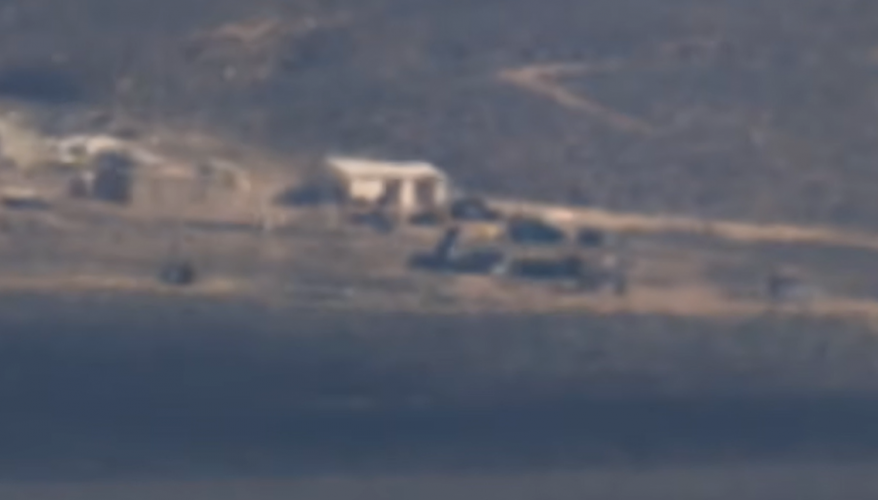
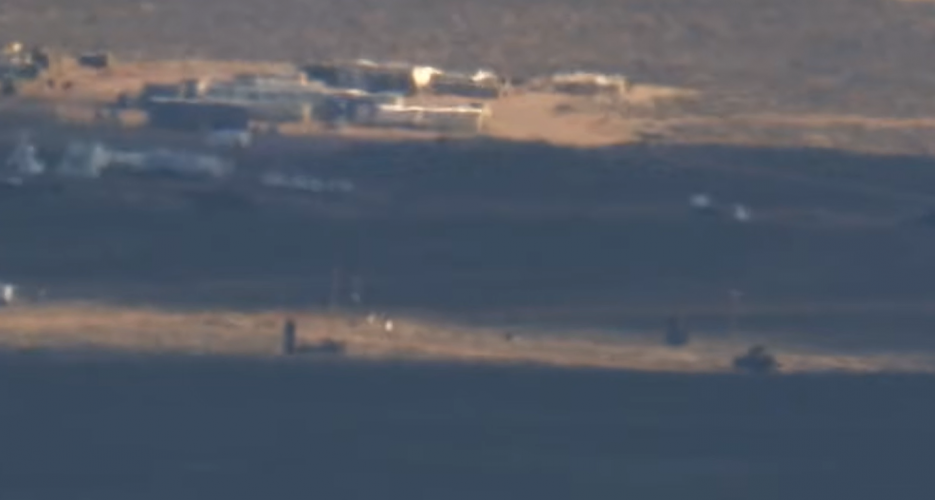
Most likely a mockup, there's plenty of those sorts of things out there. I believe they also have HQ-9 battery mockups.Does anyone have any idea how a Triumf battery could've gotten into the states? And from who?
This doesnt look like a bombing test range due to the proximity of all the buildings near the mobile radar/launchers
Could be a mockup.Post comes from Uncanny Expeditions - I caught something interesting as he was filming a base in Nevada.
Of course I could be mistaken but the images below have to be showing an S400 battery (launchers and flaplids included) in the states.


i truly wonder whats going to happen in the coming months. Russia has been losing on average 30 air defense units (launchers or radars) a month. Its a snowball effect. The more that gets taken out, the easier it is for more drones to slip through and destroy the rest. This opens up a massive window of opportunity for larger drone raids or even operations by the Ukrainian air force. But Im not very certain that the Ukrainian air force could put together a meaningful air patrol to confidently challenge the VKS in open air.

Post comes from Uncanny Expeditions - I caught something interesting as he was filming a base in Nevada.
Of course I could be mistaken but the images below have to be showing an S400 battery (launchers and flaplids included) in the states.
Timestamp 26:22 for this video ->View: https://www.youtube.com/watch?v=2UG-4YPjMdY
Does anyone have any idea how a Triumf battery could've gotten into the states? And from who?
This doesnt look like a bombing test range due to the proximity of all the buildings near the mobile radar/launchers

On Wednesday, June 10, scientists discussed domestic developments in integrated photonics at a meeting of the Scientific Council of the Russian Academy of Sciences (RAS) Division of Nanotechnologies and Information Technologies. The meeting, titled "Fundamental Problems Regarding the Component Base for Information-Computing and Control Systems and Materials for Their Creation," was chaired by RAS President Academician Gennady Krasnikov."Integrated photonics will help create ultra-fast, energy-efficient computing systems, precision sensors, and high-speed communication lines. We periodically revisit this topic to assess the results achieved and the prospects for future development," the RAS head stated while opening the meeting.
Photo 1 According to Pavel Sozinov—Deputy General Director of Almaz-Antey Air and Space Defence Corporation JSC and a Corresponding Member of the RAS—who delivered the introductory report, integrated photonics technologies have largely driven rapid progress in the creation of new radar systems, electronic warfare equipment, and radio communication systems.The scientist noted that current key objectives include creating radio-photonic signal paths capable of expanding antenna array operating frequency bandwidths to 100%, as well as developing inertial navigation systems based on micro-optical gyroscopes.
Programmable photonic chips and multifunctional microcircuits are also among the priorities.Vadim Startsev, General Director of the M.F. Stelmakh Polyus Research Institute (JSC NII Polyus), presented a report on the development of radio-photonics. He stated that developments in this field are being applied in communications, medicine, metrology, sensor technology, and other areas. The specialist added that Russia is currently revising its industry development program, with the new version placing greater emphasis on end products. "It is easier to develop the component base when there is a specific target product in mind," he emphasized.
Contrary to popular belief, Russia produces thousands of telecommunications components annually, with a market value estimated at several billion rubles. This market is controlled by Russian companies, noted Andrey Zablotsky, head of the Center for Advanced Electronics at the Foundation for Advanced Research. In his view, domestic manufacturers are best positioned to compete in the creation of high-tech products for the future.During the meeting, participants presented examples of practical applications for integrated photonics technologies. Vyacheslav Svetukhin, Director of the "Technological Center" Research and Production Complex and a Corresponding Member of the Russian Academy of Sciences, outlined the range of innovative products manufactured by the enterprise. These include narrow-linewidth lasers, photodetectors, optical switches, and other high-tech devices. He placed particular emphasis on the development of optical memory based on phase-change materials.
Stanislav Straupe, head of the Quantum Computing Sector at the Lomonosov Moscow State University Quantum Technology Center, discussed the use of integrated photonics in artificial intelligence applications. He reported on the development of a prototype device capable of performing matrix multiplication using light. The computational precision is approximately 4 bits, which is sufficient for modern neural networks.The application of optical technologies in space was a key topic in the presentation by Arkady Shipulin, head of the Integrated Photonics Laboratory at Skoltech. He explained that scientists had developed an onboard satellite communication system replacing traditional wiring with optical fibers. Furthermore, special gratings were applied to the fibers, enabling the optical cables to function as sensors for measuring temperature, strain, and other parameters.Skoltech also tested photonic integrated circuits for resistance to space radiation, the specialist added. These experiments utilized a simulator employing laser pulses with parameters designed to replicate the effects of heavy charged particles. It turned out that the impact of such a particle "shuts down" the photonic microchip, but it resumes operation after 200 nanoseconds. This opens up new possibilities for inter-satellite communication technologies. Engineers are currently developing laser terminals for this purpose; initially, they will transmit data at 10 Gbps, and later at 100 Gbps.
Alexander Bobrov, Head of the Radiophotonics Laboratory at the Research Institute for Physics and Technology of Lobachevsky State University of Nizhny Novgorod, described the development of a system for controlling a phased antenna array using light.The concept, he explained, involves converting the radio signal from each antenna element into an optical signal. These signals are then combined on a specialized silicon photonic integrated circuit, where phase shifts are applied to shape the beam in the desired direction. The team has already built a working testbed and mastered the fabrication of waveguides, signal splitters, and control elements. By the end of the year, the scientists plan to assemble an eight-channel system and integrate it into a radar unit.
Leonid Karachinsky, CEO of Connector Optics LLC and a leading researcher at ITMO University, discussed the development of systems based on vertical-cavity surface-emitting lasers (VCSELs). These devices allow photonic integrated circuits to be packed tightly together and integrated into 3D structures. Such lasers are used in smartphones, medical equipment, and atomic sensors. Among the developers' achievements is the creation of mass-produced devices with a wavelength of 1250 nm, which are in demand for data centers and LiDAR systems.Continuing the discussion, Vadim Kovalyuk, a senior researcher at the National University of Science and Technology MISIS, demonstrated developments based on silicon nitride photonic chips. These include systems for monitoring the charge of vanadium batteries, tools for detecting cancer markers in blood, hydrogen sensors, and a quantum random number generator. The scientist also reported on the platform's application in developing optical memory devices and logic elements for future photonic neuromorphic computing systems.Meanwhile, Alexander Shamray, Head of the Quantum Electronics Laboratory at the Ioffe Institute of the Russian Academy of Sciences, discussed systems based on lithium niobate. According to him, thanks to high-speed light signal control and low noise levels, this material holds a unique position among platforms for converting electrical signals into optical ones.
The council meeting concluded with a presentation by Konstantin Pevchikh, Head of the Integrated Photonics Technology Division at the Zelenograd Nanotechnology Center. He reported on the development of the silicon interposer concept—intermediate layers used in microelectronic devices. In particular, these interposers will enable the integration of traditional and photonic integrated circuit components into unified systems.The Scientific Council meeting was attended by 160 participants representing 104 organizations and their subdivisions. Twenty-four individuals took part in the discussion of the agenda.
that wall of text has a lot of information, and the bolded parts are what applies to this thread. I had to also use google translate so the copy and pasting didn't help much formatting what is each paragraph, but I will edit the post again.
 .
.
I think the Gulf states need all the air defense they can use right now.Let's hope that this sale to a third country leads to said country reselling the SA-21 to Ukraine

They carry a big warhead and can fly quite a ways. Why not? Lots of SAMs have been used in the surface-to-surface mode over the years. SM-1/2/6, Talos, Nike Hercules, and probably many others around the world. Granted, if they're using S-400s one has to ask, "what happened to all the S-300s?"S-400s now formally serving as rocket launchers.
View: https://x.com/NOELreports/status/2092557995490095295?s=20
S-400 can (and mostly does) use S-300 launchers (and reverse is almost certainly also possible).They carry a big warhead and can fly quite a ways. Why not? Lots of SAMs have been used in the surface-to-surface mode over the years. SM-1/2/6, Talos, Nike Hercules, and probably many others around the world. Granted, if they're using S-400s one has to ask, "what happened to all the S-300s?"
I know. The claim is S-400 missiles are being used. I was asking, "what happened to all the S-300 missiles that they have to resort to using the better S-400 SAM".S-400 can (and mostly does) use S-300 launchers (and reverse is almost certainly also possible).
The only launcher exclusive strictly to S-400 is 51P6, and it's special in many ways.
How so?The only launcher exclusive strictly to S-400 is 51P6, and it's special in many ways.
Ah, i think it's simple. 55 series of missiles are TvM guidance, they were used in direct attack mode back in 2022-24 (they can from 1980s). It was clunky (you need guidance radar to "drop" missile where you want, it's a variant of how S-300 engages low altitude air targets), and accuracy was unavoidably meh.I know. The claim is S-400 missiles are being used. I was asking, "what happened to all the S-300 missiles that they have to resort to using the better S-400 SAM".
It's the only one equipped with datalink, and it's the only one that can use active missiles.How so?
They carry a big warhead and can fly quite a ways. Why not? Lots of SAMs have been used in the surface-to-surface mode over the years.
Granted, if they're using S-400s one has to ask, "what happened to all the S-300s?"
Sure you can use an SA-21 that way but keep in mind they're a SAM optimised for surface-to-air aircraft/missile interception and aren't great as SSMs (Such as the SS-26 Stone for example)
No. As the article above, that you liked, said: it has both ins and satnav. Its likeley fairly accurate.So basically an inaccurate terror weapon, functionally a 21st century V2/A4 missile.


