AIRBUS RACER / Clean Sky2 LifeRCraft Demonstrator

With the drag, surely some arrangement of upwards folding flaps as on the Chinook and a long downwards ramp would enable a more aerodynamic rear fuselage arrangement even with the need for fins above and head clearance below? Most helicopters are handicapped by the need for a structural tail boom whereas for this I don't see why it couldn't be much wider and flatter.
That's the problem. Wider and flatter means draggier.
 
That's the problem. Wider and flatter means draggier.
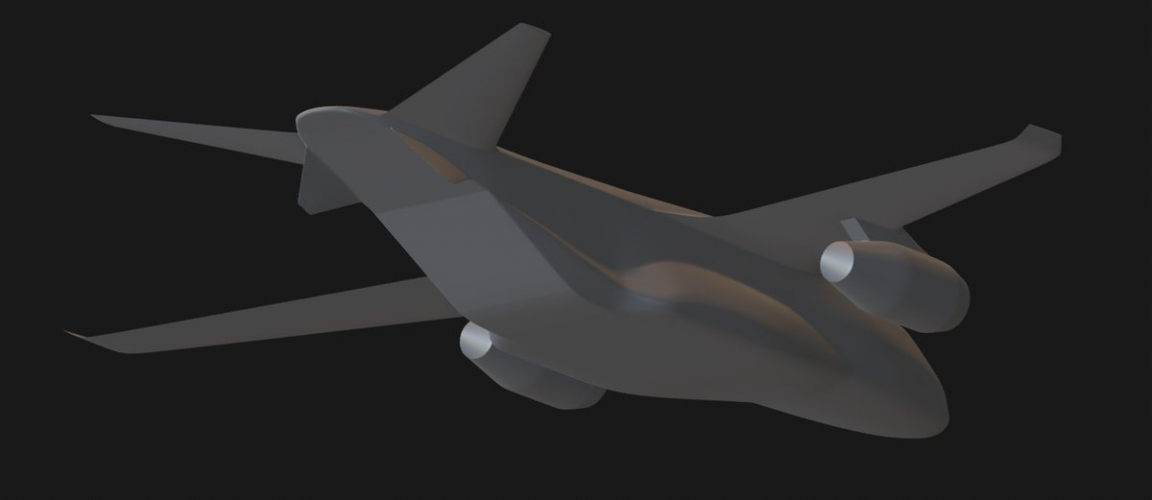
Sorry, didn't specify what 'it' was there. I meant that in order to provide the pitch stability in forwards flight instead of having a thin tail boom with stabilisers on the end of it you could have a sort of 'beaver tail' protruding above the rear ramp and then have downwards-pointing v-stabilisers for yaw to allow the boom to be closer to the rotor disk. My inspiration was this AU design I saw for a C-2 style transport designed to fit in lower hangars:
1776924801946.png
 
With moderrn control laws associated with computer driven flight controls stability might be possible, however, the design shown causes me to wonder at how turbulent the air will be coming across the ventral vertical stabilizers as it comes off the wing root and the fuselage. Potentially significant drag increase. Also, while carrier landings might not be at risk high alpha landings might find the ventral stablizerrs at risk of ground strike. If the aircraft was to have unimproved landing capability the stablizers would also be at risk of flying debris at the landing site.

Sorry! Back to Airbus helicopters. Given the number of helicopters that use ramps and cargo aircraft too, it certainly is feasible. It would come down to does the ramp buy its way into the design from the customers requirements. With the accelerated increase in UGV I would not be surprised to see a ramp to support egress/ingress of smaller UGV in support of operations.
 
With moderrn control laws associated with computer driven flight controls stability might be possible, however, the design shown causes me to wonder at how turbulent the air will be coming across the ventral vertical stabilizers as it comes off the wing root and the fuselage. Potentially significant drag increase. Also, while carrier landings might not be at risk high alpha landings might find the ventral stablizerrs at risk of ground strike. If the aircraft was to have unimproved landing capability the stablizers would also be at risk of flying debris at the landing site.
At risk of becoming an off topic discussion, the C-2 I was referring to was the Kawasaki C-2 not the C-2 Greyhound. It's a big beast, not for carriers!
Sorry! Back to Airbus helicopters. Given the number of helicopters that use ramps and cargo aircraft too, it certainly is feasible. It would come down to does the ramp buy its way into the design from the customers requirements. With the accelerated increase in UGV I would not be surprised to see a ramp to support egress/ingress of smaller UGV in support of operations.
Even smaller helicopters like the NH90 have rear ramps, it's quite well faired in on the NH90 even with the tall and mid-mounted tail boom. So I think it could definitely be done aerodynamically, the main problem would (I think) be safety with the complete absence of any side doors.
 
With the troop ingress problem, what about not having a side door at all? If the propellers were returned to the tractor configuration then they could use a rear ramp (with a high tail and downwards pointing strakes/fins) perhaps.
Some of the early Eurocopter X3 concepts and patents did in fact show a rear ramp and pretty much exactly the configuration you’re describing.

Airbus-X6-RACER.jpg

jmr-utility-jpg.163026

32001-1f8623f2e093ebb94c648ff880f0fd5d.jpg
 
Some of the early Eurocopter X3 concepts and patents did in fact show a rear ramp and pretty much exactly the configuration you’re describing.
That's nice then! I particularly like the middle one, that's the closest to what I had in mind with the extra headroom around the ramp.
 
It likely does make the aircraft heavier, more complex, and thus the likelihood to be more expensive. I think that one of the reasons Airbus has gone this route for its submission is to keep cost down. We should keep in mind that RACER is still only a demonstrator, and the designs show by Airbus are likewise initial ideas, mostly to show that the same fuselage and dynamics might be usable for both conventional and compound capabilities.

I would note that AVX also had a rear ramp and doors for their FVL medium design.
 
Looks like Racer is back in the air after its 50hr maintenance inspection and Eco-mode upgrade... 3 test flights in the last week.
https://www.flightradar24.com/data/aircraft/f-wrac

This year's test plan includes:
  • 1-engine cruise at ~180 knots
  • Noise reduction using flight path optimization and aircraft attitude control
  • Minor drag improvements (new coamings)
  • Winch operations and Search & Rescue mission demonstrations
https://www.ainonline.com/aviation-...ives-outlined-airbus-racer-completes-eco-mode
 

Attachments

  • 1779849927246.png
    1779849927246.png
    73.5 KB · Views: 26
I would love to see the *exact* requirement specs for this Egg-Laying Wool-Milk Sow 2.0...
 
Racer flew from Marseille to Berlin in 3 hops today, its fastest long-distance flight to date.

The segment times were 154nm in 49min, 243nm in 69min, 241nm in 72min which is an average of 190 - 210 knots door-to-door for each segment. Air speed at cruise altitude of 8-10,000ft was around 210-220 knots... pretty solid.

https://www.flightradar24.com/data/aircraft/f-wrac
 

Attachments

  • 1780955750041.png
    1780955750041.png
    799.9 KB · Views: 23
Last edited:
Also from ILA 2026, here's a nice video walkaround of Racer (with lots of details), as well as the full flying demo.

View: https://www.youtube.com/watch?v=NeH3NaSMjr8

I wish they would just go ahead and start selling it... although it's billed as only a technology demonstrator, it looks more like a pre-production prototype that could easily be turned into a finished product. I'm curious how many potential customers are out there who would be interested in becoming an early adopter... especially for VIP, offshore SAR and parapublic missions where intervention time matters and mission radius is at least 100-150km (there must be some EMS and police missions that fit that).
 
Last edited:
Also from ILA 2026, here's a nice video walkaround of Racer (with lots of details), as well as the full flying demo.

I wish they would just go ahead and start selling it... although it's billed as only a technology demonstrator, it looks more like a pre-production prototype that could easily be turned into a finished product. I'm curious how many potential customers are out there who would be interested in becoming an early adopter... for VIP, offshore SAR and parapublic missions where intervention time matters and mission radius is at least 100-150nm (there must be some EMS and police missions that fit that).
What's the hover efficiency like? In the UK at least police helicopters spend a lot of time loitering at low speed and altitude, and we have 15 bases for them so the range requirement isn't huge.
The smallish footprint and high speed would make a RACER a great air ambulance though.
 
What's the hover efficiency like? In the UK at least police helicopters spend a lot of time loitering at low speed and altitude, and we have 15 bases for them so the range requirement isn't huge.
The smallish footprint and high speed would make a RACER a great air ambulance though.
I was thinking more for counter-terrorism related missions (i.e. how fast can you deploy a team) than routine police work.

For air ambulance apparently the use case is less for primary response and more for secondary transfers of critical cases from small hospitals to specialized ICUs.
 
I wish they would just go ahead and start selling it... although it's billed as only a technology demonstrator, it looks more like a pre-production prototype that could easily be turned into a finished product.
No future for civilian Racer it seems...

Airbus Helicopters chief plays down prospects of high-speed programme without military money​

https://www.flightglobal.com/archiv...-high-speed-programme-without-military-money/
Airframer continues to validate its compound architecture through flight tests of the Racer demonstrator.

Airbus Helicopters is unlikely to launch a new civil rotorcraft using the compound architecture it is validating through the Racer demonstrator without first introducing the high-speed technology on a military platform, according to the airframer’s chief executive.

In flight testing since April 2024, development of the Racer has been funded by the EU’s Clean Sky 2 civil aviation programme. In addition to a goal of proving the viability of a fast rotorcraft – it has reached speeds of up to 240kt (444km/h) – the Racer is also intended to demonstrate improvements in fuel burn and noise emissions. Despite the civil focus of the Clean Sky 2 funding, Airbus Helicopters chief executive Matthieu Louvot believes the Racer architecture is “probably” destined to first appear on a military rotorcraft.

This is due to “the cost implied in the development” and the fact that “we think the value of speed, the additional speed, will be stronger for military customers”, he says. “One day if you make a high-speed helicopter you could [eventually] have a civil version,” he adds. While Clean Sky 2 bankrolled the development of the demonstrator itself, Airbus Helicopters has funded the Racer’s flight-test programme from its own research and technology budget.

Elsewhere, Airbus Helicopters is receiving EU-level support to mature the technologies required for a future military rotorcraft. Alongside Leonardo Helicopters, the manufacturer is leading a project backed by the European Defence Fund (EDF) to mature the technologies required for a future military rotorcraft. Called the European Next Generation Rotorcraft Technology (ENGRT), the EDF has provided €100 million ($114 million) for its second phase, running until early 2029. But ENGRT remains at an early stage: at this point it is focused on the technological building blocks for a future helicopter and has yet to settle on one particular architecture. (...) To a considerable extent, the overall configuration will be determined by desired performance, with high speed necessitating a more complex and costly architecture. “If you want speed then it is a trade-off for a smaller payload,” he says. “You have to accept larger costs, so it is up to governments to see if there are enough benefits to speed to cover the costs entailed by such architectures.”

Should speed be selected as the predominant characteristic, then the debate will move on to the exact design: while Airbus Helicopters is clearly championing a Racer-derived compound rotorcraft, Leonardo Helicopters favours a tiltrotor. Although the two airframers have successfully collaborated, alongside GKN/Fokker, on the current NH Industries NH90, the disparity between the two architectures proposed for high speed suggest that such a partnership would be difficult to reprise in the future. However, Louvot insists there is a genuine desire to continue working with its European competitor. “We strongly think the Racer architecture has many merits but there is a general willingness in any case to continue to co-operate efficiently with Leonardo… having a joint view of future military helicopters for Europe is a real strength and we want to keep it. “I would tend to say that European co-operation in helicopters so far has worked pretty well, we just need to continue in that vein.”

(article continues)

 
To read from an aircraft manufacturer that Speed (above 170kts) is in trade against payload is quite debilitating... What about that Kutta-Joukowski equation?

Also, what about their participation in CleanSky where the goal was clearly civilian? Did they lie? Were they promising something tricked to get the lead in the competition?... Someone with sense should close the mic of that guy...
 
I think that there will be a full military RACER effort. There has to be for the compound rotorcraft to be viable for NGRC. X2 is really not in the competition and Leonardo tilt rotor is a long shot. Boeing and Sikorsky will likely come in with conventional rotorcraft. If RACER has not further established good operations with the military pilots I think Airbus will revert to conventional designs as well.
 
Leonardo Tilt Rotor is as long shot as a McClane detective. I would suggest leaders of NGRC program start putting their German colleague with the strongest accent back in the front that Italian engineers start Yippee-ki-yay-ing before it's too late!

It would be a failure for Europe to not have a tilt or a compound win this competition (and I said win, what means being able to supersede alternative design with real performances).

View: https://youtu.be/zca9zEKejjY
 
Last edited:
Leonardo Tilt Rotor is as long shot as a McClane detective. I would suggest leaders of NGRC program start putting their German colleague with the strongest accent back in the front that Italian engineers start Yippee-ki-yay-ing before it's too late!

It would be a failure for Europe to not have a tilt or a compound win this competition (and I said win, what means being able to supersede alternative design with real performances).

View: https://youtu.be/zca9zEKejjY
While I personally agree that both high speed platforms would be in the interest of Europe, a significant portion of the rotorcraft needing replacement are in Eastern Europe where they have continued to rely on venerable Russian aircraft or second hand western platforms. The distances are not overly compelling for a tilt-rotor for much of eastern Europe. Those nations (mostly in western Europe) who have overseas concerns or significant maritime obligations might find tilt rotor compelling for reconnaissance and potentially littoral combat support.
 
Racer is technologically by far the simplest lowest risk compound rotor concept in existance. Does not seems like some mayor investment program more like , what can be built with bits and parts of existing hellos and not to much money. I am quite certain a better platform could be developed if there were funds for it.
Cool thing would be if it could slow rotor down , besides shuting one engine down to save fuel on cruise which is most of helicopters operating time

In any case for most real world applications compound beats convertiplane , disc loading alone creates so many issues when not operating from hard surfaces .

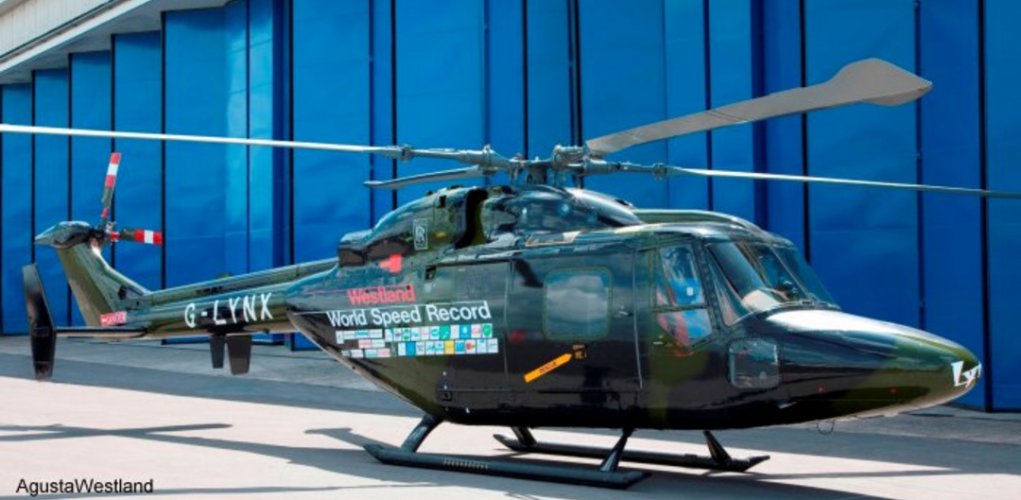
400+kmh has been reached with non compound helos in the past.
westland-lynx-ah-1-g-lynx-fai-world-absolute-speed-record-holder.jpg
2026-08-16_21h51_18.png
 
Last edited:
Has any-one discussed how the diamond-box wing potentially offers a lot of pylon points ??
 
Has any-one discussed how the diamond-box wing potentially offers a lot of pylon points ??
Remember drag is exponential. More drag means more power, which means more fuel. Certainly it is feasible to put rockets and missiles all over the diamond box wing, but I will defer to the more aerodynamically inclined as to the implications to the lift charecteristics of the diamond box in doing so.
 
Remember drag is exponential. More drag means more power, which means more fuel. Certainly it is feasible to put rockets and missiles all over the diamond box wing, but I will defer to the more aerodynamically inclined as to the implications to the lift charecteristics of the diamond box in doing so.
Indeed. IMHO they could look at internal weapons carriage in small sidebays similar to the RAH-66 Comanche. There would appear to be a perfect spot under the cabin door... probably enough space for a pop-out door with a 12-round laser guided rocket pod or 2x missiles each side. Could carry fuel tanks when no weapons needed.

Though this wouldn't really be needed for the NATO NGRC medium lift program. More relevant if someone wanted to adapt the current RACER into a smaller battlefield utility / multirole helicopter similar to H160M or Battlefield Lynx (with a 3rd crew man in the rear acting as UAV controller and the ability to launch effectors out the main cabin door).

47833eb0-859f-48b8-ae09-e26fbbf12c39-jpeg.674538
 
Last edited:
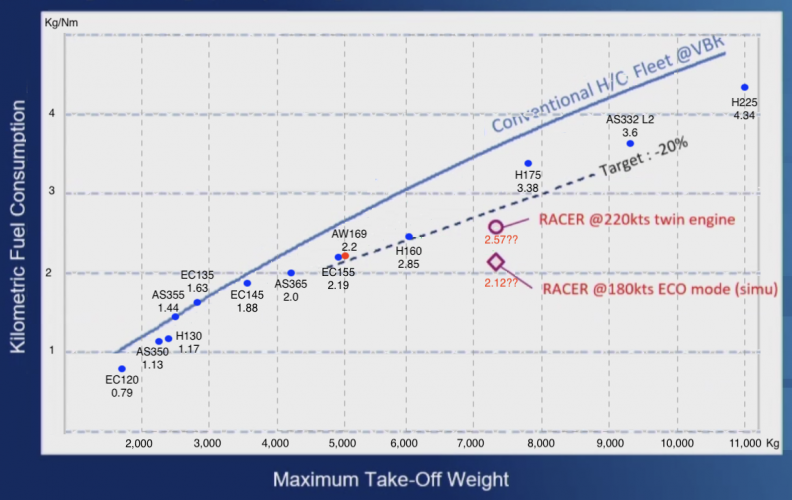
For those interested in Racer's fuel consumption claims, I was able to reconstruct the missing scale from this chart published by Airbus. I then added comparative datapoints for other Airbus helicopters, as well asthe AW169 which is Racer's closest competitor in terms of payload capacity.

This allows us to visualize the paradox that lies in Racer's performance, with claims of impressive fuel consumption reductions that don't quite add up as Airbus has taken some liberties with its benchmark (the blue line) which does not reflect the performance of the best helicopters in their own lineup. And on top of that by choosing to compare against helicopters in the same weight class the results are inherently biased since this ignores the fact that those helicopters offer superior payload capacity.

The net result is that Racer's extra weight remains a significant drawback. Ultimately, its fuel consumption is no better than the two helicopters most comparable in terms of cabin volume (the 12-passenger H155 and 10-passenger AW169). And very likely a new conventional helicopter could achieve better results using the latest technologies, raising the bar even higher for Racer.

All that being said Racer looks like an amazing machine for anyone who needs speed. Just worth pointing out the excessive greenwashing claims that have repeatedly been put forward by Airbus to try to make Racer look like a more environmentally friendly helicopter than previous generations (to meet EU CleanSky funding requirements).

Racer fuel consumption v2.png
 
For those interested in Racer's fuel consumption claims, I was able to reconstruct the missing scale from this chart published by Airbus. I then added comparative datapoints for other Airbus helicopters, as well asthe AW169 which is Racer's closest competitor in terms of payload capacity.

This allows us to visualize the paradox that lies in Racer's performance, with claims of impressive fuel consumption reductions that don't quite add up as Airbus has taken some liberties with its benchmark (the blue line) which does not reflect the performance of the best helicopters in their own lineup. And on top of that by choosing to compare against helicopters in the same weight class the results are inherently biased since this ignores the fact that those helicopters offer superior payload capacity.

The net result is that Racer's extra weight remains a significant drawback. Ultimately, its fuel consumption is no better than the two helicopters most comparable in terms of cabin volume (the 12-passenger H155 and 10-passenger AW169). And very likely a new conventional helicopter could achieve better results using the latest technologies, raising the bar even higher for Racer.

All that being said Racer looks like an amazing machine for anyone who needs speed. Just worth pointing out the excessive greenwashing claims that have repeatedly been put forward by Airbus to try to make Racer look like a more environmentally friendly helicopter than previous generations (to meet EU CleanSky funding requirements).
I am shocked to find out that Airbus is as "facturally liberal" as any other aerospace conglomerate.
 
Let's remind all that Racer concept and similar tilt-rotors are built on the assumption that speed and range are relevant (although that's less a clear advantage of Racer). Hence, comparing SFC at an identical volume is like putting side to side a Lockheed Constellation and a Boeing 707.

Tomorrow, Racer owners, military and civilians, would be looking for speed to travel at range and keep being relevant in term of timing.
The point is not the extra fuel but to offset the tirany of distance and be on-time with a vertical transportation system, something illusiory with a traditional rotorcraft.

It's clear that Racer architecture will be less efficient in term of range and speed than Tilt-rotors however. But then there are plenty of other factors where that can also be put at an advantage. Just like the OH-6 were kept aside the UH-60 until today. 2 different purposes.
 
Back
Top Bottom