AIM-9 Sidewinder "SWIFT" modification?

Flame2512

ACCESS: Confidential
Joined
24 December 2021
Messages
106
Reaction score
478
I was reading David Gledhill's book Tornado F3 In Focus: A Navigator’s Eye On Britain’s Last Interceptor. In it he says this:
If a target launched infra-red countermeasures, known as flares, against the attacking Tornado F3, the missile could be defeated. It was some years later before infra-red counter-countermeasures were incorporated into the AIM-9L in the form of the SWIFT and the AIM-9Li modifications.

I know that the AIM-9Li was an improved version of the AIM-9L, developed by Bodenseewerk Gerätetechnik in Germany, that included IRCCM capability. However the SWIFT modification he mentions has me a bit stumped. I've had a look through various books, and around the internet, and the only other mention I can find of the SWIFT modification is in this 16 year old forum thread: https://www.pprune.org/military-aviation/167754-aim-9ls-uk-service-1982-a.html

The people in that thread seem to agree that it was a (seemingly British) programme to make the Sidewinder resistant to flares, which lines up with what Gledhill says. However they don't seem to agree on whether it was applied to the AIM-9G, AIM-9L, or both. They also all seem to imply that it was (or maybe is?) quite heavily classified.

Has anyone heard of the "SWIFT" modification before, or know anything about?
 
I was reading David Gledhill's book Tornado F3 In Focus: A Navigator’s Eye On Britain’s Last Interceptor. In it he says this:
If a target launched infra-red countermeasures, known as flares, against the attacking Tornado F3, the missile could be defeated. It was some years later before infra-red counter-countermeasures were incorporated into the AIM-9L in the form of the SWIFT and the AIM-9Li modifications.

I know that the AIM-9Li was an improved version of the AIM-9L, developed by Bodenseewerk Gerätetechnik in Germany, that included IRCCM capability. However the SWIFT modification he mentions has me a bit stumped. I've had a look through various books, and around the internet, and the only other mention I can find of the SWIFT modification is in this 16 year old forum thread: https://www.pprune.org/military-aviation/167754-aim-9ls-uk-service-1982-a.html

The people in that thread seem to agree that it was a (seemingly British) programme to make the Sidewinder resistant to flares, which lines up with what Gledhill says. However they don't seem to agree on whether it was applied to the AIM-9G, AIM-9L, or both. They also all seem to imply that it was (or maybe is?) quite heavily classified.

Has anyone heard of the "SWIFT" modification before, or know anything about?
According to 'BGT - Die Geschichte eines Hochtechnologie-Unternehmens' which ofc focuses on BGT and the AIM-9L/I, SWIFT was the unsuccessful British proposal to the European Sidewinder-Consortium for improving the AIM-9L performance against flares, by incoperating a flare detection and suppression circuit in-place of a component of the cooling system. According to the book this was a more or less jerry-rigged solution becuause of the Falklands and apparently was even used in that conflict.
 
Thank you, I've spent the last year casually looking for AIM-9 SWIFT information and never managed to find anything else beyond what was in my original post.
 
I've been doing more research over the last year and have found references to the AIM-9L SWIFT in a few RAF documents, including one training manual which confirmed what the name means (unfortunately the section about it was redacted):

Sidewinder Improvement against Flare Threat (SWIFT)

So it seems that it was used to some extent by the RAF. Unfortunately I've still not found any information about how the SWIFT came to be or what its capabilities were.
 
I've been doing more research over the last year and have found references to the AIM-9L SWIFT in a few RAF documents, including one training manual which confirmed what the name means (unfortunately the section about it was redacted):

Sidewinder Improvement against Flare Threat (SWIFT)

So it seems that it was used to some extent by the RAF. Unfortunately I've still not found any information about how the SWIFT came to be or what its capabilities were.
Something I remember from Armada Magazine ads from the late 1990s was that the typical flare didn't match the total frequencies output by the aircraft. IIRC there's a big IR signature, plus another spike in the near UV range. If your missile can also detect UV, that's how you discard a false target. Ironically, this ad was for higher end flares that had this UV spike.
 
Any idea as to how the flare detection and suppression circuitry worked? Given how long ago it was it was almost certainly analogue and used Op-Amp ICs.
 
SWIFT wasn't installed until '85 in the FI, which afaik was the first and nobody who mattered, literally nobody, knew they were being delivered. The module filled up 9L argon bottle cavity which wasn't used in the RAF, it was delivered as part of the G&C as a whole unit.

Scott's right in that it sampled the heat source and anything spiking was ignored. The PPRune thread is mainly rumour and gossip, some good stuff. The RAF 'had' 9Ls in 82 but everything we had was dedicated to SACEUR, NATO stock. The US supplied us directly from their own stocks. As the referenced thread says, most shots were rear aspect and 9G could have handled them but the biggest win IMO was that they'd had minimal handling being new. Bad handling such as lifting by the wings could damage the rocket motor
 
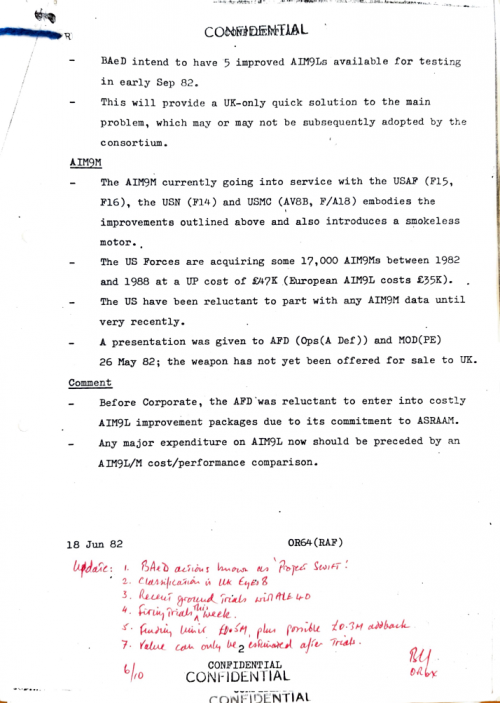
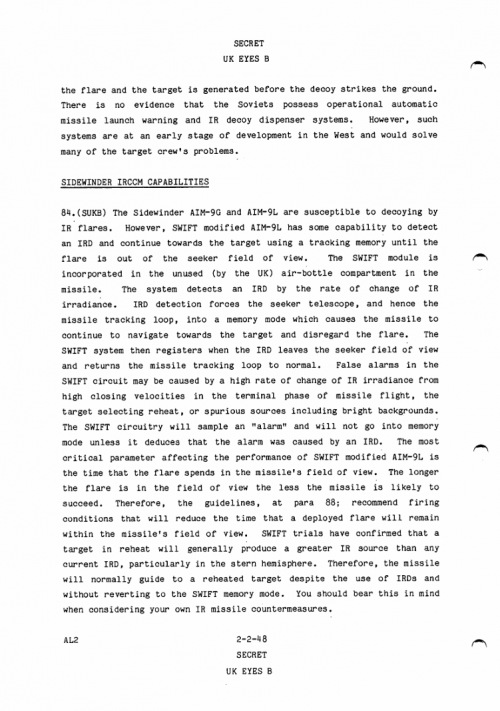
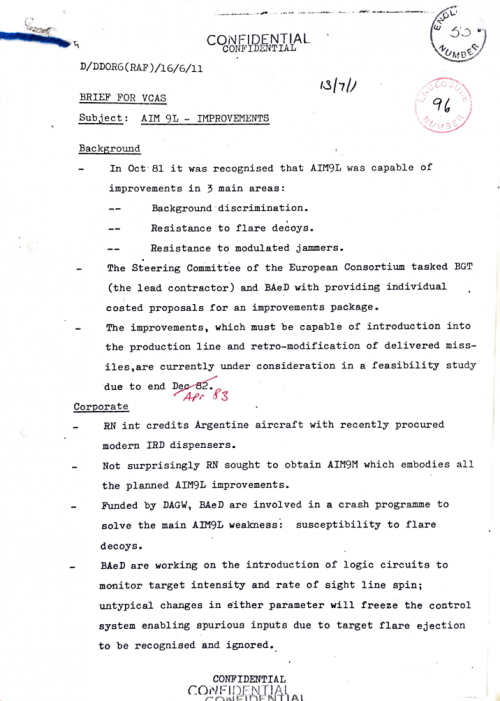
Well it's taken over three and a half years, but I've finally found some official information on the AIM-9L SWIFT modification.

I've attached what I've found. The first two images come from AIR 8/3724 at the National Archives. The third image comes from a copy of the CTTO Phantom Tactics Manual obtained through FOI. They pretty much confirm the things @alibongo said above.

So in summary:
  • SWIFT development was led by BAe Dynamics
  • It was only applied to the AIM-9L
  • The first 5 missiles were due to be available for testing in September 1982
  • It is indeed a module which replaces the gas cylinder of the missile
  • It functions by putting the missile into "memory mode" when a flare is detected and resumes tracking once the flare has left the seeker FoV (pretty much how AIM-9M functions)
I must say I am surprised just how difficult the AIM-9 SWIFT proved to research, there is shockingly little information available on it compared to pretty much anything else the RAF used.
 

Attachments

  • AIM-9L SWIFT TNA 1.png
    AIM-9L SWIFT TNA 1.png
    319.4 KB · Views: 73
  • AIM-9L SWIFT TNA 2.png
    AIM-9L SWIFT TNA 2.png
    301.6 KB · Views: 70
  • AIM-9L SWIFT Phantom Manual.png
    AIM-9L SWIFT Phantom Manual.png
    139.9 KB · Views: 63
I wonder if this SWIFT module used analogue or digital circuitry?
 
I wonder if this SWIFT module used analogue or digital circuitry?
There's not always a clean separation, sometimes your analogue circuitry feeds into digital processing (and vice versa). Date wise - Falklands, so 1982 and later, the potential is there for it to be all digital. If you're relying on some sort of real-time clock for when to restart active seeking after the flare is outside of the seeker FOV, that's probably easier done in digital circuitry, but that could mean TTL circuitry, rather than ICs.
 
As far as I know TTL gates have never been implemented using discrete transistor technology just in ICs.
Poor wording on my part, I should have said CPUs rather than ICs. If your processing is simple enough, you can just do it with TTL logic gates, you don't need a CPU and bunch of code in ROM.
 
Well it's taken over three and a half years, but I've finally found some official information on the AIM-9L SWIFT modification.

I've attached what I've found. The first two images come from AIR 8/3724 at the National Archives. The third image comes from a copy of the CTTO Phantom Tactics Manual obtained through FOI. They pretty much confirm the things @alibongo said above.

So in summary:
  • SWIFT development was led by BAe Dynamics
  • It was only applied to the AIM-9L
  • The first 5 missiles were due to be available for testing in September 1982
  • It is indeed a module which replaces the gas cylinder of the missile
  • It functions by putting the missile into "memory mode" when a flare is detected and resumes tracking once the flare has left the seeker FoV (pretty much how AIM-9M functions)
I must say I am surprised just how difficult the AIM-9 SWIFT proved to research, there is shockingly little information available on it compared to pretty much anything else the RAF used.
Top sleuthing. It was Secret and people didn't speak about it at all.

There may also have been some license issues as it was a BAE mod and BGT was lead contractor.

As above, it didn't go operational until 1985. I received the delivery - got a phone call to say that something had arrived in the port and could we collect it - said I'd nip down with the Landy and the response was "Bring the HIAB and plan a few journeys" as there were enough to replace all of the G&Cs in our stock.

OC Wpns Eng Flt got the signal to say they were coming that day. We replaced them on a rolling basis over a few weeks, OC 23 Sqn whined that I hadn't told him what it was and I suggested he spoke to my boss :D
 
Last edited:
Poor wording on my part, I should have said CPUs rather than ICs. If your processing is simple enough, you can just do it with TTL logic gates, you don't need a CPU and bunch of code in ROM.
Okay so back then it would likely still have been "semi-discrete", where it would be custom analog chains on silicon dies, then those would be bonded to ceramic substrates with interlinks and then finally wirebonded. You could easily do the hold off and re-enable tracking in pure analog without TTL, but some 74 series would have helped.
This was used all the way through Stinger RMP for some sections, paired with a conventionally packaged DSP microcomputer.
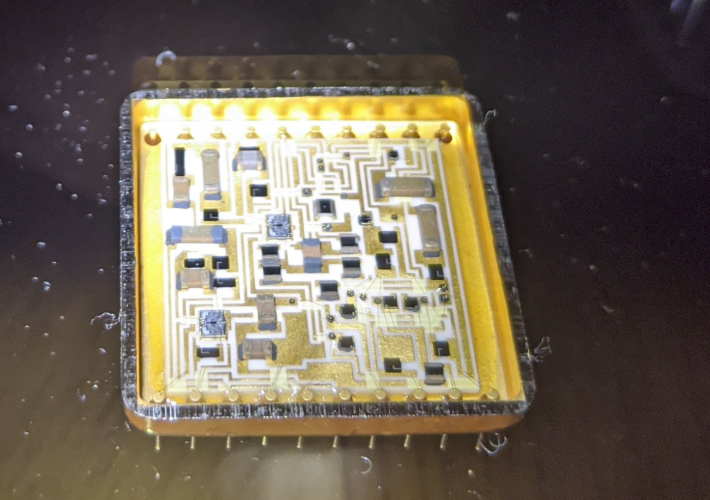
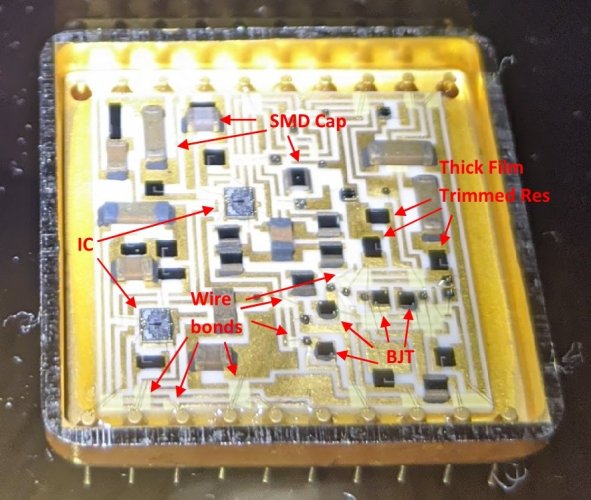
Pictured below is such a module from an uncited location in the Sidey signal chain. (My image, will be back to take higher res images sometime either this year optimally for a full image run now that I have the gear)
1752804726668.png
 
For the electronic nerds, my guess about the module (not about its functionality): it is a single layer circuit in "thick film" technology on ceramic substrate (commonly used in the '60-'70, but still now for special applications as space/military), with a pair of ICs on the left, and some BJT transistor on the right bottom corner (plus a couple more on the upper right). The "3D" components are SMD capacitors, while the flat, black objects are resistors. These are made depositing a "resistive ink", but the process (at that time) was not very precise so they were trimmed to the right value with a laser (you can easily see the "L"cut left by the laser). There are a lot of bonding wires arount the circuit, not only to connect the external pin and the ICs/BJTs to the gold traces, but also to form "bridges" between connections (creating a sort of two layer circuit).

Thick Film circuit.jpg
 
Well it's taken over three and a half years, but I've finally found some official information on the AIM-9L SWIFT modification.

I've attached what I've found. The first two images come from AIR 8/3724 at the National Archives. The third image comes from a copy of the CTTO Phantom Tactics Manual obtained through FOI. They pretty much confirm the things @alibongo said above.

So in summary:
  • SWIFT development was led by BAe Dynamics
  • It was only applied to the AIM-9L
  • The first 5 missiles were due to be available for testing in September 1982
  • It is indeed a module which replaces the gas cylinder of the missile
  • It functions by putting the missile into "memory mode" when a flare is detected and resumes tracking once the flare has left the seeker FoV (pretty much how AIM-9M functions)
I must say I am surprised just how difficult the AIM-9 SWIFT proved to research, there is shockingly little information available on it compared to pretty much anything else the RAF used.
Would you have a full copy of that phantom manual?
 

Similar threads

Back
Top Bottom