AEW for the RN

CJG #20, 34: you are being mischievous again.

I had colleagues who had put some career years into B.Ol.22R and BS.100, so were, simply, bereaved by the axe. But...
only 3 medals for a race, so finisher No.4 has failed.

Buyers do not chop for spite; even when time/cost issues emerge their preference is to be told the need remains, so kindly sort out the £. Nim AEW3 plodded down from (IIRC 21?, to 12, to 9), the budget remaining constant...until 9 came under pressure, so, Murphy's Law, 0 serviceable on the wrong day.

So the A to #20 Q is that £880Mn. gave the Buyer no utility, so it was a failure. You may argue blame. Axelady Mrs T, PM, blamed MoD Heseltine for presiding over a lesson in how not to Project Manage. So we all learned from that, before embarking on CrowsNest.
 
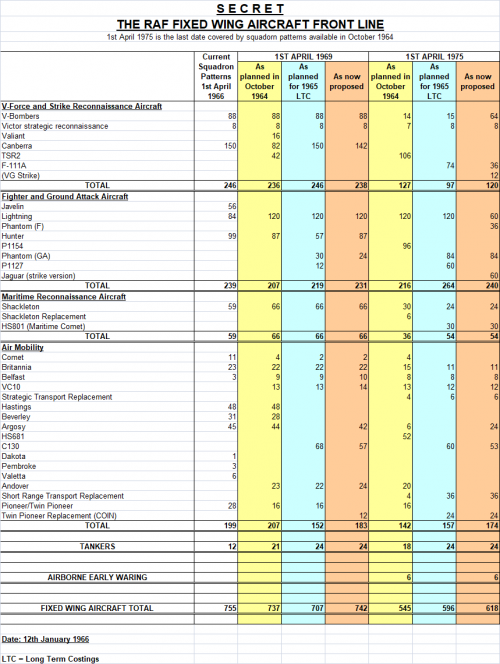
I happened to have some of my RAF squadron pattern's spreadsheets open because I was working on them for something else and for what it's worth this is the first one that says anything about AEW aircraft.

AIR.20.11708.68770 - Plan P.png

It's part of National Archives File AIR20/11708/770 "Plan P" which was open from November 1963 to March 1966. This table was constructed from a table that was spread over 3 pages of foolscap and the covering memo from F. Cooper AUS(AS) is dated 12th January 1966. I've checked the original and there were no AEW aircraft on 1st April 1975 as planned for the 1965 Long Term Costings.

I have some more information, but I have to do some real life before I can upload it.
 
Interesting. I just wondered why you you consider it a failure.

Chris

Don't get me wrong, I'm a bandit for a British virtuous cycle for the aviation industry with success breeding success, but the FASS AEW is one thing they should have let go through to the keeper. I don't know if even installing it in a VC10 would have made it work.

In my virtuous cycle mind I'd choose option 2 or 3 presented in the original project and install it in my imaginary Medway Trident.
 
Last edited:
How's this for a virtuous cycle:

The Thorn EMI Skymaster F band pulse doppler air search radar and Argus 2000 system are installed in an E2/E3 style rotodome and installed in a VC10/HS Trident/BAC 1-11/500 from the 70s. The RN the shoehorns this system into the E2 as much as possible in the 80s.

The rest writes itself!
 
How's this for a virtuous cycle:

The Thorn EMI Skymaster F band pulse doppler air search radar and Argus 2000 system are installed in an E2/E3 style rotodome and installed in a VC10/HS Trident/BAC 1-11/500 from the 70s. The RN the shoehorns this system into the E2 as much as possible in the 80s.

The rest writes itself!
Is the E-2 actually operable off Hermes etc?
 
If there's no conventional carriers there's no reason for E-2s.

Despite being a few years newer than Eagle and Ark the Hermes is not a key ship if Britain wants to retain a fleet carrier capability. Its too small and too slow to operate the F4, which is the aircraft that the future of the FAA pivots on.
 
Despite being a few years newer than Eagle and Ark the Hermes is not a key ship if Britain wants to retain a fleet carrier capability. Its too small and too slow to operate the F4, which is the aircraft that the future of the FAA pivots on.
And now for the "etc": Can Eagle and Ark safely operate E-2s?

(Yes, I'm guessing they can if they can operate Phantoms, but sometimes you get into weird things)
 
And now for the "etc": Can Eagle and Ark safely operate E-2s?

(Yes, I'm guessing they can if they can operate Phantoms, but sometimes you get into weird things)
Catapults should work, also arrest. E-2 is quite slow, so gentle on both (add ~12 kts for bs5a over c-11):

1774421875490.png


Hangar height is as in Essex and Midway class.

But the E-2 will not fit on the 54ft lifts and the 80+ ft wingspan reduces the deckpark, especially with the long angled deck. And the large plane would be a pain to move on the small deck and hangar.

The E2 can't fit down the lifts, so can't be taking down into the hangars for maintenance.
 
Or you could have BEWARE or it's earlier proposal.

PoD.1 1948 AWI research program cut. Prior looking at Bristol Type 170 Freighter
PoD.2 1954 Britannia
PoD.3 1964 BEWARE using Marconi S-band 3MW system.
PoD.4 1970 dusted of BEWARE with AN/APS.111
 
Last edited:
What is BEWARE?

The RAF wasn't interested in AEW until the RN vacated the field in the early 70s. They conducted trials with Vanguard flight APS20 Neptune's in the 50s, but didn't see the need.
 
What is BEWARE?

The RAF wasn't interested in AEW until the RN vacated the field in the early 70s. They conducted trials with Vanguard flight APS20 Neptune's in the 50s, but didn't see the need.
I think you might need to re-read your copies of The Admiralty and AEW, The Air Staff and AEW and They Also Serve.

Chris
 
I think you might need to re-read your copies of The Admiralty and AEW, The Air Staff and AEW and They Also Serve.

Chris

My copies actually belonged to the Defence Library Service and I haven't had access to that since before covid.
 
And maybe Battle Flight.

AWI Air Warning Interception, was being researched during and after The War.

Bristol Aircraft Warning Airborn Radar Equipment. Was repeatedly proposed.
 
So now we're also talking about a better refit to install larger lifts. Or at least 1 larger lift.

Or updating the radar of an aircraft that can fit on the lifts.

IIUC the early E2s weren't much chop over land, much like the APS20 Gannet, APS82 Tracer and APS95 EC121. Waiting until the Eagle and Ark leave service before buying the E2 means the RN gets the huge capability jump of the pulse doppler radar that works over land.

FWIW I think the poor overland performance, along with the policy of massive retaliation and the nature of the threat to the UK itself is why the RAF never progressed from studies to projects before the 70s.
 
Last edited:
Or updating the radar of an aircraft that can fit on the lifts.
Granted. And that brings us back to the APS82 or APS95 back end attached to the APS20 antenna under a Gannet. Oh, and it's overdriven pretty hard (4-8MW through the antenna), so we need a much bigger set of generators installed. And possibly updated cooling.


IIUC the early E2s weren't much chop over land, much like the APS20 Gannet, APS82 Tracer and APS95 EC121. Waiting until the Eagle and Ark leave service before buying the E2 means the RN gets the huge capability jump of the pulse doppler radar that works over land.
Sure, but assumes CVA-01 happens. No CVA-01, no reason for fixed-wing AEW. (Barring CL-84 on the Invincibles)


FWIW I think the poor overland performance, along with the policy of massive retaliation and the nature of the threat to the UK itself is why the RAF never progressed from studies to projects before the 70s.
Likely right.
 
Sure, but assumes CVA-01 happens. No CVA-01, no reason for fixed-wing AEW. (Barring CL-84 on the Invincibles)

I assume that CVA01 is a must for this scenario.

Granted. And that brings us back to the APS82 or APS95 back end attached to the APS20 antenna under a Gannet. Oh, and it's overdriven pretty hard (4-8MW through the antenna), so we need a much bigger set of generators installed. And possibly updated cooling.

I think the APS95 antenna could fit, although that's only based on it fitting the same dome in the EC121, it might be too heavy or something. The APS95 only had 2-3MW of power which should be more achievable for the Gannet.

I can't get out of my mind that by the late 60s solid state electronics and digital computers were becoming available off the shelf. Using some new electronics on these old radars could give them a new lease on life or at least lessen some of their problems.
 
Whilst its easy find a quoted detection range, this needs to be put alongside other metrics to understand what the real performance was under different operational conditions. Clutter environment in particular.

It's really the late 80s with the later Nimrod AEW.3 and upgraded E-3 before long range AEW overland becomes practicable, with robust AMTI modes in cluttered environments. There's also still some further development to go before adding in the robust Battle Management C2 we are now used to. This doesn't mean that prior attempts are useless, but there are pretty significant operational restrictions.

If just operating over the sea then the clutter issue becomes easier (NB. sea state dependent) and so E-2C gives a practicable solution about 10 years earlier in the late 70s.

Earlier AEW is generally limited to over sea, clean environment, and restricted range. Again, this doesn't mean its useless - Wellington ACI vectoring fighters back in WW2 did "something" better than nothing.

Maybe Gannet + AN/APS-20 is actually the 80% solution for the RN? With quite some extra effort through the 70s on back-end signal processing that would still fit in Gannet to improve performance in greater clutter.
Then replace with Searchwater in the 80s, either on Sea King, or Gannet, or a different aircraft if large aircraft carriers are kept.

ECM is another topic not covered in the above
 
The case of AEW EC-121 over Vietnam is interesting. As noted above post, they had a lot of difficulty picking NVAF MiGs at low altitude, with all the clutter (jungle, rolling hills). To the point that RED CROWN navy ships had to do a complementary job. https://www.thisdayinaviation.com/tag/red-crown/
NVAF pilots and their GCI became pretty good at picking holes into the EC-121 / RED CROWN patchy coverage. On May 10, 1972 for example a few MiG-19s popped out of nowhere, caught the Phantoms by surprise killing them with gun fire, before vanishing.


View: https://www.reddit.com/r/WarCollege/comments/1nw93qv/the_aerial_experience_in_linebacker_iii_versus/?show=original
 
Last edited:
While information on the APS95 is scarce radarturorial does say: The antenna consisted of a group of 24 horn radiators mounted side by side and fed in parallel, and produced a cosecant squared antennae pattern.

It then says: Antennas with constant height pattern or cosecant squared pattern (abbreviated as CSC² ) are specially designed for air-surveillance radar sets. These permit an adapted distribution of the radiation in the beam and causing a more ideal space scanning. This antenna pattern can get the required elevation coverage where the received power is independent of the radar range for a constant height target It is a means of achieving a more uniform signal strength at the input of the receiver as a target moves with a constant height within the beam.

Given this antenna fits into the APS20 radar bulge and the radar itself "only" demands double or triple the peak power of the APS20 and the antenna itself is inherently better than the APS20 I can't stop circling back to it as a cheap but significant uppdate path for the Gannet once the USAF EC121s start to become surplus post-Vietnam.

FWIW the APS82 in the E1 peak power was 1MW same as the APS20 in the Gannet.
 
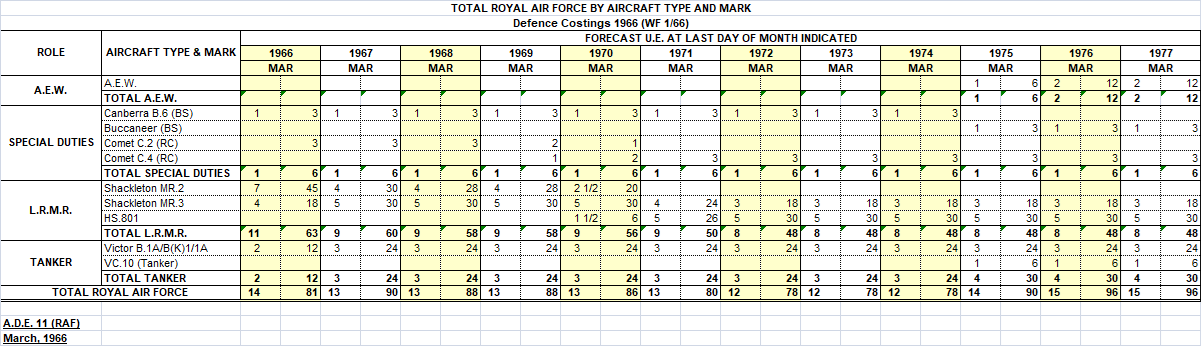
Later than intended this is a summary of the relevant parts of the Squadron Patterns for March 1966 to March 1977.

Squadron Patterns 1966-77 AEW.png
They were produced in March 1966, which is the month after the decision to phase out the strike carriers by 1975 was announced, but over a year before the decision to withdraw from East of Suez by 1975 was taken.

So the AEW squadrons were to be formed the year that Ark Royal and Eagle were to be retired. The squadron patterns also include the formation of 3 maritime fighter and 3 maritime strike squadrons in the middle 1970s with the Phantoms and Buccaneers formerly operated by the FAA.

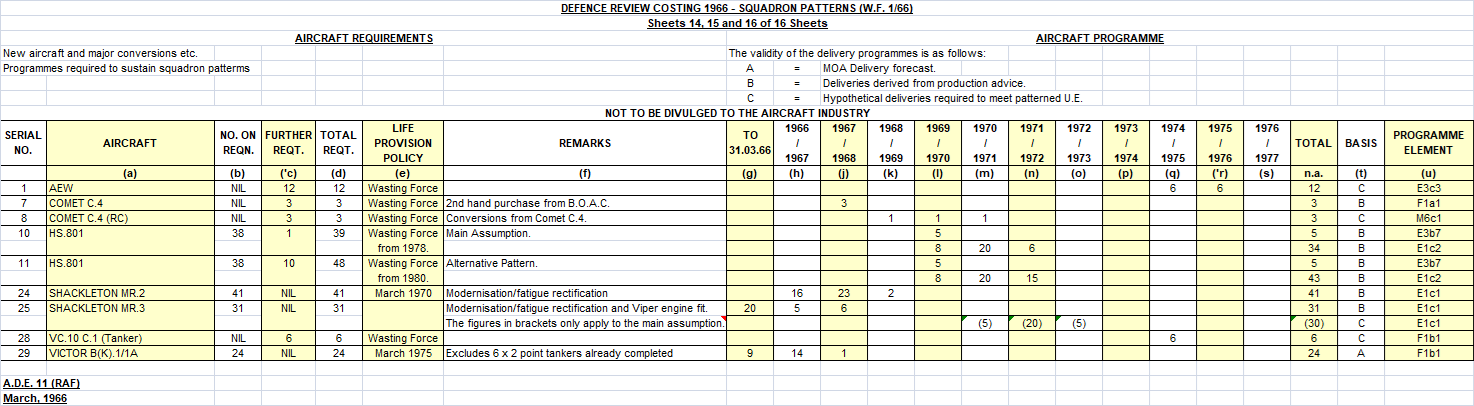
These are the accompanying Aircraft Requirements and Aircraft Programme.
Aircraft Requirements 1966-77 AEW.png

Although the table doesn't specifically say so, the VC.10 tankers were assumed to be purchased second hand for conversion and the delivery dates were of fully converted aircraft.
 
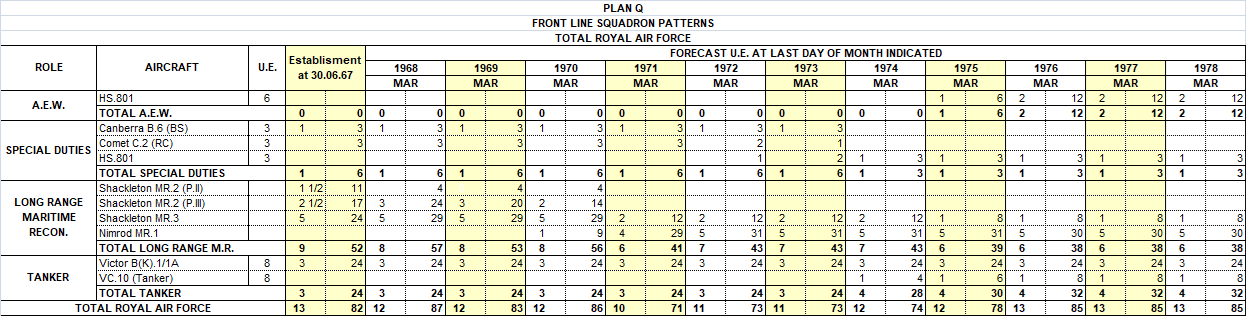
Move forward 15 months to June 1967 and this is a summary of the relevant parts of the Squadron Patterns for June 1966 to March 1978.

Squadron Patterns 1967-78 AEW Plan Q.png

This is Plan Q which was the RAF's part in the withdrawal from East of Suez by 1975 plan. I think this was replaced by Plan R when the withdrawal was brought forward to the end of 1971.

The 2 AEW squadrons were to be formed at the same time as in the 1966-77 Patterns and there would be the same number of aircraft per squadron. But now they were to be equipped with the HS.801 Nimrod. It also shows that the Special Duties squadron was to be re-equipped with Nimrods as well instead of converted Comet C.4s as previously.

It shows the formation of 3 maritime fighter and 3 maritime strike squadrons like the 1966-67 Patterns do, but the number of fighters per squadron is reduced from 12 to 10.

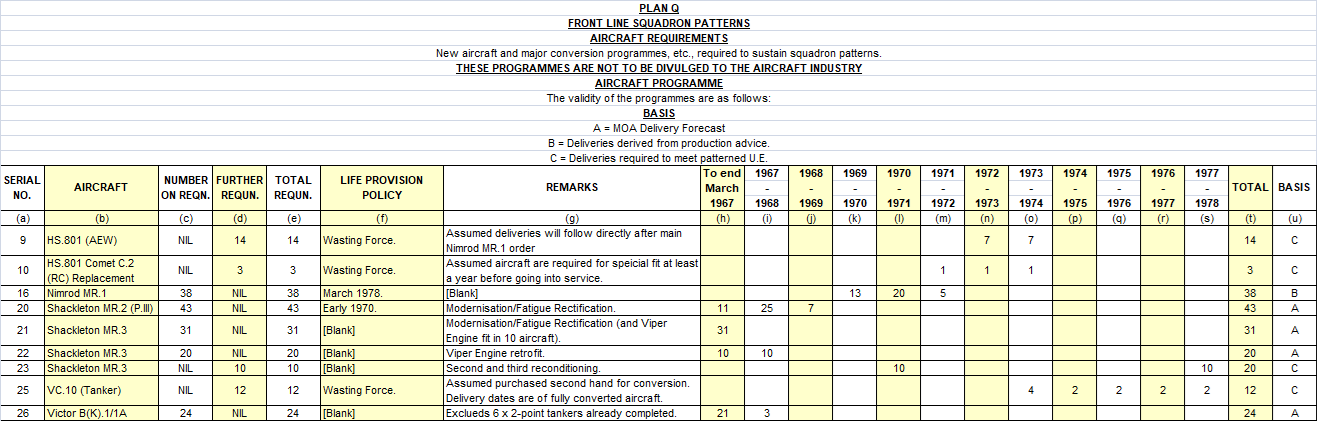
These are the accompanying Aircraft Requirements and Aircraft Programme.
Aircraft Requirements 1967-78 AEW.png

The number of AEW aircraft has been increased from 12 to 14 and they are now HS.801 Nimrods. Also the deliveries have been brought forward 2 years.

The total number of Nimrods is 55 consisting of 38 LRMP, 3 SD and 14 AEW. In the previous patterns it was 39 Nimrods (all MR) in the main assumption and 48 Nimrods (all MR) in the alternative patterns.

Incidentally, in the 1966-77 Patterns the VC.10 tanker squadron forms in the 1974-75 Financial Year and in the 1967-78 Patterns it forms in the 1973-74 Financial Year. IOTL the RAF didn't announce the plan to convert second-hand VC.10s into tankers until 1978 and No. 101 Squadron didn't reform until 1st May 1984 which was in the 1984-85 Financial Year. Therefore, the RAF got its VC.10 tanker squadron a decade later than planned in 1966-67.
 

Similar threads

Back
Top Bottom