AEW for the RN

zen

ACCESS: Above Top Secret
Top Contributor
Senior Member
Joined
15 July 2007
Messages
5,739
Reaction score
6,322
The F4 MOTS thread is getting lured away into AEW which does kinda hijack the topic. So it needs it's own thread.

The questions be "when" and "what" AEW should the RN pursue that diverges away from history. Particularly in the light on a AH path of some sort of F4 and CVA-01 proceeding.

There was two Gannet based studies. Which effectively represents the continuation of the platform in some sort of updated configuration.

Option 1. Minimum Change.
By updating the existing systems.

Option 2. Was a significant alteration.
First a mew rear fusilage in order to fit a dorsal rotordome of 16ft diameter.
Wingspan increased to 60ft in order to permit the 30,000lb AUW System II. Which was a reduced capability System I in order to cut weight. This using Pulsed Doppler in S-band (lower cost).

A precursor option in the very late 50's to early 60's which does tie in with F4 MOTS is a Brough twin engined solution, looking a lot like a scaled down Grumman design for AEW.
 
Last edited:
Isn't there already a few RN. AEW threads,
I know there is a fair few general AH threads that diverge off into Naval AEW. .
I did try to start one some years ago, I think a general AH AEW/AWACS thread but beyond that I'm not easily finding a specific thread.

Anyway the context is the MOTS F4 thread, and rather than have it drift off. To start a thread the mods could port over AEW posts into if need be and hopefully draw the conversation on that topic away from hijack/drift on the other.
 
Assuming that from the 60s the RN has a requirement for fixed wing AEW for the next 30+ years I see this as at least as much a fleet management issue as much as a capability issue.

By the early 70s the RN is 2 full generations behind the USN in terms of AEW, with their APS20 Skyraiders and APS82 Tracers retired and the troubled E2A&B being replaced in production by the E2C. However, while the RN has ships with the BS5 & 5A it can't operate E2s so it needs something that can operate from these cats.

By the early 70s the RN had done everything with the basic APS20 that could be done and really needed a capability upgrade, but money was tight so they can't go too nuts. In addition, the upgrade only needs to last 10-12 years.

In airframe terms there are only 2 options, Gannet and Tracer, both of which are of similar vintage, but the Gannet has a huge advantage in terms of airframe supportability and initial cost. However, the Gannet will require a major radar and electronics upgrade and in the mid 70s there are no obvious candidates for that. The Tracer will require a major initial investment in airframes, re-engining and a support system built up from scratch. However, the APS82 radar and supporting hardware are a generation ahead of the APS20 and will likely only require a bit of a spruce up of the electronics to make it viable until the early-mid 80s.

Perhaps the answer is a major update of the Gannet in conjunction with a RAF AEW programme.
 
I had suggested the E-1 radar backend while driving 4x the power through the Gannet antenna.

Not ideal, but it's a least-change way to get capabilities.
 
I had suggested the E-1 radar backend while driving 4x the power through the Gannet antenna.

Not ideal, but it's a least-change way to get capabilities.

Least change makes it one of the most likely.

What are the physical practicalities? How much of an improvement would it be over the setup in the Gannet, which was more sophisticated than the US systems before they were superseded?
 
Least change makes it one of the most likely.

What are the physical practicalities? How much of an improvement would it be over the setup in the Gannet, which was more sophisticated than the US systems before they were superseded?
It'd need new generators on the Gannet, I'm talking 4-8megawatts of power going through the transmitter. Might even require some dedicated cooling.

But it should give comparable performance to the E-1.
 
However, while the RN has ships with the BS5 & 5A it can't operate E2s so it needs something that can operate from these cats.

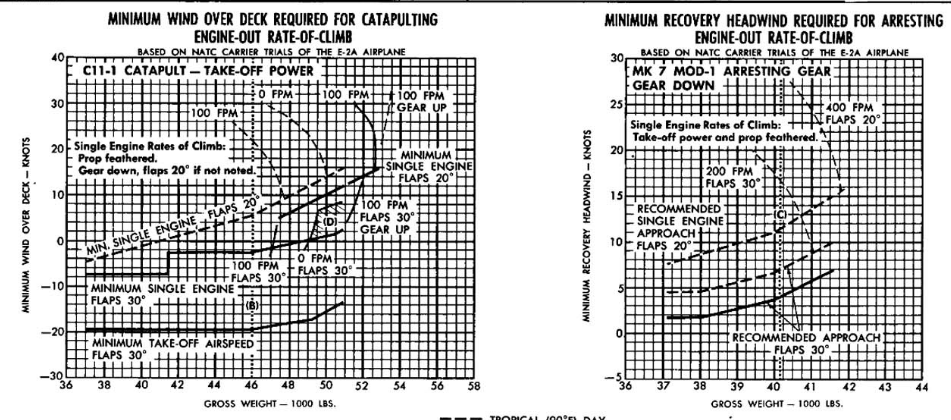
Catapults should work, also arrest. E-2 is quite slow, so gentle on both (add ~12 kts for bs5a over c-11):

1774421875490.png

Hangar height is as in Essex and Midway class.

But the E-2 will not fit on the 54ft lifts and the 80+ ft wingspan reduces the deckpark, especially with the long angled deck. And the large plane would be a pain to move on the small deck and hangar.

E-1B could also be a problem with its spot factor, pretty much the same as the E-2. 72+ ft wingspan is also much more than that of the Gannet.
 
It'd need new generators on the Gannet, I'm talking 4-8megawatts of power going through the transmitter. Might even require some dedicated cooling.

But it should give comparable performance to the E-1.

In the EC121 the APS20 was replaced by the APS95 antenna consisted of a group of 24 horn radiators mounted side by side and fed in parallel. This antenna fit in the same belly bulge as the APS20, and 2-3MW of power so might be a practical fit physically. I don't know about the electronics fitting in the little Gannet, but if some electronics were transistorised and a digital computer was used it all might fit.
 
The flipside is the early FMICW system could be beefed up for AEW.

That would fit a mid 60’s decision as the fighter radar was achieving successful outcomes. Which is why they later returned to this technology for a new fully digital Fighter radar and the troubled Nimrod AEW program.
In fact the FMICW technology was part of the P.139 effort.

Only these later, new more ambitious efforts, hit a mixture of funding, technology and managing issues.

Which means a great irony out this change is the possibility of more successful outcomes in FMICW earlier.

Another then proposition was the SLAR technology. Presumably the sides of a Gannet might mount such flat panel radars. Though this means the aircraft has to fly a curved path to give full 360 coverage. Or the aerials could fit a canoe in place of the radardome. Or mounted above the fuselage.
 
Time to churn the waters a bit:
They may well have had this in mind:
cl-84-aew-scs-jpg.3065

(h/t overscan)

In addition:


Oh, and again via overscan:
cl-84aew_01-jpg.73120
The AEW version of the CL-84. Now imagine that in RN/FAA colours....
 
The flipside is the early FMICW system could be beefed up for AEW.
The big snag is that FMICW doesn't like propellers.

To be honest the RN was never lacking in AEW projects or radar tech to put in them, they just lacked:
a) the cash to buy them
b) the influence to get the RAF to buy the same radar
c) a carrier big enough

Had CVA-01 not been cancelled then it might have proved possible to keep the Anglo-French AEW alive and get P.139 onto a carrier deck during the mid-70s. But without a long-term carrier fleet, nobody is going to fork out the cash on an expensive bespoke system.

Even if CVA-01 dies, in theory a Sea King AEW could have been in service alongside Sea Harrier FRS.1, but again the cash could never be found until those events in the South Atlantic showed the need was more pressing than originally thought.

I suppose a more interesting counter-factual question would be - if there was no Falklands War, would the RN have acquired AEW at all?
 
I suppose a more interesting counter-factual question would be - if there was no Falklands War, would the RN have acquired AEW at all?
I'm leaning towards "no".

No expensive lessons that AEW is vital to detecting sea-skimmers, no AEW getting bought. No club to beat Treasury with of "This AEW system is vital to protect our existing ships from Exocet missiles. Without AEW, we don't have a Navy, we have very expensive targets."
 
I'm under the impression that during the Cold War AEW is difficult. The considerable trouble the E2 had in it's early years and the Nimrod AEW3 failure are my main hard evidence for this, but I also think the lack of viable AEW aircraft entering service during the Cold War despite various proposals and ideas backs this up. Its for this reason that I'm not a believer in innovative solutions for a continued RN AEW requirement. Then of course there's the perpetual lack of money in the British defence budget, which I think should focus them strongly on what works and is affordable. This is why I tend toward an updated Gannet until the RN is able to buy the E2 off the shelf.

Ideally the RAF could come up with some commonality in the AEW sphere. However IIUC the whole Shakelton AEW was because the RN carrier rundown meant some AEW was needed over the sea, and it wasn't really for the RAF.
 
Difficult, but continous. Skyraider, warning Star, e-3, e-1, e-2, gannet...
It seems to me AEW was in trouble when the limits of technology were pushed too hard, as in the e-2a and the nimrod aew...
And it is expensive, even more so with small production runs. So it is logical that the two US systems prevailed in the west.
 
In the EC121 the APS20 was replaced by the APS95 antenna consisted of a group of 24 horn radiators mounted side by side and fed in parallel. This antenna fit in the same belly bulge as the APS20, and 2-3MW of power so might be a practical fit physically. I don't know about the electronics fitting in the little Gannet, but if some electronics were transistorised and a digital computer was used it all might fit.
That would probably be preferable to stuffing 4-8MW through the APS20 antenna.


The AEW version of the CL-84. Now imagine that in RN/FAA colours....
Yes, that would be an option if it was developed out.
 
That would probably be preferable to stuffing 4-8MW through the APS20 antenna.

The big question is could the internal equipment racks, cooling etc fit inside the little Gannet.

However, the APS95 does get an early 60s, as opposed to mid 40s, radar into the air in the RN.
 
Cancled in the early 1980s in favour of the E-3 Sentry, they should have stuck the radar in a rotating dome like the Sentry and it would have had no issues unlike the system they went with in the Nimrod AEW3.
 
Nimrod's ....Argus I think they ultimately named it? worked and worked well eventually.
E3 capability was behind in overland though caught up within a year or two.
Hence the considerable recriminiations over it's cancellation.

Having spent such vast sums and driven ever more capable project teams to turn the concept to functional reality. The only argument against seems to be it was a bespoke orphan for the UK only.
But without UK purchase, no one else was even going to consider it

But the Argus System was still being touted by BAE Systems into the 2000's.

It seems to have influenced the Israeli's design.
 
The RAF should have stuck with the Nimrod AEW3 zen no matter what and they eventually would have had a great aircraft.
 
Did the Nimrod AEW3 fail?

Chris

Because it's you I'm guessing that's a trick question.

Still, I'm going to say there were a lot of problems that didn't get addressed and the type didn't enter service. In the end it didn't provide the RAF with an in-service AEW capability, so the project failed.

On the topic of Nimrod AEW3 failure, what does it take to 'ruggedise' a computer for military use in the 70s and 80s?
 
Last edited:
On the topic of Nimrod AEW3 failure, what does it take to 'ruggedise' a computer for military use in the 70s and 80s?
Vaguely I reccal what might be Ferranti producing chips ruggedised for vibration, heat and radiation. Used in satellites and military systems.
Don't ask me what. Maybe Google or this forum can help.

And Google answers.
  • Ferranti F100-L: While entering production in 1977-1978, the 16-bit Ferranti F100-L microprocessor family remained a vital, hardened British technology into the 1980s. It was specifically designed for military use, offering wide temperature tolerance and radiation hardening, implemented using bipolar junction transistors to ensure reliability.
And Wikipedia says
https://en.wikipedia.org/wiki/Ferranti_F100-L
 
Last edited:
The reason I ask is because IIUC one problem with the Nimord was a lack of computer memory to deal with all the tracks it could develop. IIUC the GEC 4080M was a ruggedised version of the original 4080 computer that debuted in 1973, but the GEC 4000 series evolved over time and by 1981 the 4090 had up to 4Mb of memory compared to the 1Mb of the 4080M. If this computer was used, then presumably the memory problems would be mitigated at least, if this computer could be ruggedised and miniaturised like the 4080 was.

To bring this back to the RN, is there anything inherently wrong with the APS20 itself? Would an upgrade path be running its signal through modern (in the 70s) digital computers for signal processing? Jam a VERDAN or a 4080M behind the APS20 to filter out the clutter and take away much of the dark art of interpreting the raw signal on a 7.5" cathode ray screen from the 50s.
 
Well definitely the 'back end' side of things is the most transformative factor in how AEW develops and was obviously integral to 60's developments in the US and UK.

Getting a bigger CRT ideally connected to computers for multifunctional display is inherently going to transform performance.

Hence the Mk3 buccaneer back seat having such a display in proposal in the 60's.

What was added to APS20 when fitted to Shackleton was AMTI circuits in '73. Nothing prevents that upgrade to those fitted to Gannets and keeps this relevent until next generation AEW.

Which at this point was coming to 4 Options. Where Hawkeye was high on the list, but criticised against requirements as was Sentry.
 
Last edited:
What was added to APS20 when fitted to Shackleton was AMTI circuits in '73. Nothing prevents that upgrade to those fitted to Gannets and keeps this relevent until next generation AEW.

The APS20F(I) in the Gannet in the 60s is a long way from the APS20 & 20B of the B17, Avenger, Skyraider and Warning Star: the radar displays were tied into the aircraft Doppler navigation system, a radar amplifier, Doppler MTI and AN/APX-7 IFF interrogator were installed so the Gannet could track both friendlies and hostiles and direct interceptions. There was no height-finding capability, but you could get an indication, depending on the tilt angle set, so the lead operator was always adjusting the tilt of the scanner, the gain of the receiver and the aircraft’s height to get the optimum picture.

The problem was the radar was very susceptible to clutter from the sea state, which is exactly the sort of thing a digital computer could filter out.

In addition, I've seen claims that the APS20F weren't pulled from Skyraiders, but were new sets.
 
IIRC the Nimrod AEW was struggling to correlate tracks between the nose and tail arrays. While the E3 had no such trouble due to a single array set.
I don't know if that was the problem, but if it was, it shouldn't have been insurmountable as the USN was able to correlate the tracks of four arrays of the SPY-1A that entered service on the Tinconderogas in the early 1980s and the SCANFAR radars fitted to Enterprise and Long Beach in the early 1960s.
 
Last edited:
I don't know if that was the problem, but if it was, it shouldn't have been insurmountable as the USN was able to correlate the tracks of four trail arrays of the SPY-1A that entered service on the Tinconderogas in the early 1980s and the SCANFAR radars fitted to Enterprise and Long Beach in the early 1980s.
I may not be using the correct words. IIRC the issue was that the signals arriving at the computer were going through wires of inexact and varying lengths, so that the location timing was messed up. Whereas SCANFAR or SPY was going through waveguides and wires of specific fixed lengths so that it was easy to correlate the tracks between antennas.
 
Catapults should work, also arrest. E-2 is quite slow, so gentle on both (add ~12 kts for bs5a over c-11):

View attachment 806639

Hangar height is as in Essex and Midway class.

But the E-2 will not fit on the 54ft lifts and the 80+ ft wingspan reduces the deckpark, especially with the long angled deck. And the large plane would be a pain to move on the small deck and hangar.

E-1B could also be a problem with its spot factor, pretty much the same as the E-2. 72+ ft wingspan is also much more than that of the Gannet.
For what it's worth.
AEW aircraft dimensions.png
SAC = The Standard Aircraft Characteristics booklet published on the date indicated.

According to the E-1B Tracer's standard aircraft characteristics.
A total of 45 airplanes can be accommodated in a landing spot on the flight and hangar decks of a CVA-19 class angled deck carrier (25 flight, 20 hangar).
And despite being 11 feet longer, according to the E-2As.
A total of 46 airplanes can be accommodated on the flight and hangar decks of a CVA-19 class angled deck carrier.
 
In the end it didn't provide the RAF with an in-service AEW capability, so the project failed.
?
By that logic the Chinook failed three times, four if you include the special forces variant. Also TSR.2 et al. Failures? Nimrod MRA4. Failure? Was Blue Steel a failure? It entered service, met the spec, but would it have worked? It would have provided a flash/bang/ouch even if all the other gubbins didn't work.

These matters are much more nuanced than they initially appear and having met or talked to a lot of folk who worked on your 'failures', most don't see their work as such.

Nimrod AEW3 met the spec, so said the minister, but the RAF didn't want it and, I suspect, never did want it once the shiny Sentry appeared. My view on Nimrod AEW3 is that it blazed the trail for the bizjet types we see now but the system was shoehorned into the Nimrod. Perhaps a more suitable airframe would have helped but there were none that HMG would cough up for when all those Nimrods were idle. Perhaps 'ahead of its time' is more apt.

I'm happy to be accused of sporting Gunstonian rose-tinted specs on Nimrods of whatever stripe, but having been immersed in Nimrod for the last few years, have bocome aware of a much bigger picture.

OK, I'm off before I start channeling AlertKen.

Chris
 
By that logic the Chinook failed three times, four if you include the special forces variant. Also TSR.2 et al. Failures? Nimrod MRA4. Failure? Was Blue Steel a failure? It entered service, met the spec, but would it have worked? It would have provided a flash/bang/ouch even if all the other gubbins didn't work.
If you go down this logic chain then all "aircraft" which manage to actually achieve powered, controlled flight become "successful" which is a terrible metric of measurement. But this seems standard for almost all UK historical analysis where the only thing standing in the way of world beating success was that the dastardly government didn't provide infinite resources...

We should include other metrics along the lines of performance, cost and time to provide a more rounded assessment of projects. And compare with near neighbours.

If we can't even acknowledge "failures" then we have no hope of learning from them and trying to avoid these issues in the future.
 
For what it's worth.
View attachment 806911
SAC = The Standard Aircraft Characteristics booklet published on the date indicated.

According to the E-1B Tracer's standard aircraft characteristics.And despite being 11 feet longer, according to the E-2As.
Yes, about 2.3 A-4 spots for both. For medium carriers like Audacious or Clemenceau class, that's quite big.

The S-2A SAC says 76 planes on an essex, so that's 40% less spotting factor.
 
So the FMCW and FMICW systems offered solutions to clutter without large computing resources, which required bulky, power demanding computers, plus bulky power demanding cooling systems.

Hence Hawkeye and other proposals of that sort.

And the transition from FMCW to FMICW produced significantly positive results. As per the next generation AI set effort.
Though to be fair FMCW works as well, but needs separate transmitter and receiver aerials. See Mauler fir an example.
FMICW allowed a single aerial system.

Now for a rotordome it's feasible to fit a reasonable sized receiver aerial and shielded transmitter aerial. So FMCW is a viable path forward and fits early 60's views on such technology.

But for a aerial to fit in place of the APS20 aerial, FMICW is more viable. As it was for FASS based designs.

And let us be clear that early semi-analogue FMICW AI effort yielded viable results for the next generation fighter, such that it continued post OR.346, post P1154RN, post AFVG into UKVG. Even afterwards it was resurrected to help development of a fully digital FMICW set for the ADV Tornado.
Which is where things hit problems.

So again as with F4 successor, FMICW is at the time viewed as viable and nothing prevents the semi-analogue systems proceeding to relative success.
 
By that logic the Chinook failed three times, four if you include the special forces variant. Also TSR.2 et al. Failures? Nimrod MRA4. Failure? Was Blue Steel a failure? It entered service, met the spec, but would it have worked? It would have provided a flash/bang/ouch even if all the other gubbins didn't work.

These matters are much more nuanced than they initially appear and having met or talked to a lot of folk who worked on your 'failures', most don't see their work as such.

Nimrod AEW3 met the spec, so said the minister, but the RAF didn't want it and, I suspect, never did want it once the shiny Sentry appeared. My view on Nimrod AEW3 is that it blazed the trail for the bizjet types we see now but the system was shoehorned into the Nimrod. Perhaps a more suitable airframe would have helped but there were none that HMG would cough up for when all those Nimrods were idle. Perhaps 'ahead of its time' is more apt.

I'm happy to be accused of sporting Gunstonian rose-tinted specs on Nimrods of whatever stripe, but having been immersed in Nimrod for the last few years, have bocome aware of a much bigger picture.

OK, I'm off before I start channeling AlertKen.

Chris

As I said, it's you so it's a trick question.

However I will have a couple of responses. Firstly, the project was a failure, because it failed to deliver the aircraft to the RAF, just like the TSR2 project was a failure for the same reason.

My interest in the GEC 4080M computer is because a lack of computer power appears to be an issue that could be addressed by later models of this 4000 series. However I don't think the heat-sink cooling could be mitigated, even if the radar tracking system was worked out the Nimrod AEW3 could only fly for about 4-5 hours before refueling due to the need to keep the tanks half full to cool the electronics.

I agree a different airframe may have resulted in a successful project. The VC10 may have provided the volume needed for cooling and computer power but the UK was on such a tightrope that much of the project was driven by the fact they had stood down a Nimrod MR1 sqn in Malta and had the the spare airframes.
 
I'm very curious about the APS95 radar, mainly because its antenna fit the same belly bulge in the EC121 as the APS20 did, therefore it should fit the Gannet's airframe.

I can't help but think that this radar cold be squeezed into the Gannet in the early 70s if some modern electronics were incorporated to save weight, space and cooling.

APS95APS20
frequency:420 … 450 MHz2 860 … 2 880 MHz
pulse repetition frequency (PRF)260 Hz300 Hz
peak power:2 … 3 MW
1 MW
average power3 360 … 5 040 W
instrumented range250 NM (≙ 460 km)

250 NM (≙ 460 km)
antennagroup of 24 horn radiators mounted side by side and fed in parallel8' parabolic dish
 

Similar threads

Back
Top Bottom