- Joined
- 3 June 2011
- Messages
- 21,095
- Reaction score
- 19,524
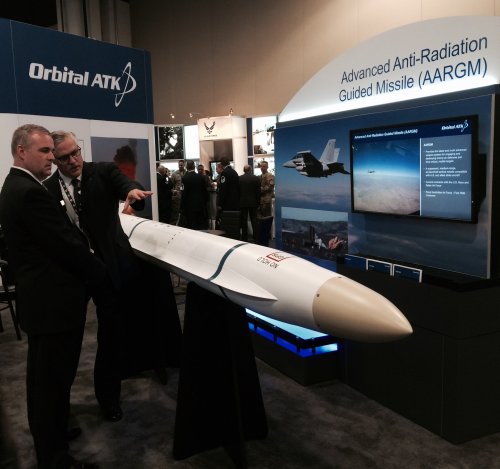
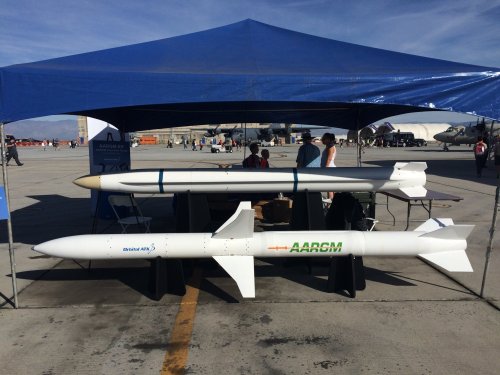
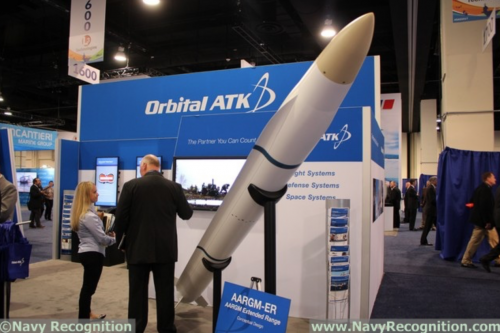
marauder2048 said:James Drew (AvWeek) says the Orbital ATK mockup is a " double-range AARGM Extended Range with 11.5" rocket motor. Internal carriage on F-35"

Last edited:

marauder2048 said:James Drew (AvWeek) says the Orbital ATK mockup is a " double-range AARGM Extended Range with 11.5" rocket motor. Internal carriage on F-35"


sferrin said:marauder2048 said:James Drew (AvWeek) says the Orbital ATK mockup is a " double-range AARGM Extended Range with 11.5" rocket motor. Internal carriage on F-35"
Sounds like such a good idea I'd wager everything I own that it'll never go beyond that mockup.
bring_it_on said:Its a program and the released the RFI for it last year. The Navy has it in its future plans with integration planned for the Growler and the F-35. Its a fairly important program from that stand point -
https://www.scribd.com/document/263052596/Aargm-Er-Rfi

marauder2048 said:James Drew (AvWeek) says the Orbital ATK mockup is a " double-range AARGM Extended Range with 11.5" rocket motor. Internal carriage on F-35"
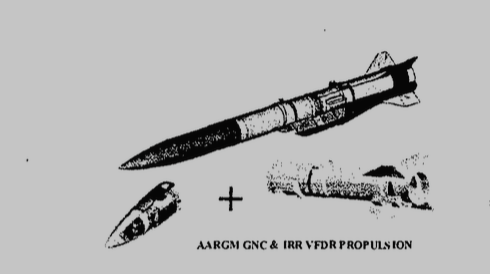
SpudmanWP said:Given that the hardest parts of the ATK version are already working (seeker, avionics, warhead, etc from (AARGM Blk1), only the motor, airframe, and physical flight controls need to be done.
It's doable in a short timeframe, especially if the 11.5" motor is from another project.
bring_it_on said:Orbital played it safe with the sort of budget the Navy plans on committing for the upgrade. Higher capability demands higher cost and would have also demanded a longer time-line. It remains to be seen whether Raytheon responded to the RFI and whether they field something in this space. Given their relationship with Aerojet in past programs (such as the T-3) they could look into a VFDR but whatever capability is offered would have to satisfy the Navy's timeline for IOC on the Growler.
bring_it_on said:The technical maturity, performance and risk_mitigation performed on the VFDR under the HSAD and T3 programs is still a bit of a gray area in terms of a lack of transparency (for obvious reasons) on how far these programs went and what milestones were met. Meeting classified range requirements would have been a challenge with a non VFDR, but if Orbital can do it (which they supposedly can) than it actually makes some sense from a risk stand-point.
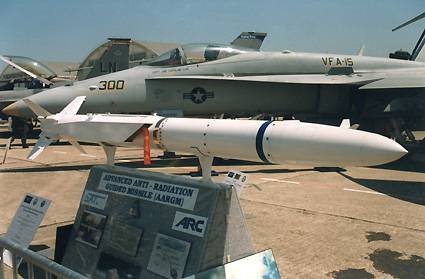
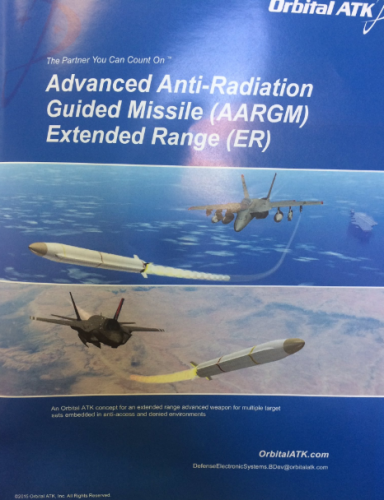
Orbital ATK has lifted the veil on its extended-range variant of the AGM-88E Advanced Anti-Radiation Guided Missile (AARGM), which incorporates a redesigned control section and 11.5 in.-dia. rocket motor for twice the range and internal carriage on the Lockheed Martin F-35 Lightning II.
AARGM-ER is a follow-on to AARGM purely focused on the extended-range scenario,” Mike Stuart, Orbital ATK’s director of business development for strike weapons and defense electronics, said in an interview on Sept. 19. “Navy budget documents define what they’re looking for, and our design addresses that. Our design maintains the current seeker on the front end. We repackage the guidance and navigation system to provide more volume [for the 11.5-in. rocket motor]. We’re anticipating over two times the range.”
sferrin said:bring_it_on said:Orbital played it safe with the sort of budget the Navy plans on committing for the upgrade. Higher capability demands higher cost and would have also demanded a longer time-line. It remains to be seen whether Raytheon responded to the RFI and whether they field something in this space. Given their relationship with Aerojet in past programs (such as the T-3) they could look into a VFDR but whatever capability is offered would have to satisfy the Navy's timeline for IOC on the Growler.
Given all the work that's already been done, the fact they couldn't just grab a VFDR off the shelf, and incorporate it, in a reasonable amount of time, is a joke.
sferrin said:bring_it_on said:The technical maturity, performance and risk_mitigation performed on the VFDR under the HSAD and T3 programs is still a bit of a gray area in terms of a lack of transparency (for obvious reasons) on how far these programs went and what milestones were met. Meeting classified range requirements would have been a challenge with a non VFDR, but if Orbital can do it (which they supposedly can) than it actually makes some sense from a risk stand-point.
Except work on these things goes all the way back to the 60s and includes the produced Coyote. That said, a rocket is more of a known, and you don't need to deal with the volume taken by air intakes (a factor for internal carriage).
marauder2048 said:Ducted rocket development goes back that far but I thought VFDRs were more a late 80's thing?
sferrin said:marauder2048 said:Ducted rocket development goes back that far but I thought VFDRs were more a late 80's thing?
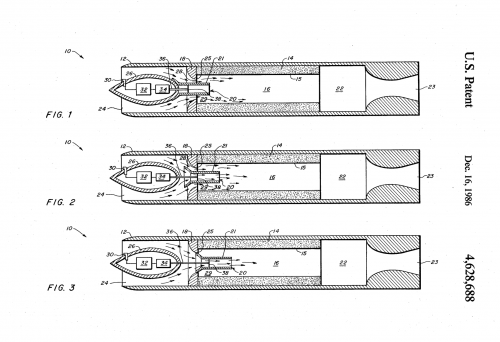
The question seems to be, "what's the difference between a ramjet, a ducted rocket, and a Variable Flow Ducted Rocket?" As far as I can tell, a "ducted rocket" is just a ramjet that uses a solid fuel gas generator for the fuel instead of liquid fuel. A VFDR would just be the latter but throttleable.
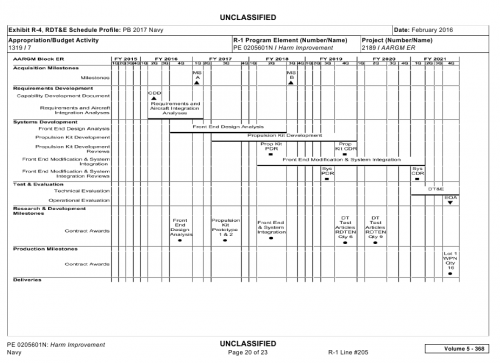
bring_it_on said:Courtesy Stephen Trimble
sferrin said:I see this and think, "no wonder China turns out copies of our stuff almost as fast as we do". Whatever happened to the days of keeping details classified at least until they're in testing or something?

Not the Brits suffering from adversaries using a British invention, but the other way around.Iron knees appear to have been first introduced in substantial numbers by the French Navy in the mid-18th century. They were a substitute for the usual ‘grown’ wooden crooks which were becoming scarce. They were, for example, found on the wreck of the French warship Invincible built in 1744 and lost off Portsmouth in 1758 (Quinn et al., 1998). Falconer in his Marine Dictionary specifically stated they were a French innovation (Falconer, 1780). Gabriel Snodgrass, surveyor to the East India Company between 1757 and 1794, appears to have been the first British proponent of the use of iron knees. Again, this probably arose from the difficulty in procuring supplies of suitable timber. Iron knees also offered superior strength and compactness. Snodgrass appeared to have strengthened some East Indiamen with iron knees retrospectively. However, on retiring he wrote a report in 1796 to the Company’s directors firmly advocating the use of iron knees and stanchions from new (Fincham, 1851). By 1810 Company ships were being built with iron knees, stanchions, breast hooks and crutches (Steel, 1823).
Plans of the East Indiaman Farquharson of 1820 in the National Maritime Museum, Greenwich, show she was fitted with iron hanging knees and horizontal ‘staple’ knees, which were fixed between two deck beams. Their use must have spread to other builders in this decade because the Shipowners’ Lloyd’s Register first included them in 1814 and their underwriting rivals did the same in the 1818 edition of their Register. The Royal Navy adopted the practice of retrospectively fitting iron knees to vessels strained by long periods enforcing the Blockade during the Napoleonic War. The systematic installation of ironwork into new ships began under the auspices of Sir Robert Seppings, the Navy’s chief surveyor from 1813 to 1832.
sferrin said:I see this and think, "no wonder China turns out copies of our stuff almost as fast as we do". Whatever happened to the days of keeping details classified at least until they're in testing or something?
The U.S. Navy has begun meeting with rocket manufacturers to support Orbital ATK’s development of an extended-range Advanced Anti-Radiation Guided Missile (AARGM-ER) as it targets service entry by 2023.
The weapon, adapted from the legacy Raytheon High-Speed Anti-Radiation Missile (HARM), is designed to suppress or destroy enemy air defenses by homing in on radio frequency emitters, such as radar sites and control hubs. By adding an improved propulsion system with more space for fuel, the service will approximately double AARGM’s range from about 60 nm to more than 120 nm. That will keep its Boeing F/A-18E/F Super Hornets and EA-18G Growler electronic attack aircraft farther from threatening weapons systems, such as the Russian S-400 and Chinese HQ-9, among others.
An added benefit will be internal carriage on the Lockheed MartinF-35C, thanks to smaller control surfaces. But the service confirms that the anticipated design being explored by Orbital ATK is still too large for the Marine Corps F-35B internal weapons bay. Instead, it can be carried externally on the short takeoff and vertical landing variant.
The plan being formulated by the Navy’s direct and time-sensitive strike weapons program office in partnership with Orbital ATK is based on a capability development document signed last June, Naval Air Systems Command tells Aviation Week....
Despite Raytheon’s heritage with the original HARM weapon and continued modernization of the Air Force’s AGM-88-series weapons, Orbital ATK has primacy with development of the front-end AARGM guidance section and modified control section that will be carried forward onto the extended-range version.
As such, the Navy has awarded a sole-source contract to Orbital ATK to figure out how to repackage the front end of the missile to make room for the larger, double-range rocket motor. The large control surfaces common with the HARM weapon that prevent internal carriage on the F-35 will be trimmed and moved aft of the weapon.

bring_it_on said:It isn't required to fit the F-35 B weapons bay. The best route there would probably be to develop a highly efficient low power Anti Radiation type seeker for an SDB II type munition. Could be very useful on the other two variants and the F-22 as well.
sferrin said:I hope they don't cripple it by trying to shoehorn the thing into an F-35B.
bring_it_on said:Courtesy Navy recognition
bring_it_on said:In its current configuration (11.5 inch diameter motor) configuration Orbital claims more than double the range.
This Industry Day is intended to identify and solicit information from sources that have the ability to partner with the Government and the AARGM-ER Prime Contractor (Orbital ATK Defense Electronic Systems (OA DES)) in conducting risk identification and reduction activities for PS development, and to develop the subsequent PS. Outputs from the PS risk identification/reduction activities will feed an Engineering Manufacturing & Design (EMD) phase in which the PS firm will either subcontract to OA DES, or execute PS development under direct contract to the Government. Selected offers for one-on-one sessions will be limited to PS design and manufacturing firms, or system design firms that may be teaming with PS design and manufacturing firms.
Industry Day Goals:
• Communicate AARGM-ER PS draft requirements status and schedule
• Solicit industry feedback on acquisition strategies that reduce total PS development time
• Gather information to support near term collaborative engagement with industry to identify/reduce risk to PS development
• Gain a better understanding from industry on state of the art solid rocket motor concepts that support AARGM-ER requirements
II. BACKGROUND INFORMATION
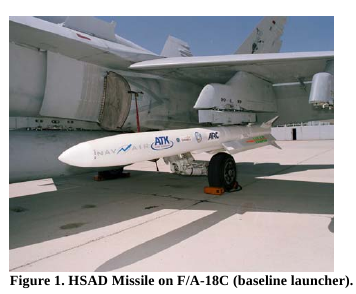
AARGM-ER is intended to be future capability Anti-Radiation Missile that leverages existing AGM-88E AARGM components. Any PS development effort for AARGM-ER is expected to compliment modifications to existing AGM-88E front end components (to include a modified interface with a repackaged control section and transition of the Control Actuation System (CAS)/control surfaces to the aft end of the PS).
The Government desires an AARGM-ER Acquisition Strategy that employs innovative approaches to initiate early PS development, reduces overall PS development timelines, and implements open standards for modularity and interface control at reasonable cost.
To support this desire, the Government requests Industry provide a draft informational paper or slide presentation for review five business days prior to the industry day. The government requests industry come to the industry prepared to discuss their informational paper or slide presentation. Details of the industry day schedule are provided in Section III and specific requests for informational paper/slide presentation content are provided in Section IV.
III. INDUSTRY DAY/ONE-ON-ONE AGENDA
DAY 1: 02 February 2017
Location: NAWS Conference Center, NAWCWD China Lake, Ridgecrest, CA
- 0800-0830 Arrival, Check-in at NAWS Conference Center
- 0830-0845 Ground rules/Agenda Review
- 0845-1000 AARGM-ER Acquisition Strategy Brief & PS Design Constraints
- 1000-1030 Break
- 1030-1200 One-on-one Session #1
- 1200-1300 Lunch
- 1300-1430 One-on-one Session #2
- 1430-1500 Break
- 1500-1630 One-on-one Session #3
DAY 2: 03 February 2017
Location: NAWS Conference Center, NAWCWD China Lake, Ridgecrest, CA
- Scheduled if necessary