A-7 versus A-10 evaluation, CAS role for Army support discussion

A big No. You'd take a severe hit in CNbeta (directional stability); i.e. you are adding destabilizing area in the very worst place (as far forward as possible on the A-7 airframe). Which is why you take the components out of the pod and and package into the airframe as best as possible. And add the pointy A-7F fin cap.

Please see Bill's post.
Thank you.

But man is that an ugly install. Need to have the Doc check those warts out!!! ;)
 
How about in the nose, in place of the radar . . . ?

cheers,
Robin.
 
Here is a close look at the Pave Penny installation under the intake of an A-7D - note that the Lockheed-Martin AN/AAS-35(V) Pave Penny is a laser spot tracker carried by the A-7D and other USAF aircraft to enable them to track a laser spot on the ground. It is a receiver only, allowing the pilot to see which targets may be attacked by any LGBs they carry. Pave Penny does not produce a laser beam and cannot be used to designate targets. It was designed to be used with designators on the ground or on other aircraft.

You would still need a FLIR to see targets at night, and a laser designator transmitter to self-designate targets.


A-7D with Pave Penny under intake.jpg
 
Thank you.

But man is that an ugly install. Need to have the Doc check those warts out!!! ;)
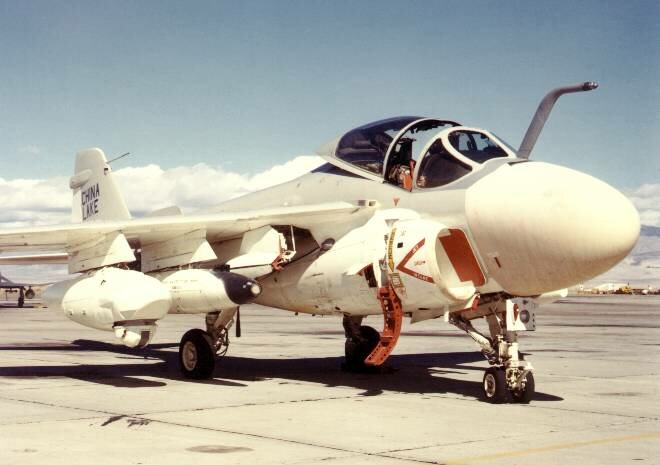
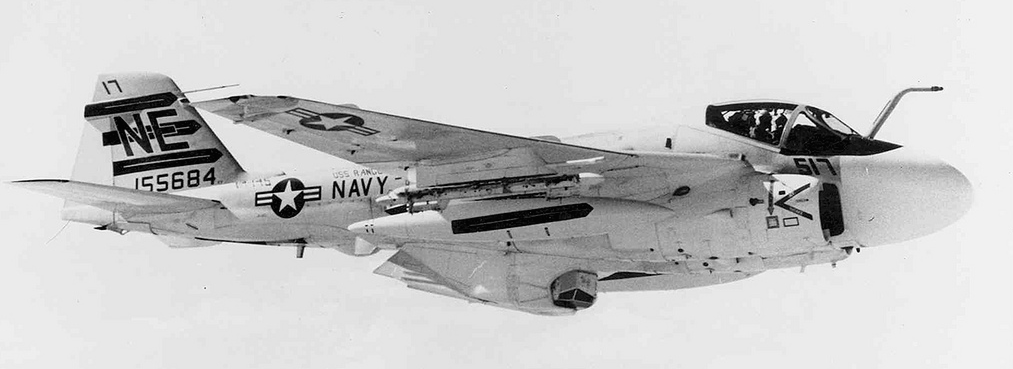
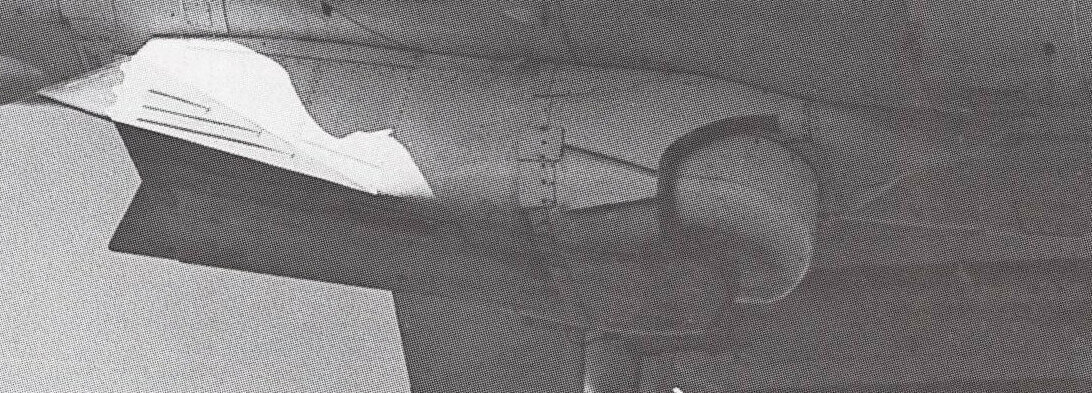
You think that is ugly... here is the first FLIR (the Trails, Roads Interdiction Module (TRIM)) on an A-6C... initially as a wing pod then mounted under the central fuselage (blocking the belly ordnance station).

TRIM was used in Vietnam to attack VC night supply movements.


TRIM at China Lake.jpg


A-6C 517NE.png


A-6C Operational Pod Lightened.jpg
 
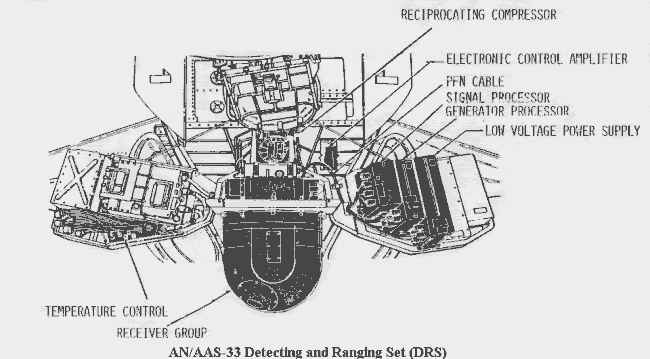
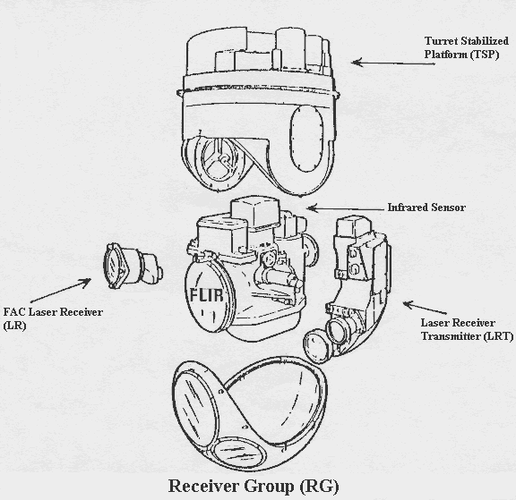
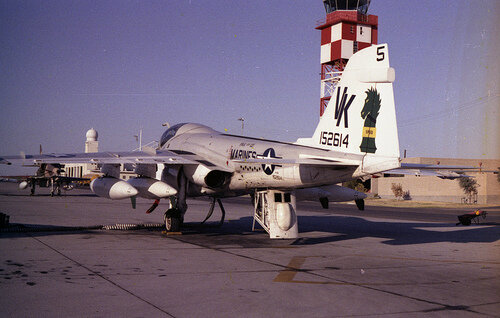
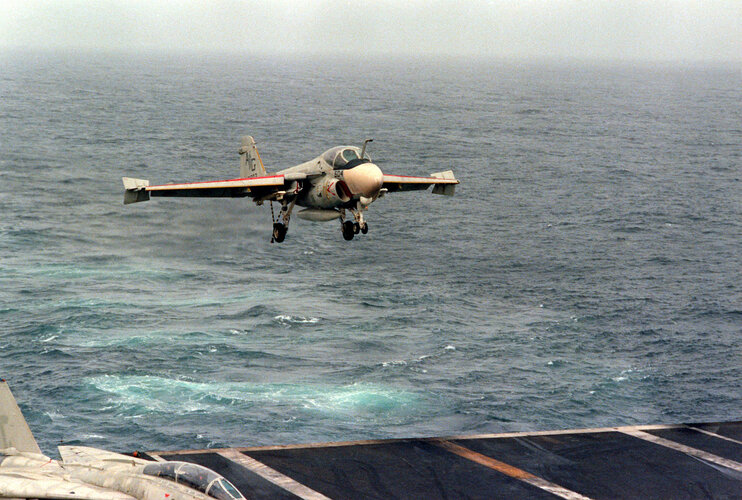
The AN/AAS-33 DRS (Detecting and Ranging System) for the A-6E TRAM upgrade (Target Recognition Attack Multisensor) was under development at the same time as the under-nose FLIR for the A-7D mentioned above (the TRAM system was approved for full production in 1978).

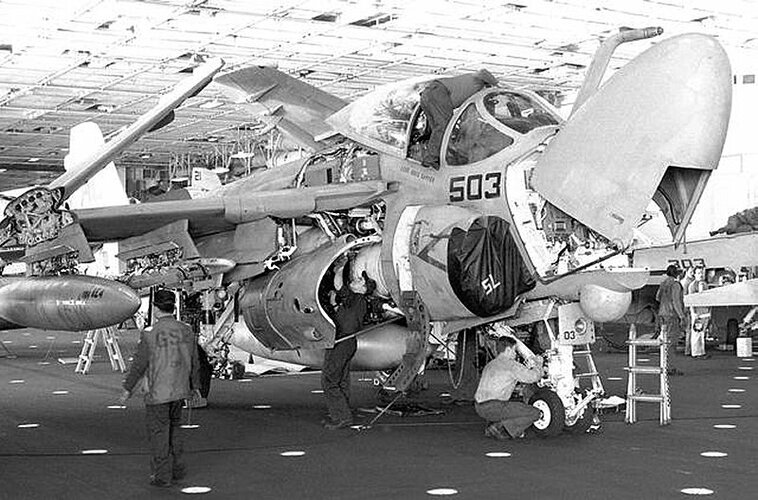
Externally it was an elegant system, but required a lot of volume in the nose of the A-6E, and the addition of a 1/4" tape recorder in the aft fuselage "birdcage" seen opened in the 4th photo so that Battle Damage Assessment could be made without need for a follow-up recon flight.


DRS nose layout.gif


RG.gif


a-6e-DN-SN-90-06268.jpg


VMA(AW)-121 A-6E.jpg


A-6E_Intruder_landing_on_CVN-69.jpg
 
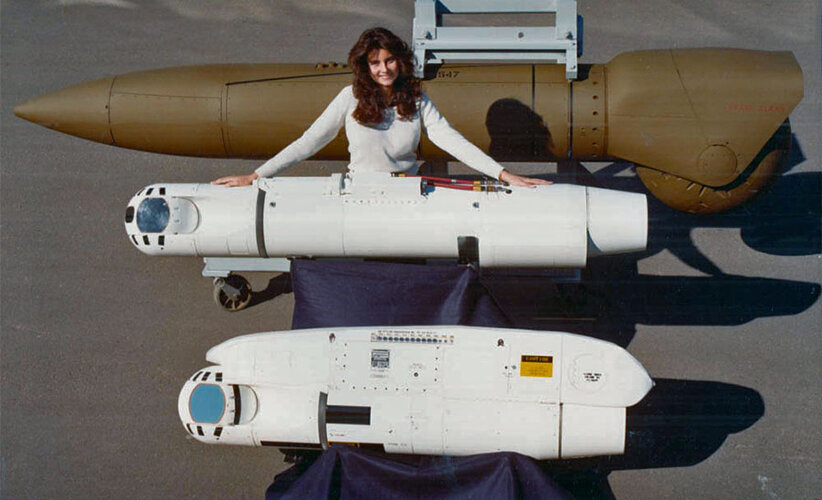
For reference, Here are two of the smaller pods of the 1980s (in white). I believe that's a Nitehawk at the bottom. The olive drab behemoth behind is the Pave Tack pod, also known as "Pave Drag", which was only carried by F-111s and occasionally, Air Force F-4s in the centerline position instead of the customary 600 gallon fuel tank.

Successful integration with the A-7 under the nose is left as an exercise for the viewer. (Pro tip: the Pave Tack might be better considered as a wingman.)

1693932082497.jpeg
 
Here is a close look at the Pave Penny installation under the intake of an A-7D - note that the Lockheed-Martin AN/AAS-35(V) Pave Penny is a laser spot tracker carried by the A-7D and other USAF aircraft to enable them to track a laser spot on the ground. It is a receiver only, allowing the pilot to see which targets may be attacked by any LGBs they carry. Pave Penny does not produce a laser beam and cannot be used to designate targets. It was designed to be used with designators on the ground or on other aircraft.

You would still need a FLIR to see targets at night, and a laser designator transmitter to self-designate targets.
A-10s also carried Pave Penny pods up till the -C upgrade, it was bolted to the side of the nose and hung down a foot or more.

For reference, Here are two of the smaller pods of the 1980s (in white). I believe that's a Nitehawk at the bottom. The olive drab behemoth behind is the Pave Tack pod, also known as "Pave Drag", which was only carried by F-111s and occasionally, Air Force F-4s in the centerline position instead of the customary 600 gallon fuel tank.

Successful integration with the A-7 under the nose is left as an exercise for the viewer. (Pro tip: the Pave Tack might be better considered as a wingman.)
IIRC, the F-111 install of the Pave Tack pod took up the entire bomb bay(!).

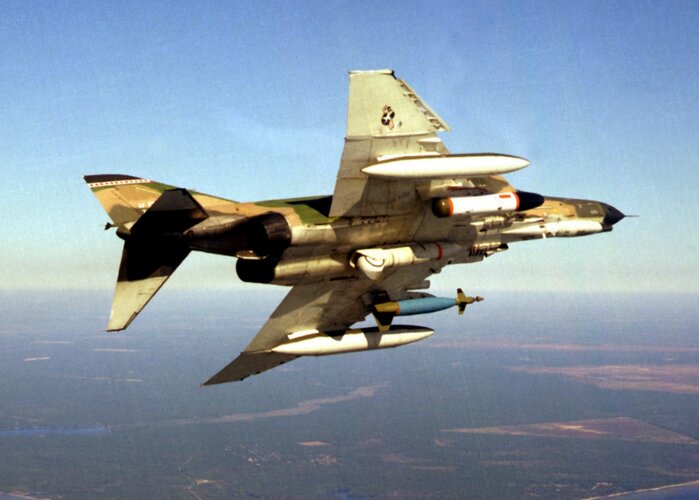
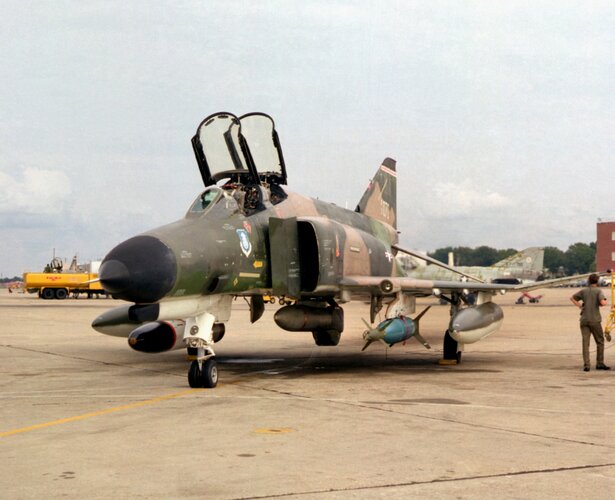
Now I need to make a 1/144 scale F-4 with the Pave Tack pod on the centerline. Did the Wild Weasels ever carry Pave Tack? (my local Air Guard squadron had Wild Weasels and RF-4Cs in the 1980s, went to A-10s in the 1990s)
 
Ah, I see . . . I was working on the principle that as the A-10 didn't have a radar, an A-7 for the same mission wouldn't need one either . . .

cheers,
Robin.
No problem!

And honestly, the A-7's radar bombing system made it able to fly and fight when the weather was nasty, while the A-10's lack of radar makes it a fair-weather-only bomber up until the A-10C. And even then I don't think the -C has a Terrain Following Radar!
 
Last edited:
On a side note, an interesting historical link between Pave Tack and LANTIRN:
The strategy for development conceived in 1978 before the TAC statement of need (1979) was simple. Ford,₁ the producer of PAVE Tack, the existing navigation and targeting system on the F-4, would be given a sole-source contract to develop an integrated navigation and targeting pod. The pod would be an improvement over PAVE Tack in that it would allow for terrain-following, automatic target recognition, and automatic weapons handoff. The PAVE Tack technology would be shrunk to meet LANTIRN specifications and automated for use in a single-pilot plane. The assumption was that these changes were technically understood although pressing the state of the art. The Air Staff estimated that the system could be developed for about $90 million.

₁There are no documents that establish this conception. This information was provided by early SPO members.

Needless to say, things did not work out as planned...
 
Last edited:
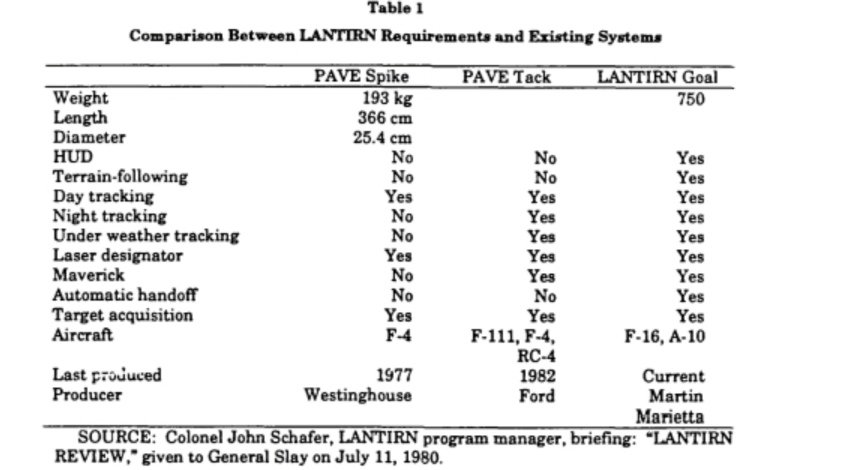
Actuals: "Weight: Navigation pod, 451.1 pounds (204.6 kilograms); targeting pod, 530 pounds (240.7 kilograms)" (as used on the MudHen).

So the "RFP Contractual Goal" weight from 1980 came down from 750 kg limit to an actual 444.8 kg by 1986. Martin Marietta was probably well under the goal weight in their proposal.
 
I'd assume so, but that still seems high for how big they are.

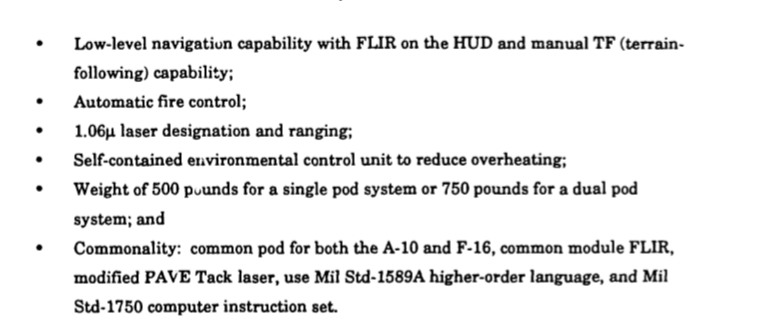
From elsewhere in the text, that's 750 pounds, not kg, for two pods. So, they missed pretty badly.

Edit: 750 pounds would have been only 340 kilos, so they ended up about 30 percent over the initial target.
 

Attachments

  • Screenshot_20250928-162036.png
    Screenshot_20250928-162036.png
    119.6 KB · Views: 13
Last edited:
From elsewhere in the text, that's 750 pounds, not kg, for two pods. So, they missed pretty badly.

Edit: 750 pounds would have been only 340 kilos, so they ended up about 30 percent over the initial target.
That's really confusing. If you're going to use KG in one part of a table, do not use pounds on that same line for comparison! /rant
 
That's really confusing. If you're going to use KG in one part of a table, do not use pounds on that same line for comparison! /rant

Oh, I know. That's really shoddy table making. They seem to have grabbed it directly from someone's pre-Powerpoint briefing slides, possibly redacted since the dimension for PAVE Tack were omitted (they were hard to find for quite a while, possibly out of embarrassment?)

There are some other interesting bits in the text. Ideally, they wanted it all in a single pod of ~500 pounds (225 kg), which is Litening territory. And that was supposed to include some form of TF (possibly via laser ranger/altimeter) rather than the separate radar/FLIR and targeting pods we got. That's basically what Ford Philco proposed, a single pod with TF navigation using a fixed FLIR and CO2 laser altimeter, plus a targeting FLIR and laser. I'd guess that the nav bits would have been fixed up front and the targeting portion in an optical ball at the back, like a miniature PAVE Tack.

The spec was really was intended to be much more of a CAS/BAI sensor, too, almost entirely for single-seat A-10s and F-16s. A major requirement was the ability to do automatic target recognition (ATR) and handoff to six Maverick in a single pass. That would mean essentially unloading the full normal warload of either aircraft in just one attack run.

If it had worked, and been deployed quickly, it would have been rather game changing. The combination of terrain following (to keep out of the envelope of Soviet mobile SAMs) and ATR (for volley firing Mavericks) was meant to make single-seat tactical fighters capable of actually conducting CAS/BAI in an opposed environment.
 

Similar threads

Back
Top Bottom