
You are using an out of date browser. It may not display this or other websites correctly.
You should upgrade or use an alternative browser.
You should upgrade or use an alternative browser.
2026 Israeli–United States strikes on Iran and elsewhere in region - News and Discussion
- Status
- Not open for further replies.

EmoBirb
ACCESS: Top Secret
- Joined
- 18 January 2025
- Messages
- 2,694
- Reaction score
- 6,920
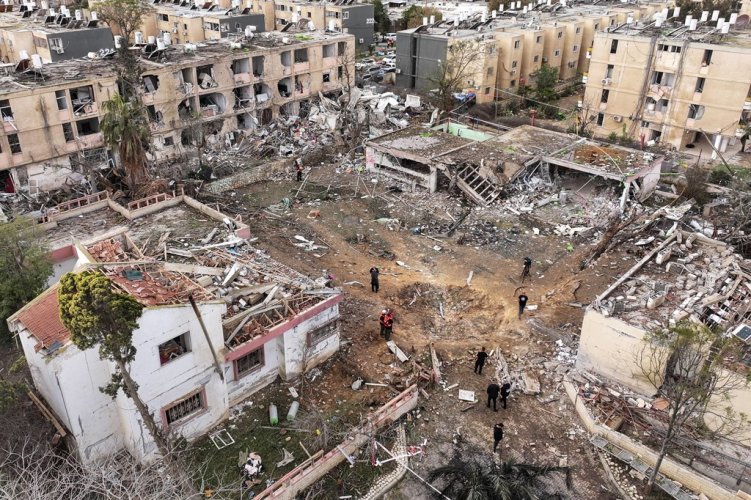
Another aftermath picture from Dimona, interesting is the presence of containers with inert gases (as evident by the green markings) like helium, nitrogen or argon. Not really something typically found in households. For context, Dimona is an important location with regards to Israeli nuclear research, nuclear weapons and the associated staff that's living in and around the City.



EmoBirb
ACCESS: Top Secret
- Joined
- 18 January 2025
- Messages
- 2,694
- Reaction score
- 6,920
And more footage of the aftermath of the missile attack on Arad
View: https://x.com/i/status/2035544204924121128
View: https://x.com/i/status/2035827070110941247
View: https://x.com/i/status/2035544204924121128
View: https://x.com/i/status/2035827070110941247
jsport
what do you know about surfing Major? you're from-
- Joined
- 27 July 2011
- Messages
- 8,596
- Reaction score
- 6,899

Sineva
ACCESS: Secret
- Joined
- 29 April 2010
- Messages
- 470
- Reaction score
- 1,323
EmoBirb
ACCESS: Top Secret
- Joined
- 18 January 2025
- Messages
- 2,694
- Reaction score
- 6,920
More sat images of damage caused by Iranian strikes on US and Gulf State infrastructure
View: https://x.com/i/status/2035798311530336665
View: https://x.com/i/status/2035798311530336665
VishnuOsiris
ACCESS: Confidential
- Joined
- 1 December 2024
- Messages
- 164
- Reaction score
- 290
I'm not trying to scoop this, but I think looking at the complete list at a glance is important. It makes an impression:
The destroyed infrastructure is as follows:
- The fuel supply line of the U.S. terrorist army at the Ras Tanura refinery in Saudi Arabia.
- The fuel supply line of the U.S. terrorist army at the Yanbu refinery in Saudi Arabia.
- The backup fuel tank of the U.S. army at the Ruwais refinery in the UAE.
- The fuel pumping station of the U.S. terrorist army at the port of Fujairah in the UAE.
- The backup U.S. fuel tanks at the port of Fujairah in the UAE.
- In addition to the fuel transfer points, the attack on the U.S. army’s data center and information backup facility at Rahbah base in the UAE was another one of Iran’s targets.
- The U.S. army’s TPS-75 early warning radar in Dubai
- The FPS-117 early warning radar at the U.S. base in Rafha, Saudi Arabia

Last edited:
Sineva
ACCESS: Secret
- Joined
- 29 April 2010
- Messages
- 470
- Reaction score
- 1,323
Hezbollah electric powered drones.
Possibly a second gps/sat-nav antenna embedded in the upper part of the left wing tip? [0:31]
Possibly a second gps/sat-nav antenna embedded in the upper part of the left wing tip? [0:31]
Reports of an american fighter said to have crashed in Kuwait.
View: https://x.com/PressTV/status/2035980201901912456
View: https://x.com/PressTV/status/2035980201901912456
Last edited:

Grey Havoc
ACCESS: USAP
- Joined
- 9 October 2009
- Messages
- 24,500
- Reaction score
- 18,172
https://www.telegraph.co.uk/world-n...ar-latest-news-trump-strait-of-hormuz-israel/
Iran has threatened to attack a UAE nuclear power plant in a standoff with Donald Trump over the Strait of Hormuz.
The regime published a list of targets that could be hit should the US president order strikes on Iran’s electricity grid.
The list includes the Barakah nuclear power plant on the Gulf coast, which is about 180 miles west of Abu Dhabi.
On Saturday evening, Mr Trump gave Iran an ultimatum: open the strait within 48 hours or face the destruction of its energy infrastructure.
Sir Keir Starmer held a 20-minute phone call with Mr Trump on Sunday night to discuss a resolution to reopen the strait. Before its closure, the shipping route served as a conduit for a fifth of the world’s oil.
On Monday, the Prime Minister will hold a Cobra meeting to address the economic consequences of the closure and the effects of price rises on British consumers.
8:58AM
Iran threatens to lay mines across Persian Gulf if Kharg Island targeted
An attack on Kharg Island will lead to Iranian forces laying sea mines in the Persian Gulf, the Islamic Republic’s defence council has warned.
The US is considering plans to occupy or blockade the island, responsible for 90 per cent of the country’s oil exports, to pressure Tehran to reopen the Strait of Hormuz, according to Axios.
But Iran’s defence council has warned against such a move in a statement issued this morning.
It said: “Any attempt to attack Iran’s coasts or islands will cause all access routes in the Gulf... to be mined with various types of sea mines, including floating mines that can be released from the coast.
“In this case, the entire Gulf will practically be in a situation similar to the Strait of Hormuz for a long time... One should not forget the failure of more than 100 minesweepers in the 1980s in removing a few sea mines.”
The defence council added that non-belligerent states can still pass through the strait by coordinating passage with Iran.
Grey Havoc
ACCESS: USAP
- Joined
- 9 October 2009
- Messages
- 24,500
- Reaction score
- 18,172
Grey Havoc
ACCESS: USAP
- Joined
- 9 October 2009
- Messages
- 24,500
- Reaction score
- 18,172
Grey Havoc
ACCESS: USAP
- Joined
- 9 October 2009
- Messages
- 24,500
- Reaction score
- 18,172
Grey Havoc
ACCESS: USAP
- Joined
- 9 October 2009
- Messages
- 24,500
- Reaction score
- 18,172
https://www.telegraph.co.uk/business/2026/03/23/oil-price-us-iran-war-energy-trump-ftse-100-markets/
https://www.telegraph.co.uk/busines...crisis-worse-than-1970s-ukraine-war-combined/
Stocks plunged after Donald Trump threatened to hit Iran’s electricity grid unless it allows oil tankers to travel safely again along its coastline.
The FTSE 100 sank by more than 2pc in a sweeping sell-off after the US president gave Tehran 48 hours to reopen the Strait of Hormuz.
Oil edged up to $114 a barrel after Iran said on Sunday it would hit the energy and water systems of its Gulf neighbours in retaliation.
The Dax in Frankfurt was down 2.1pc and the Cac 40 in Paris was down 1.9pc following sharp falls in Asia overnight.
Japan’s flagship Nikkei 225 dropped by 3.5pc on Monday and has fallen more than 12pc since the conflict began. South Korea’s market closed down 6.5pc, leaving it 14pc lower for the month.
Shane Oliver of fund manager AMP said: “The war could still go on for many weeks yet and see oil prices rise say to $150 a barrel. And the steady destruction of energy infrastructure means it will take longer to get supply back to normal.
“It’s also worth noting that past oil shocks unfolded over many months in terms of the rise in oil prices as the full impact became clearer – it was over about four months in 1973 and a year in 1979.”
https://www.telegraph.co.uk/busines...crisis-worse-than-1970s-ukraine-war-combined/
The world is facing a worse energy shock than the twin crises of the 1970s and the turmoil that followed Russia’s invasion of Ukraine combined, the boss of the International Energy Agency (IEA) has warned.
Fatih Birol, the executive director of the IEA, said no country would be immune from the impact of the war on energy prices. He described the conflict in the Middle East as “very severe”.
Mr Birol said the IEA was consulting with governments in Europe and Asia on whether to release more of the world’s stockpiles of oil as the conflict entered its fourth week.
EmoBirb
ACCESS: Top Secret
- Joined
- 18 January 2025
- Messages
- 2,694
- Reaction score
- 6,920
USS 'Gerald R. Ford' could be out of action for over a year.
https://www.19fortyfive.com/2026/03...Might,Souda Bay undergoing damage assessment.
Under normal conditions, post-deployment maintenance for a nuclear-powered aircraft carrier can take several months, even without major damage. Historical examples show that complex overhauls or major repair periods can extend well beyond a year, depending on scope and system upgrades.
In the case of Ford, several factors point to it being a longer timeline. First, the ship is a first-in-class platform with known challenges across multiple systems, meaning maintenance is already going to be more complex. Second, the extended deployment has created a backlog of deferred work that must now be addressed in a single maintenance period. Third, the fire itself caused structural and habitability damage that will require repair alongside the routine engineering work. Nothing about this is routine.
When these factors are combined, the possibility of a 12-14 month downtime seems perfectly plausible, even if it hasn ot been officially confirmed. Prolonged deployments come with a cost, and this could be it.
https://www.19fortyfive.com/2026/03...Might,Souda Bay undergoing damage assessment.
Last edited:
Grey Havoc
ACCESS: USAP
- Joined
- 9 October 2009
- Messages
- 24,500
- Reaction score
- 18,172
From BBC livestream:
Huge financial swings follow Trump statement published at 11:24
11:24Breaking
Nick Edser
Business reporter
Markets have reversed earlier moves after Donald Trump said the US and Iran had had "very good and productive conversations regarding a complete and total resolution of our hostilities in the Middle East".
Brent crude has fallen 13% to about $96 a barrel. The FTSE 100 index is now up 0.5% having fallen more than 2% earlier.
Gas prices have fallen from 159p a therm to about 139p.
The yield on 10-year UK government bonds, which had risen to 5.121% earlier, is now down to 4.89% - which is lower than at the start of the day.
11:21
Bernd Debusmann Jr
White House reporter
Donald Trump's message just a few moments ago was perhaps his most conciliatory since Operation Epic Fury began - but leaves significant unanswered questions.
While he made mention of "very good and productive" talks with Iran, that has not been confirmed by the Iranians, and the statement stands in stark contrast to the bellicose tone the warring parties struck over the weekend.
Additionally, it's not clear what, exactly, these talks focused on. The topic could potentially have been Iran's ballistic missile program or nuclear enrichment, or simply a ceasefire - a prospect Trump specifically downplayed on Friday.
It could also be a reference to the Strait of Hormuz, although opening it to shipping traffic is something that the Iranians have so far not publicly promised. Most experts consider it unlikely, as Iran's stranglehold over Hormuz presents its greatest leverage in the war.
The US president is currently in Florida but will be travelling to Memphis early this afternoon to deliver a speech focused on crime-fighting efforts.
Much of the world, however, will be watching for any update or details about these talks, and what it could mean going forward.

11:12Breaking
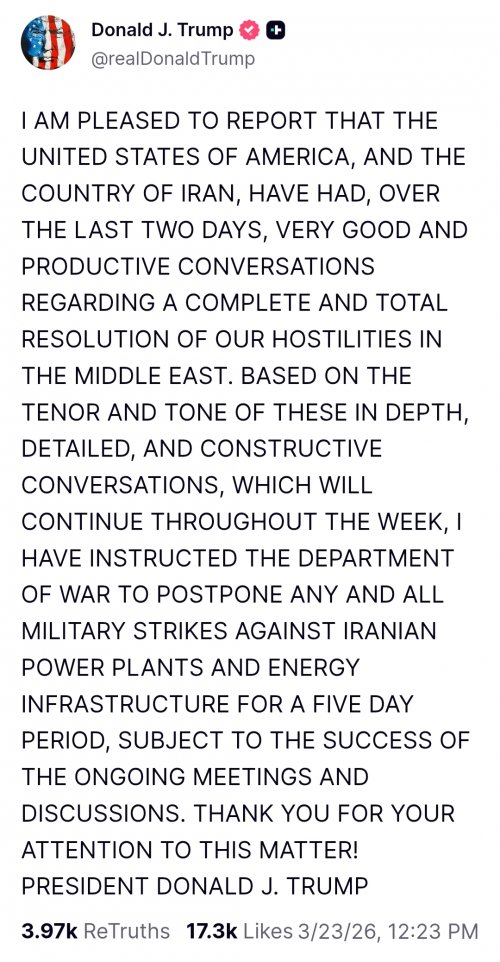
Donald Trump says there have been "productive conversations" about a "complete and total resolution" to the conflict in the Middle East.
He says he will "postpone any and all strikes against Iranian power plants and energy infrastructure" for a five day period.
In a post on TruthSocial all in capital letters, reproduced here in full and verbatim, he says: "I AM PLEASE TO REPORT THAT THE UNITED STATES OF AMERICA, AND THE COUNTRY OF IRAN, HAVE HAD, OVER THE LAST TWO DAYS, VERY GOOD AND PRODUCTIVE CONVERSATIONS REGARDING A COMPLETE AND TOTAL RESOLUTION OF OUR HOSTILITIES IN THE MIDDLE EAST.
"BASED ON THE TENOR AND TONE OF THESE IN DEPTH, DETAILED, AND CONSTRUCTIVE CONVERSATIONS, WITCH WILL CONTINUE THROUGHOUT THE WEEK, I HAVE INSTRUCTED THE DEPARTMENT OF WAR TO POSTPONE ANY AND ALL MILITARY STRIKES AGAINST IRANIAN POWER PLANTS AND ENERGY INFRASTRUCTURE FOR A FIVE DAY PERIOD, SUBJECT TO THE SUCCESS OF THE ONGOING MEETINGS AND DISCUSSIONS. THANK YOU FOR YOUR ATTENTION TO THIS MATTER! PRESIDENT DONALD J. TRUMP"
Update 11:35 GMT: President Trump subsequently reposted this statement on TruthSocial with some typos corrected
Grey Havoc
ACCESS: USAP
- Joined
- 9 October 2009
- Messages
- 24,500
- Reaction score
- 18,172
Daily Telegraph livestream:
11:47AM
Analysis: Iran will declare any ceasefire a victory
Iran’s state media narrative is already established: “Donald Trump retreated after Iran’s decisive warning.”
As the US president announced a five-day postponement of strikes on Iranian power plants to allow for “very good and productive conversations”, Tehran had its victory script ready.
The Islamic Republic will portray any ceasefire as vindication of its resistance strategy, as it did after the 12-day June 2025 war.
Survival equals victory in Iranian strategic thinking. Iran withstood three weeks of devastating attacks that killed Ali Khamenei, the supreme leader, destroyed much of the military leadership, and left more than 1,400 civilians dead.
Yet the government remains intact. Mojtaba Khamenei now leads the country and the system functions.
State television will celebrate fallen leaders as martyrs who sacrificed decades of service for the revolution rather than failures who couldn’t protect themselves.
Ali Larijani, Esmail Khatib, and other slain officials will be lionised as “shahids”, martyrs who delivered Iran this moment of triumph.
EmoBirb
ACCESS: Top Secret
- Joined
- 18 January 2025
- Messages
- 2,694
- Reaction score
- 6,920
Following this Statement made by President Trump on his Truth Social:

Iranian sources have rejected the claim of talks, let alone Agreements being made, with the US. According to them there is no on going communication between Iran and the US.
https://farsnews.ir/Qaysar/17742704...rity-Official-No-Negotiations-Between-Iran-US
View: https://x.com/i/status/2036055565106028770
Iranian sources have rejected the claim of talks, let alone Agreements being made, with the US. According to them there is no on going communication between Iran and the US.
https://farsnews.ir/Qaysar/17742704...rity-Official-No-Negotiations-Between-Iran-US
View: https://x.com/i/status/2036055565106028770
Last edited:
EmoBirb
ACCESS: Top Secret
- Joined
- 18 January 2025
- Messages
- 2,694
- Reaction score
- 6,920
According to the NYT it occurs that the 'Iranian Protests' were part of a larger operation by Mossad to bring about regime change or at least pave the way for it. Despite criticism from parts of the intelligence community in Israel and the US, the plan found support from Netanyahu and Trump.
https://archive.ph/KkEK1
Within days of the war’s beginning, said David Barnea, the Mossad chief, his service would likely be able to galvanize the Iranian opposition — igniting riots and other acts of rebellion that could even lead to the collapse of Iran’s government. Mr. Barnea also presented the proposal to senior Trump administration officials during a visit to Washington in mid-January.
Mr. Netanyahu adopted the plan. Despite doubts about its viability among senior American officials and some officials in other Israeli intelligence agencies, both he and President Trump seemed to embrace an optimistic outlook. Killing Iran’s leaders at the outset of the conflict, followed by a series of intelligence operations intended to encourage regime change, they thought, could lead to a mass uprising that might bring about a swift end to the war.
Non-Paywall:The belief that Israel and the United States could help instigate widespread revolt was a foundational flaw in the preparations for a war that has spread across the Middle East. Instead of imploding from within, Iran’s government has dug in and escalated the conflict, striking blows and counterblows against military bases, cities and ships around the Persian Gulf, and against vulnerable oil and gas installations.
https://archive.ph/KkEK1

Forest Green
ACCESS: USAP
- Joined
- 11 June 2019
- Messages
- 14,508
- Reaction score
- 31,536
EmoBirb
ACCESS: Top Secret
- Joined
- 18 January 2025
- Messages
- 2,694
- Reaction score
- 6,920
Trump claims that there has technically been regime change in Iran because the people in charge are now different than before
View: https://x.com/i/status/2036054917769539719
View: https://x.com/i/status/2036054917769539719
Forest Green
ACCESS: USAP
- Joined
- 11 June 2019
- Messages
- 14,508
- Reaction score
- 31,536
View: https://x.com/CENTCOMHebrew/status/2036036336667308090?s=20US forces continue to destroy the Iranian regime’s single-pronged attack drone capabilities, which have been used in indiscriminate attacks against civilians across the region.
View: https://x.com/Danale/status/2036003690016854371?s=20
Grey Havoc
ACCESS: USAP
- Joined
- 9 October 2009
- Messages
- 24,500
- Reaction score
- 18,172
https://www.wsj.com/livecoverage/iran-war-us-israel-news-updates-2026
https://www.wsj.com/world/europe/europe-is-quietly-playing-a-crucial-role-in-the-iran-war-aad34a00(Registration or subscription may be required)
https://www.wsj.com/world/europe/europe-is-quietly-playing-a-crucial-role-in-the-iran-war-aad34a00(Registration or subscription may be required)

Saudi are to allow the US. to use the air base at Taif close to Sakaka.
(Interestingly inside the area of SA. Israel sees as theirs)
(Interestingly inside the area of SA. Israel sees as theirs)

- Joined
- 6 November 2010
- Messages
- 6,351
- Reaction score
- 8,226
UNESCO-listed Chehel Sotoun palace damaged in airstrike.
https://www.artnews.com/art-news/news/chehel-sotoun-damaged-iran-isfahan-1234776437/
Falak-ol-Aflak castle
Jameh-mosque in Isfahan
Golestan palace
https://www.artnews.com/art-news/news/chehel-sotoun-damaged-iran-isfahan-1234776437/
Also damaged during the past few weeks:Chehel Sotoun, part of a UNESCO World Heritage landmark in the Iranian city of Isfahan, was damaged following airstrikes in the area, according to Iranian state media. The report comes one week after Golestan Palace in Tehran suffered significant damage from aerial bombardment linked to US-Israeli strikes on Iran.
A roughly minute-long video posted to X by Iranian state media appears to show doors blasted open. The grand windows of the 17th-century Chehel Sotoun Palace seem to have shattered.
Falak-ol-Aflak castle
Jameh-mosque in Isfahan
Golestan palace
Last edited:
Grey Havoc
ACCESS: USAP
- Joined
- 9 October 2009
- Messages
- 24,500
- Reaction score
- 18,172
https://www.telegraph.co.uk/world-n...latest-news-israel-trump-us-strait-of-hormuz/
https://www.bbc.com/news/live/cn8dldl0jx9t
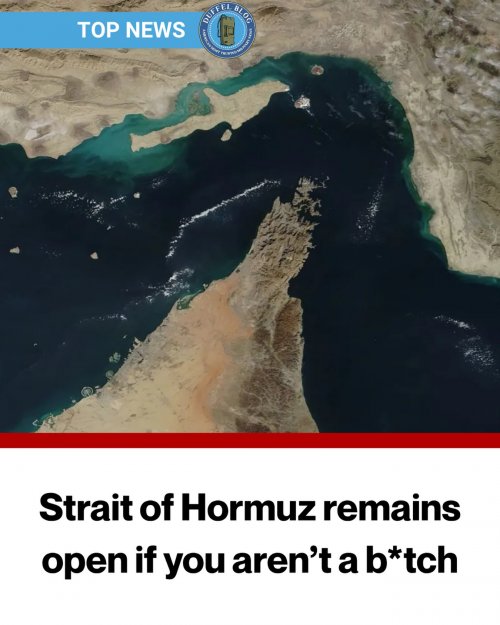
Iran has laid at least a dozen mines in the Strait of Hormuz, US intelligence officials have claimed.
The strait, which serves as a conduit for a fifth of the world’s oil, was paralysed at the start of the war after Iran threatened to destroy any vessel using the critical shipping lane.
US officials have said there are at least a dozen Maham 3 and Maham 7 Limpet mines under the narrow waterway, according to CBS News. They will need careful extraction before shipping can resume.
The Iranian-manufactured Maham 3 is a moored naval mine that uses magnetic sensors to detect nearby vessels without physical contact, while the Maham 7 is a compact, high-explosive sticking mine.
Donald Trump announced a five-day ceasefire on Iranian energy targets on Monday after he said peace talks with the Islamic Republic were progressing.
The US president said he would jointly run the Strait of Hormuz with Iran after the war ended.
Senior regime figures said Mr Trump had “backed down”, adding that no negotiations had taken place. They said it was “fake news” being used to “manipulate the financial and oil markets”.
Ursula von der Leyen, the European Commission president, described the current global energy crisis as critical and called for an immediate ceasefire in the Middle East.
https://www.bbc.com/news/live/cn8dldl0jx9t
Grey Havoc
ACCESS: USAP
- Joined
- 9 October 2009
- Messages
- 24,500
- Reaction score
- 18,172
Grey Havoc
ACCESS: USAP
- Joined
- 9 October 2009
- Messages
- 24,500
- Reaction score
- 18,172
https://www.wsj.com/livecoverage/iran-war-us-israel-news-updates-2026
Iran pressed its assault in the Middle East, hitting Israel as well as Kuwait, Bahrain and Saudi Arabia with fresh attacks, as Tehran officials worried that diplomatic attempts to secure a cease-fire could be a trap.
Sineva
ACCESS: Secret
- Joined
- 29 April 2010
- Messages
- 470
- Reaction score
- 1,323
Grey Havoc
ACCESS: USAP
- Joined
- 9 October 2009
- Messages
- 24,500
- Reaction score
- 18,172
Via the Drudge Report:
https://www.nytimes.com/2026/03/24/...e_code=1.VlA.tGWI.AzAFt1X9Mtfi&smid=url-share
https://www.nytimes.com/2026/03/24/...e_code=1.VlA.tGWI.AzAFt1X9Mtfi&smid=url-share
Saudi Arabia’s de facto leader, Prince Mohammed bin Salman, has been pushing President Trump to continue the war against Iran, arguing that the U.S.-Israeli military campaign presents a “historic opportunity” to remake the Middle East, according to people briefed by American officials on the conversations.
In a series of conversations over the last week, Prince Mohammed has conveyed to Mr. Trump that he must press toward the destruction of Iran’s hard-line government, the people familiar with the conversations said.
Prince Mohammed, the people familiar with the discussions said, has argued that Iran poses a long-term threat to the Gulf that can only be eliminated by getting rid of the government.
Prime Minister Benjamin Netanyahu of Israel also views Iran as a long-term threat, but analysts say Israeli officials would probably view a failed Iranian state that is too caught up in internal turmoil to menace Israel as a win, while Saudi Arabia views a failed state in Iran as a grave and direct security threat.
But senior officials in both the Saudi and American governments worry that if the conflict drags on, Iran could deliver ever more punishing attacks on Saudi oil installations and the United States could be stuck in an endless war.
[snip]
Grey Havoc
ACCESS: USAP
- Joined
- 9 October 2009
- Messages
- 24,500
- Reaction score
- 18,172
From the Daily Telegraph livestream:
Not entirely unexpected, reports have coming out over the last week or so that both the 82nd and 101st Airborne Divisions were among the US forces being put on heightened alert for potential deployment to the theater.Donald Trump is considering sending paratroopers to Iran despite saying he had begun talks to end the war.
The US president could send a brigade of the 82nd Airborne Division, known as the “Immediate Response Force”, to the Gulf.
Military officials suggested the force, which specialises in parachute assaults, could be used to take control of Kharg Island, Iran’s oil export hub, depending on the success of negotiations with the Islamic Republic.
US officials told The New York Times that the preparations were part of “prudent planning” and said the division had not yet received orders to deploy.
On Monday, Mr Trump said he was postponing strikes on Tehran’s oil and gas sites for five days while the two countries negotiated.
He added that if talks fell apart, the US would “just keep bombing our little hearts out”.
Forest Green
ACCESS: USAP
- Joined
- 11 June 2019
- Messages
- 14,508
- Reaction score
- 31,536
Iranian munitions depot before and after.
View: https://x.com/Etienne_Marcuz/status/2036400057226871071?s=20
View: https://x.com/Etienne_Marcuz/status/2036400057226871071?s=20
Grey Havoc
ACCESS: USAP
- Joined
- 9 October 2009
- Messages
- 24,500
- Reaction score
- 18,172
aonestudio
I really should change my personal text
- Joined
- 11 March 2018
- Messages
- 3,377
- Reaction score
- 9,218

jeffb
ACCESS: Top Secret
- Joined
- 7 October 2012
- Messages
- 1,591
- Reaction score
- 3,150

Big_Zukini
ACCESS: Top Secret
- Joined
- 23 November 2024
- Messages
- 906
- Reaction score
- 1,741
Cruise missile manufacturing hit in Tehran
- Status
- Not open for further replies.
Similar threads
-
Israeli jet malfunctioned above Iran, narrowly averted emergency landing amid war — report
- Started by datafuser
- Replies: 4
-
-

-
Military Interventions in Syria and 2024 Syrian regime change
- Started by seruriermarshal
- Replies: 220
-
