Forest Green
ACCESS: USAP
- Joined
- 11 June 2019
- Messages
- 14,510
- Reaction score
- 31,539


“We don’t need anybody,” Trump insisted during a press conference in the East Room of the White House. “We’re the strongest nation in the world. We have the strongest military by far.”
“I’m almost doing it, in some cases, not because we need them, but because I want to find out how they’ll react,”

I just inserted quotes from the article, Scott. If you have an issue with that's written, you have to message the NYT or the AuthorYou do realize that the laundry on a carrier is big enough for ~6000 people, right? Not exactly a small thing. And a fire in a confined space gets really bad in a big hurry.
Smoke so black you can't see your hand in front of your face in 2 minutes or less.
Major fires on a carrier always take a long time to put out and then to overhaul.


Helicopters would be more sensible for escort cover, as would USVs and UUVs for demining. No sense sticking an expensive warship in there. Seems more like a stupidity test.
According to Greek media, the USS Ford will return to Crete for replenishment and an investigation into the recent fire.The USS Gerald R. Ford (CVN-78) is expected to return to Souda Naval Base in Crete next week from the it current position in the Northern Red Sea
I can only say Kuznetsov's curse has been transferred to Ford now.According to Greek media, the USS Ford will return to Crete for replenishment and an investigate into the recent fire.
View: https://x.com/i/status/2033901186454090103

Some of the stuff he writes there... absolute cuckoo.

Because we don't do much pillaging and plundering nowadays.In all wars the first victim is the truth and the second is the taxpayer.



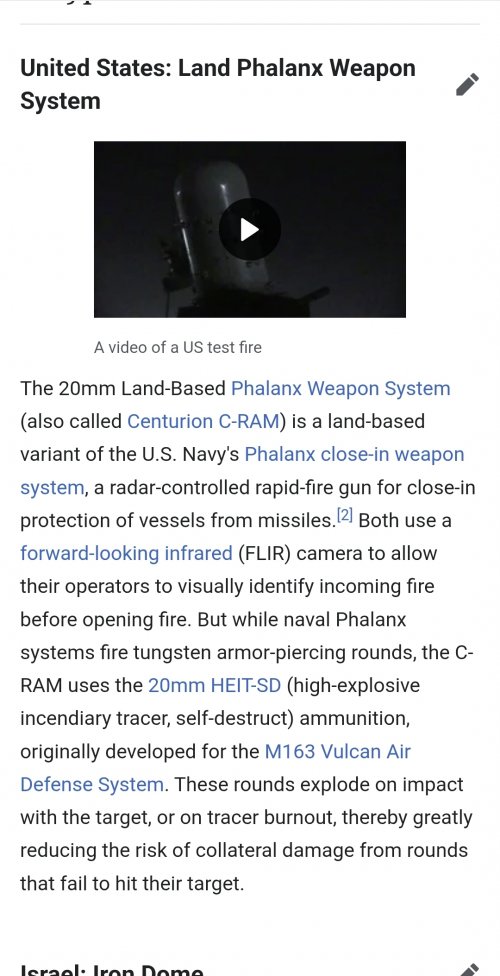
What is it? A land based 20mm Phalanx ?Claimed C-RAM drone interception in Baghdad.
Land, like the Iranian ones.And where do those helicopters, UUVs, and USVs operate from?
I actually think it could be a blurry image of an Iranian F-4.

In the many bizarre exchanges that occurred in the run-up to the US-Israeli attack on Iran, perhaps the most unexpected was an invitation by Donald Trump’s special envoy Steve Witkoff for the Iranian foreign minister, Abbas Araghchi, to join him and Trump’s son-in-law, Jared Kushner, for a visit to the USS Abraham Lincoln carrier strike group.
The idea that Araghchi would leave talks in Oman about the future of Iran’s nuclear programme to tour a ship sent to the Gulf in an effort to dislodge his government seemed idiosyncratic at best.
One Gulf diplomat, who has direct knowledge of the talks and is furious with Witkoff and Kushner’s behaviour, described the pair as “Israeli assets that had conspired to force the US president into entering a war from which he is now desperate to get himself out of”.
Witkoff does not pretend to regional expertise – in one of his recent interviews he referred to the strait of Hormuz as the “Gulf of Hormuz”. Similarly, he admitted in an interview that his knowledge of Iran’s nuclear programme was sketchy, but insisted he “was competent to discuss it since he had studied it”.
Yet, in the five sessions of the first round of talks last year – held before the 12-day June war – Witkoff rarely took notes and brought with him only Michael Anton, a hawkish essayist and political philosopher with no specialism in the Iran nuclear file. Anton was supposed to have an unnamed technical team back in Washington, and at times, as in May 2025, they could produce hard-core technical demands, but this level of expertise was never in the talks.
When talks resumed in Oman on 6 February, Witkoff, in a breach of protocol and to the surprise of Oman’s foreign minister, Badr bin Hamad Al Busaidi, arrived in Muscat with Adm Brad Cooper, the commander of US forces in the Middle East, in full naval uniform. Witkoff’s explanation was that “he just happened to be in the neighbourhood”.
Cooper was politely asked to leave the talks by his Omani hosts.
One source said he was in the building at Oman’s ambassadorial residence in Cologny, Geneva, acting as an adviser, reflecting widespread concern about the US expertise on the talks represented by Donald Trump’s son-in-law Jared Kushner and Steve Witkoff, Trump’s special envoy on several issues.
Britain’s national security adviser, Jonathan Powell, attended the final talks between the US and Iran and judged that the offer made by Tehran on its nuclear programme was significant enough to prevent a rush to war, the Guardian can reveal.
Powell thought progress had been made in Geneva in late February and that the deal proposed by Iran was “surprising”, according to sources. Two days after the talks ended, and after a date had been agreed for a further round of technical talks in Vienna, the US and Israel launched the attack on Iran.
“The UK team were surprised by what the Iranians put on the table,” the former official added.
“It was not a complete deal, but it was progress and was unlikely to be the Iranians’ final offer. The British team expected the next round of negotiations to go ahead on the basis of the progress in Geneva.”
The UK saw no compelling evidence of an imminent threat of an Iranian missile attack on Europe, or of Iran securing a nuclear weapon. This is the first time it has become clear that Britain was so closely involved in the talks, and so had good reason to decide whether diplomatic options had been exhausted and a US attack was necessary.
One Gulf diplomat with knowledge of the talks said: “We regarded Witkoff and Kushner as Israeli assets that dragged a president into a war he wants to get out of.”
Iran hit a military base used by British and Australian troops in the United Arab Emirates during overnight strikes across the Gulf.
A missile struck Al Minhad Air Base, where Britain maintains a permanent military facility, late on Tuesday UK time.
The projectile caused “minor damage” to an accommodation block and a medical facility, Anthony Albanese, the Australian prime minister, said.
The base, operated by the United Arab Emirates, serves as Australia’s military headquarters for the Middle East and has hosted its forces since 2003. Mr Albanese confirmed that all Australian staff were “absolutely safe”.
The UK opened its permanent headquarters at the base in 2024 to support British operations in the region. The Ministry of Defence has yet to comment on the attack.
Al Minhad was hit by an Iranian drone strike in the first days of the war, but no damage was reported.
Iran’s overnight bombardment also killed an elderly couple in Tel Aviv.
Iranian officials had vowed revenge for the killing of Ali Larijani, its most senior security chief, who died in an Israeli air strike on Monday.
Hedge funds have slashed their exposure to stocks and bonds since the outbreak of war in Iran, as traders seek to guard against market volatility.
Ownership of global stocks among funds has fallen by 75pc since the start of the conflict, according to UBS.
Economists from the Swiss bank also revealed funds have been selling off bonds at a rapid pace, using the first half of March to offload 80pc of debt bought last month. It warned bond investors were facing a “worst case scenario”.
It was revealed in UBS’ latest update on trend-tracking funds, which use algorithms to follow market movements.
The global economy has been put at risk of an inflationary shock from energy prices, which have risen as the Iran war dramatically reduced supplies of oil and gas from the Middle East.
As a result, markets have been thrown into turmoil, with the FTSE 100 down by 4.5pc since the start of the war. Germany’s Dax has declined 5.5pc and the Dow Jones Industrial Average in New York has dropped by 5.1pc.
Bond prices have also dropped sharply, pushing up the cost of government borrowing around the world.
The yield on 10-year UK bonds has risen to 4.64pc compared to 4.23pc before the conflict, while the equivalent in Germany has climbed from 2.64pc to 2.88pc. Bond yields rise as prices fall.
UBS said hedge funds were instead turning their investments into cash, buying up roughly $175bn worth of US dollars since the start of March.
The bank’s analysts said they expect hedge funds will purchase another $70bn to $80bn worth of dollars before the end of this month, as investors pile into the currency as a safe haven asset.
The investment funds, which manage hundreds of billions of dollars, are also expected to cut their exposure to stock markets even more over the coming weeks, but at a slower pace than the selling seen over the last two weeks, UBS said.