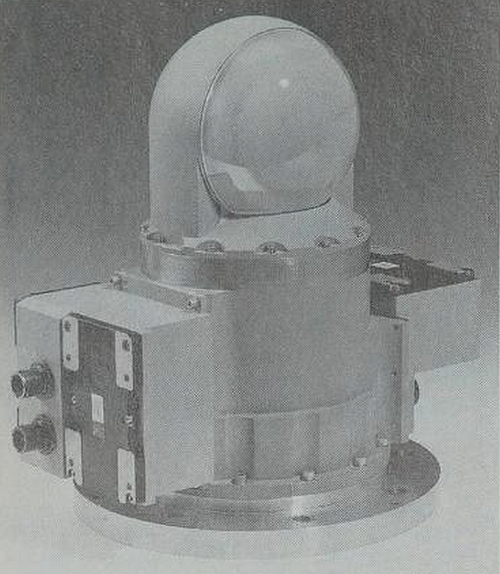
1990s GEC Type 260 IRST prototype

overscan (PaulMM)

Administrator
Staff member
Joined
27 December 2005
Messages
19,230
Reaction score
35,693
Type 260 stabilised fast acting mirror

Type260.png

GEC-Marconi developed the Type 260 for an airborne Infrared Search & Track (IRST) demonstrator programme. The mirror is compact and rugged and requires a minimum volume external to the host airframe. It uses a novel strapdown stabilisation technique which permits the mirror sightline to be rapidly pointed, stabilised against ‘own ship’ motion and accurately registered with respect to inertial space.

In addition to IRST applications, the Type 260 mirror is suitable for other demanding optical tasks such as IRCM.

The modular nature of the system, mirror head, gyro package and compact electronics allows for greater flexibility in installation than usual. It is also possible to change the gyro type without major changes to the system.

Specifications
Mirror size: 130 x 182 mm
Field of regard (this can be expanded if required):
(azimuth) +30°
(elevation) +25° -20°
Acceleration: >150r/s*
Slew rate: >5r/s
Stabilisation: >100urad
Electronics unit: 371 x 194 x 192 mm
Operational status
Prototype delivered
Contractor
GEC-Marconi Electro-Optics Ltd, Navigation and
Electro-Optic Systems Division, Silverknowes.
Presumably this is some kind of ancestor to PIRATE?
 
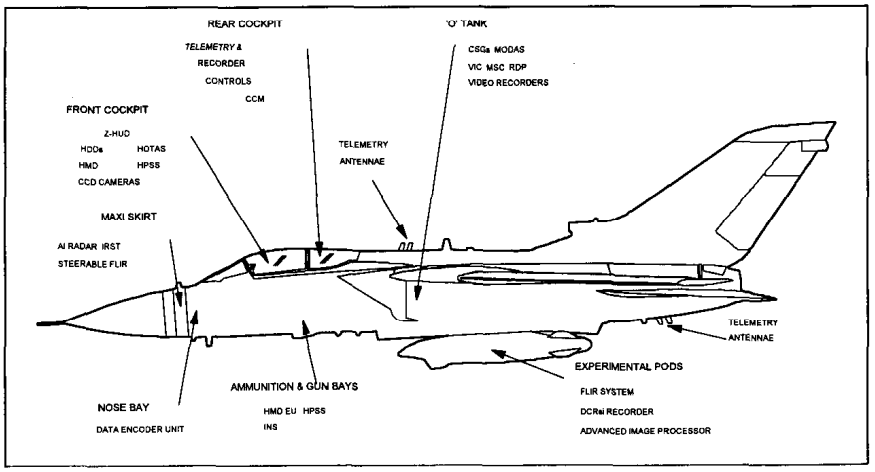
Incredible coincidence, I was going to start a thread asking about the Defence Research Agency InfraRed Search and Track Technology Demonstrator from the early-to mid 1990s. There is a paper, that I don't have access to, in the Society of Photo-Optical Instrumentation Engineers (SPIE) collection that covers it. This was the GEC-Marconi FIRSTSIGHT system that was apparently flown in Tornado ZD902 as part of the Tornado Integrated Avionics Research Aircraft (TIARA) programme - paper about that attached.
 

Attachments

  • TIARA Paper.pdf
    582.4 KB · Views: 24
  • Tornado TIARA.png
    Tornado TIARA.png
    82.6 KB · Views: 56
Last edited:
There is a paper, that I don't have access to, in the Society of Photo-Optical Instrumentation Engineers (SPIE) collection that covers it.
InfraRed Search and Track Technology Demonstrator Programme by D. J. Clarke? IIRC it has the same image as the one overscan posted in it.
 
The IRST demonstrator programme commenced in December 1991. The objective was for GEC-Marconi Sensors (GMS) to build a demonstration system capable of detecting and tracking air targets at long range in an airborne environment. The equipment, termed FIRSTSIGHT, was delivered in March 1995. In order to meet the timescales, FIRSTSIGHT hardware was based upon existing equipment either in production or in an advanced state of development'. Signal processing hardware and target detection algorithms are well established within GEC-Marconi Sensors. However, a significant software development programme was required to incorporate these into an overall IRST algorithm.
FIRSTSIGHT was required to be flown in an experimental Tornado F2A, designated TIARA (Tornado Integrated Avionics Research Aircraft) operated by the Defence Research Agency (DRA). This resulted in several constraints, namely, that the maximum protrusion into the airstream is limited to 150mm and the equipment was to fit within the confines of a Tornado nose. In addition, the equipment was required to provide the functionality of an operational system to enable real time engagements to be carried out in a realistic environment. A further, important requirement was to provide the capability to interface with other systems (e.g. helmet mounted sights and Radar), on the Tornado aircraft.
The sensor for the TIS is a TICM Class II miniscanner which operates in the 8-12tm band. This is based on the FLIR currently in service with the Royal Air Force on Harrier GR7. The detector is an 8 element Cadmium Mercury Telluride(CMT) SPRITE detector that has been upgraded by the incorporation of several modifications which include the use of anamorphic optics in the detector lens to increase resolution and the use of very high sensitivity CMT material. The telescope magnification is such that the resultant sensor Field of View (FoV) is optimised for the detection of long range targets while still providing a reasonable area of coverage.
There are three principal modes of operation: .

Autonomous Search

This mode provides the capability to locate and track multiple targets over a wide Field of Search. The search area is externally defined as an integer number of sensor Fields of View, from one up to the maximum Field of Regard. Once started, the FoS is stabilised to either inertial space or aircraft heading depending upon the initial command. The FoS is continuously updated by stabilising the FoV, during which time targets are detected, before stepping the FoV to the next position. Each successive FoV overlaps the previous thus providing complete coverage of the FoS. All targets detected within each FoV are tracked and prioritised continuously throughout Autonomous Search.

Slaved Acquisition

FIRSTSIGHT accepts positional demands, from the mission computer, which may be sourced, for example, from the pilot's 'hands on throttle-and stick' (HOTAS), the pilot's helmet or from external sensors such as RADAR. Once positioned, targets within the single FoV are tracked.

Single Target Track (STT)

This mode of operation provides the capability to track a single designated target within the FIRSTSIGHT FoR. The sensor FoV is centred on the target position, which will have been located during the Autonomous Search or Slaved Acquisition modes, and maintained on centre using image tracking techniques. The capability to provide passive range data on the target under track is also provided. Transition between each mode of operation can be pilot controlled or fully automatic
https://www.spiedigitallibrary.org/...-demonstrator-program/10.1117/12.280372.short
 
Last edited:

Similar threads

Back
Top Bottom