1950's RN carrier rebuilds: Implacable in place of Victorious, Indefatigable in place of Hermes.

Archibald

ACCESS: USAP
Senior Member
Joined
6 June 2006
Messages
14,971
Reaction score
21,289
All in the title.
[One possible POD would be that the trio of Illustrious damaged in 1941, 1942 and 1945 (Stukas, Malta, kamikaze) are so damaged they cannot be rebuilt post WWII. This leaves Victorious as an orphan, so emphasis shift to the mostly intact Implacables that came late in WWII.]

The Implacables were the most capable carriers outside the Audacious. So go all out and rebuilt them (with all the OTL Victorious goodies). How would they compare to OTL Victorious and Hermes, and also the Clemenceaus ?

Are they big enough to safely operate Phantoms (better than OTL Victorious and Hermes, which were marginal at best) ?
 
Realistically, what you are talking about is a more heavily built, closed hangar, Essex.

They would have been very good, very capable ships, especially with their extra boilers and shaft providing more steam and more speed (for WOD).
 
Realistically, what you are talking about is a more heavily built, closed hangar, Essex.

They would have been very good, very capable ships, especially with their extra boilers and shaft providing more steam and more speed (for WOD).
More capable than Ark and Eagle, do you think ?
I'd like to have a solid discussion akin to the many other RN-carriers threads, see that search. https://www.secretprojects.co.uk/search/1915600/?q=Implacable&o=relevance
Calling the usual gang to the rescue
@Martes
@NOMISYRRUC
@Rule of cool
@EwenS
@zen
@Hood
@JFC Fuller

https://en.wikipedia.org/wiki/Implacable-class_aircraft_carrier#Planned_modernisation

The two Implacables were tentatively scheduled to be modernised in 1953–55 with Implacable following Victorious. The draft Staff Requirements were drawn up in July 1951. This included combining the two hangars into a single 17-foot-6-inch (5.33 m) hangar, strengthening the flight deck and aircraft handling equipment to deal with 30,000-pound (14,000 kg) aircraft, enlarging the lifts to 55 by 32 feet (16.8 by 9.8 m), adding a gallery deck between the hangar and the flight deck to accommodate the additional personnel required, the addition of steam catapults, and the increase of her aviation fuel stowage to 240,000 imperial gallons (1,100,000 L; 290,000 US gal). Other desired improvements were new boilers to increase her endurance, more space for the latest radars, and the replacement of her anti-aircraft armament with the British version of the 3"/70 Mark 26 gun and sextuple mounts for the Bofors guns.[22]

By October 1951, the estimated completion date for Victorious's modernisation was already a year past the initial estimate of April 1954. Implacable was scheduled to begin her modernisation in April 1953 for completion in 1956, but the Director of Dockyards pointed out that existing schedules prevented her from beginning any earlier than April 1955 unless the modernisations of two cruisers and the guided missile test ship RFA Girdle Ness were delayed. The Controller of the Navy asked if the time and cost of the reconstruction could be reduced, but the minimum modifications were the most expensive as they involved structural alterations. The Controller ordered the Director of Dockyards to plan for rebuilding Implacable between June 1953 and December 1956 even after the latter protested that even a limited modernisation would require about three-quarters of the structural work of the original plan and that the shortage of skilled workers (already insufficient for Victorious by herself) would delay work on both ships. In order to reduce the amount of structural work, the requirement to replace the boilers was cancelled and the ship would receive existing radars instead of systems then still under development. In January 1952, the ship's new armament was finalized at six twin-gun 3"/70 mounts and three sextuple Bofors mounts. Five months later the Admiralty decided that Victorious would be the last fleet carrier modernised as experience showed that the process would take longer and cost more than was practicable
 
Last edited:
Offhandedly, I remember an often cited comment that there were some potential problems caused by the class hangars being armoured and that this armour was a part of structural integrity of the ships, so any modification to the hangar were considered complicated, especially considering the change in the size of the aircraft, elevators and all.

There also seem to have been certain reservations about the condition of the hulls and machinery for both of them, but then Victorious would be no better, would it? All this implied expenses, though, the curse-word.

Note this is all from memory, no sources at the moment.

------------------------------------

Also note, that Formidable was considered for a missile cruiser conversion circa 1951.

------------------------------------

Looking from fleet composition point of view, of course, it's a very tempting proposition.

Two additional fast medium carriers, that can potentially be phantomized or something, and leaving all the Centaurs to commando helicopter carrier role with Majestics as proto-Invincible ASW cruisers?
 
Last edited:
Two additional fast medium carriers, that can potentially be phantomized or something, and leaving all the Centaurs to commando helicopter carrier role with Majestics as proto-Invincible ASW cruisers?
This.
-scrap the Illustrious ASAP by 1946
-sell all the Colossus
-keep the Majestics, tests new technologies on them, post 1961: commando carriers, sold, or scrap
-finish the third Audacious
-rebuilt the two Implacables in place of Victorious and Hermes
-gradual upgrades to the three Audacious
-Audacious and Implacable class become the fleet attack carriers
-Centaurs: the four of them replace the Majestics in the 1960s.
-No attempt is ever made to turn them into attack carriers, Hermes style
-Instead the four of them are turn into commando carriers, as per Albion and Bulwark OTL in the 1960s.
 
You only have to kill the Malta project to get something like this going, as far as I understand the contemporary situation.

Then sort the existing carriers by condition and class - note that however close they were by size, Centaurs and Victorious/Implacables were percieved as totally different beasts - to define the modernization queue.
 
You're right. An "Implacable" search in the thread brings this.
https://www.secretprojects.co.uk/search/1917503/?q=implacable&t=post&c[thread]=50960&o=relevance

Page 3 https://www.secretprojects.co.uk/threads/alternate-post-war-royal-navy-carrier-rebuilds.50960/page-3

Narrowing the debate and questions to
-how does rebuilt Implacables compare to Victorious ?
-how does rebuilt Implacables compare to Clemenceaus?
-how does rebuilt Implacables compare to SCB-125A Oriskany ?
And
-could rebuilt Implacables handle F-4K Phantoms better than OTL Victorious ?
 
Last edited:
What would be the effect of when designing the Implacables, an Audacious size hull was used from the start - does that delay their completion
 
What would be the effect of when designing the Implacables, an Audacious size hull was used from the start - does that delay their completion
Of course it does.

The Implacable design was drawn up from the end of 1937 and into 1938 at a time when Britain was still bound by the terms of the 1936 Second London Treaty.

"Article V

(1) No aircraft-carrier shall exceed 23,000 tons (23,368 metric tons) standard displacement or carry a gun with a calibre exceeding 6.1 in. (155 mm.).

(2) If the armament of any aircraft-carrier includes guns exceeding 5.25 in. (134 mm.) in calibre, the total number of guns carried which exceed that calibre shall not be more than ten."

Implacable - 1938 Programme. Ordered 11 Oct 1938, laid down, 21 Feb 1939. Expected completion in Sept 1939was Oct 1941.
Indefatigable - 1939 Programme. Ordered 19 June 1939, laid down 3 Nov 1939. Expected completion in Sept 1939 was June 1942.​

The initial design came in at 23,460 tons standard but exceeded that on completion due to a myriad of design changes that occurred after war broke out and while they were still under construction. As usual for the period some weight savings during the build would have been expected.

So no, the Implacables couldn't have been built bigger before the outbreak of war as Britain wanted to comply with the Treaty (small overages in tonnage being an accepted practice), unless some greater sacrifices were to be made in terms of the armour or something else in the design.

Details of shipbuilding programmes and of the ships needed to be notified to other Treaty Powers. So there is no chance of keeping a larger ship secret beyond outright lying, which Britain was not prepared to do.

So a larger ship has to await the outbreak of war. How do you predict over a year in advance when war will break out? Do you build Implacables or delay? The latter might put you at a disadvantage later if war is delayed. When do you draw up the new larger design? John Brown managed to get Indefatigable about 13% of the way to completion by the time the hiatus caused by the invasion of France kicked in in May 1940. How much of that becomes "lost". Start later and potentially wartime delays have a greater impact.

And don't forget that there was an interim stage. An Implacable that underwent much modification 1940-42 (Irrestible) before it was decided to build it as an Audacious that became Ark Royal.

As designed in Sept 1942, the standard displacement of the Audacious was to have been 31,600 tons. That rose to 32,500 tons in Dec 1942 when it was decided to increase the hangar height to 17ft 6in, which drove an increase in beam. As wartime modifications continued it reached 36,800 tons standard in July 1946. All those figures are substantially larger than an Implacable.

Something else to bear in mind. Indefatigable was seen as an Eagle replacement (she disappears from pre-war RN planning by 1942 when Indefatigable was originally scheduled to complete). Historically, she was completely clapped out by the time of her last refit in Dec 1941 to Feb 1942. Only the lack of anything better kept her in service in 1942.
 
So no, the Implacables couldn't have been built bigger before the outbreak of war as Britain wanted to comply with the Treaty (small overages in tonnage being an accepted practice), unless some greater sacrifices were to be made in terms of the armour or something else in the design.
This gets more into the politics than the technical aspects but could an adjustment to carrier tonnage not have been gained if desired?

The escalation in battleship gun calibre was built into Second London, IIUR. And the escalation to Battleship tonnage from 35,000 to 45,000 was negotiated between the remaining powers by March 1938 after both the RN and USN designers ran into the sacrifices that would be required to mount 16” guns on a 35,000 ton hull.

If the RN was serious about an Audacious sized carrier (which is, I suppose, a whole other issue) then could not an increase in allowable carrier tonnage be negotiated with the US?
 
This gets more into the politics than the technical aspects but could an adjustment to carrier tonnage not have been gained if desired?

The escalation in battleship gun calibre was built into Second London, IIUR. And the escalation to Battleship tonnage from 35,000 to 45,000 was negotiated between the remaining powers by March 1938 after both the RN and USN designers ran into the sacrifices that would be required to mount 16” guns on a 35,000 ton hull.

If the RN was serious about an Audacious sized carrier (which is, I suppose, a whole other issue) then could not an increase in allowable carrier tonnage be negotiated with the US?
Which suggestion ignores the difference between capital ships and carriers in the eyes of the world's navies. The capital ship was still the pride of the fleet by which a navy's power was measured.

The USN & RN were fairly sure that the IJN would build battleships larger than laid down in the 1936 Treaty (to which they were not a signatory). The RN thought maybe 46,000 tons with 16in guns. Hence all the efforts to pin them down diplomatically and have a specific provision in relation thereto in Article IV as well as the general protection of Article XXV.

Article IV
"(2) No capital ship shall carry a gun with a calibre exceeding 14 in. (356 mm.); provided however that if any of the Parties to the Treaty for the Limitation of Naval Armament signed at Washington on 6 February 1922, should fail to enter into an agreement to conform to this provision prior to the date of the coming into force of the present Treaty, but in any case not later than 1 April 1937, the maximum calibre of gun carried by capital ships shall be 16 in. (406 mm.)."


All other categories of ship had to depend solely on Article XXV.

"Article XXV
(1) In the event of any vessel not in conformity with the limitations and restrictions as to standard displacement and armament prescribed by Articles 4, 5 and 7 of the present Treaty being authorised, constructed or acquired by a Power not a party to the present Treaty, each High Contracting Party reserves the right to depart if, and to the extent to which, he considers such departures necessary in order to meet the requirements of his national security;
(a) During the remaining period of the Treaty, from the limitations and restrictions of Articles 3, 4, 5, 6(1) and 7, and​

(b) During the current year, from his Annual Programmes of construction and declarations of acquisition.
This right shall be exercised in accordance with the following provisions:​

(2) Any High Contracting Party who considers it necessary that such right should be exercised, shall notify the other High Contracting Parties to that effect, stating precisely the nature and extent of the proposed departures and the reasons therefore.​


(3) The High Contracting Parties shall thereupon consult together and endeavour to reach an agreement with a view to reducing to a minimum the extent of the departures which may be made."
http://www.ww2ships.com/documents/doc0004-london1936.shtml

That requires knowledge of what the other countries were doing. So the USN & RN were pretty sure that the IJN were building bigger battleships because Japan wouldn't give them the assurances about compliance that they sought, so Article Article IV authorised the increase in gun calibre back to 16in while Article XXV allowed them to negotiate a higher tonnage limit.

The problem was that the USN & RN had no real clue what the IJN were doing with regard to carriers. They knew about the Soryu and Hiryu as they had been laid down before Japan left the Treaty system.down

While it is true that the IJN laid down the two Shokakus of about 27,000 tons standard in Dec 1937 & May 1938, until 1942 when the pair were photographed at Coral Sea, they were believed to be simply an improved Soryu of c17,000 tons. Even the USN ONI book on IJN ship characteristics of late 1942 had to admit that lack of knowledge, but had corrected some of what had previously been assumed based on the photographic evidence (like the increased AA armament).

So without knowledge of a breach on carrier size I can't immediately see how Article XXV can be triggered with respect to carriers.​

Then there is the US position. It incorporated the 1922 Treaty carrier tonnage of 135,000 tons into its domestic law. It used that up building CV-2 to CV-7. After the Lexingtons, the largest it built were the 19,800 ton Yorktowns. When it increased the carrier tonnage limit in the 1938 Second Vinson Act, it did so by the specific amount of 40,000 tons, enough for two more Yorktown sized carriers. Half that went to build Hornet and the rest was the starting point for the Essex design starting in summer 1939. As experience with the Yorktowns became available in1939 (Only commissioned in Sept 1937 & May 1938) and with the prospect of a new generation of larger, thirstier aircraft it was only with the Treaty system collapsing in Sept 1939 that the USN moved to a larger ship.

So clearly, in 1938 it was happy with 20,000 tons per carrier. I'm not aware of any attempts at that point to even fully exploit the 23,000 ton limit of the 1936 Treaty.

Moving to the larger Essex of 27,100 tons standard, allowed the air group to be expanded back to the 90 planned for the Yorktowns, but which had been eroded by increasing aircraft size. It also allowed an increase in avgas capacity from 178,000 USG to 232,000 USG, as well as better protection.

Another point to bear in mind about the 1936 Treaty with regard to carriers, is that it removed the overall carrier tonnage limit of 135,000 tons for the USN & RN. So, finances permitting, they could each have built as many 23,000 ton carriers as they wished. That they didn't leads us back to the first paragraph in this post.

 
Last edited:
You're right. An "Implacable" search in the thread brings this.
https://www.secretprojects.co.uk/search/1917503/?q=implacable&t=post&c[thread]=50960&o=relevance

Page 3 https://www.secretprojects.co.uk/threads/alternate-post-war-royal-navy-carrier-rebuilds.50960/page-3

Narrowing the debate and questions to
-how does rebuilt Implacables compare to Victorious ?
-how does rebuilt Implacables compare to Clemenceaus?
-how does rebuilt Implacables compare to SCB-125A Oriskany ?
And
-could rebuilt Implacables handle F-4K Phantoms better than OTL Victorious ?

The F-4 is ~16ft high, so you have to change the hangar height (or add a phin-phold to the Phantom). Lifts too.

Internal volume of the Implacables - somewhat better than Hermes, but a good deal lower than Audacious? The need for workshops etc made Ark Royal's hangar shrink, probably worse on Vic/Implacables.

With the low pressure of RN steam plants, you need a ~200 ft catapult for the F-4; unclear whether the 176 ft suggested for Hermes would have really worked. As the Implacables are shorter then the Audacious likely a difficult fit.

For lower arresting weights the Mk13 should suffice, which has 220 ft pullout; the Mk 14 probably more (at least it had that in Ark, I've seen 250-270ft quoted). So you need at least 300ft from the last wire on the angled deck, which will have a smaller angle, limiting deckpark.

Ship speed after refits ~28 kts?

Of the lot, Oriskany looks best.
Clems and Audacious have some tradeoffs - higher steam pressure and speed as well as overall length on the Clems, better stability and deck strength on the Audacious.
Victorious vs Implaceables, probably not much difference either way.
 
@Archibald as you asked.
  • The Implacables had the same beam as the Illustrious class. So no improvement there.
  • They had 33% more powerful machinery than the Illustrious - 148,000shp v 111,000 shp - which furthermore wasn't far off the 152,000shp of the Audacious class.
    • Therefore, they may be a few knots faster and have more steam for the catapults.
    • But the disadvantages are a larger crew and the machinery occupied more of the hull than the Illustrious class.
  • The deeper hull may allow the ship to have a deck edge lift à la Hermes, and if it does, that may allow the ship to have longer catapults, because.
    • Centaur was fitted with a pair of 139ft stroke BS.4 steam catapults in her 1956-58 refit.
    • Hermes was completed with a pair of 151ft stroke BS.4s. The stroke of the port catapult was increased to 175ft in her 1964-66 refit.
  • The hull's 20 feet longer at the waterline, which might (I stress might) allow longer catapults.
  • The cost of rebuilding an Implacable will be the same as the cost of rebuilding Victorious.
  • The rebuild of the ship rebuilt instead of Victorious will take as long as the rebuild of Victorious.
Therefore, unless the result is a ship that can be fitted with catapults powerful enough launch Phantoms there's no improvement over the rebuilt Victorious.
 
    • Hermes was completed with a pair of 151ft stroke BS.4s. The stroke of the port catapult was increased to 175ft in her 1964-66 refit.

Wasn't it 2x 103 ft stroke initially, 145 and 103 ft stroke after refit and 151 and 176 ft planned for the phantomization?
 
The much better solution to the problem was to have stuck with the Illustrious and not changed the design.
It wouldn’t save much money or time during WWII, a little perhaps.
But post war, it would have allowed Victorious style upgrades for between 3 to 4 such ships.

Materially I don't see evidence for the increases these variant designs achieved during WWII. Nothing dramatic anyway.

But the savings in the 50's and 60's would be substantial and it would push off CVA-01 ISD potentially by upto a decade.
Not that that would save CVA-01.

Arguably cheaper than Audacious completion/modernisation.

F4 Phantomisation would be problematic. But not intractable.
 
@Archibald as you asked.
  • The Implacables had the same beam as the Illustrious class. So no improvement there.
When Victorious was reconstructed her hull had to be bulged, to give a waterline beam of 103ft 4in (up from 95ft 9in), an increase of 7ft 7in.

The reconstruction proposal for Implacable indicated that her hull would need bulged by 15ft to 110ft 9in to maintain the same degree of stability as in Victorious. While it would help increase internal hull volume, such a width would restrict her to being dry docked in just two dry docks in the UK - No.10 at Devonport and the floating dock at Portsmouth. That would also drive the location of her reconstruction (Victorious was reconstructed in one of the dry docks at Portsmouth).

By way of comparison Eagle & Ark Royal had a waterline beam of 112ft 9in.
  • They had 33% more powerful machinery than the Illustrious - 148,000shp v 111,000 shp - which furthermore wasn't far off the 152,000shp of the Audacious class.
    • Therefore, they may be a few knots faster and have more steam for the catapults.
    • But the disadvantages are a larger crew and the machinery occupied more of the hull than the Illustrious class.
The whole point of the Implacables was that they were to be faster than an Illustrious - 32 knots v 30 knots (31 knots for a rebuilt Victorious with her new boilers.

What effect on speed the extra beam with the original machinery?
  • The deeper hull may allow the ship to have a deck edge lift à la Hermes, and if it does, that may allow the ship to have longer catapults, because.
    • Centaur was fitted with a pair of 139ft stroke BS.4 steam catapults in her 1956-58 refit.
    • Hermes was completed with a pair of 151ft stroke BS.4s. The stroke of the port catapult was increased to 175ft in her 1964-66 refit.
As built the Implacable hull was only 3ft 3in deeper than Illustrious as built (70ft 11.5in v 67ft 9in).

As reconstructed Victorious was 72ft deep.

The reconstruction plan for Implacable, using the floor of the upper hangar as the floor of the new hangar heightened to 17ft 6in, and adding a gallery deck, would have added 9ft to the depth of the ship, taking it to approx 80ft. That was why she required wider bulges to maintain stability.

For a deck edge lift in that configuration, the freeboard at hangar deck level was expected to be 23ft. That compared to 14ft in Victorious and 30ft in Ark Royal. I don't have a figure to hand for Hermes.

Something else that caught my eye recently was that redesigning Ark Royal to take a side lift, meant some rerouting of the air intakes feeding the boilers. (Looking at the various carrier designs it seems air for the boilers entered on the port side with the exhaust going to starboard). It never arose with Victorious because no side lift but it might have with Implacable.
  • The hull's 20 feet longer at the waterline, which might (I stress might) allow longer catapults.
  • The cost of rebuilding an Implacable will be the same as the cost of rebuilding Victorious.
  • The rebuild of the ship rebuilt instead of Victorious will take as long as the rebuild of Victorious.
Therefore, unless the result is a ship that can be fitted with catapults powerful enough launch Phantoms there's no improvement over the rebuilt Victorious.
See the other thread and the discussion I had with Hood about where the extra 20ft of length in an Implacable actually lay. IMHO most, if not all, lay aft of the funnel. The forward lift in Victorious was moved aft about 40-50ft in her reconstruction, producing a hangar section forward of the lift.

I'm not sure it follows that the cost of converting an Implacable would be the same as Victorious. A deeper dive on the work involved would be necessary to determine that.
 
Last edited:
It is interesting to look at the 1938 edition of Jane's Fighting Ships and the information therein about the IJN. See here. P305 of the book, p299 of the .pdf file.
https://www.scribd.com/doc/84063027/Jane-s-Fighting-Ships-1938#page=299

New battleships - 4 of 35,000 tons with 16in guns planned but none laid down as of end of Nov 1937 per p314 (Yamato had in fact been laid down on 4th Nov in great secrecy)

Carriers -
Soryu class noted on p307 of the book as one built (Soryu completed Dec 1937) and one building. P319 carries details of the ships with displacement noted as 10,050 tons standard and carrying 40 aircraft. IIRC that was the displacement of the original design which was completely reworked before Soryu was laid down, let alone the modifications made during her construction (actual displacement 15,900 tons standard, with air group of 63 + 9 reserves).

Note also the reference to a third ship, Koryu, being planned with construction scheduled to start in 1938. That of course turned out to be the much larger Shokaku which was laid down in Dec 1937.

Unfortunately the British section right at the front of the book has pages missing from the scan, including those that would cover the KGVs, Ark Royal and the Illustrious class.
 
Last edited:
Therefore, unless the result is a ship that can be fitted with catapults powerful enough launch Phantoms there's no improvement over the rebuilt Victorious.
There is this after-knowledge predicament - since the decision to modernize the ships as opposed to building new large carriers (or anything else) would have to be taken much earlier than the Phantom appears on the stage.

Another possibility would be retaining the hulls and attempting to resurrect them at some point with specific Phantom in mind. Only that would be a stretch for post-1966 reality.
 
The Implacables finished their working days as training ships, plans for their reconstruction having been dropped in mid-1952. In Jan 1954 the Admiralty announced that their places in the Training Squadron would be taken by the light fleet carriers Ocean & Theseus (much cheaper to run in a shrinking navy).

Implacable, converted to a training ship Sept 1950 to Jan 1952, handed over to Theseus in Aug 1954 and was sold for scrap in Oct 1955.

Indefatigable, converted to a training ship in 1949/50, was replaced by Ocean in Sept 1954. She was laid up on the Gareloch, listed for disposal in June 1955 and sold for scrap in Sept 1956.

While McDonnell had been playing around with new aircraft designs since 1953, it was May 1955 before they were presented with the spec by the USN for an all weather fleet defence interceptor that would lead to the XF4H-1 Phantom prototype flying for the first time on 27th May 1958.

So the fate of the Implacables was sealed before the idea of the Phantom even appeared.

The carriers had taken the place of the battleships in the Training Squadron starting off with Victorious replacing Nelson in 1947.
 
Looking at Hobbs, Carrier design:

Victorious design was completed in June 1950 with a goal of 40k lbs aircraft.

The 1952 carrier design looked for 70k lbs aircraft, later reduced to 60k lbs (as difficult on a relatively small hull).
This was inspired by the Forrestal class, which was ordered in July 1951. Design work and freeze must be earlier.

So a requirement for operating a generic 50k lbs jet aircraft about 1950/52 would not be that far off. I just think it would kill all the rebuilds instead of yielding phantomized Implacables.
 
The USN was able to reduce the carrier bomber weight limit in March 1949 from 100,000lb to 70,000lb in July 1949 when Douglas won the contract for a new carrier bomber with its design for what became the A3D Skywarrior.

Early studies for what became the Forrestal were simply a continuation of work on the cancelled CV-58 United States, which happened on 23rd April 1949. The design that emerged was straight decked with a retractable island and radar masts, and funnels canted well out each side and catapults sponsored out each side with a pair in the bow. The first orders were placed in July 1951 & July 1952.

Then came the advent of the angled deck in Aug 1951 and trialled on Antietam from Dec 1952. That triggered a virtual complete redesign to incorporate the angled deck layout, island with funnel, steam catapults, changed elevator layout etc in 1953. The new characteristics were issued on 7th Oct 1953, some 15 months AFTER Forrestal had been laid down and 10 months AFTER Saratoga had been laid down. This redesign came just in time for Newport News to incorporate the changes into Forrestal with little or no delay, and at a cost of only $2 million (which it was thought could be recouped by not having the retractable island).

See Friedman " US Carriers".
 
A3D empty was 36k lbs. Max catapult weight 70k lbs, the RN 1952 design goal with 60k lbs accepted the need for refueling.
So even with minimal fuel, a possible design goal for the rebuilds with the A3D as a benchmark would be 50-55k lbs.
If we can match that we probably have our phantom ship for later. If not, there go our rebuilds...
 
I don't know the technical details of WW2 carrier rebuild, but the ideal outcome is for the RN to have multiple Buccaneer and Phantom capable carriers with good service lives in front of them from the mid 60s. The Eagle fits this requirement, the Ark could as well with some historical alterations but for the rest the RN likely needs a Malta or a 1952-53 carrier and a firm commitment to CVA01 or something like it. A Malta is highly unlikely in the aftermath of WW2 and the 1952-53 carrier is also unlikely given the war the British expected to fight up until 1957.
 
More capable than Ark and Eagle, do you think ?
it’s up in the air how capable they would have ended up but they certainly wouldn’t have been more capable than Eagle. Them being more capable the Ark is more debatable given the absolutely awful state that ship was in for most of her career, though not getting a proper rebuild definitely didn’t help her case.
 
I don't know the technical details of WW2 carrier rebuild, but the ideal outcome is for the RN to have multiple Buccaneer and Phantom capable carriers with good service lives in front of them from the mid 60s. The Eagle fits this requirement, the Ark could as well with some historical alterations but for the rest the RN likely needs a Malta or a 1952-53 carrier and a firm commitment to CVA01 or something like it. A Malta is highly unlikely in the aftermath of WW2 and the 1952-53 carrier is also unlikely given the war the British expected to fight up until 1957.
Best case scenario i can think of being a realistic possibility is getting all 3 Audacious’ in the water ASAP and not letting them rot on a slipway for half a decade like they did with poor Ark, and maybe getting a pair of Maltas built to Victorious standard, by convincing the government using any means necessary that they would be cheaper than rebuilding the Treaty carriers.

The 2 Maltas would guarantee a British carrier force into at least the mid-1980s, while how long the Audacious’ would last would depend on how thoroughly they were rebuilt.
 
Best case scenario i can think of being a realistic possibility is getting all 3 Audacious’ in the water ASAP and not letting them rot on a slipway for half a decade like they did with poor Ark, and maybe getting a pair of Maltas built to Victorious standard, by convincing the government using any means necessary that they would be cheaper than rebuilding the Treaty carriers.

The 2 Maltas would guarantee a British carrier force into at least the mid-1980s, while how long the Audacious’ would last would depend on how thoroughly they were rebuilt.
IMO, a best-case realistic scenario would be one where HMS Elephant which would later become HMS Hermes is cancelled in November 1945 instead of HMS Eagle (the third Audacious) which is then suspended, renamed HMS Hermes when HMS Audacious is renamed HMS Eagle and finished to a fully modern configuration in 1959. This ship would then operate alongside her sisters with Eagle upgraded as IOTL during 1959–64 and Ark Royal maybe given a more thorough reconstruction during the 1960's than she did get (maybe 1964–68), as there would be no need to fit this alternative, Audacious-class Hermes with longer catapults just a few years into her career. Alongside these ships, Albion, Bulwark and Centaur could operate as commando or ASW carriers until replaced with something resembling the Invincibles beginning in the 1970's. This would also probably reduce the need to convert the Tigers into helicopter cruisers (IMO a much worse waste of money than finishing them as gun cruisers in the 1950's). With the ships taken good care of, Britain could possibly continue to operate CATOBAR carriers at least until the end of the Cold War and then probably even until the 2020's. This minor change in cancellations should be quite easily achievable as both ships were undergoing construction at the Vickers-Armstrong yard in Barrow-on-Furness. Anything more would most likely be beyond Britain's economic means in a very dire period as EwenS and others have kindly explained. This could even be a good subject for an AH storyline.

Another slight improvement would be giving HMS Victorious a waist catapult instead of one of her bow catapults during her reconstruction. If this could be replaced by a 199' BS-5, her catapults fitted with bridle catchers and her arrester gear upgraded to a similar standard to what Ark Royal got, she would most likely be able to operate Phantoms, even though her limited hangar space would lead to a very small air group (possibly with no Buccaneers at all). Her new boilers should certainly be able to provide enough steam to these improved catapults and thanks to her generally speaking good material condition (especially when compared to Ark Royal!), she should be able to soldier on until the early 1980's if well taken care of. Maybe she could operate as a fighter carrier with another carrier (ie. OTL's HMS Hermes) unable to operate Phantoms operating the Buccaneers.
 
The only ‘issue’ I can see with your proposed 3 Audacious Timeline is that by delaying the completion of ‘big’ Hermes until 1959, unless the hill etc is treated in the same way as ‘little’ Hermes, you risk ending up with another carrier with issues like Ark Royal had, although weren’t a lot of her problems down to a lack of proper protections etc whilst she was languishing in her slow build?
I don’t think that fitting a waist catapult to Victorious would occur, not in anything like the OTL as wasn’t the angled deck seen as a way of keeping the landing deck clear, and cluttering it up with a catapult would go against the thinking of the day.
Sure, Eagle, during her 1959-63 refit had one installed, and so did Ark Royal in 67-70, but surely that was down to revised operational thinking, not to mention acceptance that aircraft weights and sizes had increased considerably?
In all of the discussions about Cartier Rebuilds, and Victorious in particular, you have to remember that ORIGINALLY, her (and her sisters planned) reconstructions were not anywhere near as extensive as they finally resulted with Vic. Part of the ‘extras’ in Victorious’s modernisation came about due to the cancelation of the ‘1952’ Fleet Carriers resulting in trying to out as much new tech as possible into her rebuild.
Just my two penny worth…
 
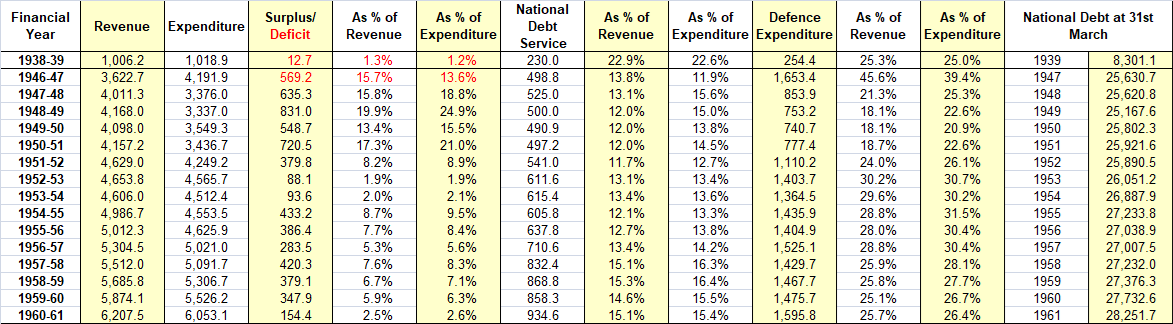
Regarding the state of Britain's finances from the end of the Second World War to 1960.

This is from the British Government's expenditure for the 15 financial years following World War II
Source the Annual Abstract of Statistics.

British Revenue and Expenditure 1946-60.png
Notes
  1. The amounts are in millions of Pounds.
  2. British financial years start on 1st April and end on 31st March. So for example 1946-47 is began on 1st April 1946 and ended on 31st March 1947.
  3. 1938-39 is included because it is the last full financial year of peace before World War II.
  4. The main table starts at 1946-47 because it is the first full financial year of peace after World War II.
  5. The defence expenditure in 1938-39 is exclusive of issues under the Defence Loans Act, 1937 viz: £128.1 million which increased the total to £382.5 million.
  6. The National Debt at 31st March 1946 was £23,636.5 million.
According to the Bank of England Inflation Calculator £1.00 in 1939 was worth.
  • £1.56 in 1946
  • £1.91 in 1950.
  • £2.49 in 1955.
  • £2.82 in 1960.
According to the Bank of England Inflation Calculator £1.00 in 1946 was worth.
  • £1.22 in 1950.
  • £1.59 in 1955.
  • £1.81 in 1960.
I've run out of time to write the long answer. This is the short answer.

The amount of money required to complete all 3 Audacious class (i.e. including the one that was cancelled), the 4 Centaur class and the 4 Tiger class (i.e. including the one scrapped on the slips) by 1950 was peanuts in comparison to the average annual revenue of £3,975.0 million and average annual expenditure of £3,613.6 million for the 4 financial years ending 31st March 1950. Furthermore, doing so may have saved money in the period to March 1960.

However, the Government decided to have the British shipbuilding industry concentrate on building merchant ships for the export drive. That was to increase visible exports by selling ships to foreign countries and increase invisible exports by rebuilding the British Merchant Navy. Britain needed all the foreign currency it could earn to pay for its imports. It was literally, "Export or Die!" for Austerity Britain.

On the other hand I suspect that the amount foreign currency that would have been lost by completing these ships by 1950 was insignificant in the scheme of things. Furthermore, I suspect that in the longer term more foreign currency would have been earned by getting these ships into the water sooner (especially Ark Royal and Hermes) so the cleared slipways could be used to build merchant ships.

I repeat (especially to @EwenS) that the above is the short answer and that it lacks many important details. I intend to write the long answer later, but that may be several days later before I can post it on the forum.

P.S. If you see any obvious spelling mistakes, transcription errors, arithmetical mistakes or other typos, please tell me in a PM (so I can make the necessary corrections) rather than in the forum. I'd do the same to spare your blushes and it makes the threads easier to read.
 
Last edited:
The thing about these sorts of carrier rebuilds is that they solve a problem that didn't appear until at least the Buccaneer in 1964 and definitely the Phantom in 1969. I think the best bet would be to use up these WW2 carriers in Korea and Suez and build new, ~55,000t carriers after the 57 DWP defined the defence policy and strategy that would last more or less the rest of the Cold War.

A killjoy post I know, but there it is.
 
This gets more into the politics than the technical aspects but could an adjustment to carrier tonnage not have been gained if desired?

The escalation in battleship gun calibre was built into Second London, IIUR. And the escalation to Battleship tonnage from 35,000 to 45,000 was negotiated between the remaining powers by March 1938 after both the RN and USN designers ran into the sacrifices that would be required to mount 16” guns on a 35,000 ton hull.

If the RN was serious about an Audacious sized carrier (which is, I suppose, a whole other issue) then could not an increase in allowable carrier tonnage be negotiated with the US?
I don't think that anyone but maybe the Japanese really saw the effectiveness of a carrier. So it's really unlikely that there'd be an escalator clause in carriers.
 
IMO, a best-case realistic scenario would be one where HMS Elephant which would later become HMS Hermes is cancelled in November 1945 instead of HMS Eagle (the third Audacious) which is then suspended, renamed HMS Hermes when HMS Audacious is renamed HMS Eagle and finished to a fully modern configuration in 1959. This ship would then operate alongside her sisters with Eagle upgraded as IOTL during 1959–64 and Ark Royal maybe given a more thorough reconstruction during the 1960's than she did get (maybe 1964–68), as there would be no need to fit this alternative, Audacious-class Hermes with longer catapults just a few years into her career. Alongside these ships, Albion, Bulwark and Centaur could operate as commando or ASW carriers until replaced with something resembling the Invincibles beginning in the 1970's. This would also probably reduce the need to convert the Tigers into helicopter cruisers (IMO a much worse waste of money than finishing them as gun cruisers in the 1950's). With the ships taken good care of, Britain could possibly continue to operate CATOBAR carriers at least until the end of the Cold War and then probably even until the 2020's. This minor change in cancellations should be quite easily achievable as both ships were undergoing construction at the Vickers-Armstrong yard in Barrow-on-Furness. Anything more would most likely be beyond Britain's economic means in a very dire period as EwenS and others have kindly explained. This could even be a good subject for an AH storyline.
The problem with this is that leaving “big Hermes” on the slips to be completed in 1959 may just end up with her being a lemon ship like Ark Royal was in OTL.

Another slight improvement would be giving HMS Victorious a waist catapult instead of one of her bow catapults during her reconstruction. If this could be replaced by a 199' BS-5, her catapults fitted with bridle catchers and her arrester gear upgraded to a similar standard to what Ark Royal got, she would most likely be able to operate Phantoms, even though her limited hangar space would lead to a very small air group (possibly with no Buccaneers at all). Her new boilers should certainly be able to provide enough steam to these improved catapults and thanks to her generally speaking good material condition (especially when compared to Ark Royal!), she should be able to soldier on until the early 1980's if well taken care of. Maybe she could operate as a fighter carrier with another carrier (ie. OTL's HMS Hermes) unable to operate Phantoms operating the Buccaneers.
Apparently Vic’s angle deck sponson was too thin to accommodate a waist cat, which is why she never got one.

As for her air group size, she was operating 9 Buccs, 10 Vixens, 5 Gannets and 7 Wessex helicopters, a total of 31 aircraft.

“Little Hermes” was operating 7 Buccs, 12 Vixens, 5 gannets and 6 Wessex helicopters before she was decommissioned to become a commando carrier.

Thats a massive difference of a single aircraft.

What people seem to have forgotten is that Victorious wasn’t actually that much bigger than Hermes, her main hangar was 360ftx63ft, compared to 356ftx62ft (at least I think this is correct for Hermes, there are conflicting sources). She was also only about 30ft longer overall.

I doubt Vic would have been much better for Phantom ops than Hermes would have been.

Regards,

Temeraire
 
The thing about these sorts of carrier rebuilds is that they solve a problem that didn't appear until at least the Buccaneer in 1964 and definitely the Phantom in 1969. I think the best bet would be to use up these WW2 carriers in Korea and Suez and build new, ~55,000t carriers after the 57 DWP defined the defence policy and strategy that would last more or less the rest of the Cold War.

A killjoy post I know, but there it is.
The idea of having 2 Maltas built to Victorious standard (alongside the 3 Audacious’) would largely address this problem to be fair, and they’d likely last as long as the Clems did in French service.
 
This gets more into the politics than the technical aspects but could an adjustment to carrier tonnage not have been gained if desired?

The escalation in battleship gun calibre was built into Second London, IIUR. And the escalation to Battleship tonnage from 35,000 to 45,000 was negotiated between the remaining powers by March 1938 after both the RN and USN designers ran into the sacrifices that would be required to mount 16” guns on a 35,000 ton hull.

If the RN was serious about an Audacious sized carrier (which is, I suppose, a whole other issue) then could not an increase in allowable carrier tonnage be negotiated with the US?
I feel this comes from a fundamental misunderstanding of what the Implacables actually were.

They weren’t a clean sheet design, they were an extremely modified form of the Illustrious class. They weren’t much bigger than their older half sisters because the admiralty didn’t want them to be, even though they had 4,000 tons standard displacement headroom before the carriers would be treaty breakers.

An “escalator clause” for carrier tonnage wouldn’t have meant bigger ships, because they weren’t planned to be bigger.
 
Trouble is, we don't really know what a Malta would have looked like if the project had gone ahead. As I've noted before:-

1943 - armoured carrier, enlarged Audacious
1944/45 - open hangar, no armoured flight deck resulting in Design X1 (strength deck = hangar deck). Driven by then Fifth Sea Lord, Vice Admiral Sir Denis Boyd. Never approved by Admiralty before cancellation in Oct-Dec 1946.
Mid-1945 - experience of kamikazies now filtering through. New Fifth Sea Lord (Rear-Admiral Tom Troubridge) who apparently favoured an armoured flight deck. He was succeeded by Admiral Vian in 1946. Who knows what his position might have been given his experience commanding 1st ACS in the Pacific.

Then consider what the USN was doing in 1946/46. Their 1945 Fleet Carrier design was to be a bit smaller than a Midway but still with an armoured flight deck.

IMHO, all the Malta contributes to the debate is an indication of max size possible without massive investment in new port infrastructure.
 
I feel this comes from a fundamental misunderstanding of what the Implacables actually were.

They weren’t a clean sheet design, they were an extremely modified form of the Illustrious class. They weren’t much bigger than their older half sisters because the admiralty didn’t want them to be, even though they had 4,000 tons standard displacement headroom before the carriers would be treaty breakers.

An “escalator clause” for carrier tonnage wouldn’t have meant bigger ships, because they weren’t planned to be bigger.
The 27,000 ton standard limit set out at Washington was superceded by the 1936 Second London limit of 23,000 tons. Both the Illustrious and Implacable classes were originally designed to meet the latter more or less. So the option of building bigger did not exist without breaking the Treaty, which the RN did not want to do.

So to gain the extra speed and aircraft capacity on what, as you note started as a modified Illustrious, meant sacrifices elsewhere, like reduced hangar side armour in order to stay within, or at least close to, the 23,000 ton Treaty limit.

Note there were a lot of changes, some significant, to the Implacables between the outbreak of war and their eventual completion 1943/44.
 
The amount of money required to complete all 3 Audacious class (i.e. including the one that was cancelled), the 4 Centaur class and the 4 Tiger class (i.e. including the one scrapped on the slips) by 1950 was peanuts in comparison to the average annual revenue of £3,975.0 million and average annual expenditure of £3,613.6 million for the 4 financial years ending 31st March 1950. Furthermore, doing so may have saved money in the period to March 1960.

However, the Government decided to have the British shipbuilding industry concentrate on building merchant ships for the export drive. That was to increase visible exports by selling ships to foreign countries and increase invisible exports by rebuilding the British Merchant Navy. Britain needed all the foreign currency it could earn to pay for its imports. It was literally, "Export or Die!" for Austerity Britain.
I wonder if they could have converted/completed some of the Colossus/Majestic class as large cargo vessels.

I know it sounds a bit ridiculous, but there is precedent for Aircraft carriers being used in such a manner. Furious was used to ferry Bullion to Canada and somehow managed to find herself carrying a large quantity of sugar back to the UK.

They have a large, open hangar decks that would be perfect for carrying cargo, though they wouldn’t be able to carry perishables without major modifications.

With the burgeoning post war automotive industry (Britain supplying 52% of all exported cars in the world at one point) they would have made great car carriers.
 
The 27,000 ton standard limit set out at Washington was superceded by the 1936 Second London limit of 23,000 tons. Both the Illustrious and Implacable classes were originally designed to meet the latter more or less. So the option of building bigger did not exist without breaking the Treaty, which the RN did not want to do.

So to gain the extra speed and aircraft capacity on what, as you note started as a modified Illustrious, meant sacrifices elsewhere, like reduced hangar side armour in order to stay within, or at least close to, the 23,000 ton Treaty limit.

Note there were a lot of changes, some significant, to the Implacables between the outbreak of war and their eventual completion 1943/44.
Ah my mistake, I forgot that the 2nd London Treaty reduced carrier tonnage.
 
Back
Top Bottom