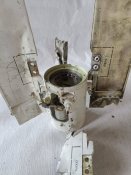
The R-73/73L/73E all have same boresight limits as I said in other thread.
The SCAB units in all MiG-29 9.12/9.13 variants can show the full 60 degree field of view of the helmet and slew R-27R/ER/T/ET to 50 degrees. So I do not know where you get this from.
One more time and that's it. MiG-29A/B thanks to the SCAB-A/B module, have limitation during lock-on of R-73E ( mode SHLEM ) to +/-45 degrees. Manuals and you wrote that you 've read all of them.
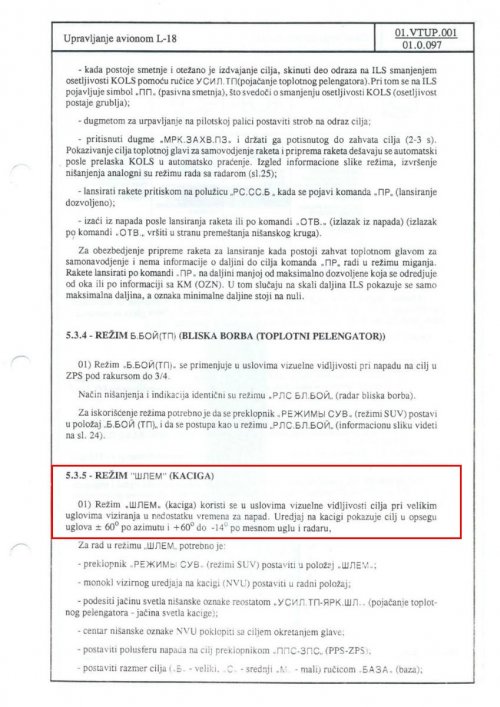
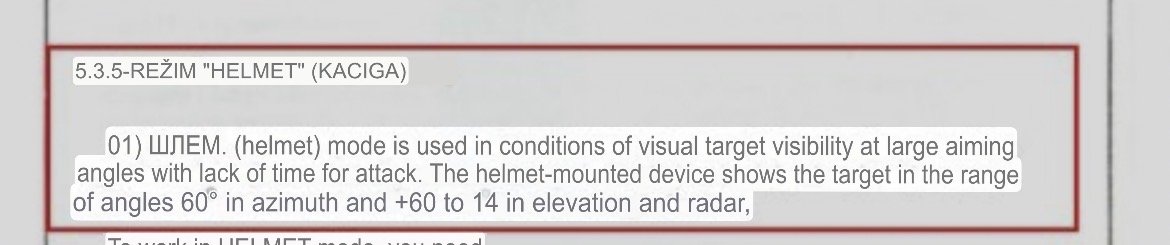
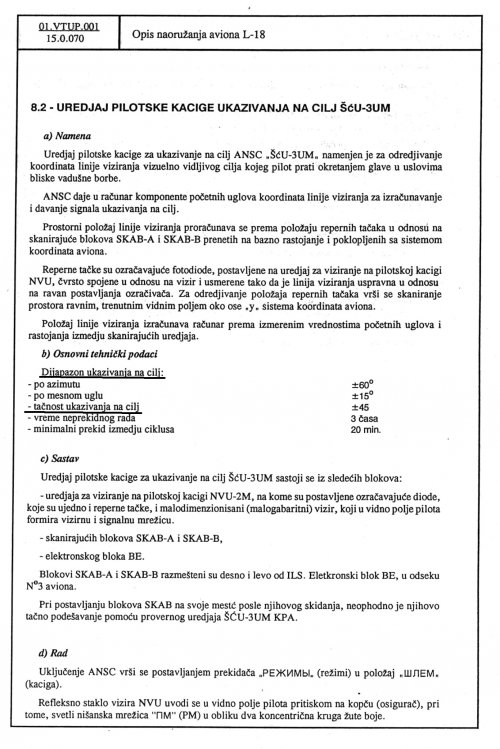
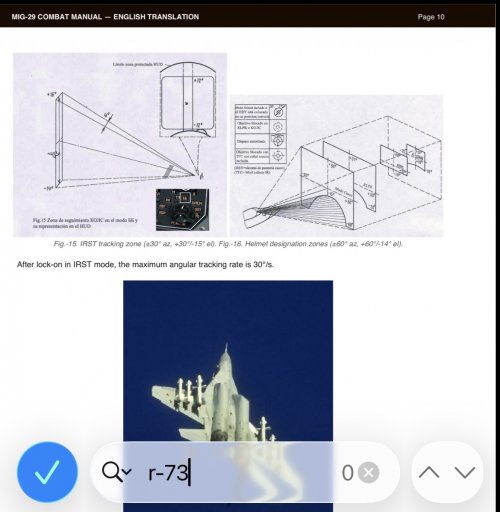
What is described in the VTUP L-18 /YuAF MiG-29B F.M. inside of the red rectangular? Literally, HMS shows the target inside of the +/- 60 degrees but the lock on can be performed only in the +/-45 degrees angle aspect.It is described in another Manual, Weapon Manual.
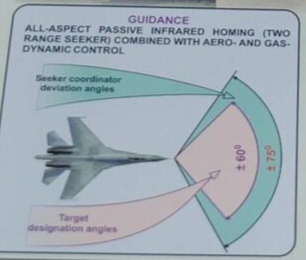
Where confusion arises, it arises in the translation of certain words and terms. Angles +/-75 degrees is as I wrote ,angle limitation for the IR seeker coordinator, +/-60 degrees is the limitation for the lock -on of the R-73 in the MiG-29/Su-27 in VVS ( originaly translated in the VTUP L-18 and I personally knew the translator professor R.T.) Angles +/- 45 degrees is the limitation for the lock -on of the R-73E limitied by the SCAB-A/B.
What is described in the VTUP L-18 /YuAF MiG-29B F.M. inside of the red rectangular? Literally, HMS shows the target inside of the +/- 60 degrees but the lock on can be performed only in the +/-45 degrees angle aspect.It is described in another Manual, Weapon Manual.
Incorrect. What you underlined is saying the whole limits of the HMS display, not the limits of the R-73. And as you said, you show export manual saying 60 degrees when you said it should say 45.
It pretty clearly is only about Schel-3UM. Not R-73.
HMS is not showing any target, it can only display if sensors or missile is locked and if you have launch authorization. So the max it will display “Missile seeker locked” and “launch authorization” (squares 3 and 4 in graphic of HMS display) is 45 degrees for R-73 and 50 degrees for R-27.
As I have shown it is the same case for domestic variants. It is not a SCAB-AB limitation but a missile seeker limitation and manuals and other documents show us. I have never heard of them limiting SCAB angles for any reason ever.
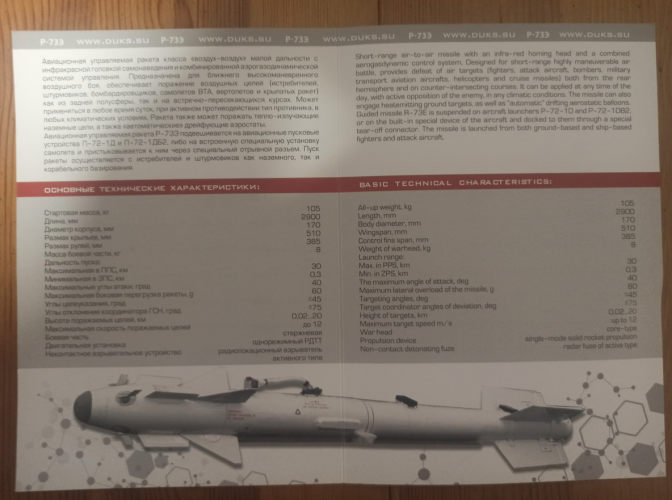
I don’t know what translation you mean. Maximum seeker coordination means the gimbal limit of seeker. Max target designation angle is max the seeker can be slewed, which is only 45 degrees max for variants until post Cold War. No where is 60 degrees part of R-73/73L/73E seeker spec.
Like I said, HMS going to 60 degrees would be fully utilized by setting radar into Coop mode so radar locks at same time as IRST when lock pressed.
If in 9.12/9.13 your HMS is on for 60 degrees sides and up. R-73 locks within 45 degrees R-27 within 50. Your radar can lock up to the full range of the HMS if you enable COOP mode. R-60 is supported up to 12 degrees and R-60M to 20. That’s it.
There was designer A.Molody from Kiev's Arsenal who invented new IR seeker for than new short range AAM type K-73 (Izd 72).
''Тем не менее коллективом во главе с А.В. Молоды в киевском "Арсенале", на первом этапе работавшем на конкурсных началах с московской "Геофизикой", была осуществлена разработка достаточно компактной ГСН "Маяк" (ОГС МК-80) с новым чувствительным элементом. Новая ГСН обеспечивала углы целеуказания по пеленгу до 60°, что в пять раз превышало соответствующий показатель ГСН ракеты Р-60.Угол прокачки гирокоординатора был доведен до 75°, а угловая скорость слежения - до 60 градусов в секунду.''
"Nevertheless, a team led by A.V. Molody at Kyiv's Arsenal, which initially worked on a competitive basis with Moscow's Geofizika, developed a fairly compact Mayak seeker (OGS MK-80) with a new sensing element. The new seeker provided targeting angles of up to 60°, five times greater than the R-60 missile seeker. The gyrocoordinator's sweep angle was increased to 75°, and the angular tracking velocity to 60 degrees per second."
In the same time another designer from the Arsenal company A.Mikhalik invented HMS ''Schel-3UM'' with the optical colimator NVU-2M.
''NSTs-27 Shchel-3UM.
During the tests the OEPS-27 received a new element - the Shchel-3UM
helmet-mounted target designator. This had been developed at the Kiev-based Arsenal plant (chief designer A.K. Mikhailik) and incorporated a helmet-mounted viewing device and an optical location block carrying a
scanner to determine the angle at which the pilots head was turned. The helmet-mounted target designator allowed the pilot to measure the line-of-sight coordinates within +60 deg. in azimuth and within -15 deg. to +60 deg. in elevation, with the line of sight changing at a speed up to 20 deg./sec. It also let the pilot place the target into the OLS's automatic acquisition 'box' and at the same time transfer the line-of-sight coordinates to the OBRS and missile homers. Using both the helmet-mounted target designator and the OLS, a pilot could reduce the sighting time in air combat, quickly acquire a target and give target designation to the missile homers before the target entered the acquisition cone of the missile. This made it possible to launch a missile at the maximum admissible angle.''
Btw word ''пеленг'' or ''пеленгация'' means direction finding.
Now some details about the gyrocoordinator and IR seeker which was from the very beginning as it was mentioned ,dual-band MWIR ( working on two differ average wavelenght).To ensure proper seeker angular movement ,deflection,the gyro coordinator must have bigger angle limitation and in the case of the original MK-80/Mayak-80 ( or lighthouse) ,it is +/-75 degrees.
So ''Угол прокачки гирокоординатора'' is one thing, '' угол целеуказания/ по пеленгу'' is another thing.
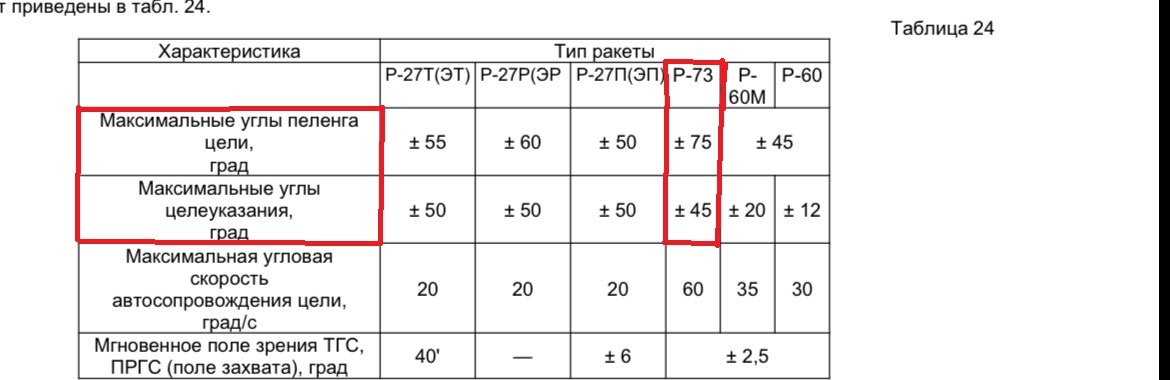
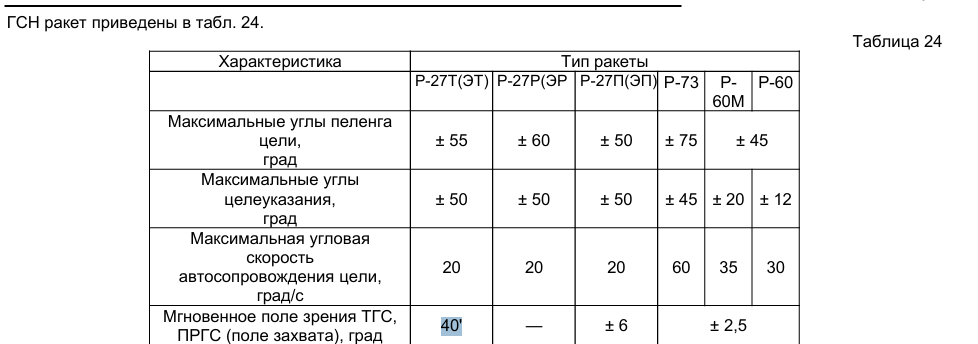
Now this was posted on another thread as the table from the MiG-29 Manual ( literally ''Domestic 29 manual'')
Скорость отработки угла целеуказания, не менее -64°/с
Угловая скорость автосопровождения 60°/с
Мгновенное поле зрения ТГС ±2,5°
Время захвата от выполн. ком-ды целеуказания 0,3—1,2 с
Время схода ракеты с пускового устройства 1,1—1,35 с
Max G limit of the MiG-29 and Su-27 for the launch of the R-73 is 8. There is no some kind of max targeting angle of the seeker's coordinator. How IR seeker works inside the dome , we can see exactly on 0:47
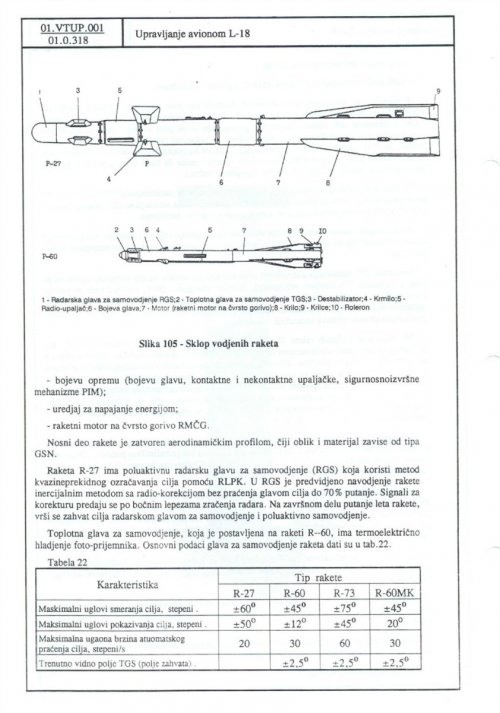
''The max the seeker can be slewed is 45 degrees despite having a maximum 75 degree angle to target after launch.''
In fact ,R-73 after launch can turn up to 90 degrees. On the video is the R-73L but the sequence with double R-73 launch is from the previous video (Soviet MiG-29). If seeker has only +/-45 degrees as half of 90 degrees , target lock-on limitation ,this from video would be impossible to achieve.
Also if the IR seeker has target lock on limit of +/-45 only with the coordinator limit +/-75 than for the lock on limitation of +/- 60 , it will needed coordinator limitation of +/-90 ??? Of course not.
Now about those translated manuals for the exported Luftwaffe MiG-29A/G and YuAF MiG-29B or L-18 and many advertising brochures. What is described in the MiG-29G F.M. completely the same is described in the YuAF MiG-29B/ L-18 so called 'Weapon Manual 'and I already mentioned that.
Again,if we use GT,we can understand that those scanning blocks SCAB-A/B control so called 'line of the sight' during the movement of the NVU-2M optical collimator of the HMS 'Schel-3UM'. For me there is no need for the GT and there is that word ''ukazivanje''/''ukazivanye'' and it is very similar to the Russian word целеуказание оr ''tseleukazaniye' , meaning of course the lock-on, target designation ,whatever.
Now we have two different things there, underlined black : diapazon of the target lock-on as the +/-60 degrees limited by the azimuth and precise lock-on of the target limited by +/-45 degrees.
So we have +/- 60° and +/-45°,both as the lock-on limitation. Тhat +/-45° comes from those SCAB-A/B scanning blocks.What we can see here ( already posted), is that HMS lock-on elevation angle limitation is greater in comparison with radar's one .It is simple,where pilot looks with that NVU-2M ,IR seeker will follow so w/o the use of the radar or IRST, w/o using that COOP mode.
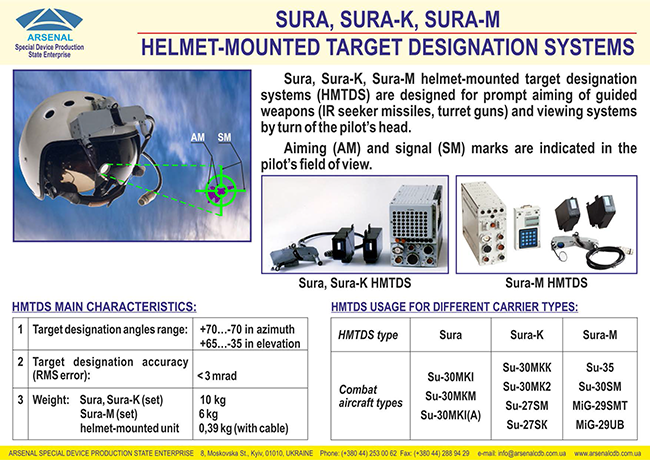
Now this is brochure for the newer 'Sura' family of the HMS and it is the material/brochure ( from the same company ) posted on another thread.
Now first to look on the material about MK-80 and MK-2200 seekers at mentioned topic. In the table we have next details : field of regard ( as nothing but that gyro coordinator angle limitation) and targeting angles. So values are +/-75° and +/-45° than +/-60° . How can it be for the same angle limitation of the gyrocoordinator ??? Simple, in the case of the MK-80 for the export ,target lock on limitation was reduced to +/-45° and in the case of the newer MK-2200 ,target lock on limitation is +/- 60° as for the VVS fighters. I will repeat again, old MK-80 was two band MWIR seeker and that wasn't mentioned in the brochure.
New HMS 'Sura' family was designed to use with the old Soviet R-73M/ML than newer Russian made R-74/M( L/ML).After 2014 crises ,Russians got new domestic made HMS. MK-80M and Impulse-90 seekers have new gyro coordinators with +/-90° limitation .Target lock-on angle limit was increased to +/-75°. For the R-73ME(MLE) or newer R-74E/EL (Izd 740) it can be +/-60° but for the R-74ME/MLE (Izd 750), it can be even +/-75°.
Point of the story is that exported MiG-29A/B, 9.12A/B were much degraded in the comparison with MiG-29 9.12/9.13 in the VVS. Same story is about that APK mode which was useless in the A/B just like using that 'compensation channel' during active jamming of the enemy.
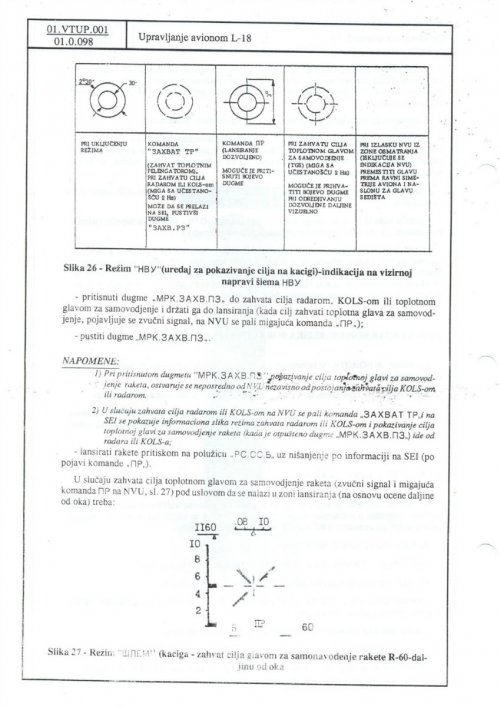
Yes there is. Manual says this is 45 degrees. 45 degrees the computer can command the R-73 to slew in one direction. If a pilot turns their head in HMS mode the max they will be able to lock a R-73 is 45 degrees from boresight.
fact ,R-73 after launch can turn up to 90 degrees. On the video is the R-73L but the sequence with double R-73 launch is from the previous video (Soviet MiG-29). If seeker has only +/-45 degrees as half of 90 degrees
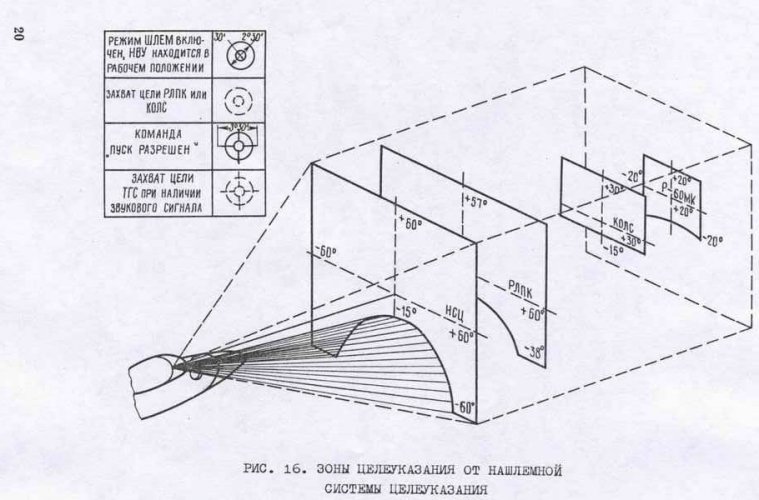
No it is not! Look at the labels squirrel! It says HCU! Is that a name for R-73? No it is the name for HMS! It is saying the HMS looks 60 degrees to the side!
And you know what else? This manual was apparently made before R-73 and doesn’t mention it once! Nothing in that chapter of the graphic you posted and nothing in the ENTIRE manual mentions R-73!
So how can this graphic say anything about it?
The 60 degree field labeled RLPK is obviously for the radar because that’s the max the HMS can designate the radar.
As I showed you they can use APK most likely fine. Domestic Russian manual also says “we do not use this switch.”
9.12A is only worse in not being able to use laser to update navigation all other performance is basically the same. I actually bet export users had an advantage for a while as export orders were always made with the most up to date radar software block and I bet many Russian units used the older software blocks from 1983-1986 without having upgrade for a while.
Only thing 9.12B looses on top of this is being able to automatic IFF interrogate and that its interrogator will mark every single target on the scope of it gets one yes signal. For the pilot these are the only differences.
And yes, that manual doesn’t mention R-73, idk how you see evidence of R-73 gimbal limits on this graphic labeled with the HMS and radar systems
As far as we can tell export and domestic R-73s have the same performance.
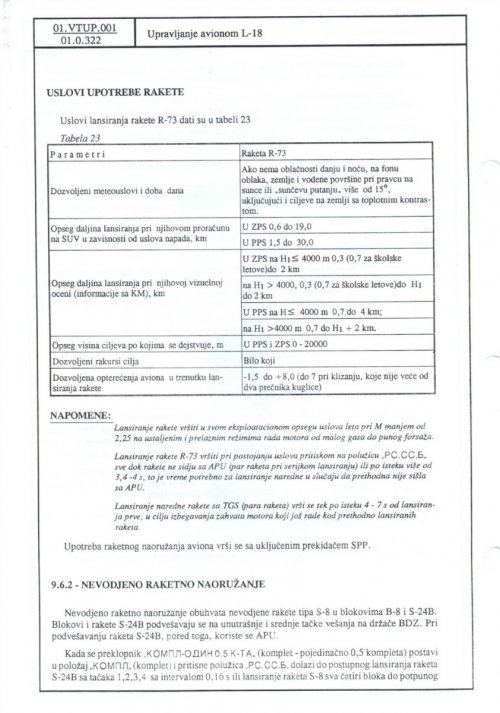
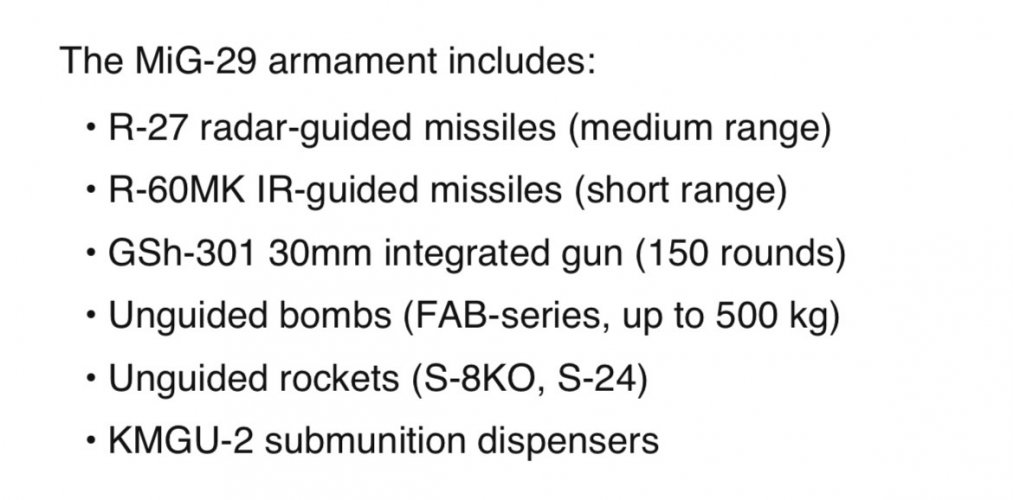
Manual weapon list. The fact it gives data for S-8KO but not KOM also points to the early nature of this manual.
Механіка керування елеронами та два стабілізатора з елеронами Крила ракети Р 73 з елеронами Проект/системаК-73Годы (разработка-испытания,/принятие на вооружение) 1974-79/84Носителиразличные модификации МиГ-21, МиГ-23, Миг-27,Миг-29, Миг-31, Су-27, Су-30,Су-34, Су-35, Ка-52 Ракеты: индекс...
Apparently the R-73 radar fuse as well as R-60 radar fuse also have a minimum closure limitation of 150 m/s. There is maximum closure limitation of 1400 m/s for R-60 so R-73 likely a little higher or even the same.
Yes becuase it is only about what Schel-3UM can do and says 0.00% about what R-73 can do. Just because HMS looks 60 degrees in one direction doesn’t mean R-73 can lock that far
As I wrote,you already posted the evidence with the given attachment.
Really don't understand how you can't understand ,OK we both made mistakes and also both posted some real things there and here. Now because you love to post so many Manual -materials ,now look again on the German MiG-29G and Yugoslav L-18 Manuals where you can see that besides +/-60 degrees lock-on limit for the HMS ,you have +/- 45 degrees lock-on limit. Why ? There is no sign for the R-73E there but it is so obvious. So in the both doc's, we have ''0.00% about what R-73E can do.''
In the MiG-29 ( 9.12/9.13) Manual we can find only +/-60 degrees limit for the lock-on. That is because VVS R-73 from 1983 had lock on limit of the IR seeker's photo detector of +/-60 degrees, for the exported R-73E from 1987 it was +/-45 degrees ( with the blockade yes). Seeker's coordinator angle limit was the same, +/-75 degrees and the same target's angular tracking speed of 60 degrees pour sec but the version 'E' was much degraded. Letter 'E' ( except for the AAM type R-27E), means not only export but it means big,very big difference between something in the VVS and something that was exported . I will repeat again, N019 has almost twenty Technical Doc's and Bulletins for the overhaul,upgrades etc, N019EA/EB has less than ten. Same story was about R-73/L and R-73E. For the R-27/E family ,max lock-on limit with HMS is +/-50 degrees.Now,where is the catch with that max +/- 60 degrees limit, think about that.
Mobile complex for the 'plug-in' monitoring of the all systems and subsystems of versions 9.12/9.13 called ''MK -9.12/9.13'' has many many 'parameters' which don't exist in the MK 9.12A/B at all. Again, APK mode is not usable in the 9.12A/B 's N019E just like radar compensation channel in the case of intense and active enemy jamming.Also, I wrote you that so called LITER codes and working frequencies for the N019 and R-27R are completely different in the comparison with the N019E and the R-27R1 .Difference is in the number of the possible usable frequencies ( N019 has them more) and in the working frequencies.
Soviets/Russians were very sceptical of those to whom very modern weaponry was to be sold.Already mentioned that MiG-25PDE were exported with the RP-25E Smerch-A2E not with the N005E Sapfir-25E. Example ,only thing that 'WP air forces' MiG-29A's N019EA had the same with the VVS 9.12/9.13 were IFF codes ,nothing else. Already mentioned also that my uncle worked in the Batajnica air base 'Moma Stanojlovic' overhaul plant and he was one of the 28 technical officers which were in the USSR during their technical training for the MiG-29B/UB on the Summer of 1987 in the Frunze. During the 1989 when the second batch of R-73E came to that plant ,they discovered several real R-73.When they tested them on the test-bad ,they were amazed how many differences were between them and the 'E'. From the lock on limit to the IR detector's 'average wavelenghts' where the real R-73 was more sensitive. What I completely misunderstood from him was that optical bloks SCAB-A/B limitation.In fact ,those scanning blocks in the 9.12A/B ( 9.51A/B also), can scan in the +/-60 degrees sector but the R-73E were already limited by +/-45 degrees.So those optical IR sensors on the Schel-3UM /NVU-2M 'tool' can catch the signals from those two scanning blocks in the complete sector but the ''precise lock-on'' limitation as it was described in the both 'export version Manuals' is already limited by +/-45.
Once upon a time,there was a missile for engaging the target in the 6 o'clock position and for the anti-AAM engagement.Some sources gave its designation R-73M.
''Р-73М / Р-73 РМД-2 - вариант ракеты с улучшенными ТТХ и новой ГСН (с карактеристиками ГСН “Маяк”), впервые показан на авиашоу МАКС-1997. По данным с выставки - испытания ракеты начаты в конце 1994 г., ракета готова к серийному производству. Вообще же создание модификации К-73 с расширенной зоной поражения начато по решению ВПК при Совмине СССР от 13 февраля 1984 г. Позже, работы по ракете заданы Постановлением Совмина СССР от 28 декабря 1984 г. В 1988-1989 г.г. изготовлены первые 16 прототипов новых ракет. Модель ракеты Р-73 РМД-2 обладает возможностью пуска в заднюю полусферу носителя и может использоваться против ракет “воздух-воздух”.''
''The R-73M / R-73 RMD-2 is a variant of the missile with improved performance characteristics and a new homing head (with the characteristics of the Mayak homing head), first shown at the 1997 MAKS-97 air show. According to information from the exhibition, missile testing began in late 1994 and the missile is ready for serial production. The development of the K-73 modification with an extended engagement zone was initiated by a decision of the Military-Industrial Complex under the USSR Council of Ministers on February 13, 1984. Later, work on the missile was mandated by a Resolution of the USSR Council of Ministers on December 28, 1984. The first 16 prototypes of the new missiles were manufactured in 1988-89. The R-73 RMD-2 missile has the ability to launch into the rear hemisphere of the carrier and can be used against air-to-air missiles.''
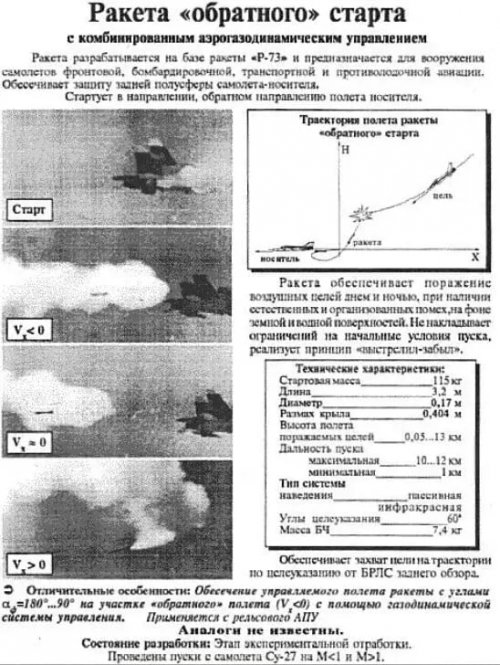
Ракета «обратного» старта с комбинированным аэрогазодинамическим управлением
''Ракета разрабатывается на базе ракеты «Р-73» и предназначается для вооружения самолётов фронтовой, бомбардировочной, транспортной и противолодочной авиации. Обеспечивает защиту задней полусферы самолёта-носителя.Стартует в направлении, обратном направлению полёта самолёта-носителя.Ракета обеспечивает поражение воздушных целей днём и ночью, при наличии естественных и организованных помех, на фоне земной и водной поверхностей. Не накладывает ограничения на начальные условия пуска, реализует принцип «выстрелил-забыл».
Обеспечивает захват цели на траектории по целеуказанию от БРЛС заднего обзора. Обеспечение управляемого полёта ракеты с углами aф=180°...90° на участке «обратного» полёта (V<0) с помощью газодинамической системы управления. Применяется с рельсового АПУ. Этап экспериментальной отработки. Проведены пуски с самолёта Су-27 на М<1 и M>1.''
''The missile is being developed based on the R-73 missile and is intended for use on frontline, bomber, transport, and anti-submarine aircraft. It provides protection for the rear hemisphere of the carrier aircraft. It launches in a direction opposite to the carrier aircraft's flight path. The missile can engage aerial targets day and night, in the presence of natural and organized interference, against land and sea surfaces. It imposes no restrictions on initial launch conditions, implementing the "fire and forget" principle.
Provides target acquisition along the trajectory based on target designation from the rear-looking radar. Guided missile flight at angles af = 180°...90° during the return flight phase (V < 0) is ensured using a gas-dynamic control system. It is used from a rail-mounted launcher. Experimental development stage. Launches have been conducted from a Su-27 aircraft at M < 1 and M > 1.''
First to be clear, designations like RMD-1/RMD-2 ( raketa maloy dalynosti /short range AAM) are not the real military designations at all.
It seems that almost in the same time when R-73 went operational during 1983 and officially entered service on June 1984, R-73M was developed as the much upgraded version. Upgrade was highly leveled ,so much that R-73M was in fact the first AAM which could engage target flying in the rear hemisphere of its own fighter!
Now ,from 1:08 of this video we can see that old R-73 could turn up to 90° after its launch ( same video we have here on this page).
R-73M could turn up to 180° after launch and that could be achieved only with the new nozzle's TVC capabilities.Also as we can see, that new version has LOAL capability with the inertial+IR guidance ( just like R-74M2/Izd 760 today on Su-57 ).About the test launches during the first half of the 1990's,I've found from some source that it was in fact prototype of the Su-27M '703' with the white tip of the vertical stabilizers and with the N012 radar in the tailboom,hm,maybe.
Another source:
''Работы по модернизации Р-73 развернулись уже с конца 1984 года. В модификации Р-73 РМД-2 головка самонаведения, построенная на цифровой элементной базе, отличается увеличенным углом целеуказания, повышенной помехозащищенностью, возможностью менять алгоритмы слежения и перехвата. Появилась возможность пуска в заднюю полусферу, перехвата вражеской ракеты «воздух — воздух». Модернизированные ракеты представлены уже после распада СССР. Модификация Р-73М (К-74МЭ), представленная в 1997 году, отличалась увеличением дальности пуска до 40 км и увеличенными углами целеуказания и прокачки гирокоординатора ГСН. Ракета Р-73Л (показана в 1999 году) получила лазерный взрыватель взамен радиолокационного.''
''Work on upgrading the R-73 began in late 1984. The R-73 RMD-2 modification features a digitally based homing head with a wider target acquisition angle, improved jamming immunity, and the ability to change tracking and interception algorithms. This allowed for rearward launch and the interception of enemy air-to-air missiles. Modernized missiles were introduced after the collapse of the USSR. The R-73M (K-74ME) modification, introduced in 1997, boasted an increased launch range of 40 km, wider target acquisition angles, and increased seeker gyrocoordinator adjustment. The R-73L missile (introduced in 1999) received a laser fuse instead of a radar one.''
I couldn't find the photo of the R-73M/K-74ME on MAKS 1997 and it is interesting that R-73M had greater seeker's coordinators angle limit .Old R-73 from 1983 had +/-75°. In last sentence it can only be the R-73EL ( MAKS 1999) ,not the original R-73L.
''- Р-73Л / Р-73ЭЛ - вариант ракеты с оптическим лазерным неконтактным взрывателем в экспортном исполнении впервые показан на авиасалоне МАКС-1999, но фактически ракеты с оптическим взрывателем (без объявления) впервые были показаны в августе 1989 г. на первом московском авиасалоне. Ракета оснащена оптическим лазерным взрывателем.''
"The R-73L/R-73EL—a missile variant with an optical laser proximity fuse in an export configuration—was first shown at the MAKS-1999 air show. However, missiles with optical fuses were actually first shown (without announcement) in August 1989 at the first Moscow air show. The missile is equipped with an optical laser fuse."
you have +/- 45 degrees lock-on limit. Why ? There is no sign for the R-73E there but it is so obvious. So in the both doc's, we have ''0.00% about what R-73E can do.''
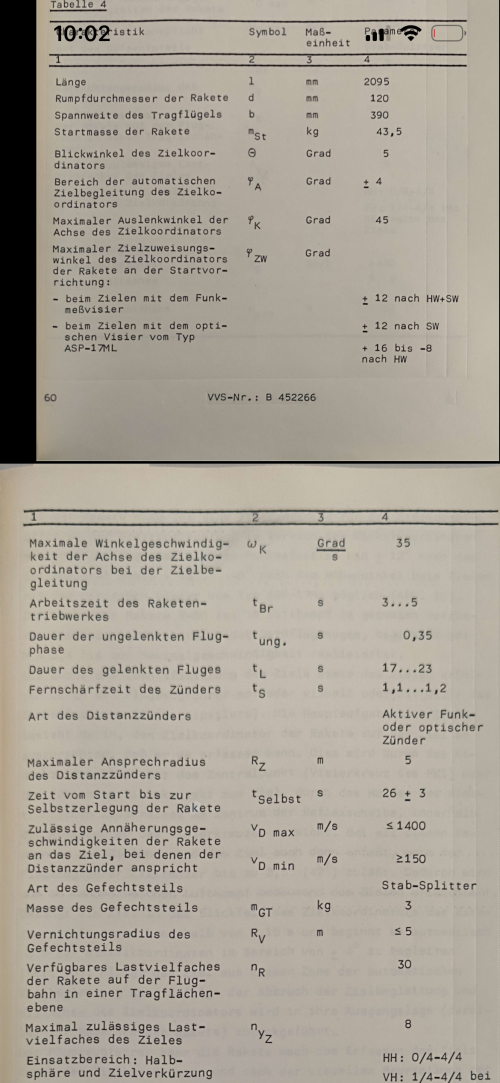
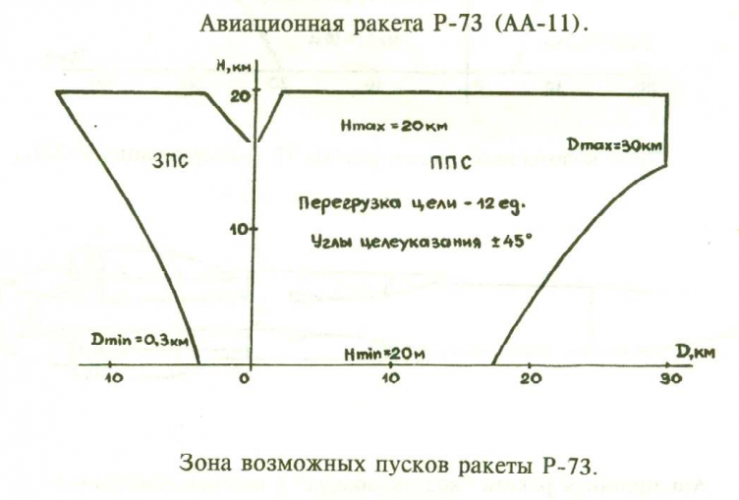
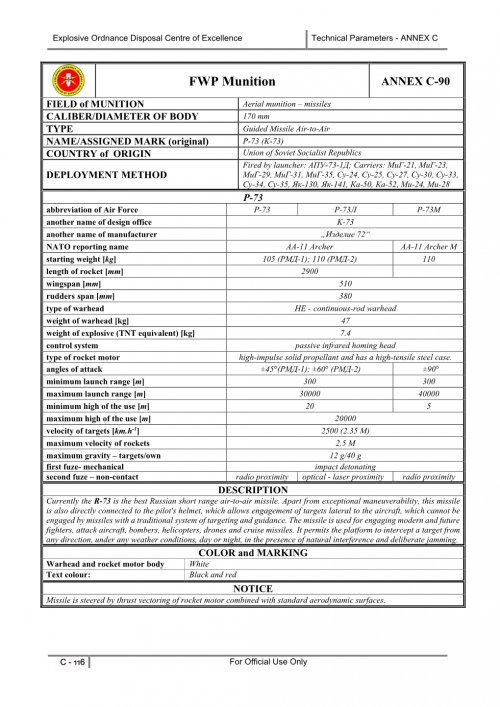
Umm no. I said 0.00% becuase the weapon manual you are using to show HMS view does not mention R-73 anywhere in it. The German manuals do becuase they had it delivered at the time. Here are other Russian materials for both R-73E and domestic R-73 showing same 45 degrees off boresight acquisition distance, and a Warsaw pact weapon disposal manual that gives statistics from documents for each of the weapons described.
In the MiG-29 ( 9.12/9.13) Manual we can find only +/-60 degrees limit for the lock-on. That is because VVS R-73 from 1983 had lock on limit of the IR seeker's photo detector of +/-60 degrees, for the exported R-73E from 1987 it was +/-45 degrees ( with the blockade yes).
Every 60 degree figure you mention is for “the area that the HMS displays the reticule and can lock with radar in COOP mode” not the R-73 angle, which is no where mentioned in the weapons manual your graphic is from. You have never shown anything yet that actually says that R-73 domestic had a 60 degree limit whereas export was lower. Nowhere says this.
Whatever can you possibly mean? All this means is if pilot turns on HMS the reticle is lit up from +/-60 degrees azimuth. If the reticule is within 50 degrees azimuth and elevation it can lock the R-27 and fire it if in radar coop mode OR if R-27T/ET has lock from its own seeker.
For r-73 is same just 5 degrees less, reticule will be lit on monocle from +/-60 degrees azimuth (as shown by the graphic and said in my references I previously posted) and when the reticule is 45 degrees or less from boresight it is possible to lock R-73 seeker on its own when holding lock or to get LA/LP from it locking after cued from IRST/radar.
We see same exact information for HMS and R-73 and R-73E both domestic and export. I am no stranger to you ignoring numbers and reality so you really don’t need to make an effort to convince me.
case of intense and active enemy jamming.Also, I wrote you that so called LITER codes and working frequencies for the N019 and R-27R are completely different in the comparison with the N019E and the R-27R1 .Difference is in the number of the possible usable frequencies ( N019 has them more) and in the working frequencies.
Except that range and search and lock times were the same and operating frequencies and time slots the same and overall performance identical to the operator except for first 3 domestic batches with SP mode. Only difference for 9.12B is the older IFF. Now if we talk navigation system there are other differences in terms of a laser correction mode being gone.
When they tested them on the test-bad ,they were amazed how many differences were between them and the 'E'. From the lock on limit to the IR detector's 'average wavelenghts' where the real R-73 was more sensitive
All domestic info that you seem to ignore gives the identical limit of 45 degrees. You will not find 60 degrees describing anything about R-73 seeker.
RMD-1 and RMD-2, domestic names, all both give 45 degrees HOBS acquisition for RDM-1 and 60 for RDM-2. Or do you think they straight up did not upgrade RDM-2 seeker
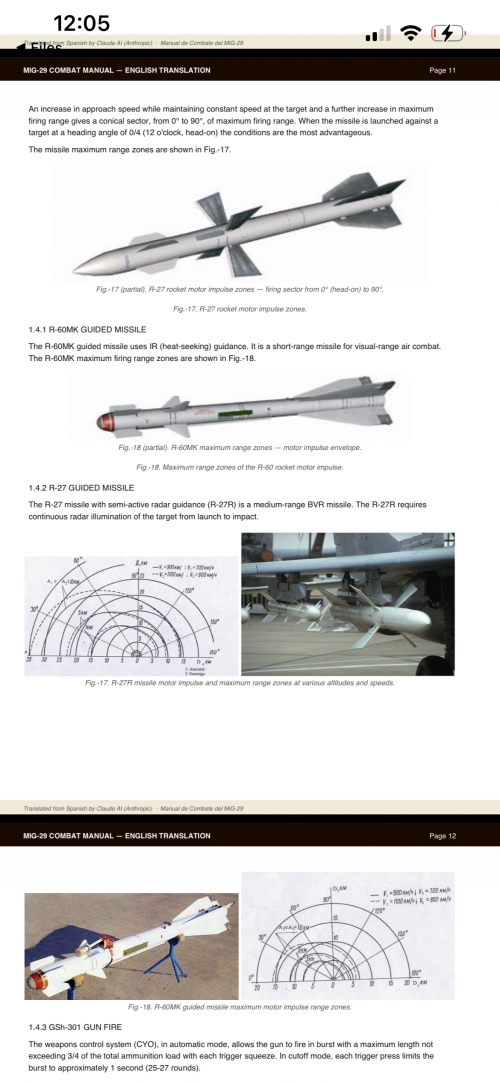
So manuals have to give 3x sets of figures for pilots with HMS. The limits of the HMS itself that it displays reticule, and since this is inside radar limits it works in coop, the limits of R-73 HOBS and limits of R-27. The class graph showing 50 for R-27 is for domestic models and says 45 for R-73, I shared this with you before, afterall, there is very good reason it’s in a cryllic manual and not a Polish or German one. This is where Russian domestic manual gives HOBS ranges. Or do you think it lies?
If someone you trust talked to you about domestic models having larger lock angles, they were talking about RMD-2/R-73M and original 73 not original domestic R-73 and R-73E. Only for RMD-2/RVV-MD2 will you see 60 degree lock angle.
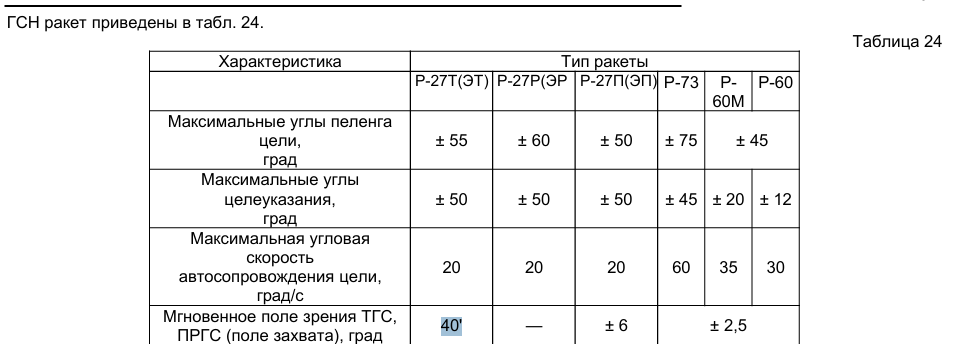
I've already wrote that this table is very suspicious and false.For the R-73 value +/-75 degrees is not some 'max target track' limit (максимальные угльи пеленга цели) as it is mentioned ,that is wrong. It is value for the seeker's coordinator.Yes, it is translated in German but as something completely wrong and illogical.
Btw ,source mentioned as MiG-29 F.M. ( that table on page 201 ) is very strange .
Это руководство по эксплуатации самолета МиГ-29, которое содержит информацию о его назначении, конструкции, тактико-технических характеристиках, ограничениях, подготовке к полету, выполнении различных маневров и полетов.
www.scribd.com
We have also Doc called ''РЛЭ и БП МиГ-29'' MiG-29's F.M. and 'combat usage' where we can find this ( page 196 part for the R-73 ).Also something strange and illogical ( for the No 3).
1.Максимальн. угол отклонения оси координатора ТГС ±75°
1. Yes it is right and max seeker's coordinator angle limit is +/-75°. So gyro-coordinator platform of the IR seeker can move +/-75 degrees left-right and up-down.
2. Yes ,max target tracking angles +/-60° ( by the IR seeker).
3 .Max targeting angle of the seeker's coordinator +/-45° ??? Of course it can not be right because coordinator as a seeker's moving platform has its own limitation (No 1) .
Now I will go back again to the Weapon/F.M.'s of the German MiG-29A/G and YuAF MiG-29B ( part about HMS) ,where we can see that besides target's lock-on limitation of +/- 60° ,we have that ''fine,precise,accurate ,(whatever) lock-on'' limit of +/-45°. Be aware , something like that, we can not find in the Russian Manual of the MiG-29 9.12 ( 9.13).
Now what we have indeed. We have the max target lock-on limit of +/-60°, +/-15°,60° of the HMS in the 9.12/9.13 and max target lock-on limit of +/-45° of the HMS in the 9.12A/B. All of this isn't w/o the reason of course. There is also one interesting detail to consider and it is between the IR seeker/detector and its coordinator. If coordinator/ gimbal has its deflection limit even +/-75 degrees ,for me it is hard to believe that IR seeker has lock-on limit only +/-45 degrees ( in R-73/L).So for the seeker's lock-on limit of +/-60 degrees than coordinator needs deflection limit +/-90 degrees ???
Again ,citation (from this page) :
"Nevertheless, a team led by A.V. Molody at Kyiv's Arsenal, which initially worked on a competitive basis with Moscow's Geofizika, developed a fairly compact Mayak seeker (OGS MK-80) with a new sensing element. The new seeker provided targeting angles of up to 60°, five times greater than the R-60 missile seeker. The gyrocoordinator's sweep angle was increased to 75°, and the angular tracking velocity to 60 degrees per second."
About designations like RMD-1 and RMD-2 ,suppose that all of them came from either Vladimir Pustovoytov or Gennadiy Sokolovsky from the Vympel company because those designations has nothing to do with the military/VVS .Just like RVV-AYe, RVV-MD(MD2), RVV-SD or RVV-BD etc ...
This site uses cookies to help personalise content, tailor your experience and to keep you logged in if you register.
By continuing to use this site, you are consenting to our use of cookies.