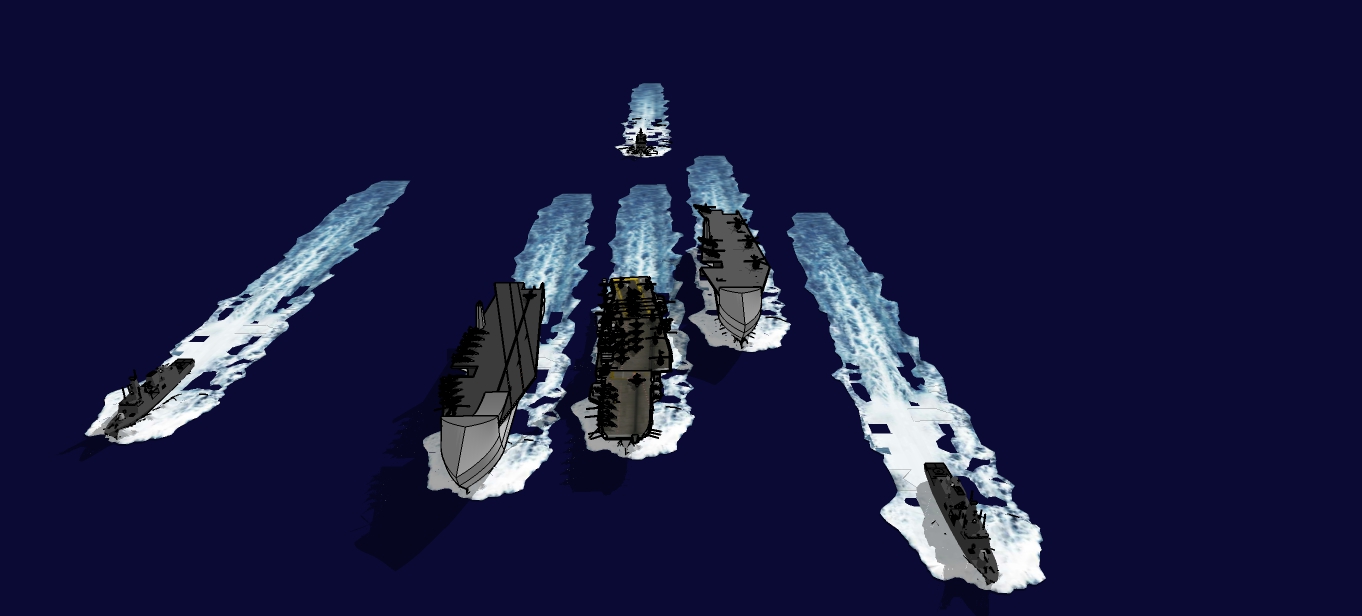
Modern Escort Carrier Hypothetical

What you're suggesting is telling the builders they're going to get money whether they deliver or not, cuz, you know, we need 'em. And that's exactly how you get shit performance.
Also this is such a painfully immature way of looking at naval shipbuilding. The problem is if you don't pay enough money up fron then how can they possibly deliver on time? If you don't fund the industrial base appropriately how can they possibly deliver on time? If you don't consistently order from companies how can they reliably pay and retain their workforce at appropriate levels?

I completely agree, don't pay bonuses for shoddy work but you're advocating for not funding the bare minimum, the same issue which is causing massive bottlenecks in parts and slowing down shipbuilding
 
Also this is such a painfully immature way of looking at naval shipbuilding. The problem is if you don't pay enough money up fron then how can they possibly deliver on time? If you don't fund the industrial base appropriately how can they possibly deliver on time? If you don't consistently order from companies how can they reliably pay and retain their workforce at appropriate levels?

I completely agree, don't pay bonuses for shoddy work but you're advocating for not funding the bare minimum, the same issue which is causing massive bottlenecks in parts and slowing down shipbuilding
You should reread what I said.
 
Do you want carriers or no? That's what happens when you don't buy enough to support two builders. (And some are saying we should have yet another round of consolidation in the military aircraft market. Who needs more than one fighter developer?)
That started in 1958.

The USN hasn't built a carrier anywhere but Newport News starting with the Enterprise in 1958. America and JFK were also built at NNNS, then the Nimitz class.

I was trying to blame that on BRAC, but no. It's very old Navy policy.

In theory, either Bremerton or Pearl Harbor could be upgraded to build carriers (or subs). They both have the nuclear shops and drydocks large enough to hold carriers. Bremerton would need whole new parking structures for the additional however-many thousand employees this would require. I think Pearl Harbor has enough parking but you'd have to pay an extra crapton of money due to cost of living there.
 
That started in 1958.

The USN hasn't built a carrier anywhere but Newport News starting with the Enterprise in 1958. America and JFK were also built at NNNS, then the Nimitz class.

I was trying to blame that on BRAC, but no. It's very old Navy policy.

In theory, either Bremerton or Pearl Harbor could be upgraded to build carriers (or subs). They both have the nuclear shops and drydocks large enough to hold carriers. Bremerton would need whole new parking structures for the additional however-many thousand employees this would require. I think Pearl Harbor has enough parking but you'd have to pay an extra crapton of money due to cost of living there.
Saratoga, Independence, and Constellation were built at NY Navy shipyard. If you look at how fast they were building them then that explains how they were able to support two shipyards. Not anymore though.
 
Found a couple of interesting things when I went digging for info on fast ROPAX designs.

1) Take Spirit of Tasmania IV/V, for example. Very fast (26 knot service speed), good size (~27,000t displacement, 212x30.6 meters).

2) Plans available here. Would be quite easy to add a magazine and aviation fuel tanks below the waterline, convert the lower truck deck into 2 accommodation decks, and the upper truck deck into an aviation hangar and shops. The passenger decks above that would be removed and replaced by a flight deck
https://www.facebook.com/groups/775853707209069/posts/1403047981156302/

3) Cost €284M ($320M) built in Finland, which gets interesting…

4) … because this is the exact same shipyard that is building a pair of Arctic Security Cutters for the USCG, at the same cost per hull as the 4 ASCs built at Bollinger, which means the cost of Finnish and US domestic production are not too different and you might be able to build it in the US for $350M or less

5) Also note that a fast ROPAX is a better starting point than a container ship due to speed, greater subdivision, separate machinery spaces, greater emphasis on seakeeping (eg. fin stabilisers), and those truck decks. Plus the costs are more realistic as they reflect a high standard of internal fit out.

Next I’d want to see how many CCAs could fit in that hangar and on deck. Ideally I’d be aiming for 24 CCAs of approx A-4 size (10-12 tonnes take off weight), ie 2 squadrons, with a surge goal of 60+ offensive sorties per day x2-4 munitions (mix of internal and external), so ~240 munitions expended per day. Assuming 800-1,000nm combat radius for each CCA, plus organic buddy tanking if necessary, plus 200-400nm range munitions, that would allow the CVE to stand-off at least 1,200nm from Chinese shores.
 
This is a hypothetical discussion hinging at outsourcing to civilian hull builders. The probematics above may differ significantly. Who knows?
I don't think it's a simple matter to convert a container ship but it's not impossible. In the end conversion time, effort and cost will determine success (while relaxing and waiving a lot of regs).

Back to stability concerns. Not a lot of information is provided publicly on ship designs offered like range, tankage, stability... So I can't say with certanty which ones can be used outright.
From what I see the freeboard requirement matches the max stacking heights on these container ships. They are almost all the same height. The difference varies between 1-2 container stacks. The carrier will be less dense so listing angle/rigthing moment arm limit would be less.
 
Next I’d want to see how many CCAs could fit in that hangar and on deck. Ideally I’d be aiming for 24 CCAs of approx A-4 size (10-12 tonnes take off weight), ie 2 squadrons, with a surge goal of 60+ offensive sorties per day x2-4 munitions (mix of internal and external), so ~240 munitions expended per day. Assuming 800-1,000nm combat radius for each CCA, plus organic buddy tanking if necessary, plus 200-400nm range munitions, that would allow the CVE to stand-off at least 1,200nm from Chinese shores.
Keep in mind the ship shares fuel with the aircrafts which means a lot is need to satisfy range and operational intensity.
Afaik ~4 days of fuel & ordanance are required. Something like 6t ordnance/CCA/day to match the chinese 1-on-1.
 
Keep in mind the ship shares fuel with the aircrafts which means a lot is need to satisfy range and operational intensity.
Afaik ~4 days of fuel & ordanance are required. Something like 6t ordnance/CCA/day to match the chinese 1-on-1.
Indeed, the logistical requirements are substantial. I'm assuming 60 sorties/day consuming 3t of fuel and 1t of ordnance (4x 500lb class weapons). That's 4t per sortie = ~250t per day (180-200t aviation fuel + 60t ordnance). Plus ships' fuel.

Here's a sketch of a 26-knot, 26,000t ROPAX hull with a 200m flat deck. (Adapted from Spirit of Tasmania IV plans) The hangar would be big enough for 18 F-35s + 2 helicopters... so seems likely that 24 CCAs could fit in there. This also shows the substantial available volume under the waterline for fuel & munition storage, and the 2 lower hangar decks which could be subdivided into accommodation and workshops.

I haven't sketched out the flight deck arrangement, but most likely it would be a reverse angle deck to help optimize landing operations and help each CCA quickly turn around and clear the landing area, heading either for pitstop areas in front of the island or to the forward elevator to be refueled & rearmed in the hangar. A mini ski jump (~5-6 degrees) + optional low-powered catapult could help the CCAs achieve higher take-off weights.
 

Attachments

  • CVE ROPAX 26000t 10px=1m v2.png
    CVE ROPAX 26000t 10px=1m v2.png
    2.3 MB · Views: 25
Last edited:
planta-mercante-9.jpg
 
@carvalho2008 None of those designs is even remotely workable. Terrible island placement, no space for sensors and antennas, safety issues galore (angled deck edge prevents safe bolters, ski jump too close to the island), the hull structure would buckle due to the forward elevator arrangement with corners that prevent proper load carrying, the funnel is too small to allow for sufficient propulsion power etc.
 
planta-mercante-9c-copia.jpg


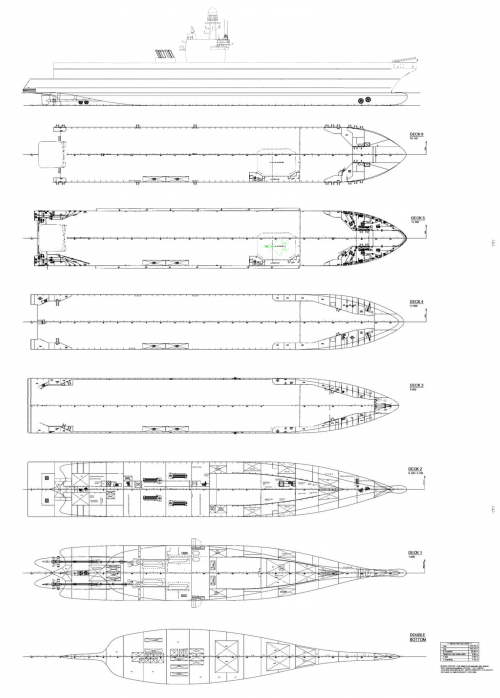
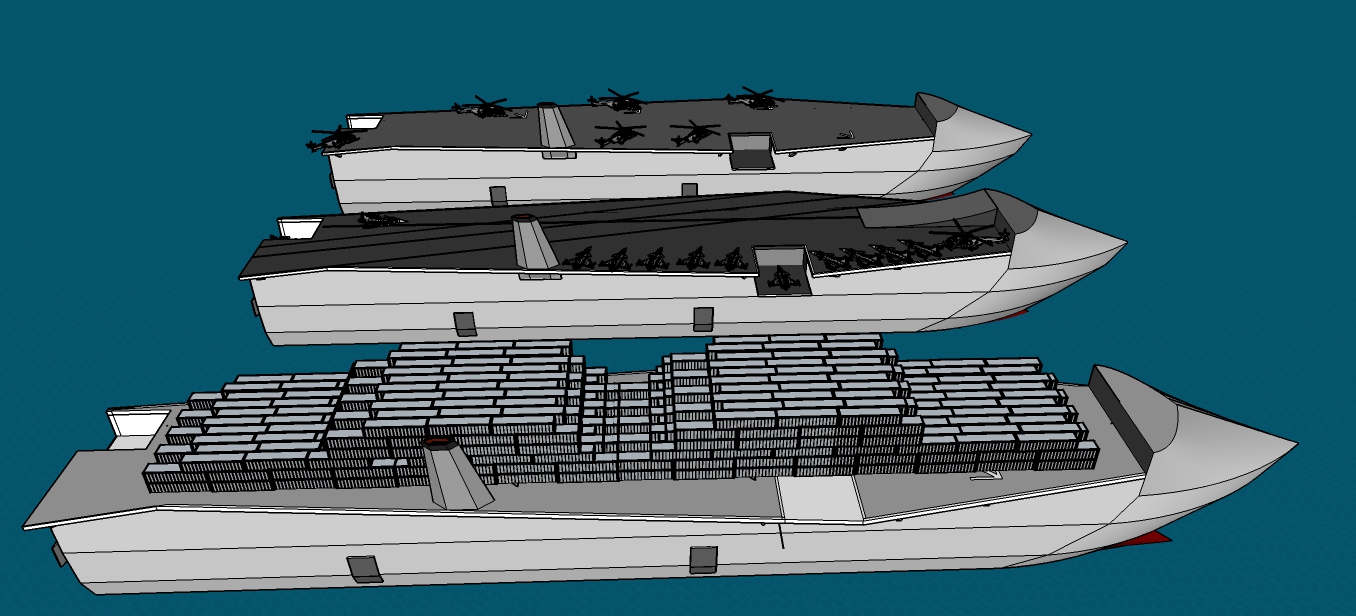
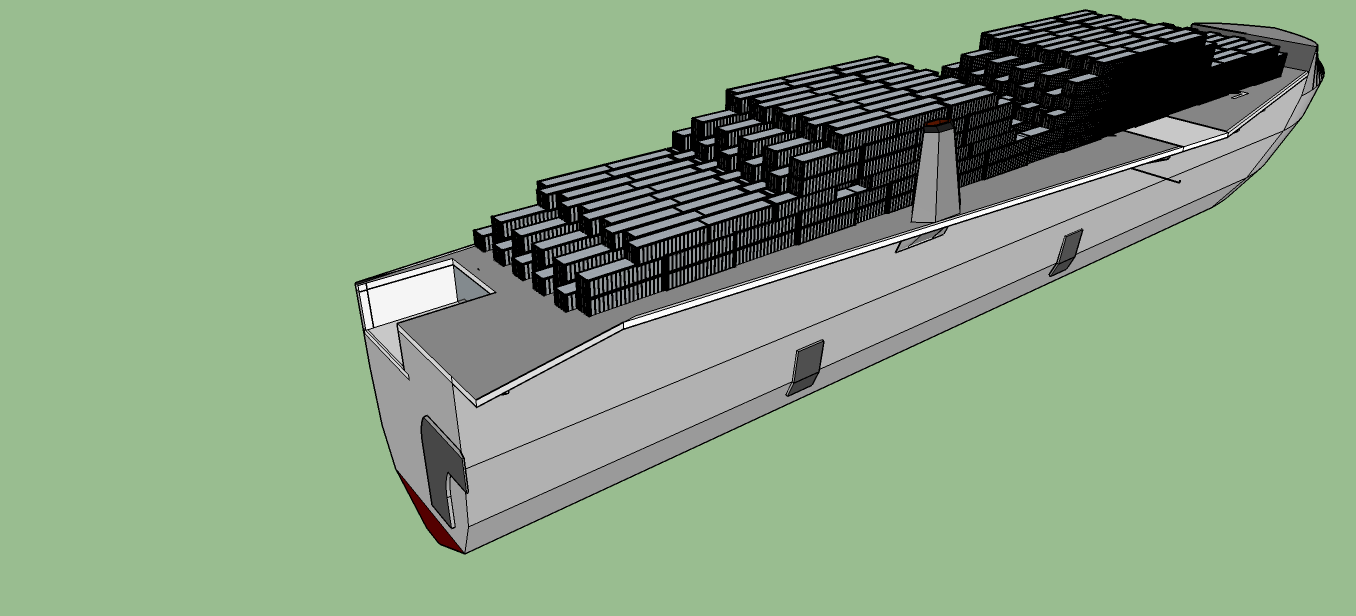
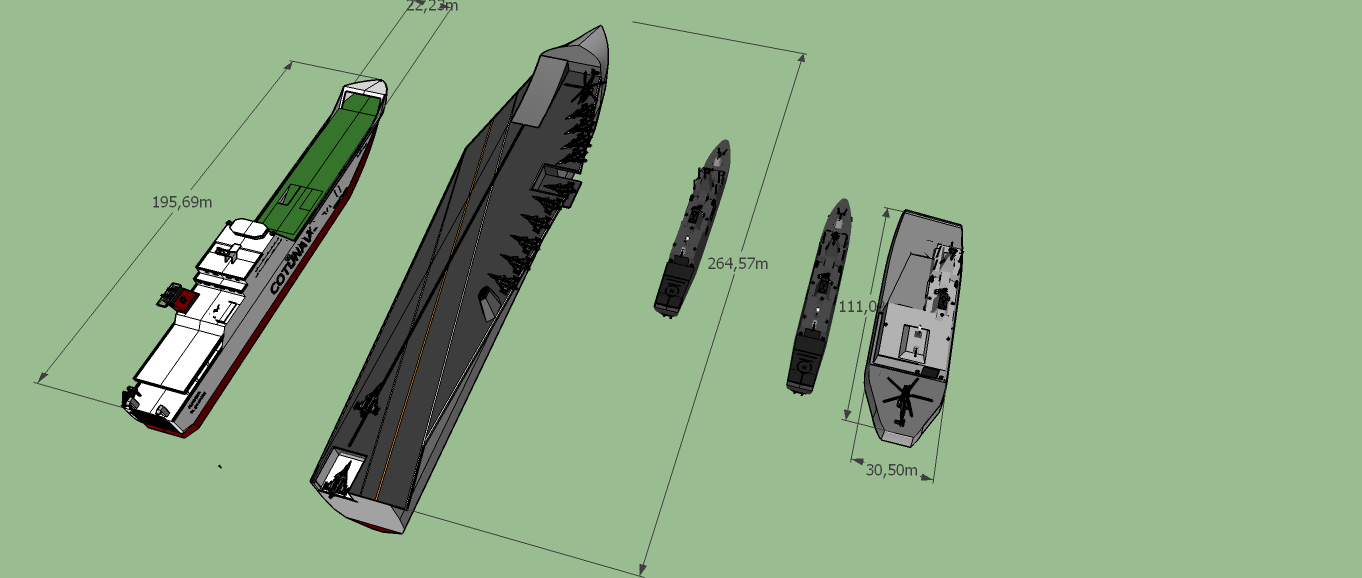
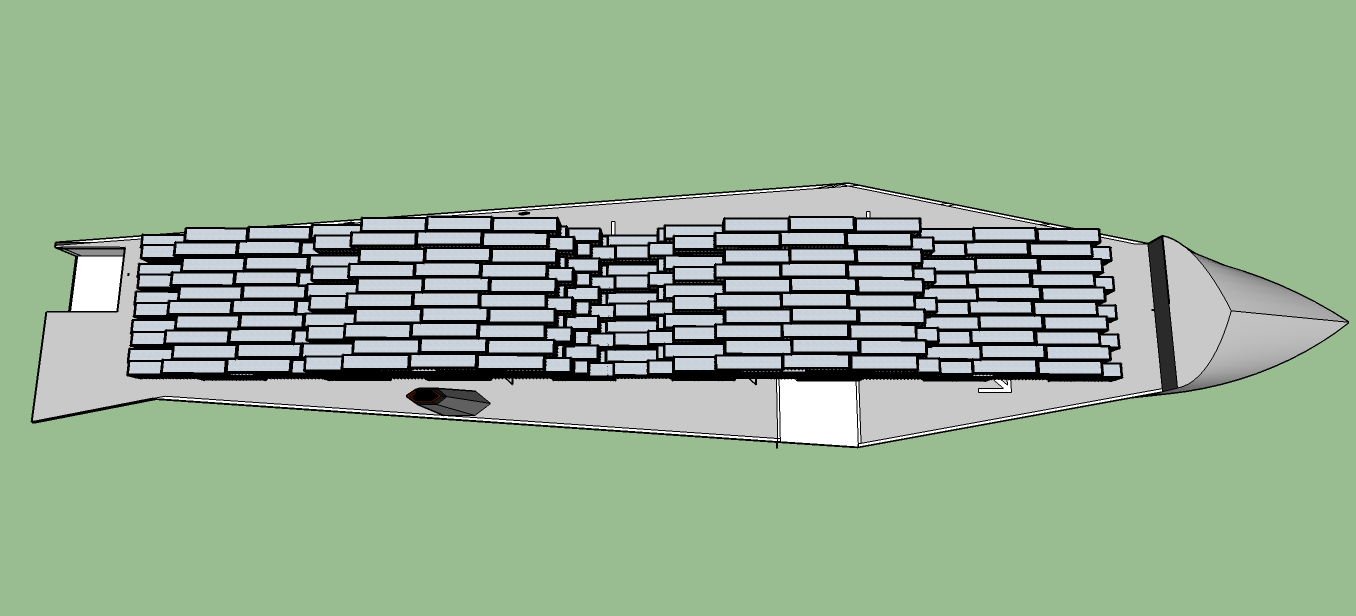
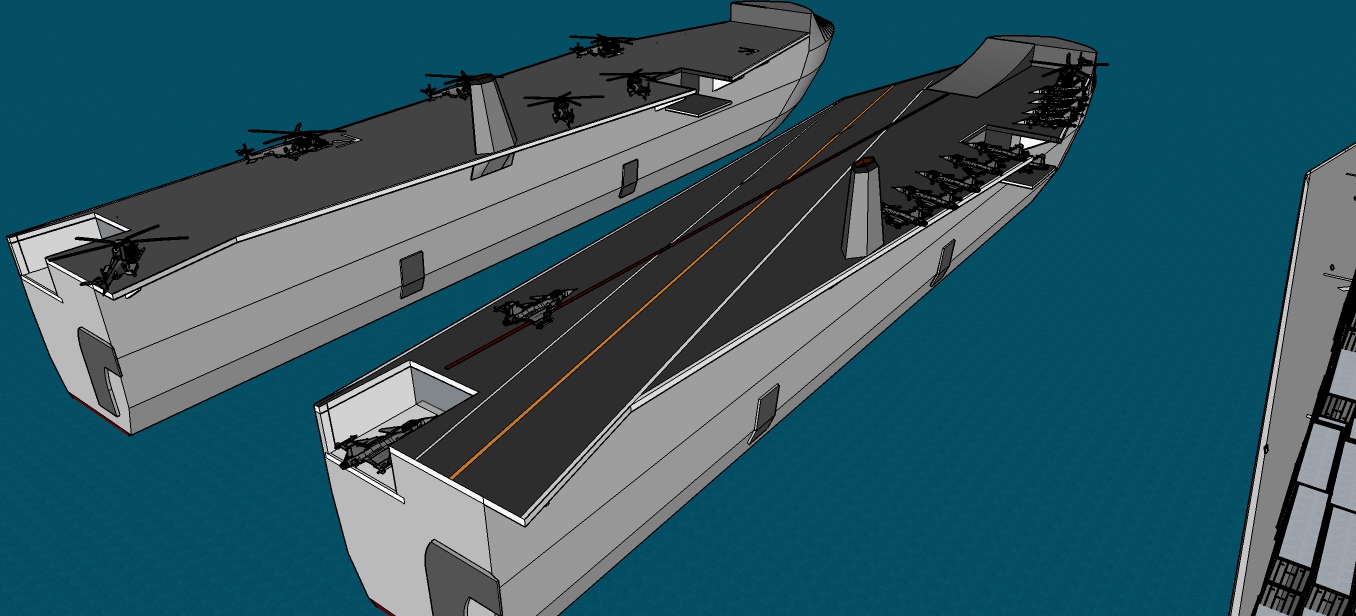
The bridge structure is located at the bow, which sits higher than the main deck. I simply didn't draw the windows—it’s an artistic concept rather than a refined design—based on the idea of commercial Ro-Ro vessels with designs adaptable for military use. It’s a very crude, simple concept intended to ensure extremely low costs and allow for the installation of SATS system kits. Basically, it’s a 45,000-ton, 265-meter steel "bathtub" capable of carrying aviation fuel and featuring a lower deck with two elevators... that’s it, nothing more... a way to disperse fighter jets at sea using a structure similar to the SATS concept used by the Marines on land.
 
Last edited:
@carvalho2008 None of those designs is even remotely workable. Terrible island placement, no space for sensors and antennas, safety issues galore (angled deck edge prevents safe bolters, ski jump too close to the island), the hull structure would buckle due to the forward elevator arrangement with corners that prevent proper load carrying, the funnel is too small to allow for sufficient propulsion power etc.
The design aims to meet commercial requirements and ensure marketability while featuring a layout that allows for conversion into an aircraft carrier within one to two weeks—taking the Arapaho concept a step further. It is a Ro-Ro container ship. Beyond the basic design, it would include conduits for cabling and power distribution, as well as dedicated spaces for installing generators. Fuel tanks would be compartmentalized to allow for the separation of ship fuel and aviation fuel. Ski-jump ramps, arresting gear, and optical landing systems would be kept in storage for potential use. In practice, this represents the SATS doctrine—ironically—stored away for deployment on a versatile, dual-use vessel. It even allows for the use of an auxiliary catapult—operating solely during heavy-configuration aircraft launches—to complement the ski-jump (the catapult launches the fighter toward the ramp). It functions as an auxiliary aircraft carrier, capable of carrying between 12 and 16 fighters and 4 to 6 helicopters... Undoubtedly, operating a CATOBAR/STOBAR mix would be the most complex aspect; however, this type of commercial Ro-Ro hull allows for roles such as LPD, LHD, drone carrier, etc. ...with a target price of an incredible US$ 300 million.

And that is why the island cannot be positioned on one of the sides, but rather at the bow, in the Xbol profile...
 
Great Lakes shipyards.

Though it's unlikely they'd be very happy to work for the US government. Bad habit of changing designs in the middle of construction, and little pisses off builders more than ripping out work they just did.

Lakers are pretty big. There's a few over 1000ft long and 68,000tons (dimensional limits of the Soo Locks), though their lines tend to be pretty fat instead of the lean lines of a warship.
The Great Lakes access to the sea is limited by the Seaway locks to vessels less than 23.8 meters beam and 225.6 meters long. Seaway expansion is very unlikely because of the declining economics and demographics of the entire Great Lakes region.

Moreover, the Great Lakes industrial base seems likely to decline further with the new mammoth steel mill planned on the Mississippi in Iowa that is vertically integrated with an inland Minnesota mine. No need for Laker traffic carrying iron ore from Duluth, Minnesota to steel mills from East Chicago to Cleveland. There are precious few American “Jones Act” Lakers in the Great Lakes trade to begin with. This is probably the end of the inland merchant marine, aside from tug and barge traffic.

Probably not a “bad” development as much as inevitable. You can service an Iowa steel mill with rail and barge traffic, with a lot less lead time than building a single Jones Act Laker. And indeed, if the mammoth Iowa mill comes to pass, I can see East Chicago and Cleveland Cliffs Mills being closed, which is probably good for the environment back east.
 
Last edited:
I still lean more toward container ship for a number of reasons:
A container ship is designed for heavy load, hence, inherently stable with all that. I'm certain the carrier will be at least in the 30kt range. But we don't really need the full 90kt load offered, only about 25-30kt max. Hence, my compromise for going with a catamaran/trimaran design to fix the draft while retain stability.
The PCTC on the other hand we are looking at 7000-8000 CEU capacity or ~up to 10kt load. It's too little.
Their deck design (from bottom) large, large, small, small but we need large, small, large, small. And the small deck's height (~2.2m) don't comply with any human habitation code (~2.5m) anywhere. One reason they have theirs on top. So there's no way around rearranging/redesigning the decks.

Anyhow, carriers of the sizes we are looking at used to have a total crew of more than 1000. That's no longer desired. But I do agree the ship's core crew needs to be cruiser size plus some for carrier specific stuff like elevators, catapult and additional for engineering since we need more power, too. The air crew needs to be small which means " large" drones need to be similar manageable like the swedish Gripen. I'm looking for ~350 core ship crew and 360-400 air crew, hence no more than 800 if possible.
 
Last edited:
Anyhow, carriers of the sizes we are looking at used to have a total crew of more than 1000. That's no longer desired. But I do agree the ship's core crew needs to be cruiser size plus some for carrier specific stuff like elevators, catapult and additional for engineering since we need more power, too.
I'm not sure how many extra bodies you'd need for the extra working bits on a carrier. Not if you're using EMALS and AAG.

You don't need but one mechanic on watch for a gas turbine or big diesel, for example, and I'm not sure you need more than 1 mechanic for multiple engines (see a B-52, where one crew operates 8 GTs).


The air crew needs to be small which means " large" drones need to be similar manageable like the swedish Gripen. I'm looking for ~350 core ship crew and 360-400 air crew, hence no more than 800 if possible.
Just going to point out that a Nimitz has an air wing of ~2480, divide by 80 airframes in the wing and we're talking about 31 bodies per aircraft. Going to UAVs is not going to greatly reduce your manning since you still need all the other bodies even if the plane itself is completely autonomous.

I'm not sure what the QE class is doing in terms of air wing, less than 900 for a wing of 40 brings us to about 22-23 bodies per aircraft at the peacetime load and clear down to 12-13 per aircraft at the wartime loading of 72 airframes. Unless most of the extra aircraft are helos, not more F-35s?

With helicopters you can probably get away with 10 per aircraft, but without the ability to do major repairs onboard. The typical Burke helo det is ~20 crew for 2 helos.
 
I appreciate that this is a bit ‘out of left field’, but how about dusting off the old ‘Protean’ designs from the late mid 1970’s?
The original article was in Navy International April 1975 - this was a pdf I created pulling text and images together….
 

Attachments

  • Protean.pdf
    1.5 MB · Views: 10
I appreciate that this is a bit ‘out of left field’, but how about dusting off the old ‘Protean’ designs from the late mid 1970’s?
The original article was in Navy International April 1975 - this was a pdf I created pulling text and images together….
Yes, I based my work on the Protean project, the SATS System, Point-class ships, RFA, HMS Ocean, etc.

My premise is that in times of conflict, there is no time to build dedicated escort carriers or auxiliary carriers. The Arapaho and SCADS doctrines demonstrated their value through vessels like the SS *Atlantic Causeway* and SS *Atlantic Conveyor*.

Thus, the question these designs aim to answer is:

- What design features should a commercial cargo ship possess to enable operational effectiveness superior to that seen in the SATS, SCADS, and Arapaho doctrines, specifically to support operations for aircraft such as the F/A-18, SH, MiG-29K, F-35, FC-31, Rafale M, and A-4? What structural steel modifications are required, while ensuring the vessel remains commercially viable for civilian use? The goal is to have one or two purpose-built units—constructed with permanent installations—to establish doctrine and capability, while maintaining the ability to requisition six additional civilian vessels for conversion and preparation within two weeks in an emergency.

Air control and primary defense would be provided by the combat systems of the escort vessels.
 
I'm not sure how many extra bodies you'd need for the extra working bits on a carrier. Not if you're using EMALS and AAG.

You don't need but one mechanic on watch for a gas turbine or big diesel, for example, and I'm not sure you need more than 1 mechanic for multiple engines (see a B-52, where one crew operates 8 GTs).


Just going to point out that a Nimitz has an air wing of ~2480, divide by 80 airframes in the wing and we're talking about 31 bodies per aircraft. Going to UAVs is not going to greatly reduce your manning since you still need all the other bodies even if the plane itself is completely autonomous.

I'm not sure what the QE class is doing in terms of air wing, less than 900 for a wing of 40 brings us to about 22-23 bodies per aircraft at the peacetime load and clear down to 12-13 per aircraft at the wartime loading of 72 airframes. Unless most of the extra aircraft are helos, not more F-35s?

With helicopters you can probably get away with 10 per aircraft, but without the ability to do major repairs onboard. The typical Burke helo det is ~20 crew for 2 helos.
I took it from the Ticon assuming manning savings & additions cancel out and the air crew numbers from the Invincible (366) with headroom for a slightly larger wing.
I could try to break down the composition.
In any case, I do assume people are being pooled to work with a set of drones rather single teams assigned to individual drones as in the case of manned aircraft (it's a responsibility relaxation).
Yes, I based my work on the Protean project, the SATS System, Point-class ships, RFA, HMS Ocean, etc.

My premise is that in times of conflict, there is no time to build dedicated escort carriers or auxiliary carriers. The Arapaho and SCADS doctrines demonstrated their value through vessels like the SS *Atlantic Causeway* and SS *Atlantic Conveyor*.

Thus, the question these designs aim to answer is:

- What design features should a commercial cargo ship possess to enable operational effectiveness superior to that seen in the SATS, SCADS, and Arapaho doctrines, specifically to support operations for aircraft such as the F/A-18, SH, MiG-29K, F-35, FC-31, Rafale M, and A-4? What structural steel modifications are required, while ensuring the vessel remains commercially viable for civilian use? The goal is to have one or two purpose-built units—constructed with permanent installations—to establish doctrine and capability, while maintaining the ability to requisition six additional civilian vessels for conversion and preparation within two weeks in an emergency.

Air control and primary defense would be provided by the combat systems of the escort vessels.
I assume your scheme is to have these in civil service via some sort of lease contract?
But this would require the civil operator to provide extra security and (annul) readiness certification and or provide guarantee (or be fined and or imprisoned otherwise). This would cost time, additional insurrance and eat into their margins. In turn this would require monetary incentives etc. Will this really work?
 
The PCTC on the other hand we are looking at 7000-8000 CEU capacity or ~up to 10kt load. It's too little.
Their deck design (from bottom) large, large, small, small but we need large, small, large, small. And the small deck's height (~2.2m) don't comply with any human habitation code (~2.5m) anywhere. One reason they have theirs on top. So there's no way around rearranging/redesigning the decks.
Where are you getting 10,000 from?

The PCTC Tamesis for example has a deadweight of around 35,000 tons?

Some of the decks have good height and some are hoistable.
 
I appreciate that this is a bit ‘out of left field’, but how about dusting off the old ‘Protean’ designs from the late mid 1970’s?
The original article was in Navy International April 1975 - this was a pdf I created pulling text and images together….
I have that spread over several files ....good to have in one.
 
I took it from the Ticon assuming manning savings & additions cancel out and the air crew numbers from the Invincible (366) with headroom for a slightly larger wing.
I could try to break down the composition.
In any case, I do assume people are being pooled to work with a set of drones rather single teams assigned to individual drones as in the case of manned aircraft (it's a responsibility relaxation).

I assume your scheme is to have these in civil service via some sort of lease contract?
But this would require the civil operator to provide extra security and (annul) readiness certification and or provide guarantee (or be fined and or imprisoned otherwise). This would cost time, additional insurrance and eat into their margins. In turn this would require monetary incentives etc. Will this really work?
An operation similar to what the RFA carries out when requisitioning *Point*-class vessels—or as was done with the *Conveyor*—but with far greater predictability regarding mechanical design...

Maintain one unit within the fleet's active force to establish doctrine. In the event of war, requisition additional hulls from commercial transport service for rapid conversion.

planta-mercante-2.png


planta-mercante-9b.jpg
 
Last edited:
I took it from the Ticon assuming manning savings & additions cancel out and the air crew numbers from the Invincible (366) with headroom for a slightly larger wing.
I could try to break down the composition.
Invincible-class air wing crew still works out to right about 16 bodies per airframe (~22 birds).

So between QE and Invincible manning I think we have the number of bodies needed for VSTOLs. I believe that the extra bodies "per plane" on a Nimitz are needed for handling catapults and arresting gear.


In any case, I do assume people are being pooled to work with a set of drones rather single teams assigned to individual drones as in the case of manned aircraft (it's a responsibility relaxation).
I agree, I just needed some way to ballpark that.

And I think it's going to end up as a mix of general pool workers and a few people assigned to an individual aircraft to be the responsible body (USN calls them "plane captains").
 
Invincible-class air wing crew still works out to right about 16 bodies per airframe (~22 birds).

So between QE and Invincible manning I think we have the number of bodies needed for VSTOLs. I believe that the extra bodies "per plane" on a Nimitz are needed for handling catapults and arresting gear.


I agree, I just needed some way to ballpark that.

And I think it's going to end up as a mix of general pool workers and a few people assigned to an individual aircraft to be the responsible body (USN calls them "plane captains").
The important part here is to differentiate between the ship's company and the air wing. On a US carrier or amphib, there will be an Air Department and an Aviation Intermediate Maintenance Department who directly support aviation operations on the ship, the Weapons Department who deal primarily (but not exclusively) with aviation ordnance, and other support coming from other departments.

AIMD
- IM-1: Maintenance admin
- IM-2: Engine and structural repair shop
- IM-3: Avionics and armament
- IM-4: Ground support equipment

Air Department
- V-1: Flight deck personnel
- V-2: Catapults and arresting gear
- V-3: Hangar deck personnel
- V-4: Aviation fuels (operating the ship's aviation fuel system)
- V-5: Air administration and Pri-Fly

Weapons Department
- G-1: Hangar and flight deck ordnance handling
- G-2: Magazines
- G-3: Weapons assembly
- G-4: Weapons elevators
- G-5: Ordnance control

The Operations Department will have an OC division for ATC services and an OZ division for intelligence and targeting and the Supply Department will have a division for aviation stores.

In total, these personnel probably include about 1,200 of the ship's company of 3,500 personnel on a Nimitz class carrier. They are members of the crew and are not part of the air wing that embarks onboard the carrier. They are on the carrier when it gets underway regardless of whether or not any aircraft are onboard. Given how manpower-intensive the aviation-related roles are compared to the Engineering and Deck Departments on a merchant ship, the ratio of aviation-role ship's company to total crew could easily exceed 50% on an escort carrier.

The embarked personnel are composed of the Carrier Air Wing staff (40 people for a US Navy CVW) and the CVW's squadrons. Each of those squadrons will have an Operations Department that does schedules and training, an Admin Department, and a Safety Department. However, at least 75% of the squadron's personnel are part of the Maintenance Department, which includes the plane captains, jet and airframe maintainers, avionics maintainers, personnel who maintain life support equipment, and the ordnance personnel who actually load weapons on the planes.

The personnel attached to the squadrons are the ones necessary to operate the squadron while ashore at the squadron's home installation. During its training cycle, the carrier air wing conducts training as a unit from shore installations prior to embarking on the carrier. It may be tempting to allocate aviation support personnel from ship's company to the squadrons for flexibility, but then those personnel would not be able to train as regularly or intensely while located ashore and requirements for maintaining their spaces on the ship would fall to the rest of the ship's company, who will not have the skills to ensure that equipment is maintained and functional before the air wing drops in.

 
Where are you getting 10,000 from?
CEU used to be the
1966 Toyota Corona RT43 @7.4 m² and ~1 t
Now it's 10 m² and assuming same deck load pressure ~1.35 t
I took the 7500 CEU as average for 10125 t and rounded it.
There are tables listing 1.5 t but they also list 1 TEU as 7 t when it's full load is 30.48 t.

The PCTC Tamesis for example has a deadweight of around 35,000 tons?
This includes fuel etc. not just the payload I'm looking to add on top of the baseline performance offered.

I agree, I just needed some way to ballpark that.

And I think it's going to end up as a mix of general pool workers and a few people assigned to an individual aircraft to be the responsible body (USN calls them "plane captains").
Given how manpower-intensive the aviation-related roles are compared to the Engineering and Deck Departments on a merchant ship, the ratio of aviation-role ship's company to total crew could easily exceed 50% on an escort carrier.
Our escort carrier is not going to do all the mission set a fleet carrier does.
It does do patrol, SAR, and self defence of the emmidiate area not theater. It does provide aircrafts to do strikes but under someone else's direction and operation command.

The majority of the air wing is unmanned so a lot of admin, HR and supply management work can be unified and reduced to 1 or 2 staff teams.
For example a MQ9 squadron has 66 personnel for 15 airframes on a base somewhere. The pilot, sensor tech, intel officer and whatever ops personnel in Ramstein are not counted. The squadron should have the HR & supply staff etc. as usual.
For our carrier the same is true except the ops personnel counts but for the whole wing. Pilot, sensor tech count separately for each drone.
In comparision a manned squadron has 170-190 personnel for 12 airframes.

My desired air wing:

core:
4x 10t helicopters SH60 [spot size 0.28]
4x MQ-9B SeaGuardian STOL: AWACS, ASW, EW [spot size 0.7]

mission contingency:
4-6x GA Mojave/MQ-1C Gray Eagle (4-6 fully assembled, 5-8 containerized)[spot size 0.57]

12x UCAV [spot size 0.77][X-47B spot size 0.69]
3x MQ25 [spot size 0.94]

for a total of 29 to 37 aircrafts max.
the personnel should be around ~140 without pilots, ops

So I still have 220 to 260 positions to fill for my aloted 400 "air department".
 
My quick and dirty fleshed out spec. that is generally applyable but specific to ship performance (speed, power => fuel needs)

cruise speed 21 kts for a desired range of 23000 nm
max speed 25-27 kts using 26 kts

at cruise propulsion power is ~36MW for a total power requirement of ~76MW
at max speed propulsion power is ~55MW for a total power requirement of ~95MW

The required power is provided by up to 25 diesel (FM 175D) at 4.4MW each for 110 MW max
in a Integrated Power and Energy System (IPES)
The required oil is 17500 t (15% reserve) and 600 TEU volume (at 50°C)

Air craft fuel: 5 days 30 aircrafts 80 sorties/day
JP8: 3211.5 t 126 TEU volume (at 50°C)

Assuming 1000 PAX, including marine contingency
provision for 180 days: 1500 t
water: 267000 L/day
 

Similar threads

Back
Top Bottom