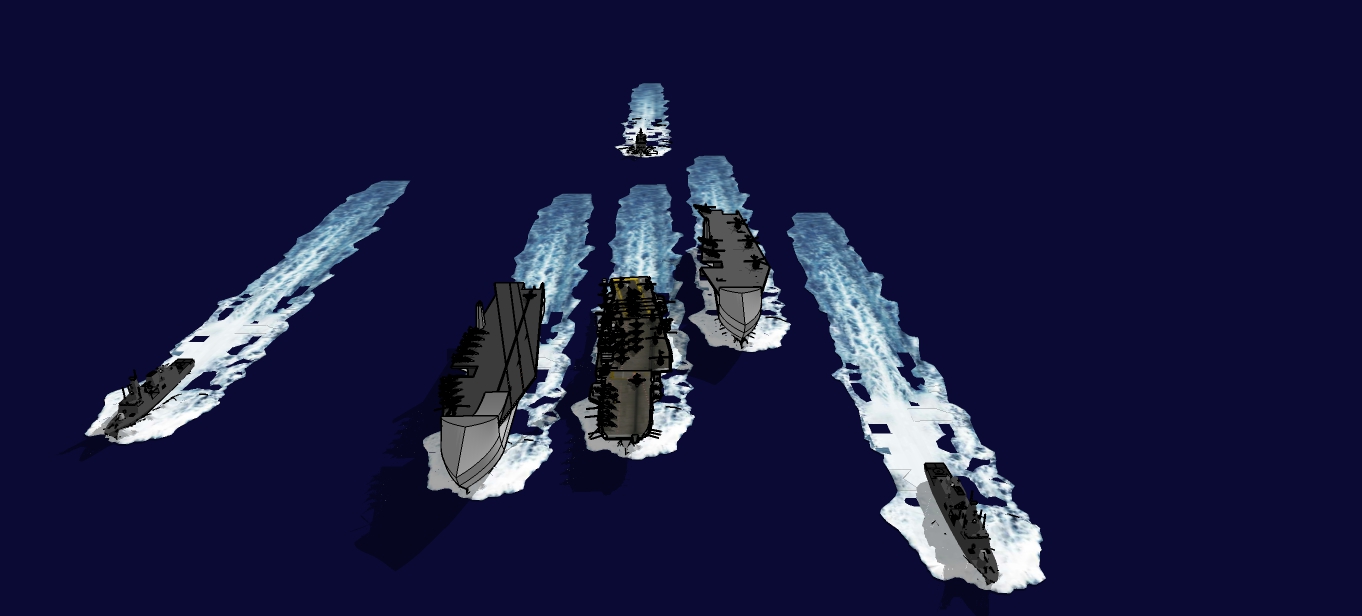
Modern Escort Carrier Hypothetical

What you're suggesting is telling the builders they're going to get money whether they deliver or not, cuz, you know, we need 'em. And that's exactly how you get shit performance.
Also this is such a painfully immature way of looking at naval shipbuilding. The problem is if you don't pay enough money up fron then how can they possibly deliver on time? If you don't fund the industrial base appropriately how can they possibly deliver on time? If you don't consistently order from companies how can they reliably pay and retain their workforce at appropriate levels?

I completely agree, don't pay bonuses for shoddy work but you're advocating for not funding the bare minimum, the same issue which is causing massive bottlenecks in parts and slowing down shipbuilding
 
Also this is such a painfully immature way of looking at naval shipbuilding. The problem is if you don't pay enough money up fron then how can they possibly deliver on time? If you don't fund the industrial base appropriately how can they possibly deliver on time? If you don't consistently order from companies how can they reliably pay and retain their workforce at appropriate levels?

I completely agree, don't pay bonuses for shoddy work but you're advocating for not funding the bare minimum, the same issue which is causing massive bottlenecks in parts and slowing down shipbuilding
You should reread what I said.
 
Do you want carriers or no? That's what happens when you don't buy enough to support two builders. (And some are saying we should have yet another round of consolidation in the military aircraft market. Who needs more than one fighter developer?)
That started in 1958.

The USN hasn't built a carrier anywhere but Newport News starting with the Enterprise in 1958. America and JFK were also built at NNNS, then the Nimitz class.

I was trying to blame that on BRAC, but no. It's very old Navy policy.

In theory, either Bremerton or Pearl Harbor could be upgraded to build carriers (or subs). They both have the nuclear shops and drydocks large enough to hold carriers. Bremerton would need whole new parking structures for the additional however-many thousand employees this would require. I think Pearl Harbor has enough parking but you'd have to pay an extra crapton of money due to cost of living there.
 
That started in 1958.

The USN hasn't built a carrier anywhere but Newport News starting with the Enterprise in 1958. America and JFK were also built at NNNS, then the Nimitz class.

I was trying to blame that on BRAC, but no. It's very old Navy policy.

In theory, either Bremerton or Pearl Harbor could be upgraded to build carriers (or subs). They both have the nuclear shops and drydocks large enough to hold carriers. Bremerton would need whole new parking structures for the additional however-many thousand employees this would require. I think Pearl Harbor has enough parking but you'd have to pay an extra crapton of money due to cost of living there.
Saratoga, Independence, and Constellation were built at NY Navy shipyard. If you look at how fast they were building them then that explains how they were able to support two shipyards. Not anymore though.
 
Found a couple of interesting things when I went digging for info on fast ROPAX designs.

1) Take Spirit of Tasmania IV/V, for example. Very fast (26 knot service speed), good size (~27,000t displacement, 212x30.6 meters).

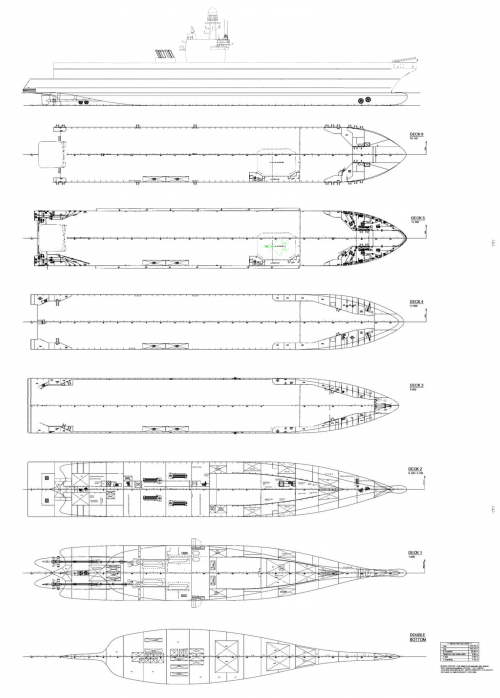
2) Plans available here. Would be quite easy to add a magazine and aviation fuel tanks below the waterline, convert the lower truck deck into 2 accommodation decks, and the upper truck deck into an aviation hangar and shops. The passenger decks above that would be removed and replaced by a flight deck
https://www.facebook.com/groups/775853707209069/posts/1403047981156302/

3) Cost €284M ($320M) built in Finland, which gets interesting…

4) … because this is the exact same shipyard that is building a pair of Arctic Security Cutters for the USCG, at the same cost per hull as the 4 ASCs built at Bollinger, which means the cost of Finnish and US domestic production are not too different and you might be able to build it in the US for $350M or less

5) Also note that a fast ROPAX is a better starting point than a container ship due to speed, greater subdivision, separate machinery spaces, greater emphasis on seakeeping (eg. fin stabilisers), and those truck decks. Plus the costs are more realistic as they reflect a high standard of internal fit out.

Next I’d want to see how many CCAs could fit in that hangar and on deck. Ideally I’d be aiming for 24 CCAs of approx A-4 size (10-12 tonnes take off weight), ie 2 squadrons, with a surge goal of 60+ offensive sorties per day x2-4 munitions (mix of internal and external), so ~240 munitions expended per day. Assuming 800-1,000nm combat radius for each CCA, plus organic buddy tanking if necessary, plus 200-400nm range munitions, that would allow the CVE to stand-off at least 1,200nm from Chinese shores.

 
This is a hypothetical discussion hinging at outsourcing to civilian hull builders. The probematics above may differ significantly. Who knows?
I don't think it's a simple matter to convert a container ship but it's not impossible. In the end conversion time, effort and cost will determine success (while relaxing and waiving a lot of regs).

Back to stability concerns. Not a lot of information is provided publicly on ship designs offered like range, tankage, stability... So I can't say with certanty which ones can be used outright.
From what I see the freeboard requirement matches the max stacking heights on these container ships. They are almost all the same height. The difference varies between 1-2 container stacks. The carrier will be less dense so listing angle/rigthing moment arm limit would be less.
 
Next I’d want to see how many CCAs could fit in that hangar and on deck. Ideally I’d be aiming for 24 CCAs of approx A-4 size (10-12 tonnes take off weight), ie 2 squadrons, with a surge goal of 60+ offensive sorties per day x2-4 munitions (mix of internal and external), so ~240 munitions expended per day. Assuming 800-1,000nm combat radius for each CCA, plus organic buddy tanking if necessary, plus 200-400nm range munitions, that would allow the CVE to stand-off at least 1,200nm from Chinese shores.
Keep in mind the ship shares fuel with the aircrafts which means a lot is need to satisfy range and operational intensity.
Afaik ~4 days of fuel & ordanance are required. Something like 6t ordnance/CCA/day to match the chinese 1-on-1.
 
Keep in mind the ship shares fuel with the aircrafts which means a lot is need to satisfy range and operational intensity.
Afaik ~4 days of fuel & ordanance are required. Something like 6t ordnance/CCA/day to match the chinese 1-on-1.
Indeed, the logistical requirements are substantial. I'm assuming 60 sorties/day consuming 3t of fuel and 1t of ordnance (4x 500lb class weapons). That's 4t per sortie = ~250t per day (180-200t aviation fuel + 60t ordnance). Plus ships' fuel.

Here's a sketch of a 26-knot, 26,000t ROPAX hull with a 200m flat deck. (Adapted from Spirit of Tasmania IV plans) The hangar would be big enough for 18 F-35s + 2 helicopters... so seems likely that 24 CCAs could fit in there. This also shows the substantial available volume under the waterline for fuel & munition storage, and the 2 lower hangar decks which could be subdivided into accommodation and workshops.

I haven't sketched out the flight deck arrangement, but most likely it would be a reverse angle deck to help optimize landing operations and help each CCA quickly turn around and clear the landing area, heading either for pitstop areas in front of the island or to the forward elevator to be refueled & rearmed in the hangar. A mini ski jump (~5-6 degrees) + optional low-powered catapult could help the CCAs achieve higher take-off weights.
 

Attachments

  • CVE ROPAX 26000t 10px=1m v2.png
    CVE ROPAX 26000t 10px=1m v2.png
    2.3 MB · Views: 10
Last edited:
planta-mercante-9.jpg
 
@carvalho2008 None of those designs is even remotely workable. Terrible island placement, no space for sensors and antennas, safety issues galore (angled deck edge prevents safe bolters, ski jump too close to the island), the hull structure would buckle due to the forward elevator arrangement with corners that prevent proper load carrying, the funnel is too small to allow for sufficient propulsion power etc.
 
planta-mercante-9c-copia.jpg


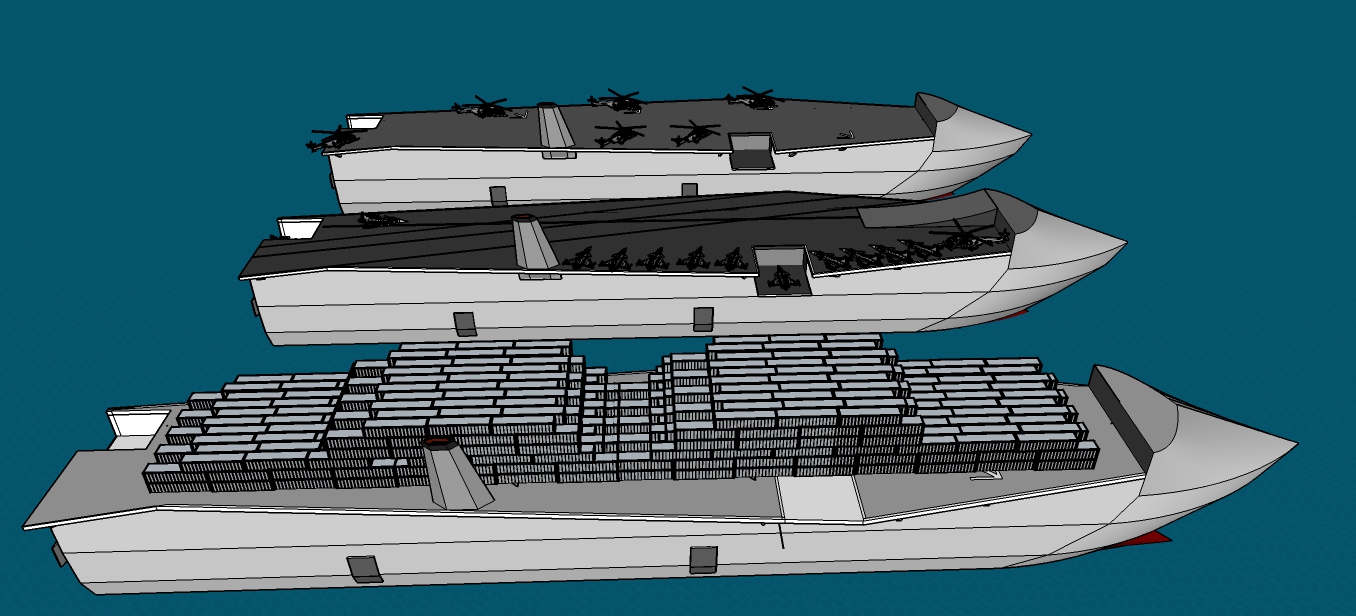
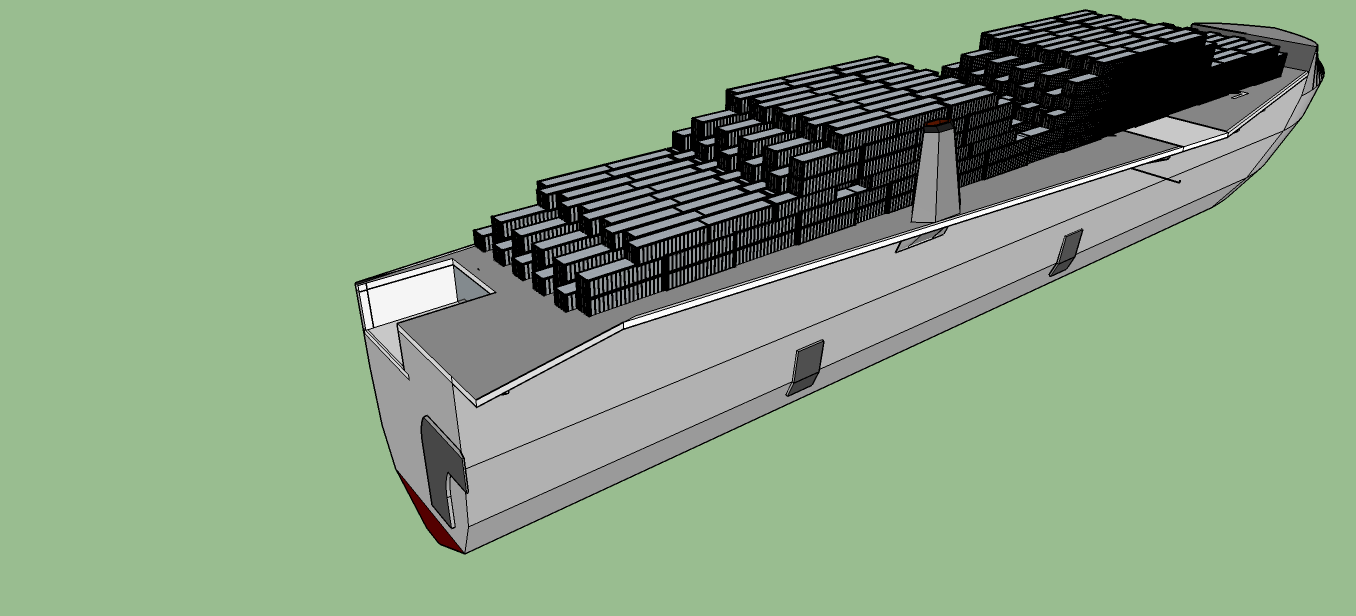
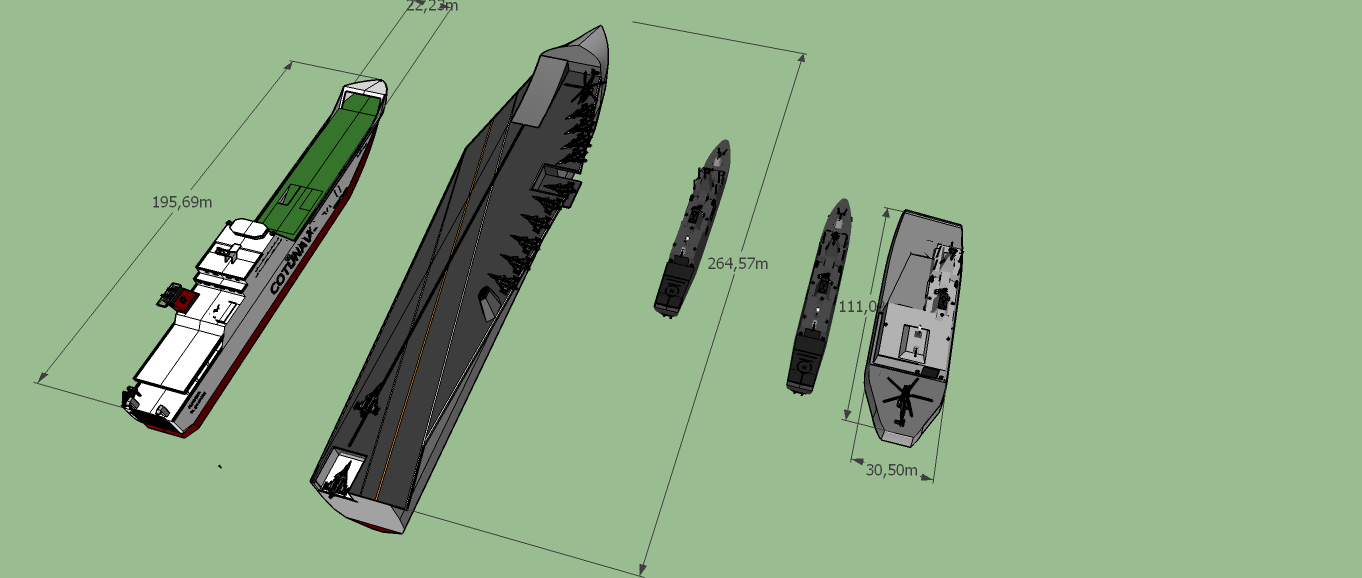
The bridge structure is located at the bow, which sits higher than the main deck. I simply didn't draw the windows—it’s an artistic concept rather than a refined design—based on the idea of commercial Ro-Ro vessels with designs adaptable for military use. It’s a very crude, simple concept intended to ensure extremely low costs and allow for the installation of SATS system kits. Basically, it’s a 45,000-ton, 265-meter steel "bathtub" capable of carrying aviation fuel and featuring a lower deck with two elevators... that’s it, nothing more... a way to disperse fighter jets at sea using a structure similar to the SATS concept used by the Marines on land.
 
Last edited:

Similar threads

Back
Top Bottom