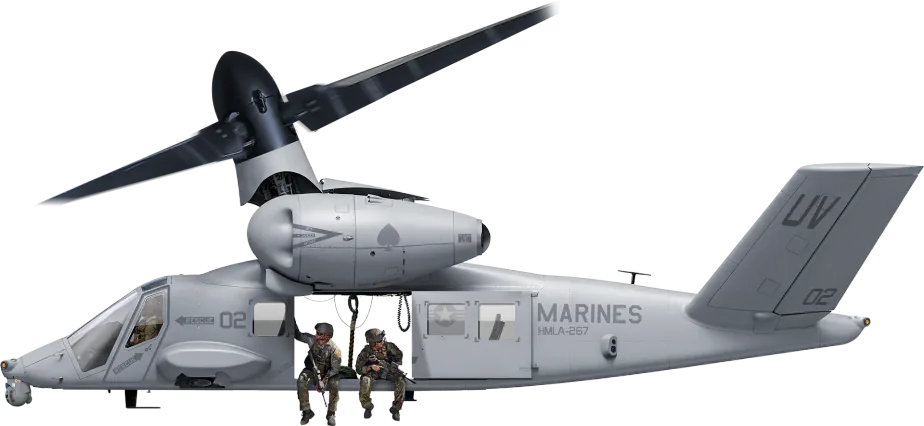
If a tiltrotor craft loses the entire rotation of one prop, regardless of distributed power, the craft flips over and... This has been known for decades.
Likewise, in extemis transition under fire is not conducive to natural pilot reaction, Pilots often have to mix fixed wing piloting reactions w/conflicting rotorcraft piloting instinctual reactions. Understand when that when the v-22 ingresses troops it hovers at longer distances forcing disgorged dismounts to walk drastic distances so the 22 an avoid groundfire potentials.
Downwash is horrendous and thus not complementary to low hover.
Famously the Chinook is faster than the Apache and am not sure how much a tiltrotor can really manuver. Speed can transmit as the appearance of higher maneuver ability, for those who belive that. Tiltrotors have speed & range, and an inability to operate in urban enviroments due to dowwash and landing zone diameter. Most future ops will need to occur in urban areas where a MH-6 best operates not a V-22.
That is an amazingly surprising statement.
The statement
"a tiltrotor craft loses the entire rotation of one prop, regardless of distributed power, the craft flips over and... This has been known for decades" indicates a lack of understanding of Bell Tiltrotor drive system architecture and the survivability benefits created by separation of engines. Like on the Chinook, the XV-15, V-22, and MV-75 both rotors are interconnected. Unlike the Chinook loss of the interconnect shaft in flight is not catastrophic. This is because by positioning the Tiltrotor engines adjacent to the rotors power to both rotors is maintained following interconnect shaft failure. In the event of loss of one engine from ballistic damage, the interconnect shaft maintains power to both rotors.
Having personally performed analysis for engine turbine burst aircraft survivability, having engines spaced as far as possible from each other is the ideal configuration. For military aircraft, the IR signature is reduced by a wide engine separation and a single IR missile is unlikely to impact both engines.
As far as the V-22 flipping over incidents documented in videos, none were directly due to loss of engine power. The earliest was due to a combined failure of reversed wiring and and a failed FCC. Another was due to an engine fire caused by a maintenance failure that was so severe it burned a section of the composite interconnect shaft. This led to the shaft in the fire zone being redesigned to Ti construction. Note, that this information has been known for decades ;-)
Regarding the comment "i
n extemis transition under fire is not conducive to natural pilot reaction, Pilots often have to mix fixed wing piloting reactions w/conflicting rotorcraft piloting instinctual reactions" . On both the V-22 and the AH-64 lifting off is controlled using similar cyclic, collective, and directional controls. Only when the V-22 has altitude is conversion into airplane mode performed and the transition is seamless using a thumb wheel switch on the collective. Don't believe me? Google actual V-22 pilot statements.
As far as getting out of a hot LZ as quickly as possible, the table below compare the the climb rates of the V-22 to the AH-64.
| Aircraft | Fully Loaded Climb Rate | Max Rate of Climb (Clean/Optimal) | Primary Factors Affecting Load |
|---|
| Bell Boeing V-22 Osprey | ~2,100 to 3,300 ft/min (10.6 to 16.8 m/s) depending on VTOL vs. Airplane mode | 4,000+ ft/min (20.3 m/s) | Up to 20,000 lbs of internal cargo or 24 combat-ready troops. |
| Boeing AH-64 Apache | ~800 to 990 ft/min (4.1 to 5.0 m/s) depending on weapon configuration | 2,500 to 2,800+ ft/min (12.7 to 14.2 m/s) | Heavy ordnance, such as 16 Hellfire missiles or 76 Hydra rockets. |
Regarding your statement "
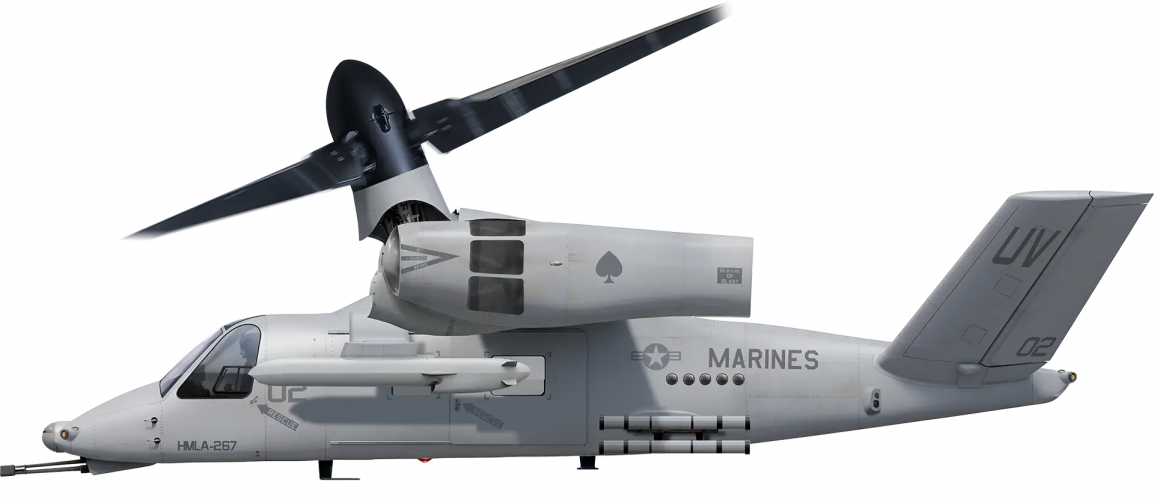
Understand when that when the v-22 ingresses troops it hovers at longer distances forcing disgorged dismounts to walk drastic distances so the 22 an avoid groundfire potentials. Downwash is horrendous and thus not complementary to low hover." The V-22 was not designed to replace the Blackhawk or perform the same missions, this is why Bell developed the V-280 Demonstrator to optimize a Tiltrotor for the Army needs. This is why the MV-75 has large sliding doors on both sides like the Blackhawk, engine pylons that don't rotate down to impede rapid troop ingress/egress. or block field of fire of door gunners. Finally, as Scott already stated, the MV-75 has much lower disc loading and down wash velocities versus the V-22.
Regarding the statement "
Famously the Chinook is faster than the Apache and am not sure how much a tiltrotor can really manuver. Speed can transmit as the appearance of higher maneuver ability, for those who belive that. Tiltrotors have speed & range, and an inability to operate in urban enviroments due to dowwash and landing zone diameter. Most future ops will need to occur in urban areas where a MH-6 best operates not a V-22"
The CH-47 has a max speed of 170 knots, versus the V-22 max speed of 275 knots.
The MV-75 is being designed to have low speed agility better than the Blackhawk it replaces. This agility was proven in flight testing of the V-280 Demonstrator.
View: https://www.youtube.com/watch?v=xRiZhCAmr6Y
The MH-6 has its mission, but it cannot perform the mission of Blackhawk or MV-75. Not sure why you even insert it into the conversation.