Modern Escort Carrier Hypothetical

Reddington777

ACCESS: Top Secret
Joined
23 March 2025
Messages
893
Reaction score
3,054
Reading the F/A-XX thread recently and the subject of fleet air wing mix came up. The navy wants the fleet air wing to be 60% unmanned aircraft for 2030. Existing fleet carriers are crammed as is and should primarily be for large sized UCAVs and manned fighters. Small to medium sized CCAs could be carried by something else - like a small escort carrier. With the advent of unmanned ships like the MUSV, and cargo ships with automated navigation systems, it's not too hard to imagine what a WWII escort carrier sized ship could be today. An escort carrier can operate alongside fleet carriers or perhaps in convoys alongside frigates.

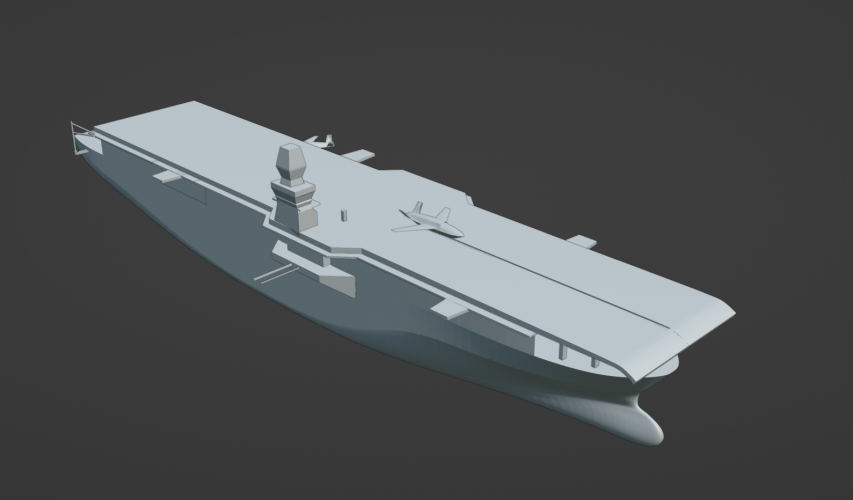
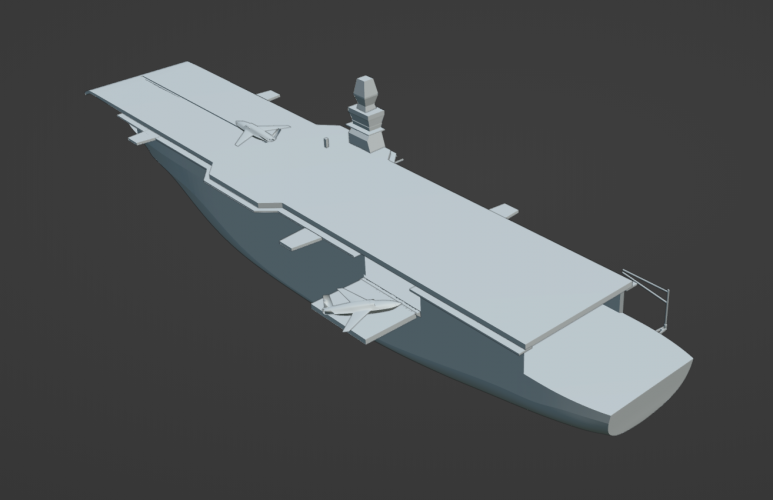
So going off that train of thought, I tried to come up with a modern take on an independence class escort carrier.

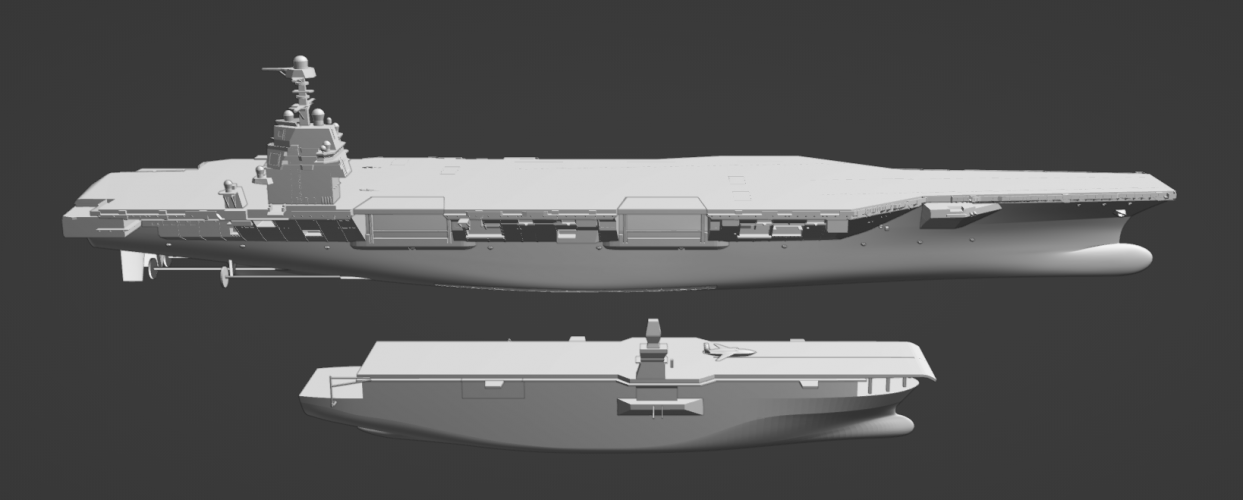
Ship wise, I did some tinkering in delftship with a basic container ship hull and got to a 15k ton container ship hull with a deck slapped on top. The hanger space is enough to probably handle 15 - 20 CCAs with an aft deck section for small drones and/or helicopters. Almost all the current CCAs today are actually smaller than WWII fighters though a little heavier. So I opted for a singular steam catapult (no thanks to Donald) to toss them. There can be two elevators - one on the rear aft and one in the center just behind the catapult. I have no idea whether there's enough space or not to actually recover them, but that may just require a larger cargo ship hull - maybe up to 20k tons displacement. As it stands, the deck length measures a meager 430 ft.

Armaments and sensors wise, I'm not sure what can be added. I think any sensors and defense systems added ought to be derived from self contained, off the shelf sensor systems. I put a small array on top of the island. Besides that, just two CIWS systems.

Another possibility is that the ship could also carry and refuel UUVs. Recently the navy refueld a UUV from a destroyer and the same idea could be applied here. Who builds it? No idea. Probably Hanwha because no one else can build cheap and on time. Ideally, someone could build the hulls and then the deck and island can get tacked on separately. The goal is to be as bare bones as possible.

1790971469325.png

1790971492764.png

Comparison to the Ford class carrier:

1790972325522.png
 
Last edited:
No. The politicians will insist they are "real" carriers and swap out CVNs for these. (Basically what you've got there is a Type 76.)
 
A type 76 is quite a bit larger. 800+ ft and much heavier sensors and armaments.

You dont need that much if you're just slinging small to medium CCAs.
 
Will do. My thinking was though that you can have more yards making these little guys. that ofcourse also depends on what the specs of the CCAs it wants to launch are

You buy the empty hull with diesel engines from South Korea or Japan, park it next to a crane pierside in your country, weld in the rest of the interior structure and install the equipment.

The U.S. has negligible shipyard production capacity. No warship design can get around that.
 
Will do. My thinking was though that you can have more yards making these little guys. that ofcourse also depends on what the specs of the CCAs it wants to launch are
The only yards in the US that do new construction of commercial ships this size are Philly and NASSCO, which can both build much larger ships. The Gulf Coast shipbuilders are mostly oriented towards the Offshore sector, so most aren't capable of much over 100 m.
You buy the empty hull with diesel engines from South Korea or Japan, park it next to a crane pierside in your country, weld in the rest of the interior structure and install the equipment.

The U.S. has negligible shipyard production capacity. No warship design can get around that.
The Aloha class container ships for Matson are roughly $350 million each, while a comparable ship from a South Korean yard would probably be around $75 million.
 
A type 76 is quite a bit larger. 800+ ft and much heavier sensors and armaments.

You dont need that much if you're just slinging small to medium CCAs.
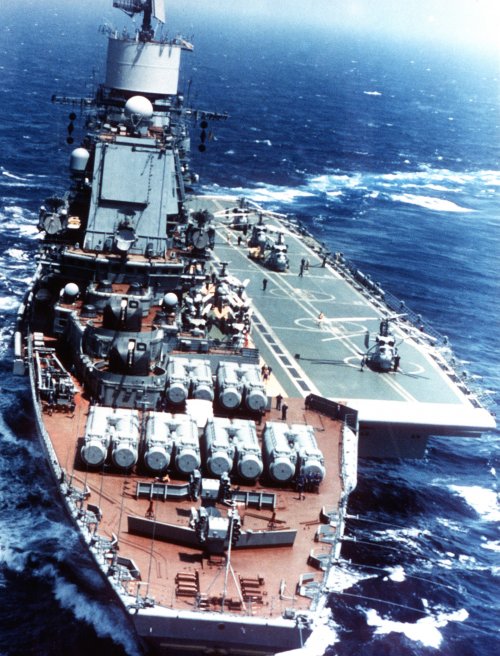
I'd convert those "battleships" the USN is talking about into Kiev-type carriers for CCAs, with a field of VLS up front.
 

Attachments

  • Carrier_Baku.jpg
    Carrier_Baku.jpg
    2.7 MB · Views: 22
I'd convert those "battleships" the USN is talking about into Kiev-type carriers for CCAs, with a field of VLS up front.
The BBG is designed around a 2,000 mile missile fight with CPS, SM-3, and GPI. CCAs can't do that kind of range, so they wouldn't play a role in that kind of battle.
 
The BBG is designed around a 2,000 mile missile fight with CPS, SM-3, and GPI. CCAs can't do that kind of range, so they wouldn't play a role in that kind of battle.
You're not going to be shooting at beaches. You might only be a few hundred miles out to sea so you can hit the interior.
 
You're not going to be shooting at beaches. You might only be a few hundred miles out to sea so you can hit the interior.
Just staying out of land-based DF-21 range will keep you more than a thousand miles from the beach. The CPS can reach 500 km into China when launched from Guam. Also, a 50,000 ton carrier-battleship hybrid is farther from an escort carrier than a nuclear-powered supercarrier.
 
A modern escort carrier would be more like a Marine Support ship with CPS built into the bridge side and VLS along the perimeter. One elevator for vehicles. A weapons elevator. At least space for one takeoff lane with a ramp. Parking for 3-4 with space left for simultaneous take off and landing. Less than 190 meter overall length and under 15k tons. Probable maximum speed under 25 knots.
 
What if some Arleigh Burke Flight 2A and Flight 3 destroyers got Shield AI X-Bat drones? One of the helicopters could be removed. In that same space one could fit 3 X-Bat drones. The ship could also pack 96 SDBs and 32 JATMs. The JATMs could be stored directly above the auxiliary machinery spaces and the aft main superstructure. A horizontal track could shunt them directly into the X-Bat hangar. The 96 SDBs are stored in mounts alongside one of the hangar's walls. Minor repairs can be done, but for anything more substantial X-Bat could use its massive range to fly to a naval base or onto an aircraft carrier or LHA.
 
Why would you assume they would? Did the USN stay out of range of Kamikaze in WW2? Did the USN stay out of range of Oscars and Backfires during the Cold War?
Why do they need to take that risk? Threat density increases exponentially as you get closer to the coast. You're talking about operating in an area where thousands of Chinese weapons can hit you. A CPS can hit Chengdu and Gansu from east of Tokyo. What targets is the Navy going to care about farther west than that? If they did want to hit something in Tibet or Xinjiang, the Bay of Bengal is closer and the Air Force would probably have a lot more fun. How did a discussion about drone-carrying escort carriers on a 15k ton civilian hull turn into a hybrid battleship with hypersonic missiles? An escort carrier could make sense for carrying light strike and maritime patrol drones, especially if they could also carry sonobuoys. A hybrid battleship does not, especially since it would never be escorting anything.
 
I've my doubts a 15t ship will do unless it's for light turboprops like the MQ9 and the like. Afaik the navy is looking for CUAV with 10klb external payload. MQ25 Stingray and RQ-4 Global Hawk will need at least 40t ships.

That said with what needs to get in and all related structures and all I think it will require almost as much design effort as a clean sheet design. The navy already has done a similar work with the USS Hector A. Cafferata Jr.

Imho requirements would be cruise speed 21kts; a range of ~23000 mn; max speed 25-27kts.
 
Why do they need to take that risk?
You might have to. I'd bet just in Ukraine they've shot more ATACMS than all the CPS/Dark Eagle missiles we will ever build. How many bombs have been dropped on Iran? (All PGMs of course.) You think we're going to buy that many 2000 mile range missiles? And if we did, what would we shoot them from?
 
You might have to.
Is that the best you can come up with? That's not even an answer. The BBG's entire job is to stand off with long-range missiles. There are no targets it would need to hit that require it to close with the coast, and even if it did, it wouldn't be using CCAs to do that. The stand-in naval force fighting in the Ryukyus and East China Sea is going to be either unmanned or underwater. Surface ships are not survivable there until the Chinese missile and air forces are destroyed, and a dozen CCAs with AMRAAMs are not going to protect you from DF-21s. I still fail to see what this unhinged distraction has to do with escort carriers.
 
The only yards in the US that do new construction of commercial ships this size are Philly and NASSCO, which can both build much larger ships. The Gulf Coast shipbuilders are mostly oriented towards the Offshore sector, so most aren't capable of much over 100 m.
Great Lakes shipyards.

Though it's unlikely they'd be very happy to work for the US government. Bad habit of changing designs in the middle of construction, and little pisses off builders more than ripping out work they just did.

Lakers are pretty big. There's a few over 1000ft long and 68,000tons (dimensional limits of the Soo Locks), though their lines tend to be pretty fat instead of the lean lines of a warship.
 
You buy the empty hull with diesel engines from South Korea or Japan, park it next to a crane pierside in your country, weld in the rest of the interior structure and install the equipment.

The U.S. has negligible shipyard production capacity. No warship design can get around that.
In the event if a war though, the logistics of dragging those hulls over the ocean to reach the US would be difficult.

The only yards in the US that do new construction of commercial ships this size are Philly and NASSCO, which can both build much larger ships.
The Aloha class container ships for Matson are roughly $350 million each, while a comparable ship from a South Korean yard would probably be around $75 million.
The other problem with a larger hull is obviously the cost and closely associated with that is what defensive and offensive systems would go on it.

If it is made more exquisite though, a larger hull certainly makes more sense. Like @Seragina said, it would allow larger CCAs too. It just wouldnt be a build-during-wartime ship. At that point it could be better to consider what other offensive functions it can also serve. Im curious about the equipment used on sub tenders. If you can fit that on, then it would really become a drone mothership capable of launching CCAs and UUVs.
 
Looking around the desired container ship sizes are 2000-5500 TEU examples:

https://www.knudehansen.com/wp-cont...-TEU-Bangkok-MaxContainer-Feeder-Vessel_t.pdf
https://www.knudehansen.com/wp-content/uploads/2017/10/2780-TEU-Container-Vessel-Open-Top-92028.pdf
https://www.knudehansen.com/wp-content/uploads/2017/10/5500-TEU-Container-Vessel-99407.pdf

These are in line with rules of thumb for their classes. So the problem that stick out to me is on the lower rung:
1. the possible below deck hangar volume & size won't be enough
2. top weight with a wide flight deck is going to be a concern. I'm looking at 40 m width.
3. all civilian ships have only one screw increasing stability concerns; no agressive maneuvering
4. slow

With these points in mind I think the best "light & cheap" hull offering a wide & large enough flight deck would be a catamaran design.
But not a typpical catamaran but more like russian project 23000.

Other important points to consider is that the number of catapults & lifts (aircraft & weapons) are the key metrics for carriers in the same sense of main cannons for battleships. In other words it's their DPS equivalent.
So to replace a fleet carrier the sum of aircrafts & catapults & lifts must be at least the same. For example instead of one Ford with 4+3 we need 2 ships with 2+2 (preferable 3+3).

Due to expected lack in facilities like say engine testing it might be necessary to have a larger sea base ship in the back line to provide the services missing.
 
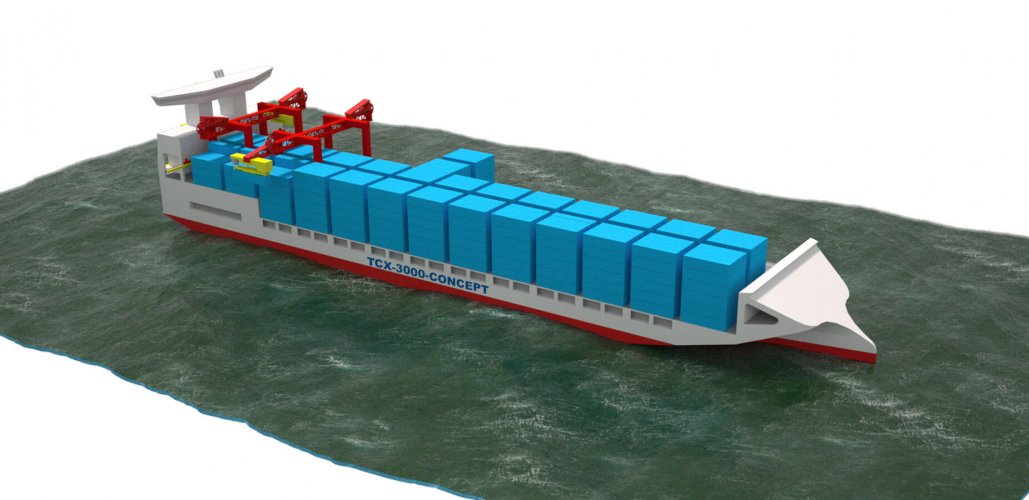
Knud E. Hansen had made a trimaran design that perfectly aligns:

https://www.knudehansen.com/news/pioneering-container-feeder-vessel-designs/

They didn't provide any specs but from the concept image and render
the main center hull is about ~2000 TEU class and overall beam is about 5000 TEU class.
I'm estimating the length to be about 204 m based on the 40' containers. The total loading capacity is 11*8*13+6*8*13=1768*2=3536 TEU, though.
Since we'll need more power anyway lengthening the hull would be desired.
In any case, 2 more screws could be added for better maneuverability.
This puts it in the 20-30kt class. With better stability the flight deck could be made wider. This puts it close to the Invincible class and a wing of about 30 drones. If 3 can be afforded to replace one fleet carrier that would be perfect.

Since it will have limited frigate escorts (AAW, ASW) that might be sunk it should have its own (ASW) USV and UUV onboard. Not sure if it should have a well deck, though.
 

Attachments

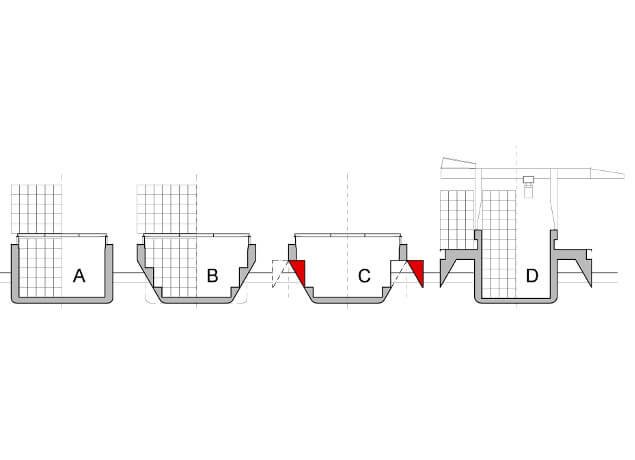
  • Evolution_of_Cross_Section_of_3800_TEU_Container_Vessel.jpg
    Evolution_of_Cross_Section_of_3800_TEU_Container_Vessel.jpg
    11.7 KB · Views: 13
  • TCX_3000_Concept_Trimeran.jpg
    TCX_3000_Concept_Trimeran.jpg
    158.8 KB · Views: 12
Last edited:
Robotics is the secret sauce to South Korean mass ship building. Unions are the problem for US builders.
 
Robotics is the secret sauce to South Korean mass ship building
South Korean yards are still primarily driven by human labor, not automation so idk what gave you that idea. Yes, it's true that this is shifting over time but it's certainly not the "secret sauce"
Unions are the problem for US builders.
God forbid shipyard workers want a competitive wage
 
God forbid shipyard workers want a competitive wage
Supply and demand should dictate that, not employees holding the company hostage to the point they destroy it. (Which they often do.)
 
Supply and demand should dictate that, not employees holding the company hostage to the point they destroy it. (Which they often do.)
That's certainly an take given the current, limited protectionist policies for yards are woefully insufficient. I too would advocate for a radically capitalist approach to sustaining critical national industry if I wanted it to entirely collapse.

It's often said that American shipyard capacity is insufficient yet shipbuilding is already a not awfully profitable industry and many aspects of the supply chain remain underfunded. That's supply and demand economics in action for the shipbuilding industry, that's an obviously dysfunctional system.
 
That's certainly an take given the current, limited protectionist policies for yards are woefully insufficient. I too would advocate for a radically capitalist approach to sustaining critical national industry if I wanted it to entirely collapse.

It's often said that American shipyard capacity is insufficient yet shipbuilding is already a not awfully profitable industry and many aspects of the supply chain remain underfunded. That's supply and demand economics in action for the shipbuilding industry, that's an obviously dysfunctional system.
That's not how that works. If you want to build your ship building industry (demand) then you're going to need to pay more to attract workers. Furthermore, it's going to have to be over a sustained period of time. If one administration dumps money into it and the next turns off the tap that's almost worse than doing nothing.

What you're suggesting is telling the builders they're going to get money whether they deliver or not, cuz, you know, we need 'em. And that's exactly how you get shit performance.
 
That's not how that works. If you want to build your ship building industry (demand) then you're going to need to pay more to attract workers. Furthermore, it's going to have to be over a sustained period of time. If one administration dumps money into it and the next turns off the tap that's almost worse than doing nothing.
I agree with this entirely but I’m confused how this is a Union problem exactly
 
I agree with this entirely but I’m confused how this is a Union problem exactly

Unions are the problem for US builders.
God forbid shipyard workers want a competitive wage"

If the wages weren't already competitive the employees wouldn't be there. Unions are never happy though because more wages mean more union dues. They're as bad as government when it comes to ever expanding taxes/dues.
 

Similar threads

Back
Top Bottom