(And all the other supporting bits, like CAD draftsmen etc)
Small unimportant note - modern programs no longer have "drafting" groups anymore. New programs don't even use physical or digital drawings, but rather all drawing notations, tolerances, PMI, etc. are all placed on the model itself in 3D. This is all done by the same engineers/designers that make the parts in CAD. Its easier for all parties involved, including the machinists who actually have to make the parts.

To your point, yes Boeing will be stretched thin in personnel. You can probably assume they're already planning/executing recruiting campaigns in Melbourne, Palmdale, and other locations of NG/LM to try and increase the engineer base instead of hiring within.
 
Small unimportant note - modern programs no longer have "drafting" groups anymore. New programs don't even use physical or digital drawings, but rather all drawing notations, tolerances, PMI, etc. are all placed on the model itself in 3D. This is all done by the same engineers/designers that make the parts in CAD. Its easier for all parties involved, including the machinists who actually have to make the parts.
I mean, it is really good that that is the case now.

Wasn't back when I was dealing with McBoing.


To your point, yes Boeing will be stretched thin in personnel. You can probably assume they're already planning/executing recruiting campaigns in Melbourne, Palmdale, and other locations of NG/LM to try and increase the engineer base instead of hiring within.
And I would expect at least a few people to be laid off from both NG and LM since they lost FAXX and NGAD to Boeing this round.
 
And I would expect at least a few people to be laid off from both NG and LM since they lost FAXX and NGAD to Boeing this round.
Definitely a possibility, but generally I think all three companies are generally pretty good at finding places for people when a program is lost. Might take 6-12 months to fully place people in permanent spots, but they'll do whatever it takes to retain talent. But without a doubt many from both will be looking at going to Boeing.

When Boeing-LM lost LRSB, Boeing was able to find spots for all the personnel that were on the program, as far as I was told.
 
I don’t want to go into speculation of red flag manipulation of aerospace related unions in certain states that are home to critical NATSEC manufacturing assets, but Boeing really needs to get its house in order in terms of labor relations, comp, HR, etc. strikes over the past few years are disconcerting and some derailed program timelines.
 
I don’t want to go into speculation of red flag manipulation of aerospace related unions in certain states that are home to critical NATSEC manufacturing assets, but Boeing really needs to get its house in order in terms of labor relations, comp, HR, etc. strikes over the past few years are disconcerting and some derailed program timelines.
Back when it was the Boeing employees union instead of the International Association of Machinists, the strikes derailing contracts happened every time production timelines were slipping and penalty clauses were about to kick in.

An observation of facts, not an unsupported statement that Boeing corporate pushed any given bargaining unit into striking to allow Corporate to claim force-majeure on delivery to avoid penalties.
 
Arent most AESA main arrays capable of doing this already?

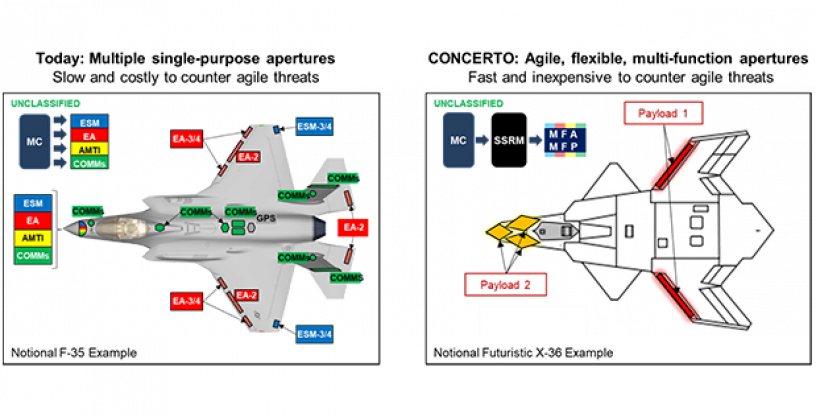
They pretty much want everything on the plane thats got a piece of RF antenna on it to be multifunctional and usable for target tracking.

No, unfortunately, and the capabilities of certain AESA radars have been.... overstated. There is one family of radars that for a while seemed to be getting some magical new capability every few months, at least according to the press and the internet (these claims were not based in facts). It's a radar, it's a jammer, it's a HPM DEW, etc.
 
There is one family of radars that for a while seemed to be getting some magical new capability every few months, at least according to the press and the internet (these claims were not based in facts). It's a radar, it's a jammer, it's a HPM DEW, etc.
F-35's radar if I had to guess. Second guess is either some GBAD radar or MAWS.

It sounds like this could enable side facing antennas to help perform targeting, but I am curious how useful those other arrays are.

Say the main radar acquired a lock, does it take significantly less power to be able to hold that lock using a smaller array / antenna? And would FOV and power of these smaller antennas even be useful at acquiring targets alone?

The genetic algorithms and reinforment learning used for resource management and scheduling can decide for the plane the right amount of power and priority to maintain tracks and that seems to imply it takes much less resources to maintain tracks than it does to acquire them.

Altogether really fascinating. learned a little of genetic algorithms in school and never thought theyd be used here.
 
Im guessing the FAXX is a naval variant of the F-47.

LMCO is loaded up on F-35, and trying to gain a CCA footing with Vectis.

NG is loaded up on B-21 and working Talon Blue.
 
Im guessing the FAXX is a naval variant of the F-47.

LMCO is loaded up on F-35, and trying to gain a CCA footing with Vectis.

NG is loaded up on B-21 and working Talon Blue.

Not exactly a variant but more so they both have a common ancestor(s) that heavily influenced their designs.
 
Arent most AESA main arrays capable of doing this already?

They pretty much want everything on the plane thats got a piece of RF antenna on it to be multifunctional and usable for target tracking.
Nope, only very few. AESA being physically capable of something is just a starting point, especially since most of AESAs in service are still direct roll-ons onto available back-end and architecture.
 
Sailors don’t want a land‑based aircraft. What problems? Build a carrier-based fighter and use it on the ground as well, just as was done with the F‑18. In this case, the logic behind Boeing’s victory is quite clear.
 
Yeah, I think the problem is that the US went all in on stealth. The idea was that AESA can do LPI and has less noise on both transmit and receive sides, and the doctrine idea was that the higher SNR and massively higher RCS of an enemy 4th gen would allow something like the F-22/35 to detect and engage planes without being engaged themselves.

Unfortunately enemy stealth planes have appeared, and detection mechanisms, as well as signal processing has developed to the degree, that this 'safe engagement range' has shrunk massively, and the practicality of the approach has become questionable.

Which meant that you need to fall back to higher transmit powers. And there lies AESA's massive weakness, that solid state transmitters are inherently less powerful and less efficient than TWT/Klystron based designs, and dealing with waste heat seems to be even more of a challenge on stealth aircraft.

Needless to say, a 0.01sqm jet cranking out 80kW of power is not exactly inconspicuous, which kind of defeats the purpose of the whole thing.

In practical terms, the Block 4 upgrade for the F35 shows the issue with AESA - the APG-85 needs way more power and especially cooling than available, making it dependent on the engine upgrade which is slated for 2031 at the earliest. Add a few years of 'Locheed time', I think it's plausible that the F35 Block 4 and F-47 entry's going to be only a few years apart, with the Chinese getting ahead of both.
 
I don’t know man, look at what we got with F-35. I can see them pulling that again.
Given what had happened with the Joint Strike Fighter Program, that is not likely to happen now. The USAF and US Navy have very different requirements for their Sixth-Generation fighters, if anything, the common ancestry would be more on the technology and capabilities side of things. The design, missions, and everything else is not gonna be the same
 
Sailors don’t want a land‑based aircraft. What problems? Build a carrier-based fighter and use it on the ground as well, just as was done with the F‑18. In this case, the logic behind Boeing’s victory is quite clear.
The F-18 was a land-based fighter (YF-17) made into a navy plane.
 
Sailors don’t want a land‑based aircraft. What problems? Build a carrier-based fighter and use it on the ground as well, just as was done with the F‑18. In this case, the logic behind Boeing’s victory is quite clear.
That's not really how either the Su-33(J-15) or Mig-29K were built and by all accounts they are excellent.
 
Americans have their own national madness. Despite the presence of serious internal contradictions and a growing national debt, the government is initiating the development and implementation of two identical programs that require significant financial investments. The Navy doesn’t need a fighter jet shared with the Air Force; give it an original one. These imperial ambitions will lead nowhere good; times have changed.
 
The Su-57 has a minimum runway length between 300-400m, it's rumored that this figure gets under <300m with second stage engines. This is literally shorter than the runway of a Ford-class. If you can do that, you can skip the reinforcements and strengthening you need for tailhooks and cats. I think it's highly plausible that you could operate a jet like that from an aircraft carrier with little modification.
 
The Su-57 has a minimum runway length between 300-400m, it's rumored that this figure gets under <300m with second stage engines. This is literally shorter than the runway of a Ford-class. If you can do that, you can skip the reinforcements and strengthening you need for tailhooks and cats. I think it's highly plausible that you could operate a jet like that from an aircraft carrier with little modification.
But surely this mean minimal fuel and payload, so it won't be of any practical use in this configuration.
 
I don’t know man, look at what we got with F-35. I can see them pulling that again.
implementation of two identical programs that require significant financial investments. The Navy doesn’t need a fighter jet shared with the Air Force; give it an original one.
No. The two programs were concieved of for different mission sets since the very beginning, and set out programmatically from the very start to avoid the same issues with the F-35 program.

The breadcrumb trail going back ten years has been consistent and unchanging. They are not identical programs. They are not identical planes. They are not even variants in the way F-35s are (F-35s at least share a mission set). They may look somewhat similar, they may share a ton of internal systems, but thats about it.

If you want to call it a variant, then we must explain how we plan on landing said air force aircraft in at most half of the deck length (notably less than 300m. 1092ft is the entire length of the carrier. Even the slanted runway itself isnt long enough) of the carrier deck when its pitching unpredictability in rough seas. Then explain how we reconcile the air intake flows of two different engine types. And then walk back and explain away every single HASC report, every press release, every talking head reporting the same message for the past 10 years contradicting this very notion. Maybe if it was just american government officials lying to the public (because as we all know only americans have problems) then fine. But a whole host of problems of which these three arent even the most prominent? Doubtful.

Unless there are ways to explain it all away, at this point its just creating an argument for the sake of outrage. The topic has been talked to death at this point. Shoulda just make a copy pasta for it.
 
Last edited:

Similar threads

Back
Top Bottom