Yes, though it's very long in this case.

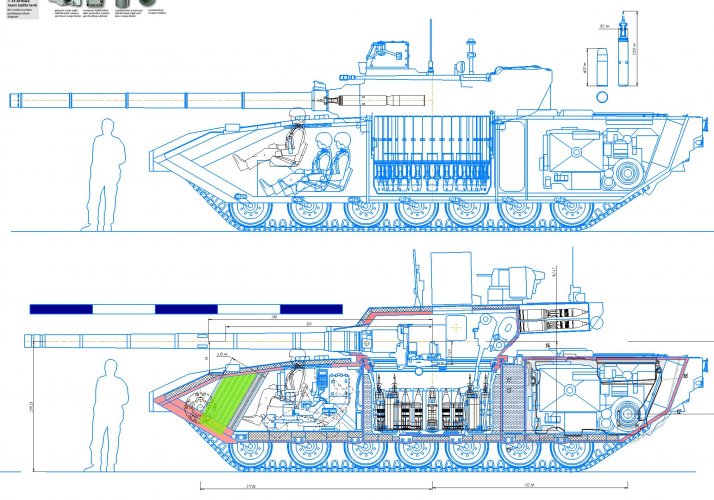
Also - as far as I understand, illustration shows an early concept of autoloader, where shells are in carousel, and charges come exclusively from the bustle.
Real tank is simpler.
Uh, no?
Bustle is for storing additional non-automated ammo outside of the hull. Like in T-90M. No loader.
Autoloader has it's own places for charges, look closely - each cassette consists of two cylinders. Like T-72 cassette, only turned 90 deg vertically.
 
Uh, no?
Bustle is for storing additional non-automated ammo outside of the hull. Like in T-90M. No loader.
Autoloader has it's own places for charges, look closely - each cassette consists of two cylinders. Like T-72 cassette, only turned 90 deg vertically.
Exactly. And then use AI translation at illustration. :)
It's a different autoloader.
 
Last edited:
Zvezda TV channel, owned by the Ministry of Defense of the Russian Federation, reports:
Rostec has modified the Russian T-14 Armata tank to the level of a short-range anti-aircraft missile system.

The Armata was equipped with the latest domestically produced electronic equipment, as well as a next-generation fire control system.

The 125-millimeter gun became a 152-millimeter smoothbore gun with a chrome-plated barrel, which will allow the T-14 to be armed with Kornet anti-tank guided missiles with a combat range of up to 10,000 meters.

The vehicle will also receive the latest artillery shell of the Krasnopol family with a bottom gas generator and a satellite navigation system. This will allow the T-14 to perform the functions of a short-range air defense system.

In addition to the Pterodactyl UAV, the vehicle will receive an additional type of onboard drone that will allow reconnaissance and targeting of precision-guided munitions at long distances.

The carried ammunition load is now designed for 40 shells, 24 of which will be in the autoloader.

The new version of the tank will have the ability to use modern ammunition longer than 1 meter. Among them are specially developed intelligent high-explosive fragmentation and thermobaric shells with remote detonation.

Rostec is also working on an unmanned version of the T-14.

Btvt.info: I thought it was another set of tall tales to go with vodka, but nevertheless this is being reported by the mouthpiece of the Russian defense industry. Are they really, after all this, trying to feed this rotten noodles on shit to the suckers? They want to carve up money on this rotten project for at least another century.
"Kornet," they probably mean this - t.me/btvt2019/16748 (Sprinter)
152 mm gun, some kind of meter-long munitions there - the old noodles on the ears from a bygone era, when they measured the length of APFSDS and gun calibers.
To the level of a short-range anti-aircraft missile system - some kind of clinic in the style of a radar on the Armata seeing satellites. I thought that in order to avoid being jailed for this pathetic disgrace and embezzlement, they would try to flash by and mention the Armata as little as possible, maybe people would forget, but no - they will carve up money all over again.

View: https://x.com/AndreiBtvt/status/2105300727497097646

 
Meter long munitions, larger main weapon & short range AAMs should not be discounted. Expensive propositions regardless.
 
A quarter of the Armata's were originally planned to have fairly capable radars, right? I always suspected that they might try to create a barrel launched anti-helicopter munition.

152mm gives enough volume to maintain terminal effects while having enough room for a guidance/control package... which allows it to be used in an indirect fire role... especially when paired with a drone - and thus keep its distance.

This move makes a lot of sense as an attempt to save the program.

You end up with a more mobile artillery piece that has more onboard sensors and armour than is typical. I'm still a bit sceptical about the price and the lack of drone defence though. But on face value, the moves would be logical if one wanted to save the platform.
 
The 125-millimeter gun became a 152-millimeter smoothbore gun with a chrome-plated barrel, which will allow the T-14 to be armed with Kornet anti-tank guided missiles with a combat range of up to 10,000 meters.

The vehicle will also receive the latest artillery shell of the Krasnopol family with a bottom gas generator and a satellite navigation system. This will allow the T-14 to perform the functions of a short-range air defense system.

It would make it more suited for the modern battlefield to be honest, where the main purpose of a tank is assault and besieging dug in and otherwise fortified positions while providing cover, protection and binding response fire.

152mm would lend itself perfectly for that role. This and the unmanned/optionally manned proposition (which has been mentioned since it's inception) are certainly reminiscent of the Shturm concept.

It's also along the lines what many, myself included, suspected. That the T-14 is going through a major overhaul in order to better meet the realities of modern warfare, something legacy tanks like the T-72, Leopard 2, M1 or Challenger fail to acknowledge entirely due to being designed around outdated doctrine from decades ago.

Fill that unmanned turret up with HE, Canister, smoke and incendiary rounds and we got something that's suited for what a tank in Europe is supposed to do, which isn't anti-tank related whatsoever (I don't see much of a future for long, high caliber AT guns on AFVs tbh).
 
Change of caliber tho means new turret and that can also means new tank. Which kinda make it hard to believe.
The idea of integrating a 152mm gun into the tank existed from the outset and has been readily advertised (I think UVZ themselves talked about it during Army-2018). Similar to how advanced Leopard concepts tend to also advertise 130mm or 140mm guns as options for up-gunning the vehicle in the future. It's neither particularly exotic nor unheard of. Reminder, the M1 went from 105mm to 120mm as well, so up-gunning doesn't exclusive exists for expos and brochures either. It's just a comparatively rare occurrence these days.
 
All these reported changes are pure nonsense from a practical PoV.
The 125mm is objectively better than the 152mm. The Kornet is an outdated missile that is going to severely limit the T-14's core capabilities. And giving Krasnopols to a T-14 instead of an SPH is lunacy. They should instead focus on making 152mm howitzers which they are sorely lacking, instead of this thing.

I agree with BTVT on this one. Sounds less like an actual combat-oriented platform and more like an embezzlement project.
 
Such a cannon has existed for a long time

it was Ob-195 tho a different tank. Now are UVZ going to remake it ?

The idea of integrating a 152mm gun into the tank existed from the outset and has been readily advertised (I think UVZ themselves talked about it during Army-2018). Similar to how advanced Leopard concepts tend to also advertise 130mm or 140mm guns as options for up-gunning the vehicle in the future. It's neither particularly exotic nor unheard of. Reminder, the M1 went from 105mm to 120mm as well, so up-gunning doesn't exclusive exists for expos and brochures either. It's just a comparatively rare occurrence these days.

and there are reasons why its rare or its on New tank altogether with all the new features, while those "upgunned" articles remain experimental vehicle. Like Ob-292 exist but you see it never went into service. Leopard-2 140 mm ? Exist in supposedly both German and Switzerland, remain experimental. French leclerc 140mm ? Experimental only, 195 ? Experimental. 477 both Molot and Nota are experimental only and they are entirely new design too.

it's just not that simple really.
 
it's just not that simple really.
Where did I say it is? I just remarked that the people who developed the tank developed it from the start with the option of accepting a bigger main armament. I also pointed out that the M1 is a real world example of a tank that went from a smaller to a bigger caliber in service (as did many WW2 and immediate post-war tanks). It's just that especially with western tanks which lack autoloaders for the most part, switching from 120mm to 140mm would require the development and integration of a new autoloading system. While the T-14 was developed from the beginning to be able to utilize a 152mm main armament with minimal modifications to the loading system. And the Russians were not the only ones doing that, every new western tank concept with an autoloader shown at various expos like Eurosatory now offers the option to "up-gunning with minimal changes", because these also feature unmanned (or minimally manned) turrets with autoloaders.

Thus Leopard 2 with 140mm or Obj. 292 are not really comparable to Leopard ARC 3.0 or T-14.
 
The 125mm is objectively better than the 152mm.
Better for what? Because when it comes to kinetic effect against structures and fortifications 152mm packs significantly more punch, giving the vehicle the ability to destroy targets and severely damage them with a single shot when there would be two shots needed with 125mm.

They should instead focus on making 152mm howitzers which they are sorely lacking
They have several hundreds of 2S3, 2A65, a couple hundred 2S5 and 2A36 as well as several hundred 2S19. They have more 152mm howitzers in select formations than many countries have 155mm or 152mm howitzers overall. With 2S19 in particular being in active production, receiving steady improvements to it's systems and ammunition and 2S35 in LRIP and 2S43 seeing active deployment.

I don't know in which reality one has to live to think that Russia of all places is "sorely lacking" 152mm howitzers when their total active fleet of such systems is virtually larger than that anyone else and vastly larger than almost all 155mm artillery inventories excluding some exceptions (looks at east asia). And the fact that this inventory is also growing is definitely not indicative of some shortage on that specific front.

Given that tanks are mostly utilized in demolition, assault and have also engaged in indirect fire, 152mm as a caliber lends itself perfectly for that picture that has been painted in the last 4 years of war. Pursuing the T-14 like it's still 2015, as do the comparable vehicles at KNDS, Rheinmetall, General Dynamics and BAE, would be blind to how the actual battlefield is and wouldn't acknowledge the needs of troops on the frontline. It would be developing a tank for 1976 in 2026. And at that point you might as well axe everything and go back to the cold war stock entirely.
 
Better for what? Because when it comes to kinetic effect against structures and fortifications 152mm packs significantly more punch, giving the vehicle the ability to destroy targets and severely damage them with a single shot when there would be two shots needed with 125mm.
Kinetic energy isn't deficient in HE-MP munitions in the 120-125mm range.
Old shells may indeed take 2-3 shots to do what a single modern HE-MP does. That was achieved by installing a delayed impact fuze, with no increase of caliber necessary.

They have several hundreds of 2S3, 2A65, a couple hundred 2S5 and 2A36 as well as several hundred 2S19. They have more 152mm howitzers in select formations than many countries have 155mm or 152mm howitzers overall. With 2S19 in particular being in active production, receiving steady improvements to it's systems and ammunition and 2S35 in LRIP and 2S43 seeing active deployment.
Oh, okay so they don't need a tank to also carry a 152mm then.

I don't know in which reality one has to live to think that Russia of all places is "sorely lacking" 152mm howitzers when their total active fleet of such systems is virtually larger than that anyone else and vastly larger than almost all 155mm artillery inventories excluding some exceptions (looks at east asia). And the fact that this inventory is also growing is definitely not indicative of some shortage on that specific front.
Russia is burning through more barrels than it can manufacture. Its burn rate is 4 digits, and its manufacturing rate is 3 digits.

Given that tanks are mostly utilized in demolition, assault and have also engaged in indirect fire, 152mm as a caliber lends itself perfectly for that picture that has been painted in the last 4 years of war.
If it's a short barrel howitzer - yes.
If it's a long smoothbore - no.
 
While the T-14 was developed from the beginning to be able to utilize a 152mm main armament with minimal modifications to the loading system.

Why they didnt start with 152mm in the first place then ? and its not just loading system. The gun too like Ob-195 use 2A83 gun and subsequently, stabilization, optics, recoil systems all have to change. It will be at least a new turret.
 
The 152mm smoothbore gun designs the Soviets/Russians have toyed with previously are high-velocity cannons with the core purpose of firing APFSDS to defeat next-gen NATO main battle tanks. Yes, it can fire other shell types, but it was built to fire KE projectiles with such energy to punch through the front armor of any tank in front of it. If you're designing a tank gun with the primary purpose of lobbing HE and other projectiles at targets that are usually not tanks, it is sensible to sacrifice some muzzle velocity to allow for a lighter more-compact weapon and ammunition. Gun-launched ATGMs could still provide this with a powerful anti-armor capability. Basically, a modern version of the 152mm guns on the M551 and MBT-70. With today's tech the concept seems a pretty good one. I don't know if the Russian 152mm gun being discussed is something new that takes such an approach, or if it's the same high-velocity gun from before.

There is a still a lot to be said for the high-velocity method which is why everyone went that direction for tanks. When you encounter an enemy AFV in typical LOS engagement distances APFSDS is usually your best response. A higher velocity for HEAT and other shell types is also beneficial for dealing with moving targets.
 
Kinetic energy isn't deficient in HE-MP munitions in the 120-125mm range.
Old shells may indeed take 2-3 shots to do what a single modern HE-MP does. That was achieved by installing a delayed impact fuze, with no increase of caliber necessary.
152mm still holds more explosive material, thus it's effect on target is significant, delayed fuze or not.


Oh, okay so they don't need a tank to also carry a 152mm then.
They do if they perceive the need for it. Otherwise you're suggesting they should use SPGs as tanks and use 2S19 in direct fire missions. I think you see why a tank with similar firepower might be more suited to fill the needs (which I partially outlined earlier).

Russia is burning through more barrels than it can manufacture. Its burn rate is 4 digits, and its manufacturing rate is 3 digits.
Russia is nowhere near burning through thousands of barrels to a point where it's a problem. Because they produce new barrels, they can leverage storage and existing spares and the immense proliferation of drones on an unprecedented scale has taken a massive burden from artillery. Which is still extensively used, but strike drones complement artillery in a huge scale. Which reduces attrition of critical components.

Why they didnt start with 152mm in the first place then?
Because the 125mm main armament was deemed sufficient for the time it was developed in and tested, meaning the early 2000s and 2010s. Why their view might've changed and why they feel a need to adapt to a new style of warfare should be self explanatory.
 
Back
Top Bottom