Wasserfall antiaircraft rocket

Wire Guidance for Anti-Aircraft Missiles
(Drahtsteuerung für Flakraketen)

March 28, 1944
Wire guidance for the "Schmetterling" missile was rejected due to unfavorable increases in drag and excessive weight. Since the "Wasserfall" missile reaches supersonic speed; the high speed at which the guidance wire would have to be unreeled cannot be managed—at least not at the present time. The "Rheintochter" anti-aircraft missile is unsuitable for wire guidance due to its shape and thin fins. Wire guidance appears feasible only for the "Enzian" anti-aircraft missile, as it possessed a significant weight margin.


Source: Bundesarchiv
Signatur: RL 3/28; Page: 64 - 66
Direct Link:
https://invenio.bundesarchiv.de/invenio/direktlink/21911449-a6e7-4a60-9379-76a2b1733c7a/
 
Wire Guidance for Anti-Aircraft Missiles
(Drahtsteuerung für Flakraketen)

March 28, 1944
Wire guidance for the "Schmetterling" missile was rejected due to unfavorable increases in drag and excessive weight. Since the "Wasserfall" missile reaches supersonic speed; the high speed at which the guidance wire would have to be unreeled cannot be managed—at least not at the present time. The "Rheintochter" anti-aircraft missile is unsuitable for wire guidance due to its shape and thin fins. Wire guidance appears feasible only for the "Enzian" anti-aircraft missile, as it possessed a significant weight margin.


Source: Bundesarchiv
Signatur: RL 3/28; Page: 64 - 66
Direct Link:
https://invenio.bundesarchiv.de/invenio/direktlink/21911449-a6e7-4a60-9379-76a2b1733c7a/
Just another example of how paranoid the Germans had become about Allied jamming and electronic warfare. Could you imagine trying to send signals over a thin, presumably steel, wire 10+ kilometers long trailing behind a missile at 10,000 meters in the air?
 
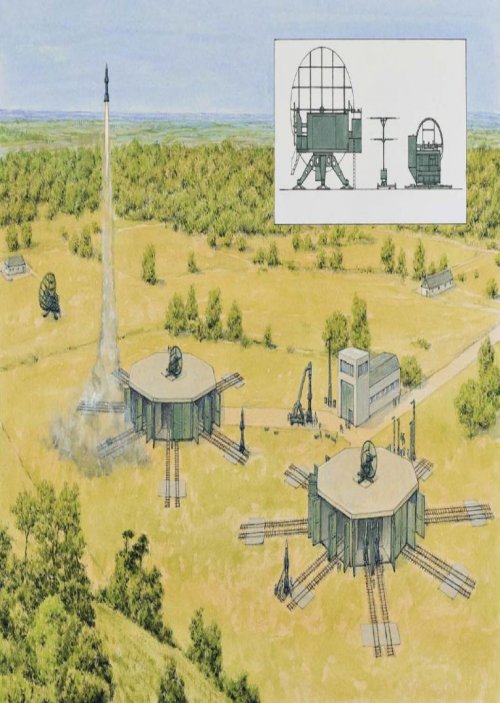
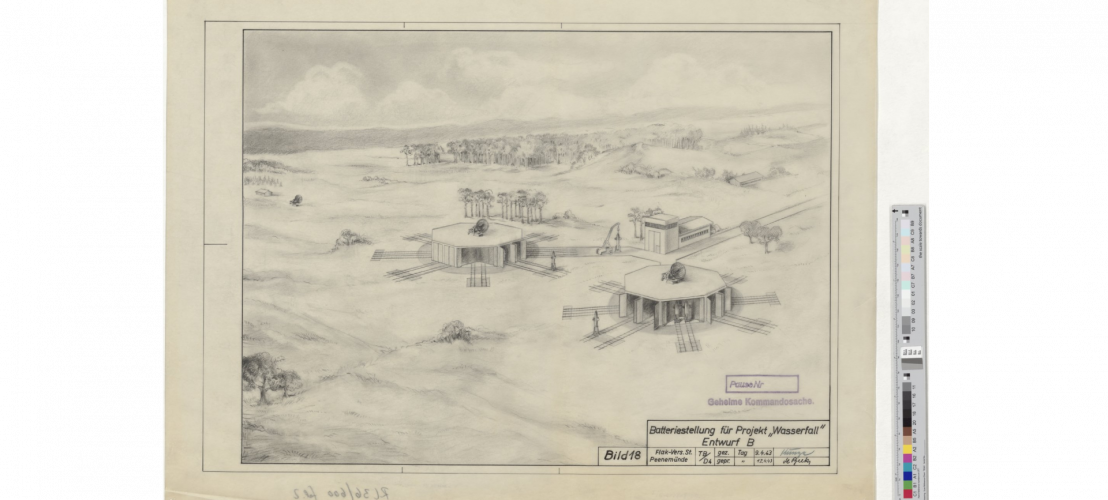
Hello foks, I came across the Wasserfall Flak Missile Battery Site, Proposal B, on Pinterest.
Is this image and proposal genuine or merely a work of imagination?
Does anyone know the original source, such as the book and the artist?
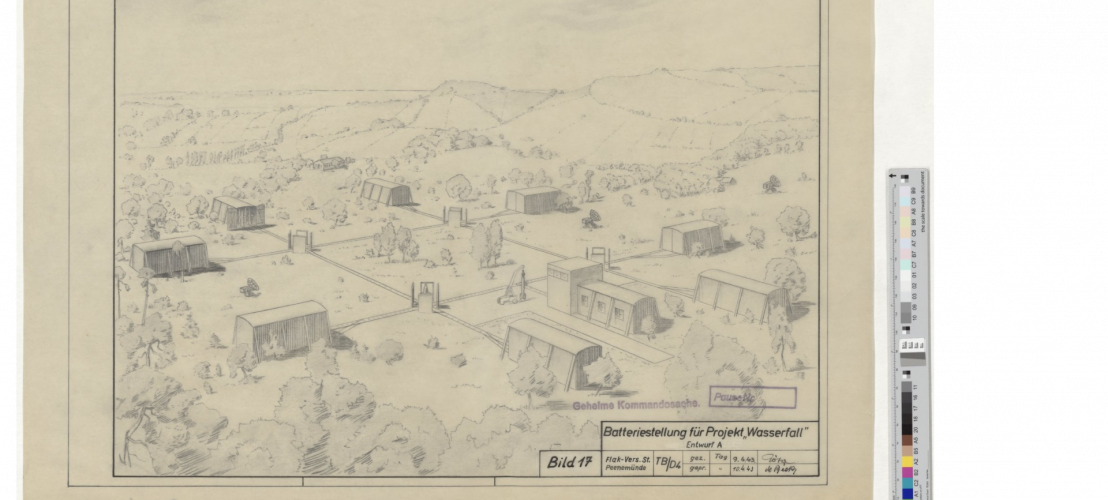
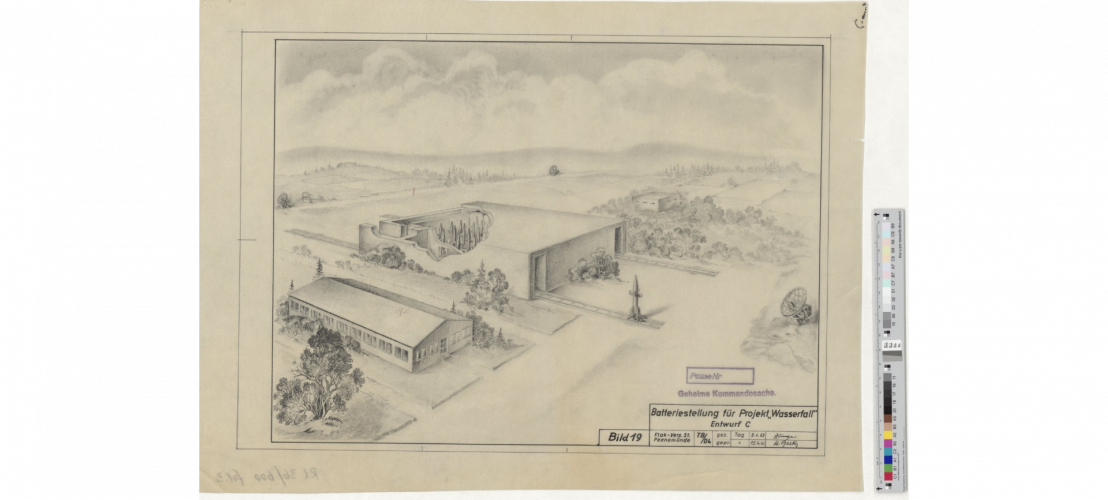
Wasserfall Flak Missile Battery Site, Proposal B – a glimpse of the future. As conventional Flak became less effective, the Luftwaffe developed its first-generation Flak missiles, with the Wasserfall C2 (“Waterfall”) being the most advanced. The first two batteries were expected to be operational by late 1945, with around 300 more planned by the end of 1946. In April 1943, three battery emplacement designs were proposed, ranging from a basic site with unprotected hangars (Entwurf A, “Proposal A”) to more complex arrangements.
Source:
View: https://de.pinterest.com/pin/470415123596084644/
 

Attachments

  • WASSERFALL FLAK MISSILE BATTERY SITE,PROPOSAL B.jpg
    WASSERFALL FLAK MISSILE BATTERY SITE,PROPOSAL B.jpg
    133.6 KB · Views: 53
Hello foks, I came across the Wasserfall Flak Missile Battery Site, Proposal B, on Pinterest.
Is this image and proposal genuine or merely a work of imagination?
Does anyone know the original source, such as the book and the artist?

Source:
View: https://de.pinterest.com/pin/470415123596084644/
Well, the radar siting is definitely wrong. Those need to be about 1 to 2 km from the missile launch positions faced closer to the expected direction of engagement or behind the launch site so the launchers and target are in the line of sight of the radars. This is because their minimum range is about that and you want to begin tracking and guiding the missile as early as possible in its flight.

For the target tracking radar, having it closer to the direction of the target gives you more time to locate and begin tracking it.

That distance is necessary because the radar would be running at 50 cm (Würtzberg or Mannheim). If you had 10 cm or 3 cm radar, which the Germans were just barely beginning to get in minimal production when the war ended, they could be placed a bit closer to the launchers.
 
Hello foks, I came across the Wasserfall Flak Missile Battery Site, Proposal B, on Pinterest.
Is this image and proposal genuine or merely a work of imagination?
Looks more like the artist attempts to extrapolate how "Wasserfall" facility was supposed to look, from the typical pattern of 1950s-1960s SAM sites (most of them usually have missile guidance radar in center, surrounded by ring of launchers). Anyway, the launchers on the picture are placed far too close both to radar and to each other.

IRRC, Wasserfall required about 200-500 meters separation between radar position and missile launcher.
 
Hello foks, I came across the Wasserfall Flak Missile Battery Site, Proposal B, on Pinterest.
Is this image and proposal genuine or merely a work of imagination?
Does anyone know the original source, such as the book and the artist?

Source:
View: https://de.pinterest.com/pin/470415123596084644/
Pretty sure that picture is in the Osprey book on German Guided Missiles of WW2 - https://www.ospreypublishing.com/uk/german-guided-missiles-of-world-war-ii-9781472831798/, which means the artist is probably Jim Laurier
 
Looks more like the artist attempts to extrapolate how "Wasserfall" facility was supposed to look, from the typical pattern of 1950s-1960s SAM sites (most of them usually have missile guidance radar in center, surrounded by ring of launchers). Anyway, the launchers on the picture are placed far too close both to radar and to each other.

IRRC, Wasserfall required about 200-500 meters separation between radar position and missile launcher.
That would leave the missile untracked for something like 5 to 10 km of its flight depending on whether Würzburg or Würzburg Reise was being used. Both have minimum ranges on the scale of kilometers. This is why they needed to be several kilometers from the firing site. The other issue was they had a poor angular resolution of about 1.5 mil at best, and depending on the operator, usually worse than that.
 
Pretty sure that picture is in the Osprey book on German Guided Missiles of WW2 - https://www.ospreypublishing.com/uk/german-guided-missiles-of-world-war-ii-9781472831798/, which means the artist is probably Jim Laurier
If that's the source, I wouldn't trust the graphics. There's also a picture in that book of what a Schmetterling site would look like. It is completely wrong. The missiles are on the early fixed launch stands used in testing, not the intended operational launcher. The missiles themselves are also identifiable as very early prototypes, not operational ones. The fire controls in the background are equally imaginary in design.
 
That would leave the missile untracked for something like 5 to 10 km of its flight depending on whether Würzburg or Würzburg Reise was being used. Both have minimum ranges on the scale of kilometers. This is why they needed to be several kilometers from the firing site. The other issue was they had a poor angular resolution of about 1.5 mil at best, and depending on the operator, usually worse than that.
Weren't they planned to use manual guidance to put missile into the radar beam?
 
Weren't they planned to use manual guidance to put missile into the radar beam?
There were the usual proposals to use MCLOS for guidance with a rotating two-chair optical system that translated the movement of the device in rotation and elevation into control commands, and for using radar with or without MCLOS. It was all rather vague and nothing really solid had been put into place by the end of the war.

The best answer I could come up with is that Rüse, a guidance system used with the A-4 during the boost phase, was to be used with Wasserfall to keep it tracking on a ballistic flight path to the tilt over point at about 5,000 meters (15,000 feet). At that point the guidance system took over and flew the missile to an intercept.

You would have one radar or optic tracking the target and a second tracking the missile. These fed into an electro-mechanical fire control computer, Aufstaz of which maybe a few had actually been completed by the end of the war. This computer took the two inputs and calculated a set of Cartesian coordinates for the missile and target along with an intercept point. The output went to a second device, Bodo, that turned them into signals that were transmitted to the missile to guide it.

Directly flying it using MCLOS appears to have been used on at least a few test firings just to prove the missile could be maneuvered but it doesn't look like the Germans intended to fly it directly using the Mk 1 eyeball and somebody stirring a joystick with something like Koggie Brigg or the like.
 
Last edited:
So, it's one of several artist's conceptions of what a Wasserfall site would possibly look like. It all looks rather vague if you ask me. For example, the launcher appears to be part of the rail system for deploying the missile to firing position. But there is no firing circuit shown and no indication of how the missile was hooked up to some firing circuit.

Everything I've read indicated that the launch site would have missiles in ready-to-fire positions at all times and that those positions would then be reloaded as the missiles were launched.
 
So, it's one of several artist's conceptions of what a Wasserfall site would possibly look like. It all looks rather vague if you ask me. For example, the launcher appears to be part of the rail system for deploying the missile to firing position. But there is no firing circuit shown and no indication of how the missile was hooked up to some firing circuit.
I doubt that author of the sketches understood much in missiles. He probably just tried to imagine how the missile battery would look like based on vague description from engineers.
 
The best answer I could come up with is that Rüse, a guidance system used with the A-4 during the boost phase, was to be used with Wasserfall to keep it tracking on a ballistic flight path to the tilt over point at about 5,000 meters (15,000 feet). At that point the guidance system took over and flew the missile to an intercept.
A possibility, true. Overcomplicated like Germans love it to be)
 
I doubt that author of the sketches understood much in missiles. He probably just tried to imagine how the missile battery would look like based on vague description from engineers.
That's my impression. The Germans certainly did love to build huge bomb proof buildings so...
 
A possibility, true. Overcomplicated like Germans love it to be)
In this case, it's a work around. The Germans couldn't get an all-in-one fire control system designed and built so they went with what they had. Each component did one thing and then fed it to the next. So, the radar was manually tracking the target and missile with some error introduced. The output of the tracking radar was sent as data to a fire control computer that calculated an intercept solution with more error introduced. This was then fed to another device that turned that solution into guidance commands with yet more small errors introduced. Those were sent to a radio that relayed them to the missile.

At each step, small errors were introduced into the system and solution. The result, operationally, would be that the Pk for a single shot was pretty low.

The whole was a work-around because German engineers couldn't build something like the US SCR 584 where all of that was integrated into a single radar and fire control system that did it start to finish. Postwar, the Russians, never ones to turn down a good idea, took the SCR 584 (they got a few via lend-lease) and built on it to come up with a SAM fire control system that was the equal--roughly--of Nike Ajax. Their radar system was, for the time (this is S-25 Berkut) was brilliant. But they needed a system that could track and allow fire on multiple targets at once to satisfy Stalin's demand that it stop a 1000 bomber raid. Money was no object, so...
 
Last edited:
At each step, small errors were introduced into the system and solution. The result, operationally, would be that the Pk for a single shot was pretty low.
It's always been my understanding that the aim (sic) of Wasserfall wasn't to shoot down bombers directly , but rather to break up the defensive 'box' formations , so that the bombing attack was disrupted , and the defending fighters could pick off the enemy bombers piecemeal . With the Wasserfall's large warhead , a direct hit wasn't necessary , all that was necessary was to get the missile inside the 'box' , and the detonation should do the rest . . .

cheers ,
Robin .
 
It's always been my understanding that the aim (sic) of Wasserfall wasn't to shoot down bombers directly , but rather to break up the defensive 'box' formations , so that the bombing attack was disrupted , and the defending fighters could pick off the enemy bombers piecemeal . With the Wasserfall's large warhead , a direct hit wasn't necessary , all that was necessary was to get the missile inside the 'box' , and the detonation should do the rest . . .

cheers ,
Robin .
That's correct and somewhere here in this forum we even have a source for that. There were detailed planing on how much explosive force would be necessary to initiate a chain reaction (Pulgzerstoerer) with the whole bomber formation exploding.
 
It's always been my understanding that the aim (sic) of Wasserfall wasn't to shoot down bombers directly , but rather to break up the defensive 'box' formations , so that the bombing attack was disrupted , and the defending fighters could pick off the enemy bombers piecemeal . With the Wasserfall's large warhead , a direct hit wasn't necessary , all that was necessary was to get the missile inside the 'box' , and the detonation should do the rest . . .

cheers ,
Robin .
The warhead was really too small to accomplish that. From everything I've read on it, they intended it to shoot down planes but had serious doubts about its accuracy and the lack of a proximity fuze to do it. You needed to only get close to shoot down a plane. That was how most SAM's through at least the 60's worked.

What surprises me about the German SAM program is:

First, they didn't pursue a ramjet missile. This would have given them a SAM with greater range and reliability than a straight rocket, solid or liquid fuel.

They made little or no attempt to improve solid fuels.

They failed to consider a much larger proximity fuze using a small on board radar given the room their SAM's had internally. Command detonation was explored at least some.

They didn't aggressively try and improve their electronics technology.

Of their SAM designs, only Enzian might have worked to break up a bomber box. With a 500 kg warhead it had the possibility. Of course, any SAM in service really needed to be able to intercept RAF bombers at night flying in a stream too. Again, the only real option was being able to target and engage single bombers.
 
First, they didn't pursue a ramjet missile. This would have given them a SAM with greater range and reliability than a straight rocket, solid or liquid fuel.
As far as I know, German engineers have rather incoherent ideas about ramjets. While Sänger and Bredt tested a small ramjet on top of Do-217 plane as early as in 1942, their experiments apparently weren't noticed and weren't given any proper support.

Also, the ramjets required high-quality gasoline, which was in rather short supply, and for single-use weapon was... not exactly the best choice from German point of view.
 
It's hard to believe, that all the efforts of starting a rocket would have been done to shoot down a single bomber. It might not have ha enough power to initiate a chain reaction, but destroy a larger number of planes by shrapnels.
 
Well, compared to the USA Germany was (and still is) a small country with less opportunities. Many real capable people left the country in the 1930s. So it was good that not many capable people were left to build sophisticated weapons.
 
You.mean people like Werner von Braun or Alexander Lipisch? Shure, if they would have had any relation to Nazi Germany, the US would have had any intrest in them...

Germany allways produced capable people amd some will leave the country. It also happens nowadays and here I em, a German Expat in.China....
 
These are the few good people who are left. Other talented people left early on. The Allied defense industry also benefited from them. No big names, but many well-trained specialists—without whom many good ideas would have remained on the drawing board because of a lack of capacity. This is a problem that every restrictive regime faces.
 
As far as I know, German engineers have rather incoherent ideas about ramjets. While Sänger and Bredt tested a small ramjet on top of Do-217 plane as early as in 1942, their experiments apparently weren't noticed and weren't given any proper support.

Also, the ramjets required high-quality gasoline, which was in rather short supply, and for single-use weapon was... not exactly the best choice from German point of view.
That was a subsonic ramjet of low efficiency. Getting one that was supersonic to run on gasoline or jet fuel took some doing. Hydrogen and derivatives of that chemically were usually used to get early data.
 
It's hard to believe, that all the efforts of starting a rocket would have been done to shoot down a single bomber. It might not have ha enough power to initiate a chain reaction, but destroy a larger number of planes by shrapnels.
The reason SAMs--using rocket engines or ramjets--became necessary was that bombers were flying higher and faster than guns alone could cope with. The B-29 made the 8,8cm Flak a very marginal weapon. Building larger, fast firing guns was clearly prohibitive in cost and complexity.

OIP.wwhjzDlmguQbyyUA6dkVYgHaIx

The experimental 15 cm Flak 50. That is absurdly large and immobile.

When you add that stand off weapons were coming into service, like the Hs 293, Fritz X, GB-1, Bat, Pelican, etc., bombers could also release their payload from outside of defensive gun range. The only solution to that was a SAM.

In turn, you needed a weapon that could take down a single aircraft otherwise, as with the RAF and their bomber stream, you were back to having no defense at all. Then came nuclear weapons. one bomber, one bomb, one city. If mass formations did appear, the way to take them down was with a nuke, not a conventional munition. Hence why nuclear armed SAM's appeared in the late 1950's.

Germany, like everybody else, recognized this problem and that is why they went into SAM development. Heavy guns for air defense against fast, high-flying aircraft were obsolete.
 
It's hard to believe, that all the efforts of starting a rocket would have been done to shoot down a single bomber. It might not have ha enough power to initiate a chain reaction, but destroy a larger number of planes by shrapnels.
The S-25 system could withstand an attack by over a thousand bombers; its cost amounted to 1% of the entire Soviet Union's total industrial output in 1955, and the footprint of its deployment sites covered 0.202% of the Moscow Oblast's land area.
In contrast, relying on anti-aircraft guns to repel a thousand bombers would require saturating the entire Moscow Oblast with such weaponry and consuming more than 5% of the annual industrial output.
It is a question of cost-effectiveness.

Furthermore, prior to the atomic age, the destructive power of bombing raids was not as terrifying; yet, even if only 2% of the bombers were shot down in each sortie, twenty missions would result in significant attrition—leaving only 60% of the bomber fleet intact. Moreover, with a sufficient number of missiles, the number of successful hits would rise rapidly.
 
Hence why nuclear armed SAM's appeared in the late 1950's.
Not exactly. By late 1950s, nobody was flying bombers in large formations anymore. Nuclear-tipped SAM's were mainly designed to answer a specific problem: 1950s radars have troubles discriminating between several targets in close formation. They assumed them to be one large target, and tried to aim missiles in the center, resulting in missile flying through the center of formation harmlessly. The nukes were mainly an answer to such situation; the idea was, that enemy planes would disperce to avoid being destroyed in one hit, and therefore would become vulnerable to conventional missiles.
 
The S-25 system could withstand an attack by over a thousand bombers; its cost amounted to 1% of the entire Soviet Union's total industrial output in 1955, and the footprint of its deployment sites covered 0.202% of the Moscow Oblast's land area.
In contrast, relying on anti-aircraft guns to repel a thousand bombers would require saturating the entire Moscow Oblast with such weaponry and consuming more than 5% of the annual industrial output.
It is a question of cost-effectiveness.

Furthermore, prior to the atomic age, the destructive power of bombing raids was not as terrifying; yet, even if only 2% of the bombers were shot down in each sortie, twenty missions would result in significant attrition—leaving only 60% of the bomber fleet intact. Moreover, with a sufficient number of missiles, the number of successful hits would rise rapidly.
Yes, S-25 Berkut was designed for that, but it was prohibitively expensive. Roughly 10% of the Soviet GDP went into building it. With nuclear weapons, it was one (or a few) bomber, one bomb (or a few), one city. SAMs forced the rethinking of how bombers would deliver these weapons. Higher and faster was not going to work. Thus the short life of planes like the B-58 and cancellation of the B-70.

Bombers went to low altitude penetration and using stand off weapons. The S-25 was totally unsuited to defense against that. Nike Ajax and Hercules, were likewise largely useless against such tactics. BOMARC didn't last because the Soviets chose to go the ballistic missile route for delivery.
 
Not exactly. By late 1950s, nobody was flying bombers in large formations anymore. Nuclear-tipped SAM's were mainly designed to answer a specific problem: 1950s radars have troubles discriminating between several targets in close formation. They assumed them to be one large target, and tried to aim missiles in the center, resulting in missile flying through the center of formation harmlessly. The nukes were mainly an answer to such situation; the idea was, that enemy planes would disperce to avoid being destroyed in one hit, and therefore would become vulnerable to conventional missiles.
There was that, several planes flying in formation and the other reason was even against a single target, at longer ranges, say beyond about 50 NM, the available guidance systems in the early to mid 50's weren't accurate enough to ensure an intercept. This meant either you needed a huge number of missile sites--in the case of the US and Soviet Union--or you substituted a nuke because close was good enough. That resulted in missiles like DAL, Nike Hercules, and BOMARC.
 
Flack munition worked with shrapnels which could destroy bombers without a direct hit and this would have been the case for this rocket as well.


These are the few good people who are left. Other talented people left early on. The Allied defense industry also benefited from them. No big names, but many well-trained specialists—without whom many good ideas would have remained on the drawing board because of a lack of capacity. This is a problem that every restrictive regime faces.

Not necessarily, many restrictive regimes can hire expats from abroad. I remember that guy developing a super cannon for Irak...

Or me, working in China...
 
As far as I know, German engineers have rather incoherent ideas about ramjets. While Sänger and Bredt tested a small ramjet on top of Do-217 plane as early as in 1942, their experiments apparently weren't noticed and weren't given any proper support.

Also, the ramjets required high-quality gasoline, which was in rather short supply, and for single-use weapon was... not exactly the best choice from German point of view.

Ramjets absolutely don't require high quality gasoline and that's why Germany even made trial with using coal for Ramjets (sic!). The main problem, is the they only function at high velocity, so you would have needed a rocket anyway to get them of the ground.
 
In my opinion the large-scale manufacture of the Wasserfall and all the huge infrastructure necessary for its use in combat would not have solved the problem of Allied bombing, this would only have been achieved by using a 2,000-2,500 kg Pulkzerstörer warhead of Amatol 39 that no missile of the time could carry.

The Luftwaffe had determined that this was the amount of explosive needed to destroy a box formation.

The Wasserfall could only destroy individual bombers at a lower rate than the Allies could manufacture them at a much higher industrial cost because of the weakness of German industry.

It would only have been useful against Mosquito bombers and reconnaissance Spitfires.
 
In my opinion the large-scale manufacture of the Wasserfall and all the huge infrastructure necessary for its use in combat would not have solved the problem of Allied bombing, this would only have been achieved by using a 2,000-2,500 kg Pulkzerstörer warhead of Amatol 39 that no missile of the time could carry.

The Luftwaffe had determined that this was the amount of explosive needed to destroy a box formation.

The Wasserfall could only destroy individual bombers at a lower rate than the Allies could manufacture them at a much higher industrial cost because of the weakness of German industry.

It would only have been useful against Mosquito bombers and reconnaissance Spitfires.

I can't judge it's usefulness, but if all the flack munition relied on shrapnel's. I don't see the point why this would have been different for the Wasserfall. I find it totally plausible to believe that the rocket should be aimed at a single bomber.
 
Back
Top Bottom