Erdosain
ACCESS: Top Secret
- Joined
- 10 March 2020
- Messages
- 744
- Reaction score
- 2,990


Would it fit in an F-22?Air Force ‘Closely Following’ Navy’s New Long-Range Air-to-Air ‘Malice’ Missile
https://www.airandspaceforces.com/air-force-navy-new-long-range-air-to-air-malice-missile/
Maybe, in principle it should.Would it fit in an F-22?
Still seem strange that they deliberately get rid of that capability. A dual role missile would be super useful

The GBU-32 is about 10' long and there is plenty of room forward of the bomb in the bay but the intake starts to encroach more into the bay forward in that area plus the supporting structure, wiring and piping. So maybe is probably correct in terms of fit but then the other question is if it can accept that load there too as it's 500lbs heavier than the GBU-32 and would there be a launcher that can launch it safely out of the bay. My bet is they will be more interested in incorporating it into the F-47 than the Raptor but just my WAG.Would it fit in an F-22?


could be 174B, but it was more a range comparison thingWhat was Phoenix 2.0?
AIM-174BWhat was Phoenix 2.0?
A major development has emerged from the Tailhook Association’s convention in Reno, Nevada, where the U.S. Navy has revealed a previously undisclosed air-to-air missile designated the AIM-424 “Malice.”
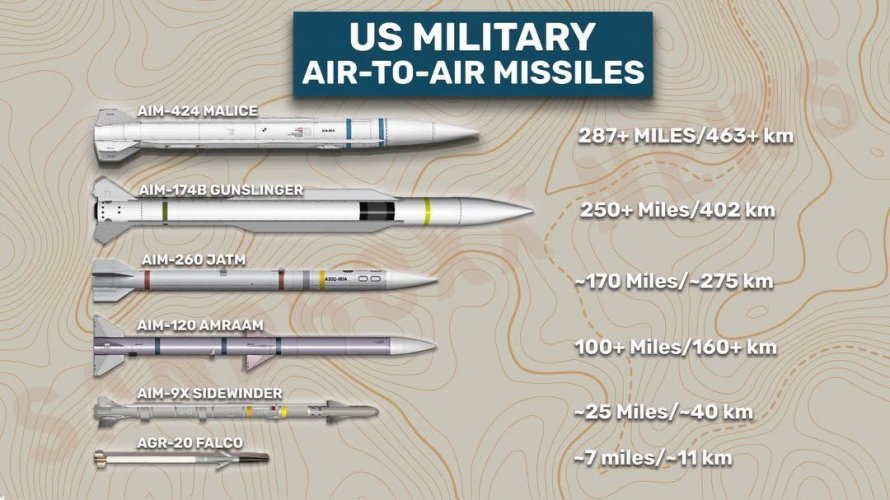
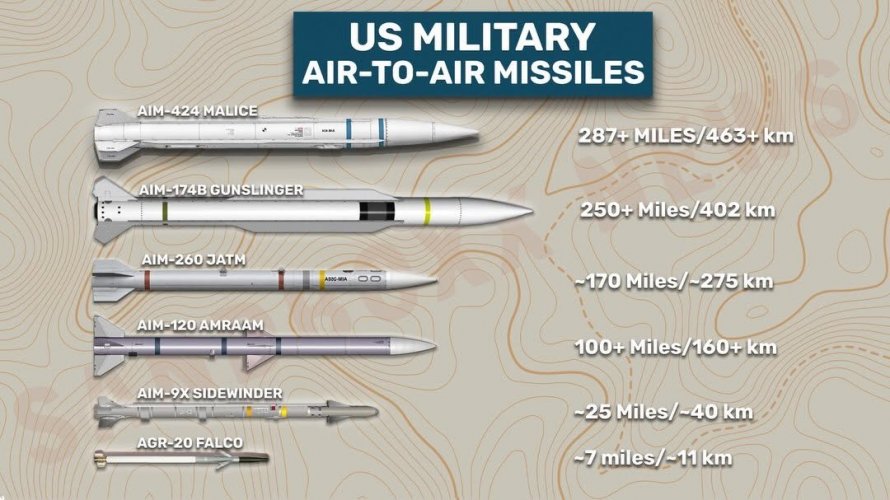
The AIM-424 Long Range Air-to-Air Missile (LRAAM) is already undergoing testing and is intended to equip several generations of U.S. Navy fighters. Planned platforms include the F/A-18E/F Super Hornet, the F-35C Lightning II, and the Navy’s future F/A-XX next-generation fighter.
The Navy has also released imagery providing the first public look at the weapon. One photograph, taken in April, shows an F/A-18E/F operated by Naval Air Test and Evaluation Squadron 23 (VX-23) carrying four of these missiles. A separate image shows the weapon integrated into the internal weapons bay of an F-35C.
The missile’s most striking advertised characteristic is its range of more than 250 nautical miles. That’s more than 285 miles or about 465 km. However, the significance of the AIM-424 extends well beyond that headline figure.
Let’s take a closer look at what is known about this new weapon and what it could mean for the US Navy’s future air-combat capabilities.
https://www.youtube.com/hashtag/defenseupdates
#defenseupdates #AIM424 #usweapons
Chapters:
0:00 TITLE
00:11 INTRODUCTION
01:35 SPONSORSHIP - NordVPN
02:09 BACKGROUND
04:50 THE PLAN
07:19 ANALYSIS


Seem to be common theme nowadays, PL-17, AIM-424, Izdeliye 810 all seem to have pretty small wing. Seem like they concluded that speed is more important than turn rate for VLAAMIf motor of AIM-424 is the same as that of AIM-174, is MK104 rocket motor. With a weight reduction of 180 kilograms, Dv can be increased to 1770m/s.
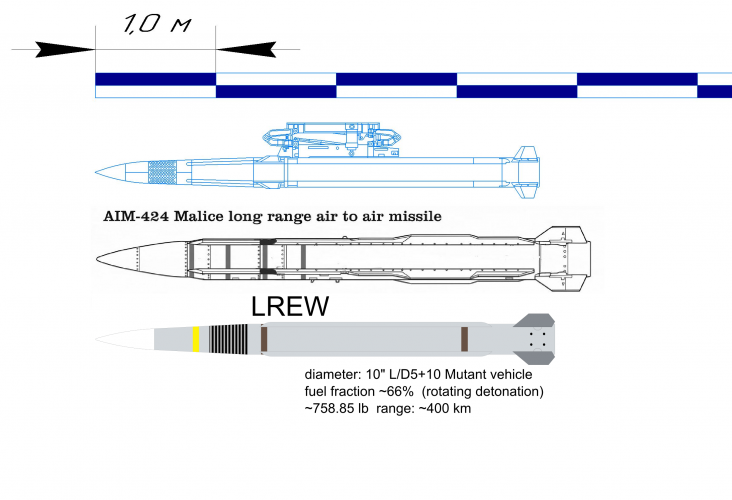
And based on public data and photo, it can be inferred that the wingspan is very small, which should be a compromise for installing it into the bay of F-35. This is very bad for a 600 kilogram missile, the 'small wing heavy missile'.
JATM also has small wing tbhBut Raytheon say maneuverability is better than JATM is somewhat funny

Reply: https://www.secretprojects.co.uk/threads/thaad-development.18894/post-936919
Let's get back on discussing the AIM-424 here so TWZ/Sandboxx has something good to steal for their next piece
Isn’t AIM-174 technically just the SM-6 without MK-72 booster?. I mean same seeker, same processor, same warhead. If SM-6 has already been tested against surface targets, and its seeker can track/guidance itself toward a surface target. What would stop AIM-174 from doing the samething?. Sure maybe the haven’t tested the AIM-174 in that exact role yet but this just seem like the technicality issue at most. Kind of like SLAM-ER probably never tested against a tank, but if you aim it at a tank , the tank will be destroyed.Anyway yeah no surface attack priority because that costs money in testing etc and the Navy is not interested.
1. This is true for pretty much all BVR missiles I think, even the ancient oneRegarding the said-so small wings inherently degrading manoeuvrability, remember:
*Picture yourself stomping on a running bug, do you really need an agile ankle able to follow it 360?
- the missile uses powder propulsion hence the missile weight at close-in distance will be much lighter than at launch. Size of wing is irrelevant when compared to launch weight.
- the missile trajectory in the close-in approach is not planar to the target. It falls down on it with a tremendous speed advantage making trajectory correction minimal*.
- Point 1&2 illustrate how the the straked wing isn't much participating to trajectory correction, much of it comes from roll in axis and yaw in plane, more demanding on cruciform tails.
Isn’t AIM-174 technically just the SM-6 without MK-72 booster?.
What would stop AIM-174 from doing the samething?. Sure maybe the haven’t tested the AIM-174 in that exact role yet but this just seem like the technicality issue at most.
2. If I recall correctly, ballistic arc is pretty common trajectory for all BVR missile since AIM-54
Honestly, I suspect that the software for surface attack is still present in the missile. But mission wise AIM-174s would not be used for anything but VLRAAM work.As the USN already has anti-ship and air-to-ground missiles it probably just wants the AIM-174B strictly as an LRAAM, adding a secondary air-to-ground role would be a distraction.
I am fairly sure that they did loft somewhat. But when you're starting out at 74,000ft there's not a lot of climbing needed.I strongly suspect that the AIM-47A Super Falcon precursor to the AIM-54 also used a lofted trajectory for long-range shots.
Isn’t AIM-174 technically just the SM-6 without MK-72 booster?. I mean same seeker, same processor, same warhead. If SM-6 has already been tested against surface targets, and its seeker can track/guidance itself toward a surface target. What would stop AIM-174 from doing the samething?. Sure maybe the haven’t tested the AIM-174 in that exact role yet but this just seem like the technicality issue at most. Kind of like SLAM-ER probably never tested against a tank, but if you aim it at a tank , the tank will be destroyed.
I am fairly sure that they did loft somewhat. But when you're starting out at 74,000ft there's not a lot of climbing needed.

Gotcha covered.Please post the image here
I don't like the "Malice" name, how about "Super Phoenix" or "Phoenix II" instead?
I would bet it's some sort of acronym. Like "Midcourse Adaptable Long range Interception Capability Experiment" (or Effector), which I just pulled fresh from my backside.I don't like the "Malice" name, how about "Super Phoenix" or "Phoenix II" instead?
If motor of AIM-424 is the same as that of AIM-174, is MK104 rocket motor. With a weight reduction of 180 kilograms, Dv can be increased to 1770m/s.
And based on public data and photo, it can be inferred that the wingspan is very small, which should be a compromise for installing it into the bay of F-35. This is very bad for a 600 kilogram missile, the 'small wing heavy missile'.
But Raytheon say maneuverability is better than JATM is somewhat funny

When did Raytheon say this? I can’t find it, and the maneuverability statement is only that the strakes allow it to “retain significant amounts of maneuverability even with its larger size compared to” AMRAAM and JATM, which is the same as more maneuverable.But Raytheon say maneuverability is better than JATM is somewhat funny
SM6 has a Boost+Sustain burn profile in its Mk104.I think someone posted above more maneuverable than AIM-120, but in any case I doubt it matters. This is not a weapon designed with fighters in mind. If it uses the mk104 as suspected, it is a single pulse that will have very low energy at the end of its trajectory. For a HALE UAV/MPA/AWACS/Tanker/bomber, that really does not matter
SM6 has a Boost+Sustain burn profile in its Mk104.


It would be pretty wild if they didn't figure out that a missile purpose built for long range air to air needs to have sufficient end game energy to accomplish that LR AAM role. I don't think either the Navy, nor Raytheon are that stupid to have not thought of this. We will have to wait for more details to emerge on both the specifications, and concept of employment for the system.I think someone posted above more maneuverable than AIM-120, but in any case I doubt it matters. This is not a weapon designed with fighters in mind. If it uses the mk104 as suspected, it is a single pulse that will have very low energy at the end of its trajectory. For a HALE UAV/MPA/AWACS/Tanker/bomber, that really does not matter
It would be pretty wild if they didn't figure out that a missile purpose built for long range air to air needs to have sufficient end game energy to accomplish that LR AAM role. I don't think either the Navy, nor Raytheon are that stupid to have not thought of this. We will have to wait for more details to emerge on both the specifications, and concept of employment for the system.
All modern LRAAMs can engage fighters. The question is conditions when they can do it.
R-37Ms in Ukraine demonstrated fighters kills, even when they were doing hard maneuvers. But they can't keep high energy state down low(in thick air) for long of they're forced to maneuver. If ground control didn't screw up, it's possible to survive them with relative ease.
AIM-174 probably have 3-4 times more strakes area compared to AIM-424Assuming 442kg of propellant for both missiles, AIM-174 is ~388kg at burnout vs ~238kg for AIM-424, so AIM-174 would need ~63% more lift to match the agility of AIM-424.