Solid State Laser News

Light manipulation
https://phys.org/news/2026-04-space-boost-links.html

Scientists at the University of East Anglia have uncovered a hidden property of light that allows it to twist, spin and behave differently—without mirrors, materials or special lenses. In a breakthrough that could transform medical testing, data transmission and future quantum technologies, researchers from the UK and South Africa have shown that light can be "programmed" simply by exploiting its natural geometry.

Life's handedness
https://phys.org/news/2026-04-life-electron.html

A team of scientists has identified a new physical mechanism that could help explain one of the most persistent mysteries in science: why life consistently uses one "handed" version of its molecules and not the other. In a new study led by Prof. Yossi Paltiel of the Center for Nanoscience and Nanotechnology at Hebrew University and Prof. Ron Naaman of the Weizmann Institute, researchers show that electron spin, a fundamental quantum property, can cause mirror-image molecules to behave differently during dynamic processes, even though they are otherwise identical. The work appears in Science Advances.

Of use with the other article above?

***************************************************************************************
On "negative time:"
https://phys.org/news/2026-05-physicists-negative-lab.html

What one finds is that the photon actually arrives far earlier than that. In fact, it arrives so early it appears to have spent a negative amount of time inside the cloud—to exit, on average, before it enters.

Not a time machine--but maybe a replacement for BECs to pack a directed energy beam a bit more densely?


Photonics
https://phys.org/news/2026-05-photonics-advance-enable-compact-high.html
https://phys.org/news/2026-05-hologram-technology-key-enables-hard.html
https://phys.org/news/2026-04-team-modulator-compact-photonic-circuits.html
https://techxplore.com/news/2026-05-optical-ai-recovers-distorted-telecom.html
https://phys.org/news/2026-05-nanoscale-channels-hybrid-lightvibration-efficiently.html
 
Last edited:
It's probably more a case that the photon doesn't decide exactly where it is until there's an interaction. It exists as a probability distribution and sometimes on interaction it decides it's near the fringes of that distribution leading to seemingly impossible outcomes.
 
It's probably more a case that the photon doesn't decide exactly where it is until there's an interaction. It exists as a probability distribution and sometimes on interaction it decides it's near the fringes of that distribution leading to seemingly impossible outcomes.
The same reason that classically "impossible" quantum tunneling occurs.
 
John Wick refuses to use lasers these days---he says hairstyles like that of Mitt Romney and Gavin Newsom are the equivalent of the ablative armor on the Defiant from DS9. One exploded out of protest just from being pointed at Jack Lord's hair. Brylcream is a great fusion inhibitor too.

So lasers are only good for cutting softer things, like neutronium.
 
John Wick refuses to use lasers these days---he says hairstyles like that of Mitt Romney and Gavin Newsom are the equivalent of the ablative armor on the Defiant from DS9. One exploded out of protest just from being pointed at Jack Lord's hair. Brylcream is a great fusion inhibitor too.

So lasers are only good for cutting softer things, like neutronium.
Lol. If lasers can cut through neutronium, they are better than Star Trek phasers, which could not cut through the neutronium hull of the Doomsday Machine.
 
I used to like bugles, but not anymore! 400 of them...

I think Peter David's novel VENDETTA did have Borg cutting beams able to do just that-(cut neutronium)-but with difficulty. That novel dealt with a second Doomsday Machine. Spinrad's idea was more of a ramscoop.

If I had to re-design it too look less like an ice cream cone, I'd have its inner maw surrounded by the Narada arms of the '09 reboot. A vampire squid actually does make more sense as a tough, asteroid mining ship--though Romulans are known for the bird motif'

O/T rant over.

Scans
https://phys.org/news/2026-05-3d-optical-fingerprints-materials-lasers.html

Hoppy
https://phys.org/news/2026-05-laser-isolated-hopfions.html
 
Last edited:
It seems that lots of laser weapon manufacuters are starting to offer ruggedized fieldable systems in the sub-100kW regime for the anti-drone mission in the near-term instead of waiting until they can field more powerful systems. That's probably a smart move as long as these systems can destroy or disable the class of drones they claim them to be effective against at the claimed ranges and dwell times in real-world battlefield conditions. On the other hand if they prove to be substantially less effective than claimed, this may dampen enthusiasm for further laser weapon development and deployment. Time will tell.
 
Laser comm for 6G
https://techxplore.com/news/2026-05-laser-powered-intelligent-6g-networks.html
https://techxplore.com/news/2026-05-optical-wireless-quantum-free-space.html
https://phys.org/news/2026-05-tiny-chip-circuit-power-generation.html
https://techxplore.com/news/2026-05-power-flexible-radio-frequency-transistors.html

Home LiDAR
https://techxplore.com/news/2026-05-smartphones-track-hidden-lidar.html

Small but robust
https://phys.org/news/2026-05-laser-enable-robust-miniaturized-sources.html

Display tech
https://phys.org/news/2026-05-hybrid-projector-super-resolution-images.html
https://techxplore.com/news/2026-05-virtual-screen-machines-3d.html

More on optics
https://phys.org/news/2026-05-sunlight-powered-generation-photon-pairs.html
https://techxplore.com/news/2026-05-power-generating-displays-device-harvests.html
https://phys.org/news/2026-05-microcrystals-bioluminescent-fish-prism.html
https://techxplore.com/news/2026-06-snapshot-3d-depth-coded-aperture.html
https://techxplore.com/news/2026-06-sonarcamera-murky.html
https://phys.org/news/2026-06-technology-efforts-rome-colosseum-ipiranga.html
https://www.secretprojects.co.uk/threads/cool-science.41252/page-10#post-915604

Soundproofing
https://phys.org/news/2026-06-newfound-bulky-effective-soundproofing.html

Ion colliders
https://phys.org/news/2026-05-ai-electron-ion-collider.html
Brookhaven and Jefferson Lab, along with more than 300 collaborating institutions around the world, are designing the 2.4-mile (3.9-kilometer) ring-shaped accelerator, with two beams circulating in opposite directions at nearly the speed of light. A house-sized particle detector, ePIC, will act as a high-speed 3D camera to capture what happens when these beams—each about the width of a human hair—collide. The facility is expected to produce data streams of up to 100 gigabits per second—comparable to tens of thousands of high-definition video streams running simultaneously—requiring a powerful readout network that can process data almost as quickly as it is generated.

X-ray data
https://phys.org/news/2026-05-imaginary-technique-ray-simulations-extreme.html

X-ray glass
https://techxplore.com/news/2026-05-moldable-glass-screen-sharpens-rays.html

X-ray laser

Laser contest
https://hackaday.com/2026/05/28/the-frikkin-lasers-contest-starts-now/

New laser
https://phys.org/news/2026-06-cavity-strategy-blue-vertical-surface.html
 
Last edited:
Esh-Tech launches pulsed laser C-UAS weapon “which can down 30 drones in one minute”

Developed specifically for maneuvering and stationary land units operating in complex and high-threat environments, DroneLight features a pulsed laser architecture that uses short, high-intensity pulses to physically remove material from the target through a drilling effect, enabling neutralization within 1-2 seconds – compared to more than 15 seconds in legacy continuous-wave laser systems, according to the company.
 
Laser comm for 6G
https://techxplore.com/news/2026-05-laser-powered-intelligent-6g-networks.html
https://techxplore.com/news/2026-05-optical-wireless-quantum-free-space.html
https://phys.org/news/2026-05-tiny-chip-circuit-power-generation.html
https://techxplore.com/news/2026-05-power-flexible-radio-frequency-transistors.html

Home LiDAR
https://techxplore.com/news/2026-05-smartphones-track-hidden-lidar.html

Small but robust
https://phys.org/news/2026-05-laser-enable-robust-miniaturized-sources.html

Display tech
https://phys.org/news/2026-05-hybrid-projector-super-resolution-images.html
https://techxplore.com/news/2026-05-virtual-screen-machines-3d.html

More on optics
https://phys.org/news/2026-05-sunlight-powered-generation-photon-pairs.html
https://techxplore.com/news/2026-05-power-generating-displays-device-harvests.html
https://phys.org/news/2026-05-microcrystals-bioluminescent-fish-prism.html

Ion colliders
https://phys.org/news/2026-05-ai-electron-ion-collider.html
Brookhaven and Jefferson Lab, along with more than 300 collaborating institutions around the world, are designing the 2.4-mile (3.9-kilometer) ring-shaped accelerator, with two beams circulating in opposite directions at nearly the speed of light. A house-sized particle detector, ePIC, will act as a high-speed 3D camera to capture what happens when these beams—each about the width of a human hair—collide. The facility is expected to produce data streams of up to 100 gigabits per second—comparable to tens of thousands of high-definition video streams running simultaneously—requiring a powerful readout network that can process data almost as quickly as it is generated.

X-ray data
https://phys.org/news/2026-05-imaginary-technique-ray-simulations-extreme.html

X-ray glass
https://techxplore.com/news/2026-05-moldable-glass-screen-sharpens-rays.html

X-ray laser

Laser contest
https://hackaday.com/2026/05/28/the-frikkin-lasers-contest-starts-now/
To get a more balanced understanding of the Excalibur laser controversy, I recommend reading the 1988 GAO report on it titled "Strategic Defense Initiative: Accuracy of Statements Concerning DOE's X-Ray Laser Research Program": https://apps.dtic.mil/sti/pdfs/ADA344547.pdf which states, "We found that the LLNL official channel, which included Mr. Woodruff,2 had made statements about the status and potential of the X-ray laser, which were similar to most of the statements identified by Mr. Woodruff as being "overly optimistic and technically incorrect."...we asked selected LLNL scientists, who had specific knowledge about the X-ray laser program, for their opinions as to the accuracy of the statements challenged by Mr. Woodruff. From these interviews, we concluded there was no general agreement among these scientists regarding the accuracy of the statements...Concerning laser energy achieved and intrinsic energy conversion efficiency, we found that Dr. Wood's April 1985 CIA briefing was based upon nuclear test results, which LLNL later found to be incorrect, and, as a result, it was subsequently modified in the summer of 1985. Based upon the uncorrected results, we were told by Dr. Weaver, then the X-Ray Laser Program Leader, that LLNL thought it had achieved the energy level out of the laser and the intrinsic energy conversion efficiency as stated by Dr. Wood. We asked selected LLNL scientists, who had specific knowledge about the X-ray laser program, for their opinions concerning the accuracy of the above statements. There was no uniformity of opinion; however, most of these scientists felt the level of energy achieved statement was technically correct, based upon (1) uncorrected test results and (2) measuring the energy at the laser rather than at the target. In addition, most of these same scientists also felt the conversion efficiency statement was also technically correct. However, some of these scientists felt that Dr. Wood's statements could be misunderstood...We discussed the results of our review with Mr. Woodruff; LLNL officials (including Dr. Roger Batzel, Dr. Edward Teller, Dr. Lowell Wood, and the new LLNL Director, Dr. John Nuckolls); and DOE officials. They all generally concurred with the information in this report."
 
Last edited:
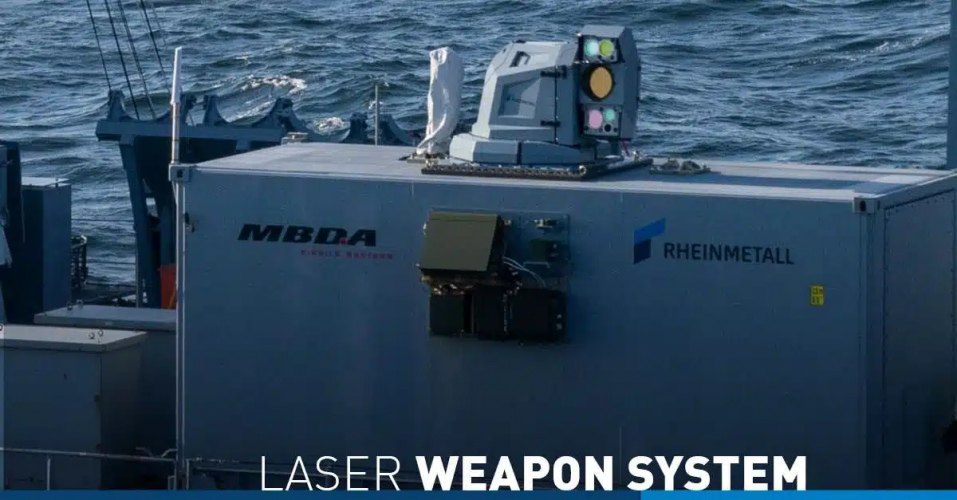
Fast !
https://www.rheinmetall.com/en/medi...lop-a-laser-weapon-system-for-the-german-navy
On 9 July 2026, the Federal Office of Bundeswehr Equipment, Information Technology and In-Service Support (BAAINBw) signed a contract with the High-Energy Laser Naval Demonstrator Working Group (ARGE HEL) for the development of a high-energy laser weapon system for the German Navy. The ARGE HEL consists of MBDA Deutschland and Rheinmetall Waffe Munition. The two companies are currently forming a joint venture for this purpose. The laser weapon system is expected to be operational by 2029. The contract value is in the mid three-digit million-euro range and covers the development of a complete system for maritime applications, including the entire operational chain from reconnaissance and target tracking to engagement. The joint venture is placing particular emphasis on German supply chains and domestic systems expertise in its development work, in order to secure national sovereignty in this key technology.
 

German Navy to Deploy New MBDA and Rheinmetall Laser Weapon by 2029​

https://www.navalnews.com/naval-new...ew-mbda-and-rheinmetall-laser-weapon-by-2029/
1783688359851.png
On 9 July 2026, the Federal Office of Bundeswehr Equipment, Information Technology and In-Service Support (BAAINBw) signed a contract with the High-Energy Laser Naval Demonstrator Working Group (ARGE HEL) for the development of a high-energy laser weapon system for the German Navy.
The complete system is tailored to the requirements and needs of the Bundeswehr. In March 2026, the naval laser demonstrator repeatedly proved its capabilities to high-ranking German delegations at the Bundeswehr Technical Centre for Weapons and Ammunition (WTD 91) in Meppen. The demonstrator has already covered 28,000 nautical miles across the North Sea, the Baltic Sea and the Mediterranean on board the frigate SACHSEN and has proven its effectiveness even in adverse weather conditions.
Over the course of more than a year of testing and operational use at WTD91, more than 1,000 shots were successfully fired at airborne, maritime and land-based targets.
 
The release says that “initial” prototypes will carry 150 kilowatts of power for meeting unspecified “urgent operational demands” — likely the counter-drone mission. Prototypes are then planned to scale the 300-500 kW range “for robust cruise missile defense,” the release says.

A separate “laser source” developed under the separate High Energy Laser Scaling Initiative will “concurrently” be developed in a 500-kW integrated system, according to the release. Overall, the Pentagon expects laser systems to be containerized and suitable for use on ground- and sea-based platforms.
 
A bit of sensationalism but a good base to start a discussion:

https://nypost.com/2026/07/30/us-ne...of-gods-system-that-disrupts-missile-attacks/

1000w_q95.jpg

A U.S. Navy sailor employs the Hammer of the Gods emitter during Project Convergence Capstone 6 experimentation in July in southern California. (Photo courtesy of U.S. Space Force)
 
View: https://x.com/UKDefJournal/status/2086408009974968737?s=20

American warship downs drones with laser weapon​

https://ukdefencejournal.org.uk/american-warship-downs-drones-with-laser/
According to Lockheed Martin, the Arleigh Burke-class destroyer USS Preble employed its High-Energy Laser with Integrated Optical Dazzler and Surveillance system, known as HELIOS, to engage and neutralise four drones during a Navy-run counter-UAS event. The activity took place last year and was disclosed publicly as part of the company’s latest financial update.
 

DOD Leader Calls for Counter-Drone, Airborne Directed Energy Weapons​

https://www.airandspaceforces.com/dod-directed-energy-weapons-airborne/
A top Pentagon tech official called on industry this week to help the military develop “lighter, more efficient” directed energy weapons designed to go on aircraft and conduct special operations missions or down drones—areas where the Air Force’s directed energy efforts have been quiet as of late.
 
AeroVironment's Multipurpose HEL shot down 3 Cartel drones:

The U.S. military used a laser in southern Texas' Rio Grande Valley to shoot down three Mexican drug cartel drones this week near the U.S.-Mexico border, U.S. officials said on Thursday.
The North American Aerospace Defense Command and U.S. ‌Northern Command said in a statement that the operation took place late Tuesday and early Wednesday and used the Army Multipurpose High Energy Laser.

https://www.reuters.com/business/ae...mexican-cartel-drones-near-border-2026-08-28/
 
https://www.shephardmedia.com/news/...exible-networks-are-the-key-to-c-uas-success/
EOS is responding with a portfolio of complementary effectors designed to address different points of failure in the existing layered model.

In the directed-energy tier, the company’s Apollo family of laser weapons represents a capability few outside the US can match. EOS and Israel’s Rafael are, Schwer notes, the only companies offering a 100kW laser system on the market outside America, and foresees economies of scale: “We believe that the laser weapon will become a standard defence system for all those C-UAS applications in the future. It’ll become a mass volume product.”

At the cannon layer, EOS’s Slinger system is ready for integration on future main battle tanks. Explaining why this capability is needed when MBTs are routinely fitted with active protection systems (APS), Schwer explained: “Those systems are good against RPGs and rockets, but they are of limited use against drones for the simple reason that you have only about six effectors on board. The third or fourth loitering munition will get through.”

Notably, the system operates autonomously, as when those enemy loitering munitions are detected closing at speed, “there is no more time to think about whether you shoot or don’t shoot.” Schwer is however clear about the company’s wider philosophy on autonomy: “The system is autonomous only if it is engaging an unmanned target; if the target detected could potentially be manned, something normally evident by its size and shape, there is always a human-in-the-loop.”

The introduction of a mesh network addresses a different problem set: including the vulnerability of hybrid combat vehicle fleets operating with incompatible systems.

The introduction of a mesh network addresses a different problem set: including the vulnerability of hybrid combat vehicle fleets operating with incompatible systems. In Ukraine, attacking Russian drones “typically take out the high-value assets first, which are the C2 and radar vehicles, and then the rest of the platoon is more or less lost”, Schwer explains.

EOS’s solution distributes both sensor coverage and C2 intelligence across the entire formation. Each vehicle carries a single flat-panel radar providing sectorial coverage, linked via standard NATO radios – modules costing around $10,000 each – that form a self-organising mesh. C2 software is downloaded into every weapon station, eliminating the dedicated command vehicle as a single point of failure. Remaining units can automatically reconfigure to maintain full hemispherical coverage: “Each tank is covering a different sector and they’re exchanging information. They can see whatever’s happening and shoot down anything flying in.”
 
https://www.shephardmedia.com/news/...exible-networks-are-the-key-to-c-uas-success/
EOS is responding with a portfolio of complementary effectors designed to address different points of failure in the existing layered model.

In the directed-energy tier, the company’s Apollo family of laser weapons represents a capability few outside the US can match. EOS and Israel’s Rafael are, Schwer notes, the only companies offering a 100kW laser system on the market outside America, and foresees economies of scale: “We believe that the laser weapon will become a standard defence system for all those C-UAS applications in the future. It’ll become a mass volume product.”

At the cannon layer, EOS’s Slinger system is ready for integration on future main battle tanks. Explaining why this capability is needed when MBTs are routinely fitted with active protection systems (APS), Schwer explained: “Those systems are good against RPGs and rockets, but they are of limited use against drones for the simple reason that you have only about six effectors on board. The third or fourth loitering munition will get through.”

Notably, the system operates autonomously, as when those enemy loitering munitions are detected closing at speed, “there is no more time to think about whether you shoot or don’t shoot.” Schwer is however clear about the company’s wider philosophy on autonomy: “The system is autonomous only if it is engaging an unmanned target; if the target detected could potentially be manned, something normally evident by its size and shape, there is always a human-in-the-loop.”

The introduction of a mesh network addresses a different problem set: including the vulnerability of hybrid combat vehicle fleets operating with incompatible systems.

The introduction of a mesh network addresses a different problem set: including the vulnerability of hybrid combat vehicle fleets operating with incompatible systems. In Ukraine, attacking Russian drones “typically take out the high-value assets first, which are the C2 and radar vehicles, and then the rest of the platoon is more or less lost”, Schwer explains.

EOS’s solution distributes both sensor coverage and C2 intelligence across the entire formation. Each vehicle carries a single flat-panel radar providing sectorial coverage, linked via standard NATO radios – modules costing around $10,000 each – that form a self-organising mesh. C2 software is downloaded into every weapon station, eliminating the dedicated command vehicle as a single point of failure. Remaining units can automatically reconfigure to maintain full hemispherical coverage: “Each tank is covering a different sector and they’re exchanging information. They can see whatever’s happening and shoot down anything flying in.”
I was pleasantly surprised to see that the article also discussed the use of low cost interceptor drones to counter swarms of attacking drones, which I have previously said seemed like a plausible strategy, but which I rarely see discussed. Here's the relevant excerpt from the article:

"Finally, EOS’s interceptor drones offer a counter to mass swarm attacks. These systems kill by kinetic impact alone, a design choice with significant implications for deployment and collateral damage risk. “We can easily store them in small launchers alongside the runway of a [civil] airport, because they have no explosives inside,” Schwer explains. Kept continuously charged, they are launchable within two seconds of a command, and are effective at ranges of 8 to 9km.

With a low unit cost, they can be deployed in quantities of 50 to 100 simultaneously, with the C2 system pairing each interceptor to an individual attacking drone. If an interceptor misses its target, it can return to base; if destroyed, it falls without any detonation risk."
 

Similar threads

Back
Top Bottom