The Future of the Royal Navy and the 'Hybrid Navy' Initiative - News, Platforms, Development and Speculation

https://suv.report/gmf-140-fuer-die-deutsche-marine/

This is interesting. It's about the German F127, their large air defence frigate planned for some eight units, but it highlights something interesting with regards to the other two major European destroyer programmes of late, the Italian DDX and British T83.

Reportedly, there is growing discontent around the cost of the F127, with options to either reduce the capability of the ships, or to procure fewer than the eight planned, being considered. There are apparently similar uncertainties around the Italian DDX.

Of course, the British T83 was significantly downsized into the Common Combat Vessel, with the original plan being branded as 'unaffordable'.

It shows that Europe's four naval primes are struggling to keep base with Pacific powers like Japan and China not only in quantity (it was never on the cards to maintain quantity parity for any of the European powers), but in individual quality of vessel.
 
Of course, the British T83 was significantly downsized into the Common Combat Vessel, with the original plan being branded as 'unaffordable'.
Nah mate, the T83 was entirely scrapped. CCV isn't even a patch on the lowest end idea they were going for with it.

I've been told that internally the place name they have for it is Type 46, even though it will be off course inferior than Type 45
 
Nah mate, the T83 was entirely scrapped. CCV isn't even a patch on the lowest end idea they were going for with it.

I've been told that internally the place name they have for it is Type 46, even though it will be off course inferior than Type 45
IDK. 130m variants were floated for the T83, so there was definitely a 'T42-esque' family of concepts for the T83 floating around at BAE, though they reportedly had radar cooling issues. I won't pass judgement on what the CCV is supposed to be until we get some initial concepts, but given it was a combination of the T83 and T32 concepts, I think my phrasing was fair.

Either way, the European powers are clearly struggling to justify these massive cruisers.
 
So you're Portuguese? Whoopty-do

SSN-Aukus used the advanced work of the SSN-R programme but it is most definitely a partnership of requirements and final design. And we're paying our way... Not many, if any, countries get access to the crown jewels of naval hardware. Unless you were friends with the Soviets and could get in on the fire sale.

Broke Britain is buying 12 submarines... Crewing then might be an issue. But they're also giving up naval destroyers because they can't afford them... Even though they think the hybrid navy will bring mass and do it cheaper. And I know our Hobarts and the Type 45s will be superior to the CCV. Whatever we replace them with will only extend that lead.

You know the specifications of a ship that IF everything goes to plan (it almost certainly wont) will hit the water in the middle/late thirties?
Those specifications are being discussed now.
If i was a betting chap (i'm not) i would bet that the T45 is going to soldier for quite a bit more than the planed (DIP) retirement date and we are not going to see the CCV/T45 replacement till the 40's. We are going to see several plans and specifications changes until something enters service with the RN.
 
The first of ZeroUSV's Oceanus17 unmanned boats is in the water.
ZeroUSV press release here:
https://www.zerousv.com/application/files/4317/8704/3223/OC17_Naming_Day_Press_Release_180626.pdf
The Oceanus17 class represent a significant step up in British autonomous USV capability - with very large payload capacity of 4,000kg, mission endurance in excess of 50 days, a top speed approaching 15 knots, whilst still retaining the Oceanus class DNA allowing fast mobilisation to any corner of the globe quickly and easily.
So achieving a slightly smaller payload than ACUA Pioneer with smaller displacement but significantly faster, and with less of an emphasis on stability.
 
Okay.. so... How do I go about this?
The assumption that more orders, bigger budgets, and bigger engineering teams immediately equates to a superior product regardless... Well that's really too stupid to give a response to. You don't actually believe that yourself. Please don't strawman or use false equivalents that make you look silly. Bigger company, more money, equals comparable or better product? Please tell me you're not that naive.

CEA only does radars and other radio frequency hardware. It's just what they do. These bigger companies do a bit of everything. Just food for thought.

No hubris here, I just understand how CEAFAR stacks up against world leading radars. And I don't use simple equations like you just did.

Seafire is already at a disadvantage to CEAFAR S, simply because it has about 33% less TRMs. CEAFAR then has better sensitivity, more transmit power, better gain and angular resolution, more beams, greater track, and greater redundancy. The tiles are small enough to pair up on a single face which increases that performs exponentially.

Kronos is making a trade-off for better precision track using C band, but lose the versatility of S band with its longer range, longer wavelengths, but much better weather performance. It's the reason it's still the sweet spot for most modern radars. X band is a strange choice for anything but target illumination, except where you want to combine functions... Again though your compounding the problems of C band with even finer resolution. There's a reason the big American SPY radars are S band only, because it's a balanced frequency range, performance wise.

Power shield... Very interesting. It's like it's trying to be CEAFAR but failing. It's got the right hardware, but it's a 7 ton revolving block that does 15rpm... Or 4 second updates on tracks. L band is great for the long range air volume search, but it's also using the lower spectrum of S band (called D band in IEEE terms) so it can't take advantage of the upper strengths of S band. Bit Lame. Both the Thales and Leonardo systems claim to be modular, but they just aren't. They're seperated and clunky and compromised by being too focused.

CEAFAR2 is a fully modular and scalable architecture naval radar. The tiles are there and you can build it according to your needs. L band, S band, and X band (transmit only). Like a tailored suit. The data is parallel processed by tiles and then enhanced in system processing. It's truly integrated and works together. No one has said it yet, but it bears the hallmarks of a 5th gen radar. The world's first operational GaN naval radar too by the way.


A) Ceafar 2 was not the "first operational GaN naval radar", if the RAN is correct it got its IOC in August 2021, Hensoldt TR-4D got there in 2016 and was in active duty by late 2019, its also quite probable that the ELTA MF-Star beat it
B) The Thales Seafire does not have "33% less TRM's than Ceafar S"; the version on the FTI might have less "33% TRM's"... Seafire is scalable, THALES will be entirely happy to deliver antennas the size of tennis courts (an example being the FREMM variant that was offered to the RAN)
C) Power Shield. Look at the ITS Trieste, a rotating antenna that you've described COUPLED with four fixed GaN "C" band antennas. On the DDX it will be a mix of L, S and X bands antennas.

Etc, etc, etc.

Both Thales and Leonardo have demonstrated radars with multiple GaN antennas working in multiple bands delivering a single compreensive image, both are offering massively scalable products, both have such operational systems now, both have active systems doing ABM work in Ukraine now.

I am entirely convinced that if the Royal Navy goes "foreign" for their main AAW/ABM next generation sensor (something very, very silly to do IMO) and does not send RFP's to RTX, LM, Thales, Leonardo and SAAB and buys directly from Cea the reason for doing so is beacause "they are buying ships and submarines from us".
Looking from the outside its a bit dificult to have any other opinion when the work between Qinetiq and CEA is an adenda to AUKUS.

I suspect that the two of us will have to (taking a punt from a UK political podcast) disagree agreably

Cheers
 
Last edited:
https://suv.report/gmf-140-fuer-die-deutsche-marine/
It shows that Europe's four naval primes are struggling to keep base with Pacific powers like Japan and China not only in quantity (it was never on the cards to maintain quantity parity for any of the European powers), but in individual quality of vessel.

Threat.
There's no PLAN in the Atlantic/Med. The ability of the probable/possible main antagonist of those four European powers to project naval/aerial power into the Atlantic/Med is becoming marginal.
 
Threat.
There's no PLAN in the Atlantic/Med. The ability of the probable/possible main antagonist of those four European powers to project naval/aerial power into the Atlantic/Med is becoming marginal.
Sure, that's one reason why. On the other hand, three out of the four naval powers have a demonstrated interest in Pacific power projection, having committed carrier strike groups to the area in the last two years or so. The Russian air and missile threat to the European fleets is also growing, not shrinking. So, the threat is IMO there.

These are developed nations with competitive jobs markets and stretched treasuries. There will always be a struggle to justify larger ships, to fund larger ships, and to build mass through larger ships. Surface combatants growing in expense beyond basic inflation with each generation and it is becoming unsustainable.

The Brits are attempting to break this cycle of bloating by gambling on uncrewed mass. The Dutch and Germans are doing a half-hearted attempt at the same. The Italians are pressing on, buoyed by their healthier ship-building industry.

Even the Americans are running into the problem.
 
Sure, that's one reason why. On the other hand, three out of the four naval powers have a demonstrated interest in Pacific power projection, having committed carrier strike groups to the area in the last two years or so. The Russian air and missile threat to the European fleets is also growing, not shrinking. So, the threat is IMO there.

The Russian air and missile threat to the "European fleets" is shrinking.
Their long range air units equiped and trained for recon and anti ship duties have pretty much evaporated, their Submarine force has been steadily disapearing, their bases in the Med are gone.
The "demonstrated interest in Pacific power projection" is (not even) secondary by comparison with whats happening in Eastern Europe, North Africa and the Middle East.
 
Last edited:
The Russian air and missile threat to the "European fleets" is shrinking.
Their long range air units equiped and trained for recon and anti ship duties have pretty much evaporated, their Submarine force has been steadily disapearing, their bases in the Med are gone.
The "demonstrated interest in Pacific power projection" is (not even) secondary by comparison with whats happening in Eastern Europe, North Africa and the Middle East.
They've been increasing munition production for a while. I'm pretty sure they've been increasing the rate of Hellduck production as well.

Besides that, I'm more talking about the missile threat, particularly the cruise missile threat from submarines in the North Atlantic and Arctic Ocean.
 
Image

1787215757457.png
View: https://x.com/Babcockplc/status/2090097740806033915


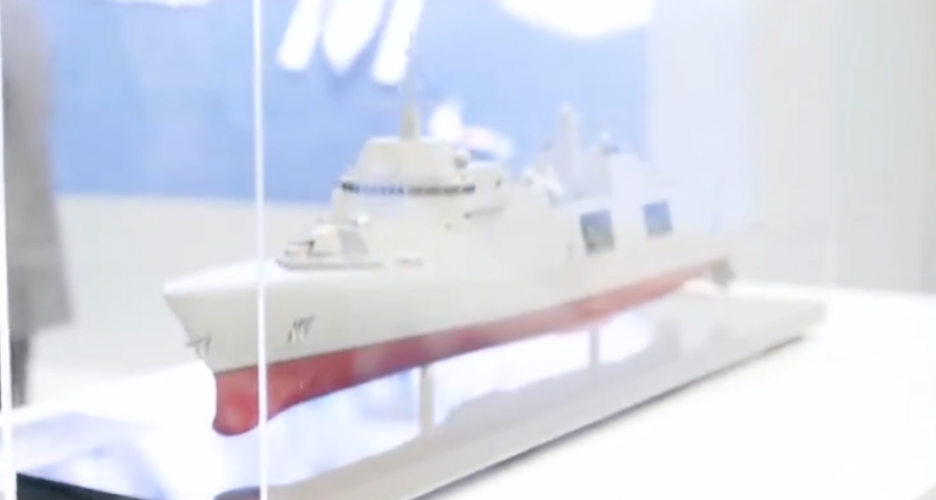
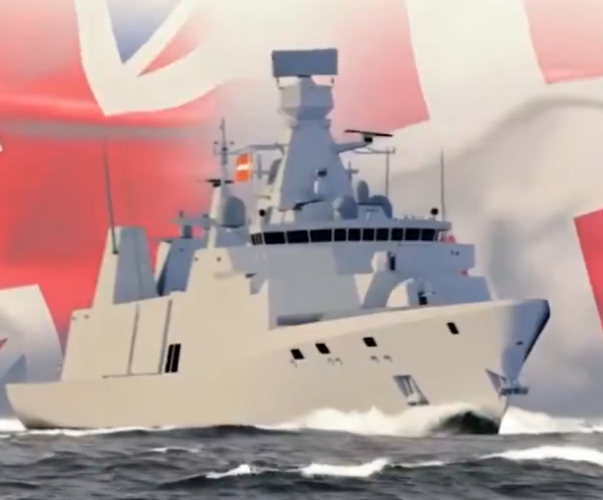
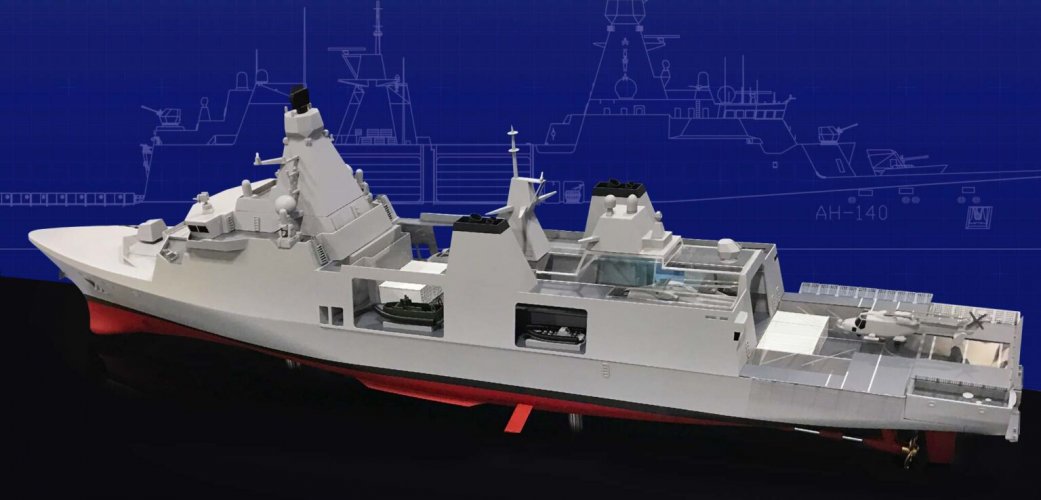
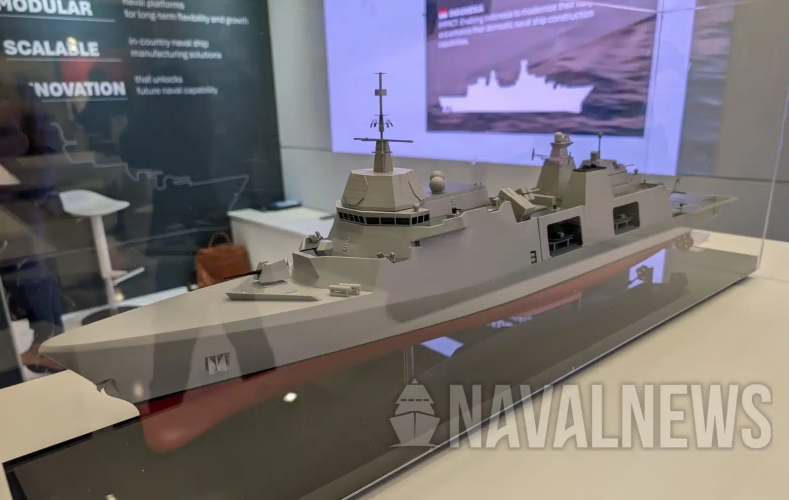
Two new AH140 variants on show in a tweet from Babcock. One is the concept variant pitched to Denmark in previous imagery, whilst the other is completely new, with a squat radar mast for what I'm thinking looks a little like SPY-6V3.

EDIT: the second image might be AH160. Definitely a bit longer than the basic T31 hull.

Both potential options for the Common Combat Vessel?
 
Two new AH140 variants on show in a tweet from Babcock. One is the concept variant pitched to Denmark in previous imagery, whilst the other is completely new, with a squat radar mast for what I'm thinking looks a little like SPY-6V3.

EDIT: the second image might be AH160. Definitely a bit longer than the basic T31 hull.

Both potential options for the Common Combat Vessel?
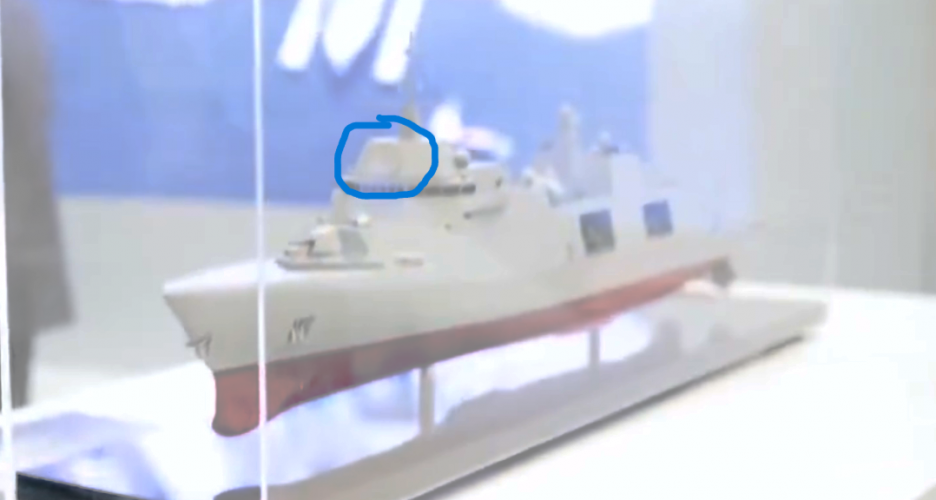
The second one looks badass. I don't think it's stretched, the radar panels being directly above the bridge just makes the 'shoulder' between the mast and the VLS tub look longer. Your screenshot hasn't picked it up but I think in the video there's a lighter patch on the (octagonal?) mast facing directly forwards, which would be the radar panel itself.


1787216439759.png
There's also this horrendous AI generated radar later in the video.
 
The second one looks badass. I don't think it's stretched, the radar panels being directly above the bridge just makes the 'shoulder' between the mast and the VLS tub look longer. Your screenshot hasn't picked it up but I think in the video there's a lighter patch on the (octagonal?) mast facing directly forwards, which would be the radar panel itself.
Good point, I think I was getting confused by the extended gap between the boat bays, but that's not necessarily indicative of a stretched hull.

I think upon closer inspection that the radar panel you point out is also circular (or at least hexagonal). Not sure what system would be small enough to fit there as well as having a circular shape. SeaFire?
 

Attachments

  • Screenshot 2026-08-20 094833.png
    Screenshot 2026-08-20 094833.png
    316 KB · Views: 28
Nah mate, the T83 was entirely scrapped. CCV isn't even a patch on the lowest end idea they were going for with it.

I've been told that internally the place name they have for it is Type 46, even though it will be off course inferior than Type 45
If you look at a drone control ship individually then of course it will be inferior to a fully integrated design - that's basically the entire point of the design. Any comparative evaluation has to be made on the basis of controller plus swarm.

And as for CCV being 'inferior' to Type 45, remember that Type 23 was originally meant to be inferior to Type 22 and didn't turn out too shabby.
 
Last edited:
Hyperion is, from the literal one paragraph that has ever been written about it that isn't behind a Janes subscription, a demonstrator for Project Theia, which is a radar array that "can transmit and receive across a large number of frequencies and in all polarisations". It sounds like it will be a single system capable of multiple RF roles like EW, ELINT and passive and active radar all at once.
This page has Theia as the Army digitalisation project?

https://www.gov.uk/guidance/army-digitalisation-theia
 
The Russian air and missile threat to the "European fleets" is shrinking.
Their long range air units equiped and trained for recon and anti ship duties have pretty much evaporated, their Submarine force has been steadily disapearing, their bases in the Med are gone.
The "demonstrated interest in Pacific power projection" is (not even) secondary by comparison with whats happening in Eastern Europe, North Africa and the Middle East.
The threat in the North Atlantic is at an all time high since the dissolution of the USSR. With a steady production schedule for the Yasen-Ms and diversified submarine fleet ranging from smaller Lada and Kilo SSKs to the variety of SSNs and SSGNs like the Yasen family, the Oscars and Akulas. Not to mention that the northern fleet alone matches the SSBN presence of the entirety of Europe, with the Borei-A's being currently the most modern ballistic missile submarines in active service. Add to that steady modernization in form of new equipment and especially weapons integration, as well as several ongoing programs for UUVs and XLUUVs, the submarine threat is at it's highest since soviet times. The threat level in the Pacific Ocean is higher, because the PLAN is completely dominating regional naval forces, but on the other side there is a considerable USN presence and the JMSDF and ROKN make any european navy look completely inadequate, except perhaps the French Navy (although certainly lacking behind in the realm of surface combatants compared to East Asian fleets). So the threat level in the Pacific is higher, but all forces involved are quite threatening. While in the Northern Atlantic the truly threatening fleets are the French and the Russians, in litoral zones the Norwegians and Swedes too, but not in the open ocean. When the sum of several entire naval fleets is equal to one portion of one Navy, I wouldn't call the threat environment low, let alone shrinking. Especially as Russia could simply re-deploy portions of the Pacific fleet into the area of operations of the northern fleet.

Big difference, in favor of the Russians, is that Western European naval forces have melted away in terms of numbers and the Royal Navy in particular is significantly weaker compared to what it was during the height of the cold war. Their premier ASW asset is the Type 23 as we speak, this should say it all. Then you have premier surface combatants not even close to approaching a dozen in numbers and certainly not in active duty and the picture is rather clear.

The Russian Navy is strengthening it's position in the Northern Atlantic and Arctic, especially in the underwater domain where it already enjoyed a considerable lead. While the large Naval Forces of Europe either stagnated or have grown weaker over the last decades. Pair that with continuously tremendous investment into the development and upgrades of the anti-ship missile arsenal, unmanned underwater vehicles and the integration of new weapons into their existing vessels, it's not looking rosy. Especially as the most capable European Navy's, the French and Italian fleets, are mostly active around the Mediterranean. And they are not hull count wonders either, although at least France has always tried to remain competitive under the sea and in the missile domain, unlike the UK.

To, appropriately for this thread, frown at the Royal Navy a bit more, when your most capable assets are 9 foreign procured, airliner based, MPAs which are super susceptible to ship based SAM and fighter aircraft, are you at this point even trying to pretend to be a capable sovereign Navy in North Western Europe? Because given the failure of the QEs to be anything resembling useful, the failure to get them decked out with the fighters they meant to carry and which are adapted for the compromised design of the carriers, when your premier AAW destroyers are derelict and suffering from low availability, when your premier ASW frigate is a design of the 1970s, when you can't manage to get the budget you need to stand up a capable Navy and basically have to rely on allies these days to protect your waters, when your SSNs are in a terrible state as well. Then are you even a serious consideration in the power dynamics of the Northern Atlantic?

When all you can bring realistically to the table are 1 QE carrier with ~ 12 F-35Bs, 1 to 2 Type 45s, 2 to 4 frigates, 1 to 2 Astutes, your P-8s operating from land (thus a target for submarine launched missiles), Merlins and that's about it, then you are clearly not a Naval Power at this point. The JMSDF or ROKN could realistically contain the Northern Fleet in 2026, if they were to swap geography with the UK and other Western European countries. But the RN would find itself at the receiving end of a Kalibr, Oniks, Granit and Zircon turkey shoot. And they don't have the numbers to absorb such losses. The advantage lies with fixed wing ASW, the P-8 being the backbone, but that doesn't off-set major shortcomings elsewhere, especially in the subsurface and missile realm. And while the VMF fields around 25 Su-30SM/SM2 from land, it's known that the VKS also conducts patrols and escorts, and as soon as Su-35s, MiG-31s, Su-57s, more Su-30SMs, Tu-22M3s and others enter the equation, it becomes more and more questionable just how survivable North Atlantic aviation and MPAs actually are.

So your assumption is ultimately the exact opposite of what's the current reality. Which is that the threat environment is currently at an all time high since the cold war and that, while others are stepping up to compete in that environment (like France, Norway, Sweden, Germany), the Royal Navy in particular and other formerly more important players like the Dutch Navy are dropping the ball extremely hard.

 
The threat in the North Atlantic is at an all time high since the dissolution of the USSR. With a steady production schedule for the Yasen-Ms and diversified submarine fleet ranging from smaller Lada and Kilo SSKs to the variety of SSNs and SSGNs like the Yasen family, the Oscars and Akulas. Not to mention that the northern fleet alone matches the SSBN presence of the entirety of Europe, with the Borei-A's being currently the most modern ballistic missile submarines in active service. Add to that steady modernization in form of new equipment and especially weapons integration, as well as several ongoing programs for UUVs and XLUUVs, the submarine threat is at it's highest since soviet times. The threat level in the Pacific Ocean is higher, because the PLAN is completely dominating regional naval forces, but on the other side there is a considerable USN presence and the JMSDF and ROKN make any european navy look completely inadequate, except perhaps the French Navy (although certainly lacking behind in the realm of surface combatants compared to East Asian fleets). So the threat level in the Pacific is higher, but all forces involved are quite threatening. While in the Northern Atlantic the truly threatening fleets are the French and the Russians, in litoral zones the Norwegians and Swedes too, but not in the open ocean. When the sum of several entire naval fleets is equal to one portion of one Navy, I wouldn't call the threat environment low, let alone shrinking. Especially as Russia could simply re-deploy portions of the Pacific fleet into the area of operations of the northern fleet.

Big difference, in favor of the Russians, is that Western European naval forces have melted away in terms of numbers and the Royal Navy in particular is significantly weaker compared to what it was during the height of the cold war. Their premier ASW asset is the Type 23 as we speak, this should say it all. Then you have premier surface combatants not even close to approaching a dozen in numbers and certainly not in active duty and the picture is rather clear.

The Russian Navy is strengthening it's position in the Northern Atlantic and Arctic, especially in the underwater domain where it already enjoyed a considerable lead. While the large Naval Forces of Europe either stagnated or have grown weaker over the last decades. Pair that with continuously tremendous investment into the development and upgrades of the anti-ship missile arsenal, unmanned underwater vehicles and the integration of new weapons into their existing vessels, it's not looking rosy. Especially as the most capable European Navy's, the French and Italian fleets, are mostly active around the Mediterranean. And they are not hull count wonders either, although at least France has always tried to remain competitive under the sea and in the missile domain, unlike the UK.

To, appropriately for this thread, frown at the Royal Navy a bit more, when your most capable assets are 9 foreign procured, airliner based, MPAs which are super susceptible to ship based SAM and fighter aircraft, are you at this point even trying to pretend to be a capable sovereign Navy in North Western Europe? Because given the failure of the QEs to be anything resembling useful, the failure to get them decked out with the fighters they meant to carry and which are adapted for the compromised design of the carriers, when your premier AAW destroyers are derelict and suffering from low availability, when your premier ASW frigate is a design of the 1970s, when you can't manage to get the budget you need to stand up a capable Navy and basically have to rely on allies these days to protect your waters, when your SSNs are in a terrible state as well. Then are you even a serious consideration in the power dynamics of the Northern Atlantic?

When all you can bring realistically to the table are 1 QE carrier with ~ 12 F-35Bs, 1 to 2 Type 45s, 2 to 4 frigates, 1 to 2 Astutes, your P-8s operating from land (thus a target for submarine launched missiles), Merlins and that's about it, then you are clearly not a Naval Power at this point. The JMSDF or ROKN could realistically contain the Northern Fleet in 2026, if they were to swap geography with the UK and other Western European countries. But the RN would find itself at the receiving end of a Kalibr, Oniks, Granit and Zircon turkey shoot. And they don't have the numbers to absorb such losses. The advantage lies with fixed wing ASW, the P-8 being the backbone, but that doesn't off-set major shortcomings elsewhere, especially in the subsurface and missile realm. And while the VMF fields around 25 Su-30SM/SM2 from land, it's known that the VKS also conducts patrols and escorts, and as soon as Su-35s, MiG-31s, Su-57s, more Su-30SMs, Tu-22M3s and others enter the equation, it becomes more and more questionable just how survivable North Atlantic aviation and MPAs actually are.

So your assumption is ultimately the exact opposite of what's the current reality. Which is that the threat environment is currently at an all time high since the cold war and that, while others are stepping up to compete in that environment (like France, Norway, Sweden, Germany), the Royal Navy in particular and other formerly more important players like the Dutch Navy are dropping the ball extremely hard.
NATO?
 
the JMSDF and ROKN make any european navy look completely inadequate, except perhaps the French Navy (although certainly lacking behind in the realm of surface combatants compared to East Asian fleets).
I think you're giving the French far too much credit there. None of the major European navies hold a candle to the Japanese surface combatant forces, and with just six nuclear submarines (compared to the what, twenty large Japanese conventional submarines), the great power trump card held by the Marine Nationale is not enough to swing the balance.

@EmoBirb
 
I think you're giving the French far too much credit there. None of the major European navies hold a candle to the Japanese surface combatant forces, and with just six nuclear submarines (compared to the what, twenty large Japanese conventional submarines), the great power trump card held by the Marine Nationale is not enough to swing the balance.

@EmoBirb
I personally believe that the french SSN force, their SSBNs and CdG give them a lot of credibility and quite frankly capabilities you don't find anywhere in Asia outside of the PLAN. And while they only field a single CVN, CdG has tremendous availability and time at sea. While an SSN has simply put the endurance and performance that no SSK can compete with, not even the really advanced and capable ones you'd find in places like Japan, Korea, Germany or Sweden. The Suffrens could be a terror to any adversary and are certainly playing at the very forefront of the SSN race.

The future PA NG should give them even more credibility, same with their new SSBNs. They are lacking in large surface combatants, but that's emblematic for Europe, where something like the projected F127 is a serious outlier.
 
A) Ceafar 2 was not the "first operational GaN naval radar", if the RAN is correct it got its IOC in August 2021, Hensoldt TR-4D got there in 2016 and was in active duty by late 2019, its also quite probable that the ELTA MF-Star beat it
B) The Thales Seafire does not have "33% less TRM's than Ceafar S"; the version on the FTI might have less "33% TRM's"... Seafire is scalable, THALES will be entirely happy to deliver antennas the size of tennis courts (an example being the FREMM variant that was offered to the RAN)
C) Power Shield. Look at the ITS Trieste, a rotating antenna that you've described COUPLED with four fixed GaN "C" band antennas. On the DDX it will be a mix of L, S and X bands antennas.

Etc, etc, etc.

Both Thales and Leonardo have demonstrated radars with multiple GaN antennas working in multiple bands delivering a single compreensive image, both are offering massively scalable products, both have such operational systems now, both have active systems doing ABM work in Ukraine now.

I am entirely convinced that if the Royal Navy goes "foreign" for their main AAW/ABM next generation sensor (something very, very silly to do IMO) and does not send RFP's to RTX, LM, Thales, Leonardo and SAAB and buys directly from Cea the reason for doing so is beacause "they are buying ships and submarines from us".
Looking from the outside its a bit dificult to have any other opinion when the work between Qinetiq and CEA is an adenda to AUKUS.

I suspect that the two of us will have to (taking a punt from a UK political podcast) disagree agreably

Cheers
A) Big enough to admit when I'm wrong, technically, it was Japan with the Asahi class. The RAN was second because the F125s had to be fixed, they didn't have operating capability even after they were accepted into the fleet, Anzacs were already working vessels. HMAS Arunta was engaged in RIMPAC exercise early the next year.
B) the hell are you on about? The FDI is the only version of sea fire at this point. And scalable doesn't mean building a bigger panel, that's just, well, building a bigger panel. Scalable is adding another panel and seamlessly fishing the data together in parallel. No one cares if they can make it the size of a tennis court... You're not putting that on a warship. Dear oh dear.
C) ahh yes... Power shield... a large rotating radar, how novel. I'll take my fixed solid state panels thanks. They can't build a system of panels and link them together into one system? Shame.

Thales and Leonardo make great stuff, and their radars are very good. They're not scalable in the same sense that CEAFAR is and I'm not sure you're able to understand why. Thales and Leonardo having separate and distinct products that can work together is not the same as a system of multiple radar panels that can work as one with multiple bands and fused data. :rolleyes:

The Royal Navy already uses foreign radars... It's nothing new to them. They're interested in acquiring ours because they've been evaluating it for a number of years now... Even before Aukus. They would also like to (circumstances being favourable) jointly develop and produce systems based on CEAFAR. So it would have some sovereign technology for them going forward... And they can give it a silly name like they like to.
 
I personally believe that the french SSN force, their SSBNs and CdG give them a lot of credibility and quite frankly capabilities you don't find anywhere in Asia outside of the PLAN. And while they only field a single CVN, CdG has tremendous availability and time at sea. While an SSN has simply put the endurance and performance that no SSK can compete with, not even the really advanced and capable ones you'd find in places like Japan, Korea, Germany or Sweden. The Suffrens could be a terror to any adversary and are certainly playing at the very forefront of the SSN race.

The future PA NG should give them even more credibility, same with their new SSBNs. They are lacking in large surface combatants, but that's emblematic for Europe, where something like the projected F127 is a serious outlier.
The French and Italians have the most sensible industrial policy when it comes to shipbuilding, which is why they are currently the strongest forces in Europe. When France needs a new frigate, Naval Group knows it can only go to them and so the design can be prepared well in advance.

Instead the RN has to pander to e.g. the idea that Cammel Laird could efficiently build frigates.
 
Aye, but we've yet to see any images of it. Anyway, on second thoughts (and a look at the original IH-class, I'm not sure it has been stretched).
I think he's talking about MNP, or the placeholder CCV as it now seems to serve. I wish companies couldn't just produce publicity videos for politicians to watch without actually labelling anything.
 
I think he's talking about MNP, or the placeholder CCV as it now seems to serve. I wish companies couldn't just produce publicity videos for politicians to watch without actually labelling anything.
I see, I forgot about that one. I was thinking AH160. Still hoping Babcock will eventually show us what could have been.
 
You know the specifications of a ship that IF everything goes to plan (it almost certainly wont) will hit the water in the middle/late thirties?
Those specifications are being discussed now.
If i was a betting chap (i'm not) i would bet that the T45 is going to soldier for quite a bit more than the planed (DIP) retirement date and we are not going to see the CCV/T45 replacement till the 40's. We are going to see several plans and specifications changes until something enters service with the RN.
I know those specifications are being discussed now, and what I'm hearing is not inspiring but also not totally unexpected. The fundamental idea for what could be the hybrid navy concept was put some time ago by a particular company and it was reported on. Details coming out of the MoD are lining up with that concept. And it seems even though the Type 45s can serve much longer... It seems they're needed scab parts from.
 
I personally believe that the french SSN force, their SSBNs and CdG give them a lot of credibility and quite frankly capabilities you don't find anywhere in Asia outside of the PLAN. And while they only field a single CVN, CdG has tremendous availability and time at sea. While an SSN has simply put the endurance and performance that no SSK can compete with, not even the really advanced and capable ones you'd find in places like Japan, Korea, Germany or Sweden. The Suffrens could be a terror to any adversary and are certainly playing at the very forefront of the SSN race.

The future PA NG should give them even more credibility, same with their new SSBNs. They are lacking in large surface combatants, but that's emblematic for Europe, where something like the projected F127 is a serious outlier.
The capabilities of their SSN are doubtless, but like the rest of the French fleet, they lack mass. There's just six, and each of the six are small for modern nuke boats, with a correspondingly smaller weapons load. Obviously their first-rank fleet is still pretty small, and again, the individual warships have reduced weapons capacity. Whilst the CdG is a useful asset, it is undermined by the weakness of its escorts.

In comparison, the Japanese field about 10 AEGIS destroyers, with something like three times the missile capacity of the entire French FREMM fleet. Then their frigate fleet is also much larger, plus a bunch of legacy destroyers.

If you asked the JMSDF to do the jobs of the MN, I think the JSMDF would fulfil the majority of those roles more capably.
 
Last edited:
Babcocks ARMOR concept even called the T31+ the "Common Command Vessel". I hope this is all making sense now

https://www.navylookout.com/babcock...ate-as-command-platform-for-uncrewed-systems/
Go and look at page 4 of this thread for the differences between MNP and the T31+ CCV, and how they have been interchanged in successive Babcock publicity events. They are truly one of the worst companies in Britain for getting clear concept lineage out of, worse than Cambridge Aerospace who have secrecy as part of their USP.
 
In comparison, the Japanese field about 10 AEGIS destroyers, with something like three times the missile capacity of the entire French FREMM fleet. Then their frigate fleet is also much larger, plus a bunch of legacy destroyers.

If you asked the JMSDF to do the jobs of the MN, I think the JSMDF would fulfil the majority of those roles more capably.
I try not to compare European navies to the JMSDF, it makes me want to cry. The Japanese yards aren't dual military-civil, what is it that makes them so much more efficient?
 
I try not to compare European navies to the JMSDF, it makes me want to cry. The Japanese yards aren't dual military-civil, what is it that makes them so much more efficient?
Well, they have had the world's fourth-largest economy for a while, and the fifth-largest by PPP, so they've had money on their side for a while.

Most of all though, they've benefited from a consistent order book, rather than the feast/famine model taken by the UK and the Netherlands.

They control prices by retiring ships early, rather than LIFEXing stuff to delay ordering new ships.

They build things like their Mogamis to a less exacting DC standard compared to the UK and much of Europe, which only goes to enhance the rapidity of their yards.

A lot of their systems in the 2000s and 2010s were American-derived, which would've sped up production a little as well.
 
Less good-looking than it appeared at first. If they're offering it though, perhaps the power generation issues on the AH140 hull aren't as bad as I thought.
 
The capabilities of their SSN are doubtless, but like the rest of the French fleet, they lack mass. There's just six, and each of the six are small for modern nuke boats, with a correspondingly smaller weapons load.
With a slight advantage that all their subs are dual-crewed, so that fleet of 6 has 4 or 5 boats at sea all the time.

Which is the functional equivalent of 12-15 single-crewed boats.
 

Similar threads

Back
Top Bottom