- Joined
- 27 December 2005
- Messages
- 19,230
- Reaction score
- 35,692
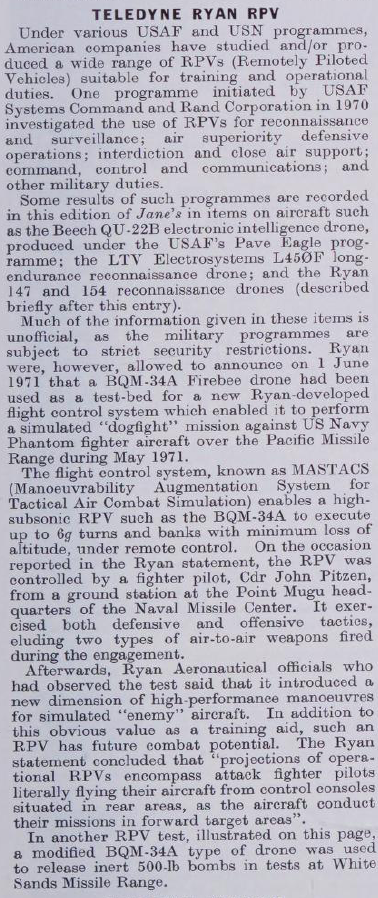
The 1971 Multi-Mission RPV studies grew out a RAND /USAF Symposium on Remotely Piloted Vehicles in 1970 and the associated reports. I haven't found a copy of the report, but a very detailed summary of its contents were published in October 1970 issue of Air Force Magazine. Its a very interesting read in the age of CCAs and drone warfare.
Remotely Piloted Aircraft-
Weapon Systems of the Future?
By Edgar Ulsamer
ASSOCIATE EDITOR
FOR certain Air Force pilots, tomorrow's com-
bat cockpit may be a swivel chair in a bomb-
proof underground control center. From
there, a USAF pilot may "fly" by remote
control his air-superiority fighter or interdic-
tion bomber against targets hundreds of miles away.
Unlike today's silent launch crews in the ICBM silos,
the remotely located pilot will truly fight his air battles
in the same decision-making, real-time fashion the man
in the cockpit does today. And his weapon system will
be deadlier and cheaper than any manned system. Most
important of all, these pilots will not be exposed to
death, injury, or capture.
Remotely controlled combat aircraft "flown" by pilots
hundreds of miles away are technically feasible and in
many cases will perform better and more cost-effectively
than conventionally controlled planes. Because such
vehicles contain, on board, only a fraction of the ex-
pensive component systems needed by manned aircraft,
and none of the latter's ife support and safety systems
they are ideaUy suited for mass production and thereby
capable of reversing the long-standing and steady trend
toward ever fewer, increasingly expenisive, and highly
complex manned vehicles.
These findings, which explicitly suggest a revolution
in aerial warfare, were the result of an intensive, high-
level review and analysis effort early in 1970, which is
now progressing toward demonstration status. Reaction
to the program by Department of Defense and aero-
space industry executive,s is said to be "enthusiastic'
and has led to sufficient government funding in
spite of current budget limitations. Launched in the
form of a symposium at the request of Gen. James
Ferguson, then Commander of the Air Force Systems
Command, this study of the Remotely Piloted Vehicle
(RPV) potential consisted of detailed examinations of
pres ntly available technologic as well as projections of
what pertinent technology advances are likely to occur
within this decade. From this information base, individ-
ual panels of experts extrapolated specific weapon sys-
tem concepts, ranging from remotely piloted air·-super-
iority fighters to remotely piloted forward air controllers
(FACs). Sponsored jointly by AFSC and RAND Cor-
poration, the RPV study program also involves other
federal contract research centers mainly MITRE and
Aerospace Corporation as well a personnel from
NAA and the Naval Weapons Center.
The first session of the RPV symposium was held in
May of this year and culminated in the formation of
five panels that were given the task of analyzing and
documenting the technical and operational feasibility
and economics of RPVs for specific USAF mission cate-
gories.
The Time Is Ripe for Remotely Controlled Vehicles
The second phase of the symposium in July, was
attended by DoD representatives at the Assistant Secre-
tary level along with key personnel from the Depart-
ment of the Air Force and the other military services
as well as industry executives of the chief-engineer/vice-
pre idential level. It was the consensus of these panels
that 'the time is ripe ' for RPVs and that a parallel pro-
gram of studies and demonstrations should be under-
taken. Such a program is currently in progress with
three teams, headquartered at the Armament Develop-
ment Test Center at Eglin AFB Fla.· the Aeronautical
Systems Division Center at Wright-Patterson AFB,
Ohio; and a third team composed of NASA and Naval
Weapon Center personnel,. each prepariininng plans for
proposed demonstrations and studies.
One panel concentrated on how and where remotely
piloted vehicles will affect the Air Force s command,
control. and communications (CCC) structure. Includ-
ed were studies of the communications required by the
various link between the vehicle possible mother ships,
and the remotely located pilot including methods of ex-
tending the line-of- sight coverage through satellites.
The conclusion were that RPVs are compatible with
and could function as an integral part of, the present
command, control, and communications system. To
date unmanned aircraft such as drone , have been used
only singly and for unique operations that call for their
own special control system . With the advent of RPVs
in greater sizes ranges, and numbers, it will be neces-
sary to integrate their command and control into the
existing system . This creates opportunities to improve
the coordination and effectiveness of remotely piloted
vehicles over conventional aircraft because a number of
pilots can be collocated and given access to information
not available to pilots operating conventionally. Sitting
at a central control console pilot operating RPVs that
function as a tactical unit also can exchange information
among themselve -and coordinate operations-much
more readily than can pilots in individual aircraft.
The panel established that the communications
needed to actually "fly' the vehicle and to control its
on-board system-the remotely located pilot "sees and
acts ' in exactly the same manner that a conventional
airborne pilot does-are within the present state of the
art and available now. Many key elements of the needed
communications links are currently in use, either in mili-
tary or NASA systems or in commercial aircraft, it was
found. The availability of relatively inexpensive video
recorders and the development of zoom lenses for tar-
get-identifying electro-optical systems make it possible
not only to reproduce the actual operating environment
for the remotely located pilot but to give him special
advantages. The RPV study has already established that
a remotely located pilot with the help of advanced
optical techniques, can identify flying objects up to
twenty miles away a capability denied the man oper-
ating in the cockpit. Similarly RPVs have been flown
at altitudes of fifty to seventy-five feet and ai speeds of
450 knots with a simple improvised video scope setup.
It is noteworthy- and typical of pilot reaction to re-
mote flying- that one of the country's top test pilots,
Milt Thompson of NASA, commented recently that op-
erating a RPV makes him as emotionally and physically
"tired" as actual cockpit flying, whereas operating a
training simulator produces no such effect.
Enemy Jamming
The symposium's technical experts acknowledged
that a·determined enemy could succeed in jamming the
communications links of a remotely piloted vehicle, just
as he can in the case of a manned system. There are
available, however, relatively simple design measures
that make jamming extremely difficult and enormously
expensive. As a result it was concluded that remotely
piloted vehicles given the present state of art, are not
uniquely susceptible to jamming. This even applies in
cases where communications relay aircraft or satellites
are used to increase the distance between the remote
pilot and the vehicle.
It is apparent that RPVs can be deployed in direct
support of the Air Force's command, control, and com-
munications mission as communications relays and sur-
veillance platforms. Both -concepts were found to con-
tain a substantial potential for reduced costs, greater
efficiency and more flexibility than manned systems.
Because the underlying t chnology is on Jrnnd and the
operational benefits appear sufficiently attractive, the
panel urged therefore, that the Air Force proceed with
RPV development for the ,command, control, and
communications role.
RPV Air-Superiority Fighters
With regard to the Air Force's air-superiority role,
the symposium developed the concept of a three-stage
RPV system. It consists of a mother ship equipped with
a good-sized radar which can acquire and track targets
at distances of about sixty miles. (The AWACS concept
has been identified as a promising radar-equipped moth-
er ship.) The mother ship would carry two remotely
piloted vehicles that would be launched singly or
jointly as soon as threats are detected. One or both
RPVs, launched and headed toward a point of inter-
ception by the mother ship, would pick up the "threat"
on their optical system at a distance of between ten and
twenty miles and move in for the attack. (The control-
lability of RPVs by mother ships sixty miles away has
already been demonstrated by the Air Force.) The
RPV fighter equipped with guns or missiles- and, in
the more distant future, laser guns-will be designed for
12-G sustained flight capability, nearly double the G-
loading an experienced fighter pilot cari tolerate for only
brief periods of time. Because of this structural advan-
tage, the RPV can "easily outfight" any manned sys-
tem. It will enjoy a turn-rate advantage of between
fifty and 100 percent over manned systems within the
speed and altitude flight envelope of air-to-air combat.
The RPV can afford to expend all its fuel if a "kill" is
at stake, thereby enjoying yet another advantage over
manned fighters. The RPV fighter would have a mul-
tiple-pass capability in case its remotely located pilot
misses the target in the first encounter. A preliminary
design of such a vehicle was undertaken by the panel
in order to compare its features against those of manned
fighters.
The initial conclusions were that a three-stage system
(mother ship, RPV, and missiles or guns) is technically
feasible but· that certain demonstration efforts were
necessary to establish an acceptable level of confidence
before further developmental work is started. While
no firm costs for such a system have as yet been estab-
lished, there is evidence t]rnt it would compare favorably
with conventional systems even without allowing for the
invaluable benefit that the human operator is protected
from death, injury or capture. No decision has been
reached as yet on the question of whether to place the
remotely located pilot aboard the mother ship or on the
ground. Both modes are being considered at this time.
The remotely piloted air-superiority fighter initially will
be weather dependent insofar as it relies on visual
means to fight air battles. As a result, its operations will
be confined mainly to daylight and clear air conditions.
Interdiction and Close Air Support
The interdiction and close air support mission con-
stitutes the classic application for remotely piloted ve-
hicles with experience dating back to World War Il
wben B-17s were modified to perform such operations.
All requisite tecbn0logy exists and is available.
The study effort defined tw0 basic concepts for RPVs
tailored to the interdiction and close air support mis-
sion. One proposed design is an air-launched vehicle,
with a mission radius of 250 miles, which would be
recovered by landing on runways using skids. Accord-
ing to preliminary estimates such a vehicle would have
an ordnance payload of 2 200 pounds and a gross take-
off weight of 7,500 pounds if it carried its stores exter-
nally, or about 8,500 pounds if carried internally. Initial
cost estimates iodicate that with some advances in
manufacturing techniques and component technology
the flyaway cost of a recoverable interdiction and
ground-support vehicle could range between $150,000
and $175,000.
Another proposed design for this mission would be a
low-cost, expendable bomber equipped with electro-
optical guidance that locks on the target remotely after
a mother ship has identified the target from afar. Such a
vehicle, with a payload of about 1 500 pounds, would
have a total weight of between 2,200 and 2,500 pounds
and is expected to cost approximately $25,000. Both
designs, it is believed, are within the trends of the
present state of the art and require no breakthroughs in
laboratory techniques or concepts.
The specific conclusions of the symposium concern-
ing the utility and technical feasibility of remotely pilot-
ed tactical bombers, were that while it is possible to de-
velop such vehicles, their cost-effectiveness in large-
scale deployment depends on the availability of low-cost
engines. Considerable progress in this area is being
made and justifies a sanguine outlook in terms of the
near future. [t was deemed necessary, however, to dem-
onstrate in practice the reliability of LORAN (long
range navigation) retransmission in a high-speed air-
craft. Finally, the exact functions to be performed at
the control center need to be determined and evaluated
before further action is to be taken.""
Reconnaissance and Surveillance
FAC (forward air controller) and SCAR (strike con-
trol and reconnaissance) missions were rated as excel-
lent candidates for RPVs by the AFSC/ RAND study.
The avionics system needed to perform the RPV recce
mission exist, and their capabilities have already been
demonstrated. All tbe necessary components could be
in production and available within one year. Some
elements of "quieted aircraft" (lowest possible observ-
able performance characteristics in terms of sonic
noise, infrared radiation, radar reflection, and others)
exist, and the techniques for further "quieting" are
known. The recommendations by the symposium were
that such a quieted RPV should be built for the FAC
-and SCAR missions as soon as possible. The potential
of a remotely piloted PAC aircraft operating in con-
cert with a manned aircraft, such as an F-4, for in-
stance, was rated as intriguing. The F AC could direct
the F-4 to drop its bomb into a given "basket area" and
would then guide the bomb to the target with its laser
designator. The exposure of the F-4 over target would
be cut substantially and its bombing accuracy virtually
guaranteed. The operational feasibility of manned and
unmanned aircraft working in concert is yet to be
demonstrated. However, it was concluded that there
are no technical obstacles in the way.
Decoys, Target Markers, and Covert Jammers
A special panel examined a variety of other tactical
missions for RPVs. Rated as highly promising was the
concept of a tactical fighter decoy that could be used
to draw enemy fire, to confuse enemy defenses, and to
test surface-to-air missile avoidance tactic . The present
technology base is sufficient to support development of
such decoys, either as miniaturized radar-simulated ver-
sions of tactical aircraft or as full-scale maneuvering
vehicles capable of sustained engagement of enemy de-
Jense . Miniaturized RPV decoys could be developed
from recent work involving smaIl high-speed maneu-
vering gliders which have the same subsonic flight char-
acteristics as the F-4. Equipped with miniaturized elec-
tronic payloads that can simulate full-scale fighters
they could duplicate the signals produced by jamming
pods. Since these vehicles can be "flown" in the same
manner as manned combat aircraft, their signature on
enemy radar will be fully credible and enhanced by
such details as duplicating formation flying and other
tactical flight maneuvers.
Full-sized decoys, the panel found, could be con-
structed from such inexpensive materials as fiberglass
plastic foam, reinforced paper or inflated fabrics. Simi-
lar in size to manned fighter aircraft, and equipped with
some form of on-board propulsion, they could perform
operational maneuvers such as formation flying or
SAM-avoidance tactics for about forty-five minutes.
heir life cycle could cover between six to ten missions
since they can return to a home base for recovery and
reuse if not shot down.
The same panel found µromise in the tactical utility
of a "quieted" RPV delivering covertly a variety of
device to target areas to increase the strike effective-
ness of manned fighter bombers. These would include
target markers, other visual aids, and homing beacons.
Sensors could be dropped covertly to monitor activities
at road intersections or potential missile or AAA sites.
Similarly, commandable jammers capable o( neutral-
izing enemy radar could be placed near such ites, to
be activated during strikes by USAF aircraft. Since
missioni; of this kind require low-level penetratfon of
high-threat areas, they could be performed by manned
aircraft only al a high loss rate of human life. Such
'low observable' RPVs could also perform effectively
on strike missions against small Beeting, low-value
targets such as enemy sampans in Southeast Asia.
The RPV study also indicated that such a vehicle
could be used to airdrop remotely controlled ordnance
that would lie dormant until activated to fire at such
targets as aircraft coming out of protected "hangar-
ettes" at airfields.
RPVs Need New, Low-Cost Production Methods
The rationale for remotely piloted vehicles in the
majority of the missions under consideration pivots on
low cost and availability in quantity. The Air Force has
encouraged the aerospace industry to study mean of
reducing design and fabrication costs of such vehicles
especially in the critical propulsion and structural areas.
Recent successful efforts to build engine compressor
stages out of stamped sheet metal were seen as pointing
the way toward truly drastic cost reductions. (Such
engines could not operate at the high temperatures of
conventional jet engines but their performance would
be adequate for the light RPVs, with the added advan-
tage that they hinder detection because of the low
temperature of the gas stream they emit.)
Overall, the symposium saw the RPV study program
as a means to basically change the nations weapon sys-
tem design and acquisition philosophy. The collision of
two trends-the ever-increasing complexity of US
weapon systems on the one hand and the shrinking de-
fense budget on the other-is causing maller and small-
er numbers of each system to be built, with the com-
pounding effect of driving unit costs up even higher.
Design of the RPVs is keyed to build truly low-cost
vehicles by moving as many of the expensive subsystem
from the aircraft to a central and safe control facility
on the ground or aboard a mother ship that stays out
of the combat zone. What is exposed to risk, then, is a
low-cost item that can be mass produced. The desire to
return to mass production, the traditional point of
strength of US industry, is one of the driving forces
behind the remotely piloted vehicle program. In order
to achieve the low-cost feature, the study suggested
that such parameters as size and maneuverability be
compromised whenever necessary. This becomes prac-
tical because the only valid criterion in the design of
such vehicles is cost-effectiveness. The reasoning is, of
course, that, the cheaper they are, the more such
vehicles the Air Force can afford to lose.
Specialized Pilots for Various Flight Operations
Understandably, the initial study effort contains a
number of uncertainties, including specific questions
about how the remotely located pilot is to function.
While for the moment the planners and designers pre-
fer to allocate one pilot to each RPV-and that pilot is
to fly the entire mission-there is thought being given
to different chemes. For instance, it might prove prac-
tical to use takeoff specialists who perform only that
operation on a number of aircraft. One pilot specializing
in navigation might be able to operate several aircraft
while they are en route to their target or air-to-air en-
gagements and then would turn over the controls to
other pilot specializing in the art of air battle or other
combat operations. It is likely, however, that, at least
initially the conventional ratio of one pilot per aircraft
will be applied. The advent of the RPV. the study
pointed out emphatically, does not appreciably alter the
role of "the man in tactical air missions but only place
him in a different position in the system loop without
diluting his role as the final decision-maker."
But the ultimate virtue of the RPV project may well
prove to be that it is in consonance with the American
military tradition of placing he highest value on human
life. If, in addition to enhancing the tactical effective-
ness of the Air Force, RPVs can safeguard the lives of
the nation's airmen, remotely piloted vehicles may be-
come the closest thing to a panacea the aerospace age
has yet created.
PRINCIPAL TEAM LEADERS INVOLVED IN THE AFSC/RAND RPV STUDY
Mr. M. Tanchel
Technical Adviser, DCS/Development Plans
Headquarters Air Force Systems Command
Mr. Fred Orazio
Aeronautical Systems Division, Wright-Patterson AFB, Ohio
Mr. H. H. Bailey
RAND Corporation
Lt. Col. R. H. Jacobson
RAND Corporation
Mr. C. E. Ellingson
MITRE Corporation
Mr. William Nance
Aerospace Corporation
Last edited: