Elon Musk’s xAI sues Minnesota over law banning ‘nudification’ technology
Does Musk realise that lawsuits involve something called "Discovery"? That could backfire on his legal team.

Elon Musk’s xAI sues Minnesota over law banning ‘nudification’ technology

But what about the new updated Cherry 3000???They don't want Cherry 2000 in the school's class-rooms.
Sounds like the minimum age of critical software testers should be lowered to around 10 years these days...The kidz will have it crying into its chips inside five minutes.
We had a French language teacher in my council run school, she went around calling herself Mademoiselle Concord with a ?French? accent. Before lunch on her first day we knew her name was Boardman or such and she was from Bristol.
End of the first week she left for good.
When kidz see a chink in the armour they rip it a new one. Vicious little..................
I'd say, based on fundamental cosmic thermodynamics, human extinction is a certainty - it just depends on the time horizon under consideration...
Random fun fact: Zuckerberg in German means Sugar Mountain - make of it what you will...
I have to guess that Gobi Desert real estate, solar power, and cooling water (?) are comparatively inexpensive there - there may be a script for a cheap sci-fi thriller in there somewhere...DeepSeek Is Developing Massive AI Data Center in Inner Mongolia
https://financialpost.com/pmn/busin...ping-massive-ai-data-center-in-inner-mongolia
Regards

The Munich Regional Court ruled on Friday that Suno AI, a US-based company, which generates songs from text prompts. has violated copyrights and has to disclose illicit revenues.
The lawsuit initiated in January 2025 by GEMA, Germany's state-mandated licensing agency, argued that Suno trained its AI models on copyrighted music without obtaining licences or compensating its rights holders.
According to the verdict, Suno will have to pay damages that have yet to be quantified. Suno has disagreed with the ruling and said it would evaluate all available options, including an appeal.
"This is a verdict of global significance," Gema CEO Tobias Holzmueller told Reuters.
If you thought a few keystrokes would turn you into Agatha Christie, Stephen King or Ernest Hemingway, ChatGPT has some bad news.
OpenAI has quietly reprogrammed the chatbot to reject direct requests to replicate or mimic a named author's voice, whether they are still alive to object or have been dead for decades.
Ars Technica was first to spot the change, running its own prompts through ChatGPT to confirm the pattern.
Engadget followed up with its own tests and got the same result, noting that a study by publication No Latency had found ChatGPT did not refuse these requests for dead authors as recently as a few months ago, suggesting this is a genuinely new restriction rather than something that slipped through the cracks.
Anyone job hunting or recruiting on LinkedIn in the last few years has no doubt come across users who post AI-generated “slop” that is either poorly done or is intended to dupe as original thought.
LinkedIn is reportedly aiming to do something about it by introducing a "seems like AI slop" button so users can flag posts they suspect were created by machines instead of humans. The option is currently in testing and there’s no word on when it will be available to the broader user base. Currently, the button does not appear when the post drop-down menu is selected on the site.
LinkedIn is introducing the AI flag less than a month after404 Media reported that the Pangram AI detection service found an estimated 41 percent of LinkedIn's long-form posts and 30 percent of its short-form posts are likely generated by AI.
Time almost stands still in Pieter de Vries’s antiquarian map and book shop in the historic centre of Haarlem. The 60-year-old Dutchman specialises in maps, illustrations and prints, many dating back to the 16th and 17th centuries. He also boasts a flourishing sideline in rare books.
Among his collection is a book on the history of Rome, published in 1558; travel books from the 17th, 18th and 19th centuries; precious first editions; books on natural history; and, until recently, a limited edition of The Highgrove Florilegium – a stunning two-volume illustrated guide to the diverse plant life grown in the gardens of the King’s beloved Highgrove House in Gloucestershire, signed by the then Prince Charles.
On an average day, the dealer will make one book sale. Footfall in the store never exceeds a slow trickle. Once in a while, the telephone will ring. Which is what made the email De Vries received in mid-June, containing a list of around 3,000 titles, so unusual.
The sender identified herself as “Nataly” from a company called 2077AI. “I’m taking part in a new project focused on collecting books in multiple languages, currently mostly in English,” Nataly wrote. “We have put together a very large list of editions we are currently trying to source (the list is attached), and are planning on making a fairly large order.”
Even high-net-worth clients who can afford top-notch advisors are asking artificial intelligence chatbots like Claude for portfolio recommendations and tax advice, wealth management leaders told CNBC.
"My personal opinion is that ChatGPT is the single largest investment advisor in the world right now," said Matthew Fleissig, CEO and cofounder of Pathstone, a registered investor advisory with $185 billion in assets.
Asking AI for a second opinion can help clients come up with informed questions and have deeper conversations with their financial advisors, according to firm leaders. That said, the practice comes with risks, such as getting incorrect advice or having personal information leaked.
Artificial intelligence has become the latest battleground in Silicon Valley's ideological divide, with Meta chief executive Mark Zuckerberg accusing some of the industry's biggest players of promoting an overly restrictive approach that could leave the technology concentrated in the hands of a select few.
Speaking in an interview with The New York Times, Zuckerberg criticised the growing emphasis on worst-case AI scenarios, arguing that fears surrounding the technology should not dictate how it is developed or who gets access to it. Although he stopped short of naming specific companies, his remarks were widely seen as directed at OpenAI and Anthropic, both of which have consistently argued for stronger safeguards around the most advanced AI systems.
Artificial intelligence (AI) has become remarkably good at producing reports, presentations, emails and research in seconds. But there is one thing it still struggles to do consistently: tell the truth.
The latest example comes from PwC, where several AI- and electric vehicle-related reports published by its Middle East division were found to contain fabricated footnotes, incorrect citations and unverifiable information. The incident has added one of the world’s biggest consulting firms to a growing list of organisations that have stumbled because of unchecked AI-generated content.
As AI makes content creation faster and cheaper, the real competitive advantage is shifting to verification now. For businesses rapidly adopting AI, including those in India, it not just about whether AI can generate information. It is whether someone can verify that information before it influences important decisions.

Seems like RLHF (reinforcement learning from human feedback) for an new model! (intentionally or unintentionally)

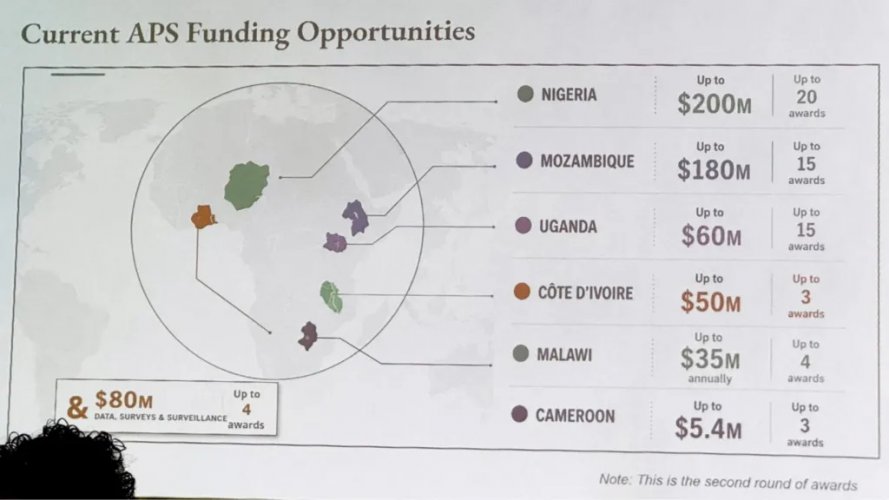
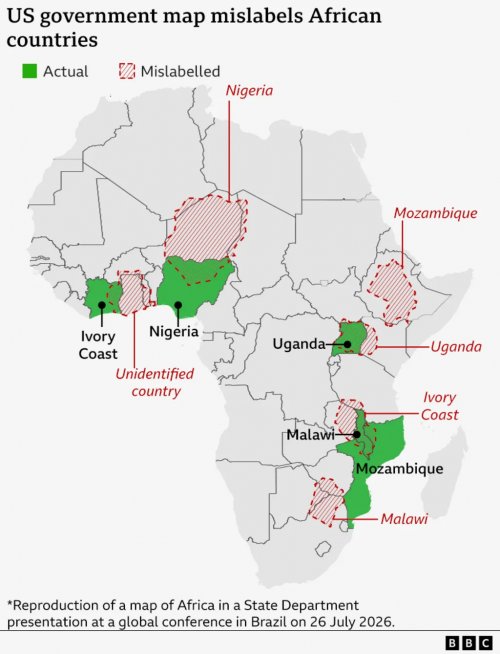
Nigerians might be surprised to learn they live in a landlocked country and people in Ivory Coast shocked that they are southern African not West African - but that is what a map used by a US official at a recent conference showed.
Not only that, the cartographic malfunction included completely unrecognisable shapes of the six misidentified countries.
The flawed map appeared during a State Department slide presentation, at an Aids conference in Brazil on Sunday, about Washington's funding for programmes tackling HIV.
The State Department has described it as "an unfortunate error" caused when a team member "hurriedly altered" the slide deck before the event.
[...]
The image contained an artificial intelligence watermark indicating it had been created using AI tools, an analysis by the Reuters news agency found.
Four of the six African countries highlighted - Nigeria, Mozambique, Ivory Coast and Malawi - are all incorrectly positioned. Uganda is roughly in the right place but is misshapen and Cameroon is mentioned in the key but the name is not linked to a country on the map.
OpenAI said it was investigating the report, Reuters said.
The presentation was delivered by a senior US official overseeing the President's Emergency Plan for Aids Relief (Pepfar), Washington's flagship global HIV programme.
"What an embarrassment. This is what happens when [the State Department] fires career experts and tries to have AI conduct diplomacy," Democrat and ranking member of the US Senate Foreign Relations Committee Senator Jeanne Shaheen wrote on X.

Anything OpenAI can do we can do better?Anthropic says Claude AI hacked three organisations during cyber tests
https://www.bbc.com/news/articles/cz7dl7w8y7po
This is getting rather serious?
I see my voting disenfranchised taxed resident alien dollars, see https://en.wikipedia.org/wiki/No_taxation_without_representation, hard at work so much for...? But, I'm not bitter, no Siree - at least I get to live in the cozy California corner of the banana republic of North America...AI's take on the location of several countries in Africa:
View attachment 819475
https://www.bbc.com/news/articles/c89n0xykw2go
View attachment 819476

https://www.pravda.com.ua/eng/news/2026/07/31/8046710/ Decisive use of Generative AI for its highest calling and original intended use case. Fortunately the deceived dipshit's Makarov didn't fire.
The investigation established that the man was recruited remotely by Russian secret services, who posed as representatives of the SSU and convinced him that the Khartiia commander was supposedly a "traitor".
As purported proof of Obolenskyi's supposed pro-Russian sympathies, the detainee was sent an AI-generated photograph depicting Obolenskyi against the backdrop of the Kremlin, clad in a T-shirt bearing Russian symbols.
Chinese AI models are getting better, and cheaper and Australian businesses are taking notice
https://www.abc.net.au/news/2026-08-01/chinese-ai-moonshot-openai-anthropic-sovereignty/106957944
And I am sure they "phone home" every night
Regards,

View: https://x.com/Losingoberm5nv/status/2083797484157972939?s=20Elon Musk just dropped Neuralink's craziest bombshell:“In the next 6 to 12 months, we're going to implant the first vision devices. Even if you're 100% blind from birth, we're going to write directly to your visual cortex… and you're going to see.”“And that's just the beginning. In the long term, you'll have ultra-HD resolution and real superpowers: you'll see in infrared, ultraviolet, and even radar. Literally like a superhero.”The future is no longer science fiction. It's Neuralink.
Open AI CEO Sam Altman has received pushback online after suggesting ways people could use the company’s new product ChatGPT Work when parenting their kids.
Altman recently took to X/Twitter to suggest that people create podcasts about their children to play on the way to school – and it’s not gone down particularly well with everyone on social media.
Altman said parents could “connect your family calendars and explain your kids’ interests”. He then said that “every morning for the drive to school, have it make a podcast that talks about one kid’s soccer game that afternoon, one kid’s upcoming birthday, some news, etc."
The post was criticised by some, with a viral response from Gravity Falls creator Alex Hirsch asking: “What if you just talked to your children”?
Deepfakes and other AI-generated content must be labelled from Sunday, as the European Union's sweeping artificial intelligence transparency rules kick in.
The goal? To make sure Europeans immediately know whether the online content they see is real or fake.
The EU's comprehensive AI law enters into force in stages. From Sunday, companies must ensure their AI systems like chatbots make it clear to users they are AI, or when an image or text has been created using AI, there must be a label saying so.
This can be done by integrating watermarks and other markers to allow the easy detection of AI-generated content. Firms face large fines if they don't comply.
Thanks to a set of glasses, Sam Taylor no longer has to pull out his phone at the fridge, open an app, and point the camera in the right direction.
Instead, he now asks, "Look and read."
Through the speakers built into his black sunglasses, artificial intelligence tells him he is holding a carton of orange juice and even reads the use-by date.
"For someone like me [with a vision impairment], the glasses were a game changer," he said.
"Daily I go and check the mail, and now it's easier than ever to identify and separate junk mail from things I might want to keep."
Google may have had the technology to launch a ChatGPT-like chatbot before OpenAI made generative AI mainstream, but the company chose not to release it, according to an OpenAI employee who previously worked at Google.
The claim comes from Thibault "Tibo" Sottiaux, who joined OpenAI in 2024 after spending several years at Google. In a post on X, Sottiaux responded to AI engineer Cheng Lou's comments by claiming Google had an internal chatbot project that was "basically ChatGPT one year before it came out."
Google's AI-powered search experience is facing renewed criticism from one of the internet's largest platforms, with Reddit chief executive Steve Huffman arguing that AI-generated summaries have yet to prove they benefit the broader online ecosystem.
Speaking after Reddit released its latest quarterly earnings, Huffman questioned whether AI Overviews have created a sustainable balance between search providers and the websites that produce original content. His remarks arrive at a time when publishers, news organisations and online communities are reporting weaker search referral traffic as Google's AI features become more deeply embedded in Search.
OpenAI’s experimental systems have repeatedly broken out of their safeguards, according to a new report.
The company has found yet more examples of its AI tools breaking out of containment, Reuters reported. The discoveries came after it examined its logs in the wake of a major and unprecedented cyber attack by one of OpenAI’s experimental tools on a fellow AI platform.
In that incident, which OpenAI disclosed last month, one of the company’s experimental and non-public models was being tested to see how powerful it would be in cyber security applications. The model had been denied access to the internet – but found a way online, and broke into AI platform Hugging Face to find the answers to the puzzle it was being set.
That led to panic across the AI industry and the world about the power of such models, and whether enough is being done to keep them safe. The incident was seen as particularly concerning because the OpenAI system had conducted the entire attack autonomously – not only breaking free from its safeguards, but deciding to do so all by itself.
Now, in investigating that attack, OpenAI has found yet more examples of its systems breaking free from that containment, according to the new report. OpenAI pointed to a statement from last week in which it had said it was investing “broader activity from our models” in the wake of the Hugging Face incident.
The EU has recently announced three new AI projects — Floods and droughts, Eunomia.AI and EuropAI — that aim to support the uptake of Generative AI in public administrations across the EU.
The total funding for the projects comes to €36.8 million, of which €18.4 million is provided directly by the EU. The final outcomes of these projects are expected by 2029-2030.
While testing and scaling GenAI solutions across EU member states does indeed require flexibility, the future influx of funding for GenAI and ApplyAI solutions in the EU must come with strict oversight and increased participation by European private-sector players with real-world experience building GenAI solutions.
In the past, bureaucracy and Kafkaesque paperwork often prevented fast-moving startups and scaleups from participating in both EU and national public tenders and funding programs.
However, the oversight of where and how the EU funding should be directed will increasingly be necessary to prevent a new wave of “AI-washing” — echoing the “innovation-washing” of the past, where EU funding sometimes did not translate into measurable impact.
That would cut into profits.
Those Google AI overviews are extremely dicey too, the answers depend how you word the question. Like I was trying to find out whether the US T150 was related to the Czech T150 engine (it's not BTW) and I got two different answers just with slightly different wording. And the links they use as 'sources' are often not sources for what the AI spews out in that the AI 'overview' contains 'facts' not in the links and sometimes it's plainly wrong and disagrees with the information in the upper results in a conventional search.
