FAA says seats on hundreds of Boeing 737 MAX jets were incorrectly installed

joshjosh

ACCESS: Top Secret
Joined
31 May 2024
Messages
690
Reaction score
2,182
https://www.reuters.com/world/faa-s...37-max-were-incorrectly-installed-2026-07-27/
The U.S. Federal Aviation Administration said on Monday that seats on hundreds of Boeing 737 ‌MAX jets registered in the U.S. were incorrectly installed and need to be fixed.
If not, the seats could injure passengers and crew members during an emergency landing or block the aisle and slow an evacuation, the agency said.

The FAA's proposed airworthiness directive issued on Monday would apply to 453 jets registered ⁠in the U.S. The agency only has jurisdiction over U.S. airlines, but foreign regulators typically follow FAA directives if applicable.

The FAA said in the airworthiness directive proposal that it received a report that some passenger seat assemblies were not correctly installed ‌in the ⁠seat tracks.
That meant the assemblies could disengage from the seat tracks if there was an increased load, turbulence or an emergency landing, the FAA said.
"This condition, if not addressed, could result in injury to passengers and crew during an emergency landing or could block the ⁠aisle, which could slow evacuation," it added.

There could be up to 69 track-mounted passenger seat assemblies on each 737 MAX plane and the issue would take an estimated one work hour ⁠to fix each assembly and requires no parts to do so, the FAA said.
It did not say how quickly airlines would need to correct the issue.


Mods, can you add this to the closed 737 MAX thread? https://www.secretprojects.co.uk/threads/boeing-737-max-family-news-only.14158/page-38
 
Last edited:
*facepalm*

Only affecting 453 out of 823 US registered 737 Maxes (presumably pro-rata for non-US registered - so about 1300 worldwide) suggests it's something either introduced by a change in installation processes, or inadvertently fixed by one, or possibly specific to the precise model of seat chosen by the purchaser.

Because seats are a buyer-specified cabin option, I'd presume they were Boeing-installed rather than by Spirit.
 
It's hard to mess up installing seats. The whole thing uses T slots into a rail with circles milled into it. The locking setup uses a bolt on one end to tighten a T bolt into the bottom of the rail at one end of the seat, and a latch that puts a circle into the rail to hold the seat at the other end.

Because seats are a buyer-specified cabin option, I'd presume they were Boeing-installed rather than by Spirit.
Seats are one of the last things installed in the cabin, it may have been done at one of the finishing sites.
 
Would this affect the safety of the 737s as a whole leading to a possible withdrawal world wide until the issue is resolved? Anyhow this is not good news for Boeing.
 
Would this affect the safety of the 737s as a whole leading to a possible withdrawal world wide until the issue is resolved? Anyhow this is not good news for Boeing.
It's only an issue if they crash, and only the affected aircraft, so only about half of 737 Maxes, and not older 737s. It's not an immediate safety of flight issue, so unlikely to lead to immediate groundings, more likely a 'fix it by date X if you haven't done it already.' It could potentially be something done at the next B check, which is usually every 6-8 months. Given Boeing sent out the notice about it in December, many may already have been fixed, it'll just need FAA chasing it to make certain every airline has fixed every aircraft.
 
So how dod they know which ones are affected with the dodgy seats? I suppose that they will have to go throught every one of the affected aircraft and find out what ones have the afected seats.
 
Man the hits keep coming. Tonight on Leave it to Boeing, Episode 50, Passenger Crash Test Dummies.
 
It's hard to mess up installing seats. The whole thing uses T slots into a rail with circles milled into it. The locking setup uses a bolt on one end to tighten a T bolt into the bottom of the rail at one end of the seat, and a latch that puts a circle into the rail to hold the seat at the other end.


Seats are one of the last things installed in the cabin, it may have been done at one of the finishing sites.
Material or bolt class.
The rail itself is Aluminum and cheap. So messing with it wouldn't bring any cost advantages. But the bolts and nuts themselves can vary in cost from an order of magnitude. And inherently, swapping one with a lower class is what brings you at worst seats separation and people flying... inside the flying machine!

But at this stage information are scarce, only headers. So let's wait and see.
 
Last edited:
A Navy buddy of mine left Boeing after 32 years and early retired who worked the 747, could not take it anymore. Boeing used to promote within the ranks and now they give up to Director-level positions to new grads with no experience and with degrees which do not relate to the positions in some cases. Once you leave school, you have to pay your dues. You graduate school thinking you are an Engineer, not yet, now you have to work and learn, it's the real world, not the academia dream state. Boeing used to be a great place to work but not anymore and hopefully, this will change.
 
Boeing used to promote within the ranks and now they give up to Director-level positions to new grads with no experience and with degrees which do not relate to the positions in some cases

That would go a long way to explaining Boeing's problems, Boeing senior management really needs to have engineering backgrounds.
 
Substandard materials ? Shoddy workmanship ? Damage when fitting the doors ?
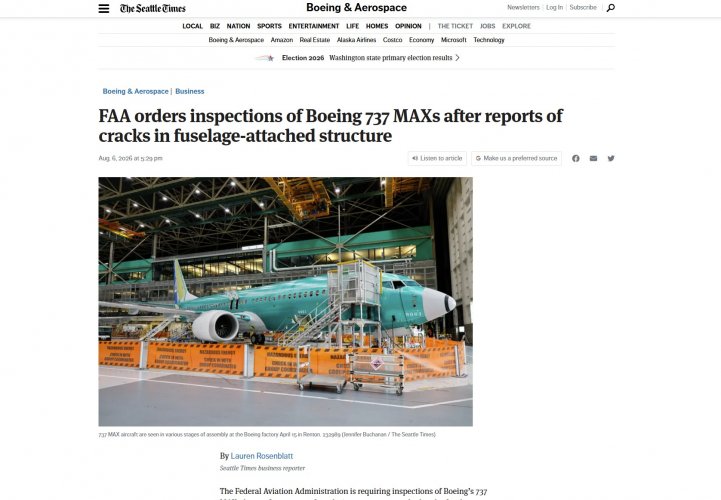
https://www.techtimes.com/articles/...d-every-jets-bear-strap-during-production.htm

TLDR: It's a high stress point, and 'hot bonding' the structure left minute scratches that have been shown to eventually develop into fatigue cracks on 737 NGs, and as the Maxes use the same parts and manufacturing processes, they're likely to be just as susceptible, they just haven't seen it happen yet.
 
https://www.techtimes.com/articles/...d-every-jets-bear-strap-during-production.htm

TLDR: It's a high stress point, and 'hot bonding' the structure left minute scratches that have been shown to eventually develop into fatigue cracks on 737 NGs, and as the Maxes use the same parts and manufacturing processes, they're likely to be just as susceptible, they just haven't seen it happen yet.
I can't say I ever saw that on 727s, but the logic is sound. (I'm guessing that 727s used the same bear strap attachment method as 737s)
 

Similar threads

Back
Top Bottom