
You are using an out of date browser. It may not display this or other websites correctly.
You should upgrade or use an alternative browser.
You should upgrade or use an alternative browser.
Bomber generations?
- Thread starter lmaoxd
- Start date

- Joined
- 3 June 2011
- Messages
- 20,991
- Reaction score
- 19,255
Never heard the whole Gen X thing applied to bombers. One could make rough approximations but even that is debatable. Only two countries have produced bombers long enough for the conversation to even be relevant.Is the B21 considered 6th gen? or just a highly evolved 5th gen bomber? like are there even generational qualifications for bombers?
Is the B21 considered 6th gen? or just a highly evolved 5th gen bomber? like are there even generational qualifications for bombers?
It is marketed as 6 gen. But even “5th generation” has a very vague definition. 6th gen is perhaps even less well defined.

I think 6th gen is a meaningless metric when applied to bombers. There are only three countries building and operating bombers, and all of them are attempting to produce a long range stealth bomber to various levels of success. China and Russia also still produce legacy bombers.

- Joined
- 1 April 2006
- Messages
- 12,285
- Reaction score
- 15,110
Is the B21 considered 6th gen? or just a highly evolved 5th gen bomber? like are there even generational qualifications for bombers?
5 or 6? Because it was both depending of speaker, lol:
In 2016, Air Force Secretary Deborah Lee James said the B-21 would be a "fifth-generation global precision attack platform" with networked sensor-shoot capability.[8] In 2022, Northrop Grumman describes the B-21 as "the world's first sixth-generation aircraft."[14]
You can spend a spare time to email requests to AF and NG public relations asking what exactly did they mean.

- Joined
- 30 May 2023
- Messages
- 674
- Reaction score
- 1,451
I believe Raider is clearly 6th gen in the sense that it was purpose built to maximize OSAs as much as possible; this increased inherent upgradeability with enhanced LO from the Spirit clearly make it a 6th gen bomber, to me.
FWIW IMSO B-17/24 1st gen, B-29/36 2nd gen, jet age as exemplified by Hustler or BUFF for 3rd, BONE for 4th, Spirit is 5th. I don’t think it’s complicated.
FWIW IMSO B-17/24 1st gen, B-29/36 2nd gen, jet age as exemplified by Hustler or BUFF for 3rd, BONE for 4th, Spirit is 5th. I don’t think it’s complicated.

A subsonic aircraft cannot belong to the fifth or sixth generation, because these are generations of supersonic aircraft.
A subsonic aircraft cannot belong to the fifth or sixth generation, because these are generations of supersonic aircraft.
I guess no manned bomber will ever be 6th generation. Which kinda fits with my original thinking…
- Joined
- 3 June 2011
- Messages
- 20,991
- Reaction score
- 19,255
Says who? Even for fighters the first couple generations weren't supersonic.A subsonic aircraft cannot belong to the fifth or sixth generation, because these are generations of supersonic aircraft.
Scott Kenny
ACCESS: USAP
- Joined
- 15 May 2023
- Messages
- 19,674
- Reaction score
- 28,153
If the fighters are at 6th generation, there's at least one subsonic generation of fighter in there.A subsonic aircraft cannot belong to the fifth or sixth generation, because these are generations of supersonic aircraft.
Using US fighters because I know them a lot better.
1st generation: P-80, F-84, F-86 <- all subsonic!
2nd Generation: F-100 <- first supersonic
3rd Generation: F-4 <- first Mach 2
4th Generation: F-14, F-15, F-16, F-18
5th Generation: F-22, F-35
6th Generation F-47
US bombers:
1st Generation: B-47
2nd Generation: B-52, B-58
3rd Generation: XB-70, FB-111
4th Generation: B-1
5th Generation: B-2
6th Generation: B-21
The 5th Generation bomber was subsonic, paralay.
1st generation: development of the aircraft concept (1882–1905)
2nd generation: reconnaissance aircraft (1905-1914)
3rd generation: the emergence of fighters and bombers (1914-1930)
4th generation: retractable landing gear, development of aerodynamics (1930-1940)
5th generation: perfect aerodynamics, enclosed cockpit (1940-1945)
6th generation: concept development jet aircraft (1940-1950)
7th generation: serial jet aircraft, swept wing (1950-1955)
8th generation: supersonic aircraft with a speed of 1.5 Mach, guided missiles and radars (1955-1960), the first generation of supersonic
9th generation: supersonic aircraft with a Mach 2 speed, triangular wing (1960–1965), second generation of supersonic aircraft
10th generation: Mach 3 speed, variable geometry wing (1965–1970), third generation of supersonic aircraft
11th generation: operational overload of 9 g (1970–1990), fourth generation of supersonic aircraft 12th generation: stealth technology, supersonic cruising (1990–2015), fifth generation of supersonic
13th generation: unmanned aviation (2015–2040), sixth generation of supersonic
14th generation: hypersonic aviation, seventh generation of supersonic
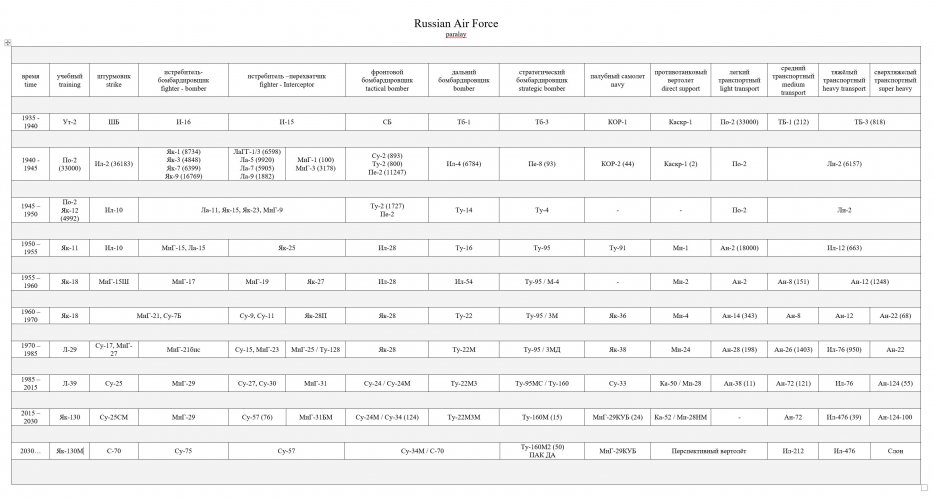
The conventional classification begins with the production-scale supersonic fighter. The first generation in the USA is the F-100, in the USSR the MiG-19. In the USA, the first supersonic bomber B-58 appeared together with the second generation of fighters. In the USSR, the Il-54 belongs to the first generation
2nd generation: reconnaissance aircraft (1905-1914)
3rd generation: the emergence of fighters and bombers (1914-1930)
4th generation: retractable landing gear, development of aerodynamics (1930-1940)
5th generation: perfect aerodynamics, enclosed cockpit (1940-1945)
6th generation: concept development jet aircraft (1940-1950)
7th generation: serial jet aircraft, swept wing (1950-1955)
8th generation: supersonic aircraft with a speed of 1.5 Mach, guided missiles and radars (1955-1960), the first generation of supersonic
9th generation: supersonic aircraft with a Mach 2 speed, triangular wing (1960–1965), second generation of supersonic aircraft
10th generation: Mach 3 speed, variable geometry wing (1965–1970), third generation of supersonic aircraft
11th generation: operational overload of 9 g (1970–1990), fourth generation of supersonic aircraft 12th generation: stealth technology, supersonic cruising (1990–2015), fifth generation of supersonic
13th generation: unmanned aviation (2015–2040), sixth generation of supersonic
14th generation: hypersonic aviation, seventh generation of supersonic
The conventional classification begins with the production-scale supersonic fighter. The first generation in the USA is the F-100, in the USSR the MiG-19. In the USA, the first supersonic bomber B-58 appeared together with the second generation of fighters. In the USSR, the Il-54 belongs to the first generation
Attachments

Last edited:
Not James Stockdale
ACCESS: Secret
- Joined
- 29 August 2025
- Messages
- 257
- Reaction score
- 477
The most important thing to remember with aircraft generations is that they are completely fake. I think NG meant that the B-21 has technology equivalent to what would be expected in a so-called "sixth generation" fighter.
This means that the RCS area has been reduced by half, from 0.4 m2 to 0.2 m2, and unmanned flight is now possible.The most important thing to remember with aircraft generations is that they are completely fake. I think NG meant that the B-21 has technology equivalent to what would be expected in a so-called "sixth generation" fighter.
Ainen
I really should change my personal text
- Joined
- 25 August 2011
- Messages
- 2,868
- Reaction score
- 4,976
And if a fighter is designed subsonic in 1980s or 1990s? Some Harriers are fighters, after all.A subsonic aircraft cannot belong to the fifth or sixth generation, because these are generations of supersonic aircraft.
Or, idk, LO and supercruising in 1960s? YF-12 was also a thing.
Or, or, or...

- Joined
- 26 May 2011
- Messages
- 2,630
- Reaction score
- 4,651
Must agree. Always considered the 'generations' to be complete PR bollocks that escaped.Never heard the whole Gen X thing applied to bombers. One could make rough approximations but even that is debatable. Only two countries have produced bombers long enough for the conversation to even be relevant.
Chris

FighterJock
ACCESS: Above Top Secret
- Joined
- 29 October 2007
- Messages
- 7,256
- Reaction score
- 8,571
Too right Chris, I was never a fan of the whole generation thing to begin with. I first came across it back in the 1980s when the YF-23 and YF-22 were chosen to take part in the ATF fly off.

- Joined
- 13 August 2007
- Messages
- 10,423
- Reaction score
- 18,114
What about B-17, B-29 and B-36 ?

Avimimus
ACCESS: Top Secret
- Joined
- 15 December 2007
- Messages
- 2,719
- Reaction score
- 1,416
What about B-17, B-29 and B-36 ?
Before that there are a few too, including Martin MB-1
The F-35 does not have a cruising supersonic speed, but this does not mean that it is not a fifth-generation aircraft.And if a fighter is designed subsonic in 1980s or 1990s? Some Harriers are fighters, after all.
Or, idk, LO and supercruising in 1960s? YF-12 was also a thing.
Or, or, or...
If you were to place the wings of aircraft from different periods in front of you, you would easily be able to divide them into generations based on their similarities.
FighterJock
ACCESS: Above Top Secret
- Joined
- 29 October 2007
- Messages
- 7,256
- Reaction score
- 8,571
True Paralay, but it does have sensor fusion something that the F-22 does not have and also EW capabilities.
Similar threads
-
 Is it cost effective to keep 3rd generation combat aircraft?
- Started by helmutkohl
- Replies: 21
-
 Indian Navy fighter project, TEDBF (Twin Engine Deck Based Fighter)
- Started by covert_shores
- Replies: 17
-

-
 USAF rethinks future fleet, ponders clean-sheet 4.5-generation fighter
- Started by DWG
- Replies: 2
-