- Joined
- 16 January 2015
- Messages
- 885
- Reaction score
- 4,844


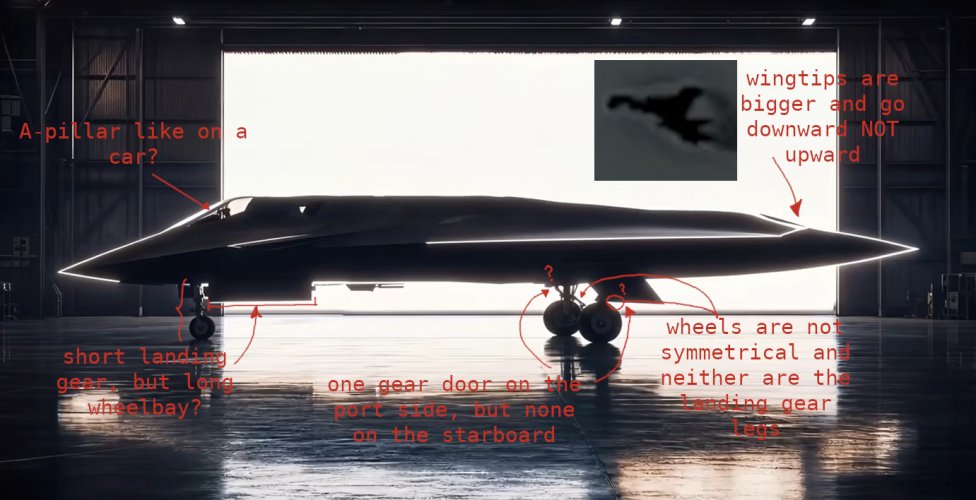
We dont know what F-47 will look like , all is possibility, and may be the plane seen near the Area51 have nothing to see with the final F-47I don't mean to offend anyone, but as @joshjosh pointed out, this is clearly AI generated.
And it's not even well done...besides the typical nonsense of flashy/cool AI pics, taking a bit of time to really look at how this thing is "built", makes it kinda obvious.
View attachment 818715
Where this picture come from ?I don't mean to offend anyone, but as @joshjosh pointed out, this is clearly AI generated.
And it's not even well done...besides the typical nonsense of flashy/cool AI pics, taking a bit of time to really look at how this thing is "built", makes it kinda obvious.
View attachment 818715
F-119 is still not in production.https://breakingdefense.com/2026/07/air-force-eyes-next-gen-engine-integration-by-2030/
It is good news that options such as the F119 and X101/102 engines can be ruled out.
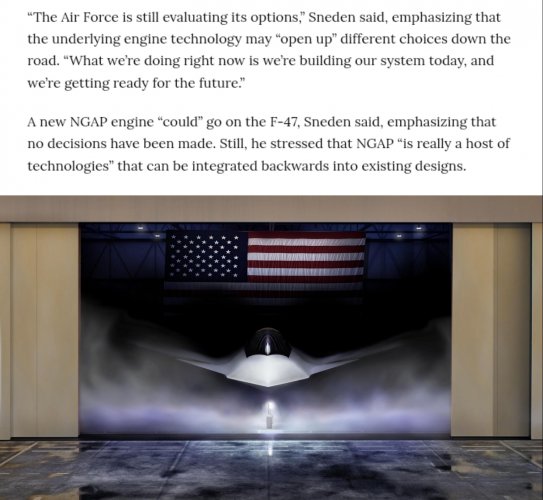
“Snedden stated that the new NGAP engine ‘could potentially’ be installed on the F-47 fighter, though he emphasized that no decision has been made yet. However, he also stressed that NGAP is ‘essentially a suite of technologies’ that can be retrofitted into existing designs.”

That sounds like weasel words for, "we don't have an engine".https://breakingdefense.com/2026/07/air-force-eyes-next-gen-engine-integration-by-2030/
It is good news that options such as the F119 and X101/102 engines can be ruled out.
“Snedden stated that the new NGAP engine ‘could potentially’ be installed on the F-47 fighter, though he emphasized that no decision has been made yet. However, he also stressed that NGAP is ‘essentially a suite of technologies’ that can be retrofitted into existing designs.”

They kinda state it directly in the articleThat sounds like weasel words for, "we don't have an engine".
But from how it reads, this feels like an entire family of engine designs coming and will be retrofitted to more than one platform. Not necessarily a bad thing.“The last non-derivative fighter engine that we pressed forward was in the 1990s,” Sneden said. “If you want to stay ahead of our competitors, then you have to lean into this technology now.”
Which part? I read the article and all I saw was a bunch of hand waving. Is it GE, P&W or both? Have they built an engine? Have they run it?They kinda state it directly in the article
But the USAF can take a handful of F119s from the F-22 spare engine fleet to support initial F-47 flight test airworthiness and envelope expansion. A lot depends on whether the F119 nozzle is usable on the F-47 or if a different nozzle configuration is needed. And if a different nozzle is needed, do you pay to develop an interim engine nozzle configuration to support initial flight test, whether that interim engine is F119 or F110.F-119 is still not in production.
Oh i put it in a quote. I guess they are not directly saying it but seems like that is the case.Which part? I read the article and all I saw was a bunch of hand waving. Is it GE, P&W or both? Have they built an engine? Have they run it?
The one in Fightingirish's post from the previous page here?Where this picture come from ?
While I agree that the plane seen in ProjectFear's video is not the F-47, but rather what I believe to be Boeing AII-X demonstrator, and that we don't yet know what the F-47 will look like, I'd be willing to bet money that it won't look anything like that AI generated picture.We dont know what F-47 will look like , all is possibility, and may be the plane seen near the Area51 have nothing to see with the final F-47

The DDR for XA102 was completed in early 25, followed by XA103. Assembly readiness review occurred earlier this year. Getting a full part set for such an engine is probably a two year effort, even if we don’t assume extra lead time for more exotic bits and bobs that enable these next gen engines.Which part? I read the article and all I saw was a bunch of hand waving. Is it GE, P&W or both? Have they built an engine? Have they run it?

Which one?This picture
... can be deduced from this:This picture could be the FA/XX Boeing project ?
... and is in fact spelled out here:And it's not even well done...besides the typical nonsense of flashy/cool AI pics, taking a bit of time to really look at how this thing is "built", makes it kinda obvious.
... so the answer to your question (*) was provided before - "no, Boeing AII-X demonstrator or Boeing F-47 is unlikely to look like that AI generated picture".While I agree that the plane seen in ProjectFear's video is not the F-47, but rather what I believe to be Boeing AII-X demonstrator, and that we don't yet know what the F-47 will look like, I'd be willing to bet money that it won't look anything like that AI generated picture.
ExactlySo they have not built either, much less flown. Still much work to be done; as someone much smarter than me told me, early casting yields are ugly and the US isn’t exactly swimming in free forging slots.
Or it could get stuck with TF30s for the majority of its career.I guess the silver lining of all this uncertainty about what engine will eventually go into the F-47 (and the implication that it may start with a more conventional engine before upgrading to an adaptive flow engine down the line), is that it may end up with oversized engine bays like the F-14, which could make later engine upgrades easier.

The AF could have delayed F-47 and wait for the engine if it was that critical. The DFE back in the day is was pretty much plug and play at least for the F-16. There were minor differences in the F100/F110 versions of the fighter such as the big mouth intake for the F110.But the USAF can take a handful of F119s from the F-22 spare engine fleet to support initial F-47 flight test airworthiness and envelope expansion. A lot depends on whether the F119 nozzle is usable on the F-47 or if a different nozzle configuration is needed. And if a different nozzle is needed, do you pay to develop an interim engine nozzle configuration to support initial flight test, whether that interim engine is F119 or F110.
Firstly:I doubt there is an advanced undisclosed engine as the AF was having difficulty carrying two different designs through EMD for NGAP.
And regarding two different designs:Air Force officials have previously said NGAP is designed to be platform agnostic, meaning the engine architecture could serve various propulsion needs
They are looking to build multiple different engines and possibly for multiple different platforms going forward.Sneden acknowledged NGAP’s schedule has slipped and said it was because the program wanted to keep working with two viable vendors who could provide advanced propulsion technology. With a fixed budget, he said that meant splitting resources between two vendors instead of one.
I'd argue that we're more likely to see this fail. The last time the US accepted an aircraft with an interim engine was the F-14. And the US was still flying the interim-engined Tomcats at type retirement!That is unless the entire goal of constantly re-competing and replacing parts of the plane is left wholly unmet.
It's about time that a new family of engines were developed. F119 at this point is 30ish years old. F135 is still a derivative of the F119 family. From the way it's being described, this sounds a lot less like "we don't have engines" and more like "we'd like this technology to port to a number of different platforms and use cases". I'd even argue that NGAP and the surrounding set of engine technology has been fairly consistent in it's goal since their inception - developing a particular set of engine technology portable to a number of different platforms of which the F-47 is one of them.I'd argue that we're more likely to see this fail. The last time the US accepted an aircraft with an interim engine was the F-14. And the US was still flying the interim-engined Tomcats at type retirement!

Firstly:
And regarding two different designs:
They are looking to build multiple different engines and possibly for multiple different platforms going forward.
https://www.airandspaceforces.com/u...ting-ahead-of-2030-integration-onto-aircraft/
NEXT GENERATION ADAPTIVE PROPULSION
Maintaining competition in the Next Generation Adaptive
Propulsion (NGAP) program remains a priority to spur
innovation and sustain a healthy industrial base. The
agreement encourages the Secretary of the Air Force to
maintain the NGAP competition until two fully developed and
tested prototypes are presented to the Air Force for
evaluation.
I assumed that's what they meant with this little bit:Not exactly.
It sounds more like it's a set of technologies surrounding adaptive cycling engines that's being designed / matured and then possibly used for different platforms but maybe that's not what that means? That's what I meant with it being used for other engines going forward.“We built NGAP as essentially an agnostic system,” Sneden said. “It was, build the system first, open up options for the future, and then when those options come to the forefront, we’ll be able to take advantage of it. You have to lean into propulsion technology first.”
I assumed that's what they meant with this little bit:
It sounds more like it's a set of technologies surrounding adaptive cycling engines that's being designed / matured and then possibly used for different platforms but maybe that's not what that means? That's what I meant with it being used for other engines going forward.

A possibility that is being overlooked is that from the get-go the baseline design and performance is based on and designed around an already available engine for the sake of schedule, risk, and reliability. Even an upgraded version of a current engine could be sufficient enough to meet or even exceed the performance values the AF was looking for.I'd argue that we're more likely to see this fail. The last time the US accepted an aircraft with an interim engine was the F-14. And the US was still flying the interim-engined Tomcats at type retirement!
Meaning NGAP seems to be well behind the curve (it may not be but what's being said doesn't inspire confidence). Maybe, like the Tomcat, the "interim" engine is the one the vast majority of F-47s are stuck with. "Back in the day", there were pictures of the PW5000 with TVC running on test stands before we even knew what the YF-22/23 looked like. Where is NGAP? Who is building it?TF-30s? The engine that plauged the F-14 for most of it's early career Sferrin? I would not touch it with a barge poll.
@quellish did say that one of the demonstrators were already flying with an engine that may or may not be in serial production (though i could be misrepresenting his words here with a lack of understanding).Maybe, like the Tomcat, the "interim" engine is the one the vast majority of F-47s are stuck with. "Back in the day", there were pictures of the PW5000 with TVC running on test stands before we even knew what the YF-22/23 looked like. Where is NGAP? Who is building it?
It flew for 20 years before it got the engine upgrade, with most never getting it. Now if it were an A-12 situation, where it flew with J75s while they finished up the J58s, that would be a different thing.@quellish did say that one of the demonstrators were already flying with an engine that may or may not be in serial production (though i could be misrepresenting his words here with a lack of understanding).
I think people have to realize that while the F-14 problem was problematic for its mission performance, the politics of the time was not helpful in getting the new engines installed. Post nam drawdowns, the thawing of relations with the USSR really didnt do well to give the navy urgency. Added to that, with the hornet eventually set to replace the F-14 in all its roles, there simply wasnt any steam left to warrant the reolacement of the whole fleets engines by the time of retirement.
The F401 engine failed because it was a little too ambitious and it was to be fielded on a compressed schedule.It flew for 20 years before it got the engine upgrade, with most never getting it. Now if it were an A-12 situation, where it flew with J75s while they finished up the J58s, that would be a different thing.


F135 is too large and heavy. What they want and need is F135 thrust in F110 size with a TWR of >10:1What don't you like about the F135?
The thrust class is the same, the fuselage layout is the same, and the fuel consumption is more or less the same