Anduril x Archer Thunder VTOL

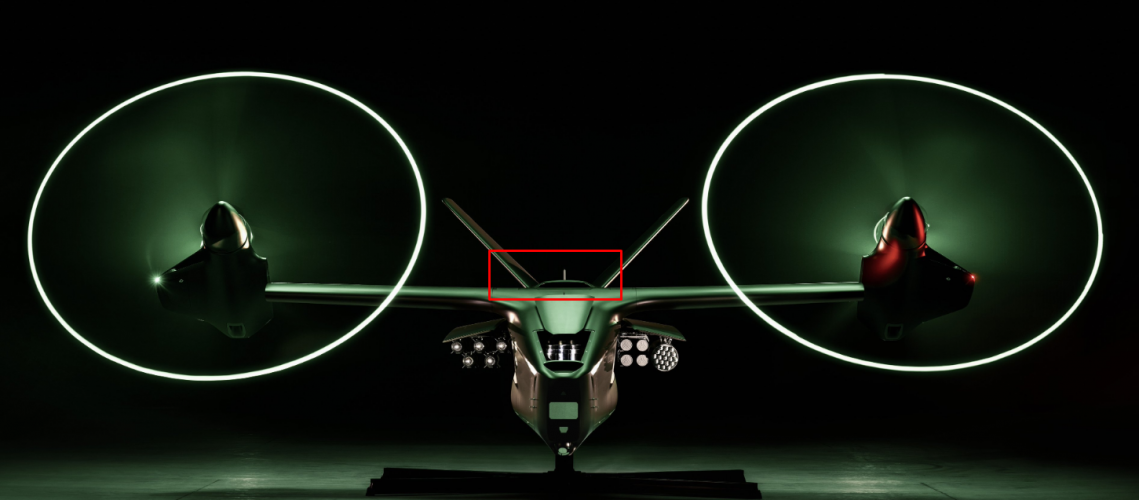
Nose mounted interceptors is an interesting idea
 

Attachments

  • IMG_9220.jpeg
    IMG_9220.jpeg
    348.5 KB · Views: 239
Last edited by a moderator:
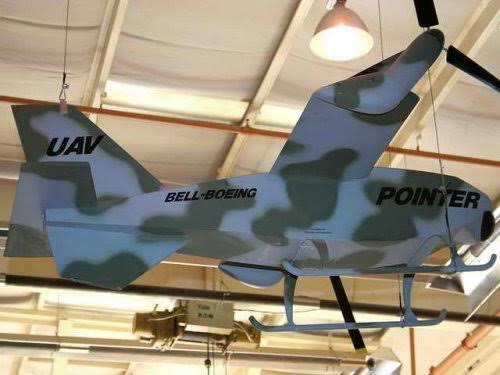
This may be completely unrelated, but FARA's cancellation makes a lot more sense now.

The renderings don't seem to have much space for the hybrid propulsion system or landing gear, I wonder how far along the design is.
 
But is it an EV or a turbine powered aircraft? Any more details were reported?

If they took Archer concept and remove the batteries, that would make sense, otherwise, good luck for keeping up with a Cheyenne II in speed or range.
Also, If the battery pack is out, then there is no sense claiming about the low acoustic footprint. Noise spectrum would be very different
 
I suspect the acoustic footprint is referring to the ability to drastically reduce the rotor RPM in airplane mode that Karem demonstrated with OSTR. I am doubtful that even if running off of batteries in helicopter mode would reduce the acoustic signature as much. Noise attenuation for the turbine might be somewhat reduced with engine location and size. If I read correctly Thunder will not use mechanical shafts for power generation. It will use electrical power, likely running through parallel paths to the proprotor generator. This might also increase survivability by providing redundant power means to the proprotors. A big concern for me with all of this electrical power is cooling for many of the components.
 
It seems very promising. The only downside I see is the lack of a radar. But it looks like you could fit a large AESA in the weapons bay. A couple of these drones with side mounted AESAs and an APKWS pod could be pretty potent at patrolling an area and protecting against OWA drones.
 
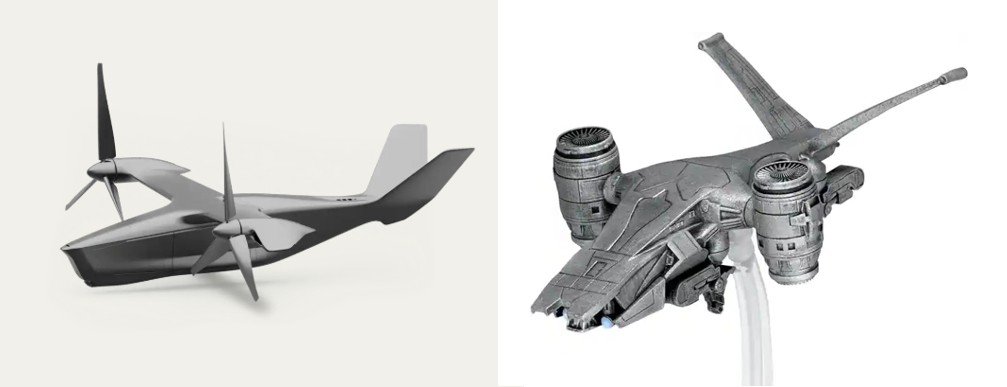
Looks nice, but it also reeks of futuristic vaporware that will never see the light of day in this terminator-esque form. Not to mention that Andurils other major endeavour, the YFQ-44, is beyond conservative (which may be to it's detriment down the line). So I'd be curious if they can deliver on their nice CG rendering in the near future.
 
But is it an EV or a turbine powered aircraft? Any more details were reported?

If they took Archer concept and remove the batteries, that would make sense, otherwise, good luck for keeping up with a Cheyenne II in speed or range.
Also, If the battery pack is out, then there is no sense claiming about the low acoustic footprint. Noise spectrum would be very different

It has an intake and exhaust, so presumably there's a turbine in there.

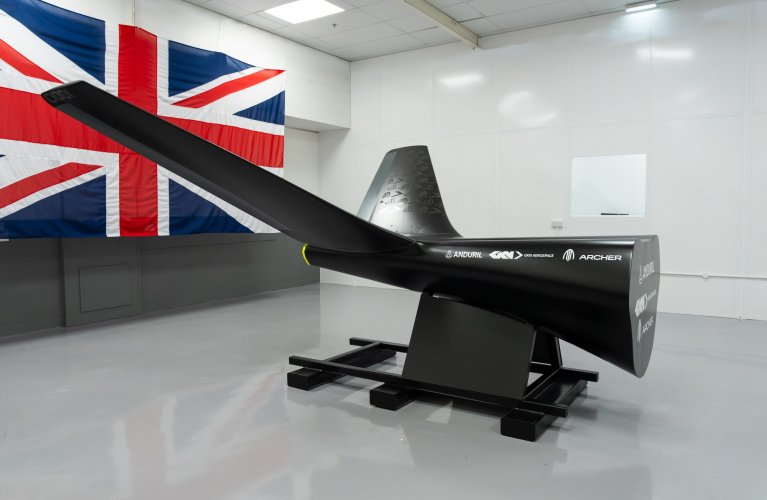
However the showcased product is clearly a 3D printed subscale demonstrator, so the project clearly isn't really that far along (at least they could've gotten to the static test piece stage, like the Russians did with the Su-75, and they stil got a lot of flak for it being vaporware).
I don't think we'll see this flying soon, and when and if it does, I expect it'll be substantially different.
 

Attachments

  • 1784580306940.png
    1784580306940.png
    737.8 KB · Views: 164
Last edited by a moderator:
Ngl "ACTIVATE THUNDAHHHHHH" got me :cool:. The GI-Joe Bro animation - idk.
Yeah, that animation with the Russian thermobaric artillery firing AA rockets, Russian TELs shown as half-deployed (the first Google pic searching for S-300 shows it in the process of deployment of the launch tubes to vertical, so the animators thought it would be always like that?). The whole thing about these drones flying alongside Apaches (the whole point of tiltrotors is they fly faster than helicopters). Dunno, it's clearly people who know stuff about military hardware at least on the level of your War Thunder player haven't really been involved with the production.
 
View attachment 818462
It has an intake and exhaust, so presumably there's a turbine in there.

However the showcased product is clearly a 3D printed subscale demonstrator, so the project clearly isn't really that far along (at least they could've gotten to the static test piece stage, like the Russians did with the Su-75, and they stil got a lot of flak for it being vaporware).
I don't think we'll see this flying soon, and when and if it does, I expect it'll be substantially different.
First flight in 2027
 
Looks nice, but it also reeks of futuristic vaporware that will never see the light of day in this terminator-esque form. Not to mention that Andurils other major endeavour, the YFQ-44, is beyond conservative (which may be to it's detriment down the line). So I'd be curious if they can deliver on their nice CG rendering in the near future.
YFQ-44 entire sales pitch is that Chevrolet or Ford can build them with minimal change to their factories in event of war time economy. the platform's bells and whistles are irrelevant.

I do have to say in regards to this Thunder bird, the shape does look like one of those startup's mockup that never gets past the presentation slides.
 
Let's say I'm skeptical but happy to be proven wrong.
Certainly rational reasoning for skepticism. At the risk of sounding like a Anduril fanboy (I'm not), they have a habit of turning a product in very short times. The viability of the product may be questionable, but they take a couple years, where most conventional vendors take a decade, even with money thrown at them.

The acid test will be what is the military willing to trade for this sort of capability. In the end the most brilliant capability won't make it if the service is not willing to trade systems and the people who maintain them for the new capability. There is likely some room in the U.S. Army if this sort of platform replaces another UAS organization that replaced half of the Apache battalions.
 
AH-64E makes a good ALE truck able to suppress anything that emits. like drone c2, drone jammers etc. Scouting can be done via ALEs. Any Apache replacement need carry sniper scouts deep & recover them under fire if things go sideways.
 
I could see this being fairly effective for the SANDY mission set.
 
I was thinking about this a bit more... and given a history of trolling (if you know what this post means)
View: https://x.com/PalmerLuckey/status/1282442963918848001


There is this private wish here he'd do a tedx on this vehicle but fill it with terminator (aka slaughterbots) refs, for the "we plan to create the torment nexus from the novel 'don't create torment nexus'" humor.

Can you meme yourself into the military industrial complex? What does marketing for weapons really mean anyways?
 
I would like to more a bit on this project - what's the powerplant, range, what's the intended weight, how powerful are the motors driving the screws etc - to make sense of what they're going for.
As for the VTOL layout - it took like 50 years to make the V-22 Osprey, if we count the time from experimental VTOL to service entry, and its an enormously complex machine, whose existence has been called into question.
Generally the argument goes that the V-22 is worse at hovering, and doing helicopter things than a helicopter, and worse at cruising than a screw-propelled aircraft. It all comes down to the sizes of the rotors. The V-22's rotors are smaller than an equivalent helicopters, giving it a more powerful downwash and less efficient hover, while they're bigger than one designed for an airplane, making it draggier and limiting tip speed.
That said, while the V-22, is worse than both in their dedicated roles, it can do both, and some cases do require that, mostly ones having to do with carrying personnel, such as special ops insertion/extraction and medevac. This being an unmanned drone, and an attack aircraft means this doesn't apply here - it's unlikely this is going to be carrying personnel in any form, so I can't shake the feeling that they should figure out whether they want a helicopter or an attack plane, and build that.

Looking at the airplane, the screws look proportionally smaller than the Osprey's and the winds block a lot of the airflow, so this thing will have an even harder time hovering than the V-22. All that said, if they're going with electric motors, and a hybrid battery/turbine propulsion, I think this *might* make sense: modern electic motors are crazy power dense, easily 10x of what a turbine can do, even if such performance cannot be sustained, it might be good enough for short hovers, vertical takeoff and landing, if not more. But in flight, this approach gains you nothing - your screws are still bigger than needed for efficient flight, and getting the power from a turbine to a screw via this complex electrical scheme (rather than a simple shaft) is just crazy overkill.
Likewise batteries can supply tremendous amounts of power (in these small drones, power draw can be like 50x capacity at peak, or more), but their density sucks.

So with regards to the screw design, VTOL results in an unhappy compromise, but without the special mission set to justify it, like the V-22 has.

If this is a VTOL attack plane, I'd say just drop the VTOL part and operate from a short runway with a much more traditional attack aircraft. like a Bronco, but drone.

 
Hybrid-electric, great starting point, all electric, won't cut it.
 
Back
Top Bottom