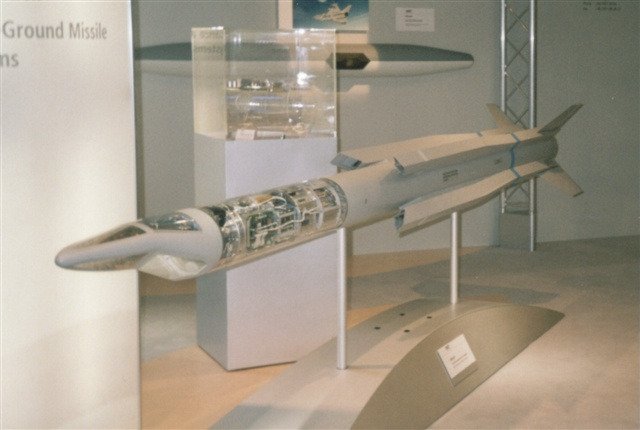
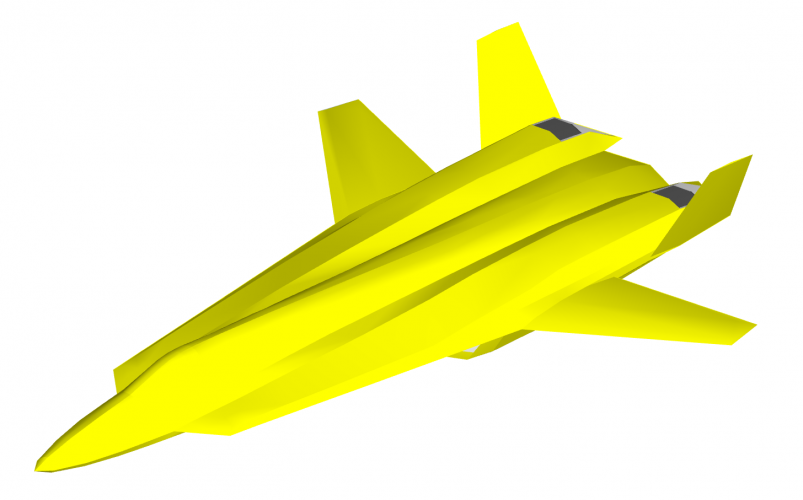
Forum Design Challenge: Conceptualizing a modern interceptor, forum input requested.

Scott Kenny

ACCESS: USAP
Joined
15 May 2023
Messages
19,533
Reaction score
27,979
Had an idea bubble up in the F-106 thread while we were bashing around the idea of F-35 versus F-106, and I would like the forum's input on choices. Note that I do not have a mental image of what this airframe should look like.

If you gave the F-35 the F-106's weapons, electronics, and radar, (or vice versa) it would be a more fair comparison.
Using the F-106 delta airframe would be doable, though I'm not sure we'd want a non-stealth aircraft. It looks like the F135 will actually fit into the same space as the F-106's J75, though you're going to need ~20% larger inlets to handle the airflow. F119 would be fun to allow supercruise, but I don't think it is still in production. Certainly might have individual pieces in production for spare parts but no complete engines.
And of course you'd have to totally redesign the weapons bay to handle AIM-260s and AMRAAMs.


So, what if we built a modern interceptor, using current MOTS weapons and avionics as much as possible?

F-35 avionics, but swap the EOTS (IIRC a Sniper or Sniper XR pod) for an air-to-air optimized IRST like the Legion pod. Because it does work (mostly) and is in current production. No development time, just contracting time to deliver radars.
(We will assume that there's other aircraft doing the bombing, like F-35 and B-21; and other aircraft doing the Air Superiority/Air Dominance missions over the front lines. like F-22. no reason to install both EOTS and IRST)
  • Keep the same antenna size as APG-81/85, or take advantage of presumed larger radar bulkhead and install a larger antenna?


But let's assume that we're going to design a whole new airframe instead of dropping F-35 engine and avionics into an F-106:
  • For the sake of the range discussion, let's assume that the US, Canada, and Australia are the primary client countries, and in an unusual recognition of where an interceptor protecting the USA should be deployed the USAF is actually giving priority to Canadian range requirements.
    • What should those range requirements be? 2 hours at 500nmi from base like GCAP and maybe F-47? 2 hours at 250nmi like F-14 or F-111B?
  • Engines off the shelf means F100s, F110s, and F135s. One or two engines?
  • How much stealth? None, Shaping/panel edge alignment with RAM only in the inlets, full cutting edge stealth?
 
though I'm not sure we'd want a non-stealth aircraft.
with F-106 internal weapon bay, you got low radar cross-section

but what is the Role of this aircraft ?
Interceptor, dog fighter or multi purpose combat aircraft ?
those specification are important for final design
 
with F-106 internal weapon bay, you got low radar cross-section

but what is the Role of this aircraft ?
Interceptor, dog fighter or multi purpose combat aircraft ?
those specification are important for final design
BARCAP interceptor, I think. AVRO Arrow, F-106, MiG-31 type of plane.

Guarding your airspace from cruise missiles (and any bombers that want to try to play) at various speeds and altitudes.
 
I would want ultrahigh sweep leading edges, non-stealth but frontal angle low observability, large fuel ratio, supercruise (think F119 not F135), laser weapon, and internally carried weapons. And if you can avoid a canopy bump using DAS and EOTS, that would be good for drag reduction. AESA radar, but with a narrow and fixed frontal array and other flat arrays on the fuselage (or wing tanks?) so scans can be made in 120 degree arcs to each side.

A flat TVC nozzle would improve handling on takeoff and landings. We do not need another F-35 version, but it cost-wise may be ideal to modify the base model into a supercruise version using the F119. Lasers are the future, especially for during an intercept. The front end would certainly not resemble F-35 but probably be the biggest cost to develop to coordinate three AESA arrays for maximum search rates. It would be much harder to notch the radar if distributed, and three arrays gives you three units to use in EW. Wingtip sensors may also passively locate threats and targets alike. Six AIM-9X/AIM-120 internally would be a good baseline, but exterior pylons could add 6-8 more.
 
Last edited:
BARCAP interceptor, I think. AVRO Arrow, F-106, MiG-31 type of plane.

Guarding your airspace from cruise missiles (and any bombers that want to try to play) at various speeds and altitudes.
need to be fast and long range with drop tanks
 
If I've got all the freedom and taking cue from history...
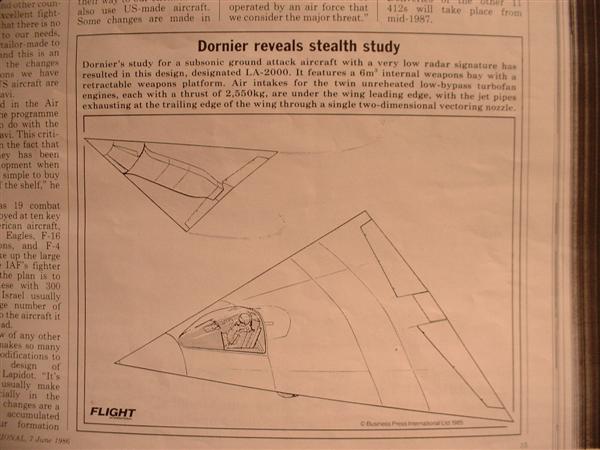
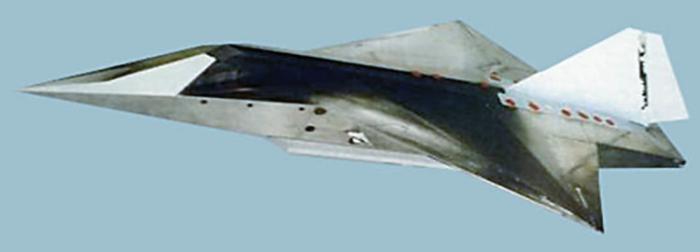
airframe design wise based on delta then I would refer to the german stealth designs:
Dornier LA-2000, that went into FATE & ICE
dornier-la-2000-in-flight-international.jpg

MBB Lampyridae (1987), that got the USAF scrample for the F117
0f10e8af9ed843589c32fd78d22084d8.jpg

both are suitable for high Mach, but we got to waive a bit and say heatshield ceramics are well deveoped & available at this point.
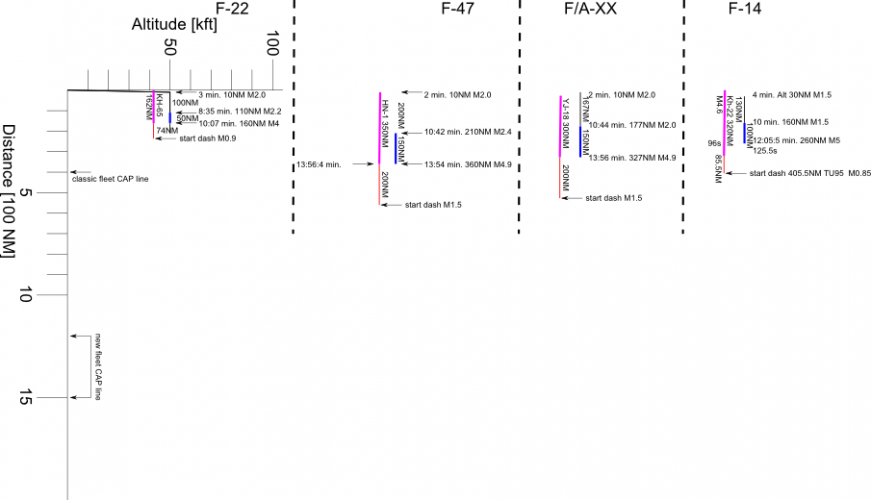
If you look back at my intercept analysis graph the CAP station point has to be at 500/550 nmi.
NGAD-intercept.png
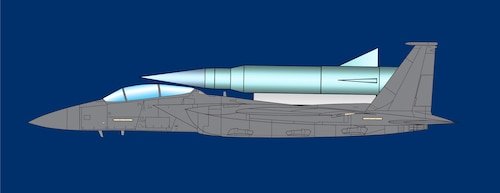
And assuming the CAP's got shot down and the aircraft has to do a deck intercept.... I woud also like to point to cold war era rocket assisted launch.
230118-F-JT962-1012.jpg
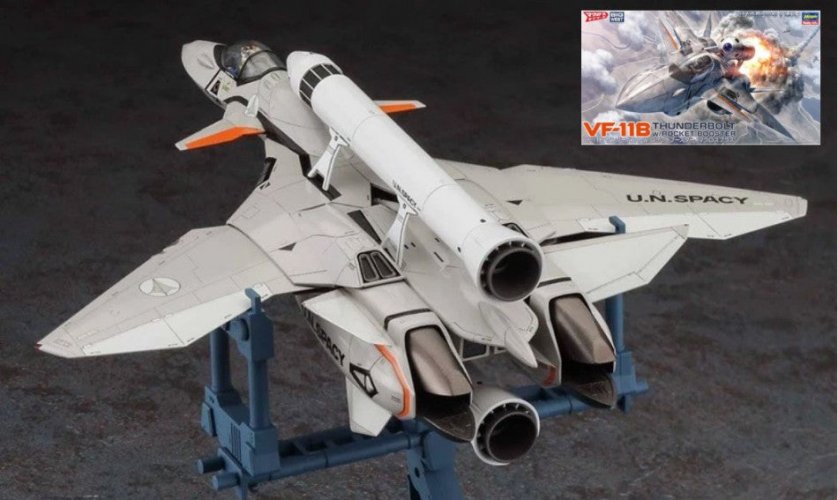
or better yet with two
 

Attachments

  • 0086848_vf-11b-thunderbolt-w-rocket-booster-macross-plus-kit-1-72_1200x1200.jpg
    0086848_vf-11b-thunderbolt-w-rocket-booster-macross-plus-kit-1-72_1200x1200.jpg
    89.1 KB · Views: 36
If you look back at my intercept analysis graph the CAP station point has to be at 500/550 nmi.
View attachment 818064
I don't remember that table, but thank you for it!


And assuming the CAP's got shot down and the aircraft has to do a deck intercept.... I woud also like to point to cold war era rocket assisted launch.
View attachment 818065
or better yet with two
For DLI, I think we're better off use bigass ramjet SAMs (excuse me, "kamikaze CCAs") instead of manned fighters.

Basic design roughly that of the Meteor AAM, but scaled up to roughly SM6 Blk2 size. 21" AESA radar, not two but 4 inlets to feed such a beast of a ramjet. Missile flies at M4.5-5, just short of hypersonic for heating and plasma blackout avoidance.

I do love the double-boosted VF-11 from Macross Plus, though. Next-generation plane is so fast the old brokeness needs satellite-launch rocket boosters just to keep up.
 
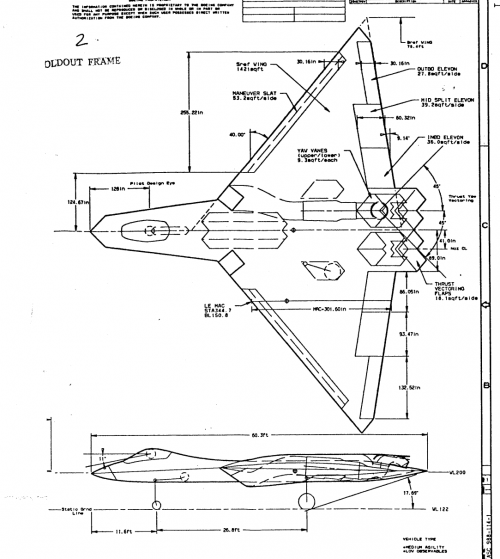
Just brainstorming here, Im thinking of something along the lines of the Boeing 988-104 (pic attached): diamond wing, no canards or tailplanes, large fuel fraction, basically go as stealth as possible while maintaining good acceleration, climb and supersonic cruise performances, possibly at the expense of some high alpha performance and max load factor. For example I'll happily take whatever the aircraft's capable of turning at ~M1.6 as the maximum load factor and shed off some structure weight that way. For engines probably twin F-119, some type of VCE if that's on the table at all. Depending on the mission profile, maybe even turbojets if the design point is high altitude and supersonic?
Weapon-wise I'll go conservative and just stick with something similar to the AIM-260 form factor, something small enough to comfortably carry 6-8 internally while having good range against non-maneuvering targets. If CUDA-adjacent missiles are a choice even better, those can be used to handle large volumes of lower-speed targets, for example subsonic drones, cruise missiles, etc.
Basic design roughly that of the Meteor AAM, but scaled up to roughly SM6 Blk2 size. 21" AESA radar, not two but 4 inlets to feed such a beast of a ramjet. Missile flies at M4.5-5, just short of hypersonic for heating and plasma blackout avoidance.
This somehow reminds me of the Armiger anti-radiation missile, I'll attach a photo, maybe the 4 inlet design aligns with what you're thinking. Also it has a dual-mode seeker which may come in handy for SAMs.
 

Attachments

  • 1784272161233.png
    1784272161233.png
    299.8 KB · Views: 49
  • 726eace514219abcfbbe0c4454f7cb63c4751a2c.jpeg
    726eace514219abcfbbe0c4454f7cb63c4751a2c.jpeg
    61 KB · Views: 44
Last edited:
BARCAP interceptor, I think. AVRO Arrow, F-106, MiG-31 type of plane.

Guarding your airspace from cruise missiles (and any bombers that want to try to play) at various speeds and altitudes.
Then I think F106/MIG-31 are not good starting points.
BARCAP is range&loiter; cruise missile defense is sensor field and magazine depth.

If you need a BARCAP interceptor - there's no need to invent anything; GCAP is the way.
 
Last edited:
Had an idea bubble up in the F-106 thread while we were bashing around the idea of F-35 versus F-106, and I would like the forum's input on choices. Note that I do not have a mental image of what this airframe should look like.


Using the F-106 delta airframe would be doable, though I'm not sure we'd want a non-stealth aircraft. It looks like the F135 will actually fit into the same space as the F-106's J75, though you're going to need ~20% larger inlets to handle the airflow. F119 would be fun to allow supercruise, but I don't think it is still in production. Certainly might have individual pieces in production for spare parts but no complete engines.
You can probaly motivate the F135 to supercruise too afterall you got around 11t less MTOW.
And of course you'd have to totally redesign the weapons bay to handle AIM-260s and AMRAAMs.
Yes all are rather to long like AMRAAM being 65cm longer. That said i would estimate, using AIR-2 Genie as basis, that you could fit atleast 4 AMRAAM probaly 6 to 8 with some on the wings.
So, what if we built a modern interceptor, using current MOTS weapons and avionics as much as possible?

F-35 avionics, but swap the EOTS (IIRC a Sniper or Sniper XR pod) for an air-to-air optimized IRST like the Legion pod. Because it does work (mostly) and is in current production. No development time, just contracting time to deliver radars.
(We will assume that there's other aircraft doing the bombing, like F-35 and B-21; and other aircraft doing the Air Superiority/Air Dominance missions over the front lines. like F-22. no reason to install both EOTS and IRST)
  • Keep the same antenna size as APG-81/85, or take advantage of presumed larger radar bulkhead and install a larger antenna?
Block 1 could retain a similiar radar for reduced cost while in a later block one could devleop a dedicated Radar.
But let's assume that we're going to design a whole new airframe instead of dropping F-35 engine and avionics into an F-106:
  • For the sake of the range discussion, let's assume that the US, Canada, and Australia are the primary client countries, and in an unusual recognition of where an interceptor protecting the USA should be deployed the USAF is actually giving priority to Canadian range requirements.
    • What should those range requirements be? 2 hours at 500nmi from base like GCAP and maybe F-47? 2 hours at 250nmi like F-14 or F-111B?
Good question next question;)
  • Engines off the shelf means F100s, F110s, and F135s. One or two engines?
While F135 is a bid heavier it pretty mutch Doubles thrust! That means its like flying the JT75 in afterburner at max dry thrust. So one could either drop the Afterburner or go even further.
  • How much stealth? None, Shaping/panel edge alignment with RAM only in the inlets, full cutting edge stealth?
Well you want to be stealthy enough not to alert someone so i would argue the basics: shaping/Panel Edges, alignment with RAM in the inlets.
 
You're suggesting the J-36, in essence
J-36 is a very offensive bird. It is far too much focused on stealth(which is helpful, but how much is it a top priority for a defensive aircraft?), and (admittedly, speculatively) unfocused on high-speed performance (thickey).

It is absolutely unfocused on engaging small, numerous targets.
 
J-36 is a very offensive bird. It is far too much focused on stealth(which is helpful, but how much is it a top priority for a defensive aircraft?), and (admittedly, speculatively) unfocused on high-speed performance (thickey).

It is absolutely unfocused on engaging small, numerous targets.
It's supersonic, presumably a super cruiser, large volume means lots of fuel and missiles for long range flight and engagement. Add to that a big radar, presumably large electro-optical sensors, powerful networking capability and two operators, it is the closest thing that exists irl that fits the bill of a next gen MiG-31, the pinnacle of the thoroughbred interceptor.

I'd be surprised if it wasn't able to track a multitude of small targets at tremendous ranges simultanously. It is after all a next generation fighter, designed for the network and sensor centric age, by people who are everything but conservative. This thing is designed around the idea that drones will play a big part in aerial warfare after all.
 
It's supersonic, presumably a super cruiser, large volume means lots of fuel and missiles for long range flight and engagement. Add to that a big radar, presumably large electro-optical sensors, powerful networking capability and two operators, it is the closest thing that exists irl that fits the bill of a next gen MiG-31, the pinnacle of the thoroughbred interceptor.
The best explanations I saw described it as mostly subsonic platform, able to go supersonic (and not really well) more in a pinch.
It tbh makes more sense this way, as an aircraft searching for targets of opportunity in a hostile airspace behind 1st chain. This is a time consuming task, ideally performed without announcing to the world that you're there.
I'd be surprised if it wasn't able to track a multitude of small targets at tremendous ranges simultanously. It is after all a next generation fighter, designed for the network and sensor centric age, by people who are everything but conservative. This thing is designed around the idea that drones will play a big part in aerial warfare after all.
Sensors are great there, but you can't kill with sensors. And for the time being, low altitude engagements of terrain following targets is not something LWs can be expected to cover.

Defensive interceptor doesn't need to hide as long as it can outfight the bomber and drones. But it needs to be able to find, catch and destroy them, in time.

I don't think there's a 100% suitable aircraft for the job in the world right now. Maybe PAK-DP will emerge as one, though I am sceptical of it's serious existence.
 
There's still the Chinese J-8 around. It's a pure interceptor design, although, not faster than M2.2.
Not to today's standard but since they still keep it around there might be a new design in the pipeline for it.
 
There's still the Chinese J-8 around. It's a pure interceptor design, although, not faster than M2.2.
Not to today's standard but since they still keep it around there might be a new design in the pipeline for it.
J-8 is directly replaced by J-20...
 
If we are reusing old airframes... I'd start with a F5D, slap a F119 in there and modern avionics and call it good. Add some DSI, conformal AIM-260 carriage... and can even bring back the internal rocket pack for APKWS. Its already hella fast, climbs like a bat out of hell, and has great legs.
 
Anime. Had to look it up.
Pass.
You had me at passing on anime - as a freshly minted retiree I realize that my remaining life time is way too short and precious to waste on mindless brain rot cartoon drivel like that...
 
Last edited:
So, what if we built a modern interceptor, using current MOTS weapons and avionics as much as possible?
Overall, to make this conversation more targeted, I guess you should provide some design input.
Nation, conditions, targets.

Just stuffing F106 with modern electronics will not give you a modern interceptor, it'll give you something akin to Soviet-style fighter-interceptor, with closest modern counterpart probably being J-10C.

Do you want a modern F-106 as actual alert interceptor? but then you probably should begin from modern SAGE(for example, tie it into AMTI). And, above all else, match it with targets.
 
Overall, to make this conversation more targeted, I guess you should provide some design input.
Nation, conditions, targets.
Nations: USA/Canada and Australia. Lots of space beween where the air bases are and where the threat vectors are.
Conditions: I'm leaning towards a mission profile more like BARCAP than DLI (to use the naval terms)
Targets: primarily cruise missiles

As I said in the OP and here:
BARCAP interceptor, I think. AVRO Arrow, F-106, MiG-31 type of plane.

Guarding your airspace from cruise missiles (and any bombers that want to try to play) at various speeds and altitudes.
 
This design reminds me of a classic scene from Nikolai Gogol's (1809-1852) play "Marriage," where the bride, Agafya Tikhonovna, says:

"If I were to put Nikanor Ivanovich's lips on Ivan Kuzmich's nose, and something cheeky like Baltazar Baltazarovich, and maybe add Ivan Pavlovich's height to it, I would make up my mind immediately. But right now, I need to think!" :)

This expression is used as an ironic comment on someone's whims, unrealistic desires, vague dreams, etc.
 

Attachments

  • maxresdefault.jpg
    maxresdefault.jpg
    101.2 KB · Views: 23
But let's assume that we're going to design a whole new airframe instead of dropping F-35 engine and avionics into an F-106:
  • For the sake of the range discussion, let's assume that the US, Canada, and Australia are the primary client countries, and in an unusual recognition of where an interceptor protecting the USA should be deployed the USAF is actually giving priority to Canadian range requirements.
    • What should those range requirements be? 2 hours at 500nmi from base like GCAP and maybe F-47? 2 hours at 250nmi like F-14 or F-111B?
  • Engines off the shelf means F100s, F110s, and F135s. One or two engines?
  • How much stealth? None, Shaping/panel edge alignment with RAM only in the inlets, full cutting edge stealth?
What kind of targets you consider as main threat? Modern air warfare is kinda diverse, and I'm not sure you could build aircraft, capable of intercepting both Mach 5+ hypersonic high-altitude missiles, subsonic low-altitude stealth missiles, and slow long-range attack drones similarly efficiently.
 
Nations: USA/Canada and Australia. Lots of space beween where the air bases are and where the threat vectors are.
Conditions: I'm leaning towards a mission profile more like BARCAP than DLI (to use the naval terms)
Targets: primarily cruise missiles
Then F-15EX is your best (ex)waifu.
Should be good enough as is.
 
Last edited:
I would add a heavy focus on how fast the interceptor can be airborne when warning is received.
Realistically the role could be done by a stealthy lead-in-fighter trainer, something that can be ready to go at a moment's notice when the Shaheds are detected.
Cheap, easy and quick maintenance would be important.
 
LIFT can be a good Low altitude air interceptor (and it's very economical), but it's more for drones rather than for LACMs.
 
What kind of targets you consider as main threat? Modern air warfare is kinda diverse, and I'm not sure you could build aircraft, capable of intercepting both Mach 5+ hypersonic high-altitude missiles, subsonic low-altitude stealth missiles, and slow long-range attack drones similarly efficiently.
I'm thinking those are best dealt with by armed LIFTs or arguably, by old fighters.
 
For slow and low drones there is perhaps a call for fast propellor-driven or dry thrust turbofan driven aircraft. Under one wing could be a radar and gun. Under the other could be an EOTS/targeting pod of some type to quickly scan and track targets quicker than any human could reliably do. APKWS (short range) and Hellfire/Stinger loadouts would give it the ability to quickly sweep the sky clean of threats at some distance.
 
I guess I should add that I'm kinda expecting the "DLI" half of interception, for when your patrolling interceptors aren't availble for whatever reason, is more or less a large sized ramjet-powered SAM. ~21" diameter kind of size, so it's got a decent enough radar to be able to work without AWACS support. Basically an F-4 sized radar flying at about M4.5. It'd be expensive, so you'd want to be able to recover that radar if the missile/drone didn't make the intercept.

Thread for that fell here: https://www.secretprojects.co.uk/th...should-be-built-forum-opinions-welcome.52024/
 
For slow and low drones there is perhaps a call for fast propellor-driven or dry thrust turbofan driven aircraft. Under one wing could be a radar and gun. Under the other could be an EOTS/targeting pod of some type to quickly scan and track targets quicker than any human could reliably do. APKWS (short range) and Hellfire/Stinger loadouts would give it the ability to quickly sweep the sky clean of threats at some distance.
I honestly suspect this setup will be outdated no later than next year, i.e., it solves an already outgoing problem.
It doesn't mean cheap&low&slow, but speeds and brains (both connectivity and AI) are going up fast.

Thoroughly upgraded 4th-gen fighters(especially those with good low-speed handling) and LIFT are a longer-term bet, but overall I think something entirely else is needed for low&slow(but also not slow).
 
Last edited:
I honestly suspect this setup will be outdated no later than next year, i.e., it solves an already outgoing problem.
It doesn't mean cheap&low&slow, but speeds and brains (both connectivity and AI) are going up fast.
So, no AT802/OA-1Ks with the F-16 radar in a pod?


Thoroughly upgraded 4th-gen fighters(especially those with good low-speed handling) and LIFT are a longer-term bet, but overall I think something entirely else is needed for low&slow(but also not slow).
The problem with engaging low things is detection. The old answer is AWACS/lookdown-shootdown radars, since you need much fewer radars that way than trying to use ground stations.

A side problem with APKWS as an example is limited range. 10km range if you're shooting at a low target from high altitude. If the launcher is at 8km/25,000ft you need to get within 6km flat range of the targets to engage at 10km slant range.
 
Back
Top Bottom