Rafales at that. That was cruel.
What do you mean?

Rafales at that. That was cruel.
Plane profile is that of RafaleWhat do you mean?

That seems like a low number of intercepts to me, lets hope they painted the rest on the other side
Given lack of known fixed wing interceptions before(this is a high profile event), even what's here smells...paint.That seems like a low number of intercepts to me, lets hope they painted the rest on the other side
Overall samp/t is limited by aster supply. No way around.

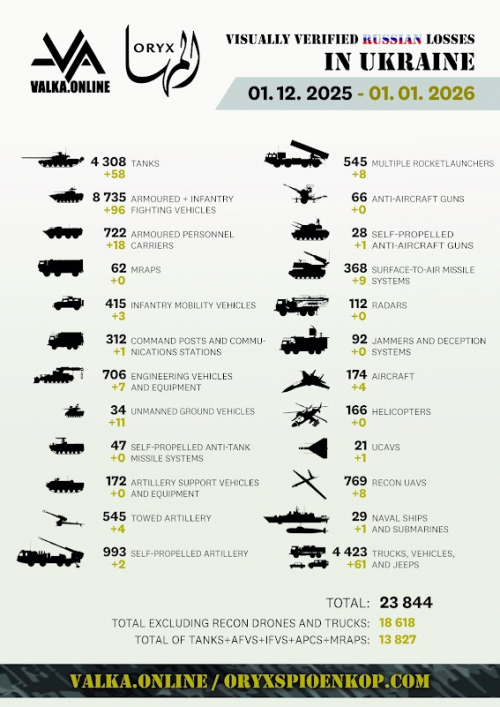
https://www.oryxspioenkop.com/2022/02/attack-on-europe-documenting-equipment.htmlGiven lack of known fixed wing interceptions before(this is a high profile event)

FU?IIRC Ukraine has 2 SAMP FUs. Only ABTs were downed by this FU, meaning if BMD is done at all, it's by a single FU.
Does anyone have good numbers on Aster production?
Googling gives me results on multiplication of past production figures but doesn't cite any concrete baseline.

Fire unit

While declining to give specific production figures on any individual weapon system, Béranger claimed the firm delivered “five times more Asters than initially planned” and the production capability of the Mistral is “four times more than in 2022.”

https://www.assemblee-nationale.fr/dyn/17/textes/l17b2630_projet-loiThe combat system of the aircraft carrier Charles de Gaulle aircraft carrier is being upgraded to deploy the ASTER missile in its modernized “Enhanced Capability (EC)” version, pending the arrival of the next-generation aircraft carrier, whose construction is beginning and whose offensive power will be strengthened by a third catapult rail and a data-centric combat management system.
Just noticed that since the war in Ukraine started, more than 1000 days ago, a grand total of 0 (that’s zero) Aster missiles have been ordered by Europeans countries.
I’m excluding the 3 existing users : Italy, France & United Kingdom.
Talk about a failure
Btw, Belgium seems more and more likely to order patriot instead of SAMP/T NG for commonality with Netherland
Markus Mäder, state secretary for security, pointed to the French-Italian SAMP/T air and missile defence system as Europe’s main offer while Bern awaits US arms maker Raytheon to deliver its system, which was due in 2027 but has been pushed back to 2032 or later.
“We want to be interoperable with our environment, and that’s Europe,” he said in an FT interview. “We’re not saying we change from one horse to the other, but [if] one horse is not fast enough . . . let’s try [to] find a second horse.”
...
The Swiss government said last month it had received responses from France, Germany, Israel and South Korea as part of its search for a second long-range air and missile defence system.
...
Switzerland’s Patriot order — five air and missile defence units acquired under the Air2030 programme in 2022 — was originally valued at about SFr2.3bn ($2.9bn). The deliveries were planned for 2027 and 2028 but Bern now faces potential cost overruns and delays of up to five years or more.
The SAMP-T NG manufacturers — European missile champion MBDA and its partners, the radar makers France’s Thales and Italy’s Leonardo — are planning the first deliveries to France and Italy by the end of the year.
Denmark last year became the first country to sign a contract to buy the SAMP-T NG, with first deliveries expected in 2028.
While Switzerland remains outside both Nato and the EU, Mäder said Bern wanted to deepen defence co-operation and interoperability with neighbours, insisting the country considered itself “an integral part of European security”.
Makes sense to go for Aster since the Netherlands (TNO, Thales and Fokker) are also part of the Hydis/Aquila program led by MBDA with France and Italy.Dutch sources are hinting that our navy with the new Air Defense Frigates will be moving to an ESSM/Aster 30 mix. No more SM-family missiles.
Given the rapid technological advancements in weapons systems and the growing diversity of air threats, future LC frigates will need to be capable of countering multiple types of threats, such as advanced anti-ship missiles and cruise missiles capable of reaching high speeds. The Ministry of Defense therefore intends to equip these LC frigates with a layered air and missile defense system for short-, medium-, and long-range capabilities, including an endo-atmospheric (within the atmosphere) intercept capability against ballistic missiles. The “Maritime Air and Missile Defense Armament” project focuses primarily on defense against other air threats, and to a lesser extent on drones. These LC frigates must also be able to defend themselves against, for example, large numbers of drones (swarms) launched simultaneously. This is being taken into account in the design of the LC frigates.
I think the Aster 30/15 dart only got a sustainer motor, probably not powerful enough to accelerate the missile from zero speed on its own. Even if the motor on the dart was changed i doubt it would have any benefits over the boosted Aster 15. Or VL Mica/CAMM for that matter.Both the Aster 15 and Aster 30 use launch boosters however I'm wondering if a short-range version of the Aster has been considered by not using a launch booster?
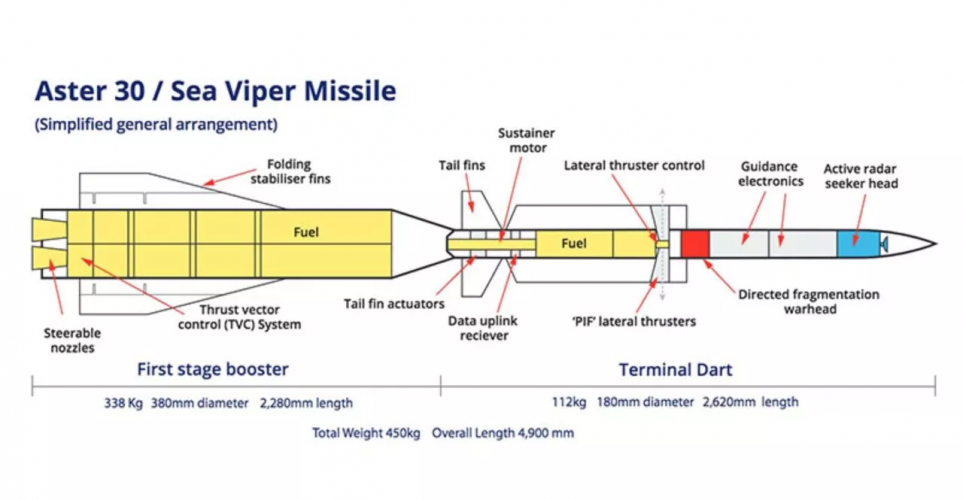
Updated missiles have the same range gap.Anyone knows if the booster on the Aster 30 got a "sustainer stage" also? The Aster 15 booster burns for about 2 seconds, and the missile got a max range of 30-40km, The Aster 30 booster burns for about 3,5 seconds and max range is claimed to ~120km. Seems unreasonable that an extra 1,5 seconds of boost extend the max range by 80-90km over the Aster 15.
I think the Aster 30/15 dart only got a sustainer motor, probably not powerful enough to accelerate the missile from zero speed on its own.
I like the Aster missile. But how is it possible that a booster that burns for 3,5 seconds and send the missile away for maybe 3-4 km, and then the 110kg missile/dart carries enough fuel to fly another 145km and still have the energy to hit a somewhat manuvering target. Other missiles that have 150km range weighs 800-900kg like the SM2 and PAC2, the Aster 30 is only 450kg.Updated missiles have the same range gap.
Aster 15 EC >60 km
Aster 30 B1NT >150 km
The dart is exactly the same between 15 and 30, so the sustainer is the same.
Aster 30 B1NT has been succesfully fired at more than max range late last year.
They are both single stage missiles and a PAC-3, also single stage, manages 105km at 300-320kg.I like the Aster missile. But how is it possible that a booster that burns for 3,5 seconds and send the missile away for maybe 3-4 km, and then the 110kg missile/dart carries enough fuel to fly another 145km and still have the energy to hit a somewhat manuvering target. Other missiles that have 150km range weighs 800-900kg like the SM2 and PAC2, the Aster 30 is only 450kg.
Not the CRI right? I think more like 60-70 km.. and that motor still burns for like 20 seconds The MSE can do 120km but thats a dual pulse motor and an overall heavier missile than the CRI.They are both single stage missiles and a PAC-3, also single stage, manages 105km at 300-320kg.
Yeah i mean MSE is bigger tooNot the CRI right? I think more like 60-70 km.. and that motor still burns for like 20 seconds The MSE can do 120km but thats a dual pulse motor and an overall heavier missile than the CRI.
Full disclosure, i went and asked our Aster specialist ( —> https://x.com/letmepickthat )I like the Aster missile. But how is it possible that a booster that burns for 3,5 seconds and send the missile away for maybe 3-4 km, and then the 110kg missile/dart carries enough fuel to fly another 145km and still have the energy to hit a somewhat manuvering target. Other missiles that have 150km range weighs 800-900kg like the SM2 and PAC2, the Aster 30 is only 450kg.

I like the Aster missile. But how is it possible that a booster that burns for 3,5 seconds and send the missile away for maybe 3-4 km, and then the 110kg missile/dart carries enough fuel to fly another 145km and still have the energy to hit a somewhat manuvering target. Other missiles that have 150km range weighs 800-900kg like the SM2 and PAC2, the Aster 30 is only 450kg.


and what about S400 ???View: https://x.com/clashreport/status/2071890378739913010?s=20
--
Italy stationed one SAMP/T system at the 3rd Main Jet Base Command in Konya. although it is on a rotational deployment for NATO alliance, I would presume Turkey may also be evaluating it. Side note; Spain has also maintained a Patriot battery in Turkey since January 2015.
and what about S400 ???
What about the Siper?and what about S400 ???
Gathering dust under lock and key. There hasn't been anything officially outlined as of yet to what will be done with the S400, but I'm sure there will be some progress into the removal aligning with US administration requirementsand what about S400 ???
What about the Siper?
These can coexist for a while. Just assign different targets or sectors between these.
4. SAMP/T Air Defence system: Thales scaling up its share of production five-fold
As part of the SAMP/T NG NATO mission proven air defence system, for which Thales supplies key components, the Group is targeting a two-fold increase in production, in order to meet accelerating demand from European armed forces. The French variant of the system includes a Thales Ground Fire radar, which offers unmatched performance: a range of up to 400 km and panoramic coverage at 360° and 90° elevation. Thales also acts as the integrator of the fire control system (the command, control and fire control system: the ME-NG – Next Generation Engagement Module), developed in partnership with MBDA. SAMP/T NG is at the core of SkyDefender, the multi-layer, multi-domain Integrated Air and Missile Defence system launched by Thales this year. Built on an open, modular architecture, SkyDefender integrates easily with existing defences and can be further developed as threats evolve.
Why Ariane or Space X or Apollo rockets are made of several stages ? You have the answer.I like the Aster missile. But how is it possible that a booster that burns for 3,5 seconds and send the missile away for maybe 3-4 km, and then the 110kg missile/dart carries enough fuel to fly another 145km and still have the energy to hit a somewhat manuvering target. Other missiles that have 150km range weighs 800-900kg like the SM2 and PAC2, the Aster 30 is only 450kg.

