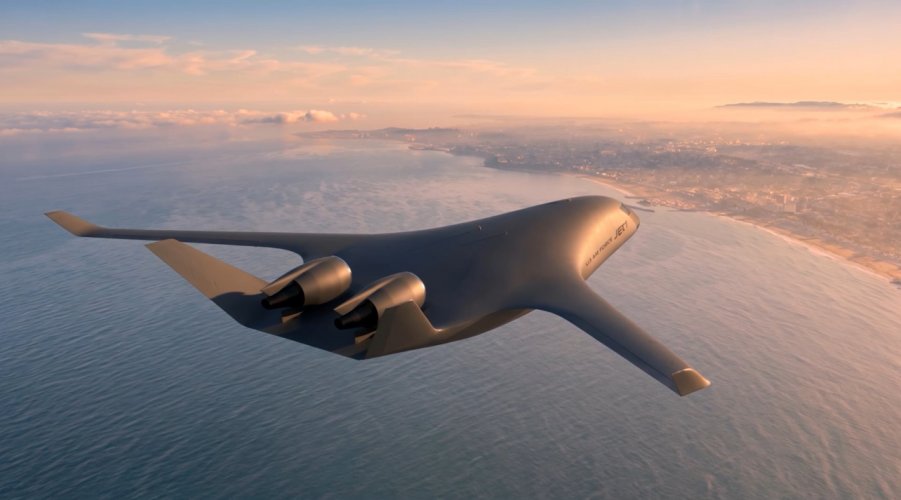
Blended Wing Aircraft, Inc. / JetZero BWB Projects

Their money comes from a number of investors, mainly the USAF and United airlines.

In some negotiated contract, apparently there is a "path" for united to buy a 100 aircraft prder from jet zero with another 100 followup (whatever a path means)

For the USAF, a BWB demonstrator.

Delta air did not enter into a contract but they apparently are doing co development with jet zero.

Apparently theres enough interest and investment to warrant the start of such a factory, which also surprised me.
 
Their money comes from a number of investors, mainly the USAF and United airlines.

In some negotiated contract, apparently there is a "path" for united to buy a 100 aircraft prder from jet zero with another 100 followup (whatever a path means)

For the USAF, a BWB demonstrator.

Delta air did not enter into a contract but they apparently are doing co development with jet zero.

Apparently theres enough interest and investment to warrant the start of such a factory, which also surprised me.
Wasn't there something similar with Pan Am and the 747?
 
JetZero has a valuation of around 700mil, for a company that does not have an airframe?
https://forgeglobal.com/jetzero_ipo/#fundingRoundsAndValuation
https://www.reuters.com/business/ai...ises-175-million-series-b-funding-2026-01-13/

Also has approx. $1 billion in total funding, grants, and commitments, one airline wants 200 airframes

$235 million contract from the U.S. Air Force to build a full-scale blended-wing body demonstrator.

Simple problem is that the $4.7 billion facility qualifies for up to $1.7 billion in state and county incentives, provided the company meets its projected targets to create over 14,500 jobs.

in a time whereas job losses are accelerating in the age of AI, making 14k jobs in aany industry is looking pretty shaky.

It is a time of hyping everything so they just joined the queue.

Regards,
 
in a time whereas job losses are accelerating in the age of AI, making 14k jobs in aany industry is looking pretty shaky.
AI cannot drive rivets, you need people for that.

It is not cost-effective to buy robots large enough to build entire aircraft when you're only talking a couple hundred airframes being built. If we were talking thousands of airframes it might be cost-effective to buy assembly robots.
 
It is a time of hyping everything so they just joined the queue.
This is probably not the same thing, but Boeing pulled the trigger on the NGAD facility expansions in STL before they got the NGAD EMD contract. One could call that forcing the issue but one could also say they were making a down payment based off strong customer signals.

If the investment is there, this may or may not be any different although its certainly much more risky to bet so much on a startup than a prime. To me while it does seem surprising, this could be something similar - bullish downpayment based entirely upon investor signals. It could also be that investors / customers found their tech at a state of maturity and value that could be worth the amount invested as well.

It seems fiscally irresponsible (in both the Boeing case and here in the Jet zero case) to make such an investment unless either the customers involved were giving strong signals and support already.
 
It seems fiscally irresponsible (in both the Boeing case and here in the Jet zero case) to make such an investment unless either the customers involved were giving strong signals and support already.

Happens every day, how much has been pi$$ed away on similar ventures.

You need the facade to get the cash.

Regards,
 
AI cannot drive rivets, you need people for that.

You don't use rivets in composite airframes.

https://www.hexcel.com/hexcel-jetze...anging-all-wing-design-aircraft-demonstrator/

According to the FAA, the FAST program is intended to “demonstrate innovative composite manufacturing technologies capable of supporting advanced non-cylindrical pressure vessel designs at unprecedented production rates.”

https://robotnik.eu/automation-and-mobile-robotics-driving-the-aerospace-industry/

The report anticipates that within the next five to seven years, around 40% of aerospace production will be carried out through advanced processes supported by intelligent robotics, data analytics, and artificial intelligence. Furthermore, 70% of advanced air mobility companies are already implementing projects to accelerate this transition, transforming their infrastructure, scale, and business models.

14,500 jobs, no chance.

Regards,
 
Unless your entire airframe is composites (not a small ask), you're still bucking rivets on the internal frames.
Probably depends on the application. From my tiny corner, Rosie the Riveter seems like a thing of the past. What few solid rivets I see we squeeze, and most of those have blind alternates. Titanium fasteners rule the day with the occasional CRES bolt for stupidly tight areas.
 
Majority of the BWB demonstrator will probably by bonded structure with possibly composite/metallic sandwiched combos fastened with Hi-Loks for critical loaded areas. If Scaled can bond everything together they will and they have had numerous successes with bonded large structure, example, the Roc/Stratolaunch aircraft.
 

Attachments

  • jetz.jpg
    jetz.jpg
    73.2 KB · Views: 202
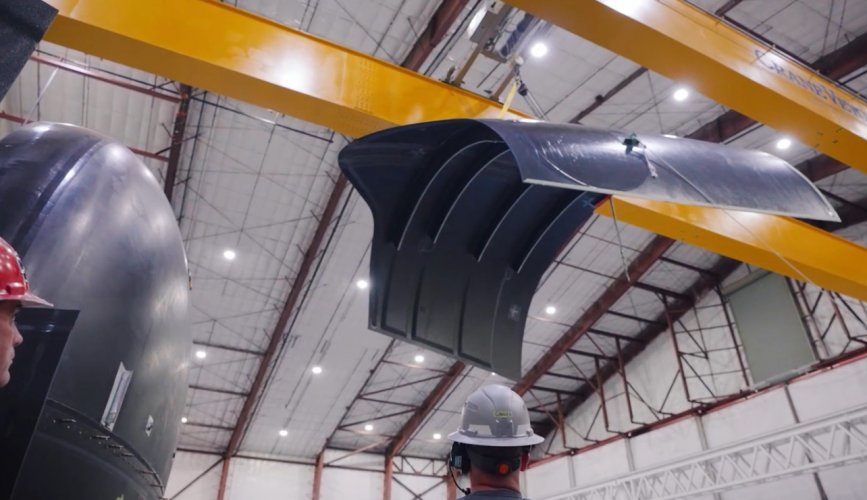
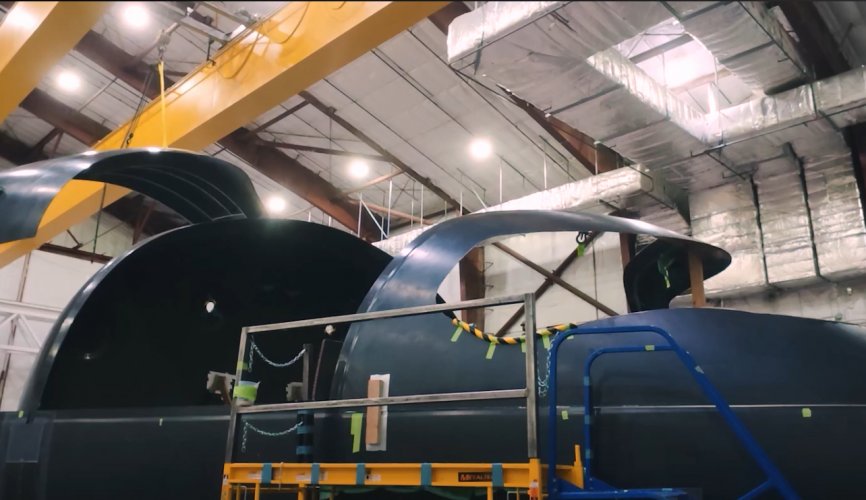
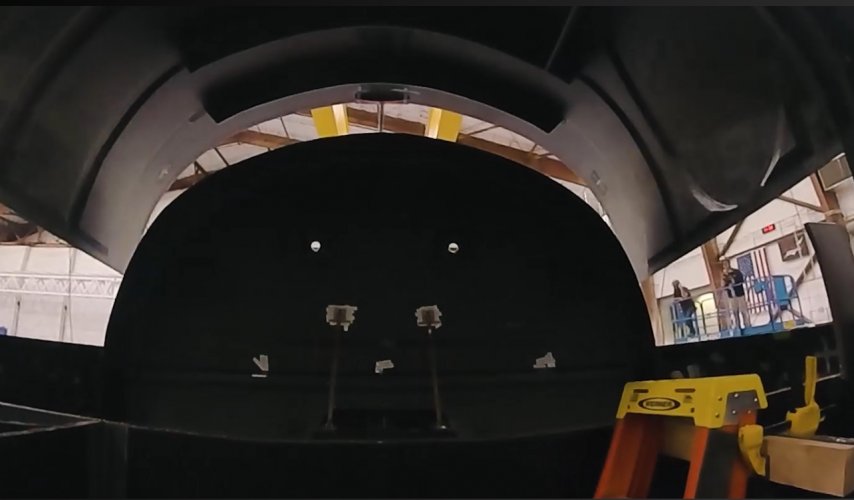
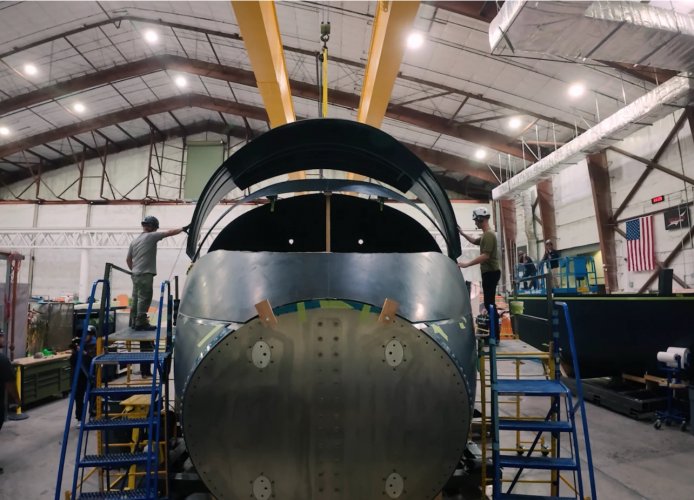
That is one BIG demonstrator!
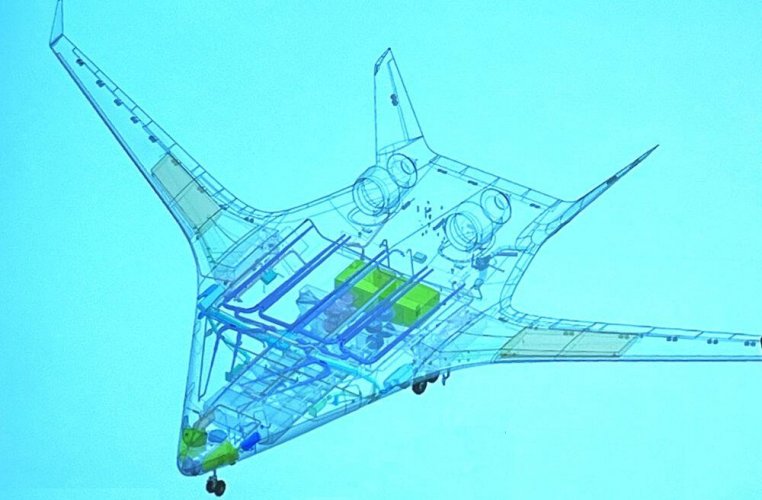
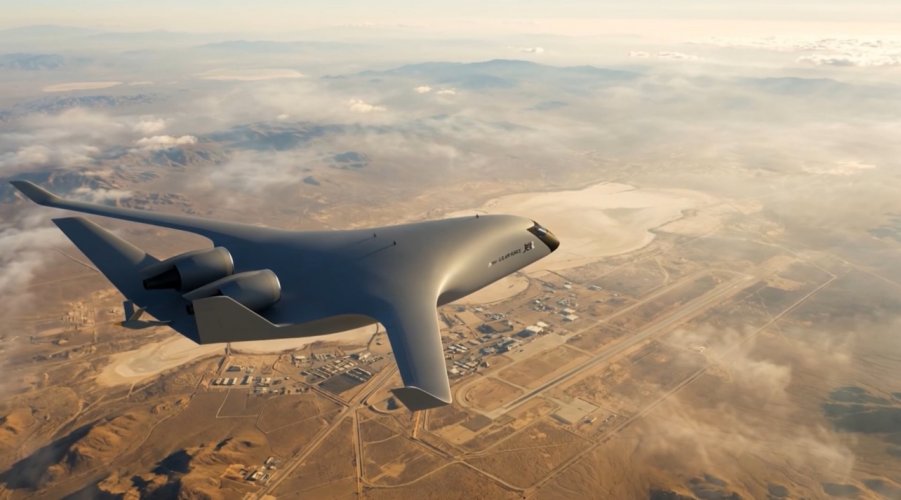
Assembly of the 178 ft. wingspan, 260,000 lb. gross weight demonstrator is progressing at partner Northrop Grumman’s Scaled Composites subsidiary.

Admittedly, it's using a pair of 757 engines so a certain level of size should be expected. But I was not expecting 260klbs gross!

https://aviationweek.com/aerospace/...s-revised-bwb-design-demonstrator-takes-shape
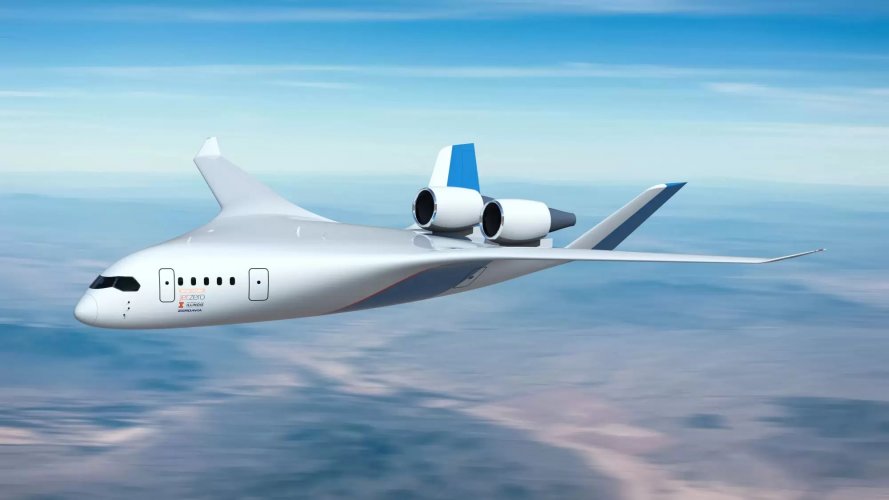
JetZero's revised blended-wing-body demonstrator has evolved toward a more practical, certifiable design by simplifying engine integration, abandoning boundary-layer ingestion, adopting a V-tail, and targeting an efficient but realistic cruise L/D of about 22.
The statements in the article do not support that statement.

All the statements in the article are about avoiding boundary-layer ingestion in engines not designed for it!
 

Attachments

  • IMG_5152.jpeg
    IMG_5152.jpeg
    787.4 KB · Views: 137
  • IMG_5153.jpeg
    IMG_5153.jpeg
    704.1 KB · Views: 127
  • IMG_5154.jpeg
    IMG_5154.jpeg
    666.1 KB · Views: 126
  • IMG_5158.jpeg
    IMG_5158.jpeg
    770.3 KB · Views: 113
  • IMG_5157.jpeg
    IMG_5157.jpeg
    721.5 KB · Views: 99
  • IMG_5161.jpeg
    IMG_5161.jpeg
    412.9 KB · Views: 88
  • IMG_5162.jpeg
    IMG_5162.jpeg
    1 MB · Views: 116
Last edited:
In one of the images on the JetZero media site, you can see a refueling boom peeking out from underneath.

Might make a nice offensive/defensive missileer as well.
 
I'd say it's mostly aerodynamically motivated, as nothing about this aircraft is particularly "LO". Possibly for improved low speed control upon take off and landing.

That is fair enough.

That said, an existing tanker or transport aircraft is going to be in the vicinity of 100-150 sq. m. RCS. If the new shape and a few RCS reduction measures (e.g. a compromise RCS reduction coating that balances maintenance with stealth) it could allow reducing the RCS closer to B-1 bomber levels... maybe even a bit below that - which would potentially reduce the range for extreme BVR acquisition (e.g. PL-17 / AIM-260 class weapons) - which would then give more time for escort fighters to intercept that attackers...
 
I'd say it's mostly aerodynamically motivated, as nothing about this aircraft is particularly "LO". Possibly for improved low speed control upon take off and landing.
Dedicated vertical tail surfaces on the "fuselage" could also reduce loads on the wingtips, allowing for overall lighter weight. They could also be bigger, which would be beneficial if this aircraft is actually supposed to cruise above 40k ft (although refueling at that altitude might not be possible).
 
it could allow reducing the RCS closer to B-1 bomber levels... maybe even a bit below that
Which is totally fair, although I doubt it heavily due to the engines.

But that aside, I think nobody would call the B-1B a low observable aircraft.

It's undeniable that the JetZero proposal will reduce it's signature across several spectrums if it gets adopted by the US. I just don't think we should focus on that in the discussion, because it's clearly not the focus of the design either. Aerodynamic efficiency, internal volume, full scale flight tests, I think these are the most important aspects of it's development right now.
 
But that aside, I think nobody would call the B-1B a low observable aircraft.

It is though. It was part of the requirement - to have a reduced RCS to increase its ability to penetrate defences. The B-1A was cancelled because it was too easy to detect (and efforts were already heading to the ATB/B-2 program) and when the B-1B was ordered it was intended to have RCS reduction features to give it some of the penetration capability. It had serpentine ducts and radar absorbent materials to lower its RCS by an order of magnitude (to something closer to that of a contemporary fighter aircraft).
 
By that measure something like the Eurofighter is low observable too. Incorporating features to achieve signature reduction doesn't warrant the "low observable" label, at least not in the way it's generally applied (to aircraft which went to great lengths to reduce their signature with regards to radar and thermal detection as well as emission of signals that could be picked up by ELINT/SIGINT assets).
 
By that measure something like the Eurofighter is low observable too. Incorporating features to achieve signature reduction doesn't warrant the "low observable" label, at least not in the way it's generally applied (to aircraft which went to great lengths to reduce their signature with regards to radar and thermal detection as well as emission of signals that could be picked up by ELINT/SIGINT assets).
I think the official term is "reduced observable" when you're talking 10-20db aka 1-2 orders of magnitude. Which is about all you can achieve without dedicated shaping.
 
Pardon me, should have responded to this earlier.
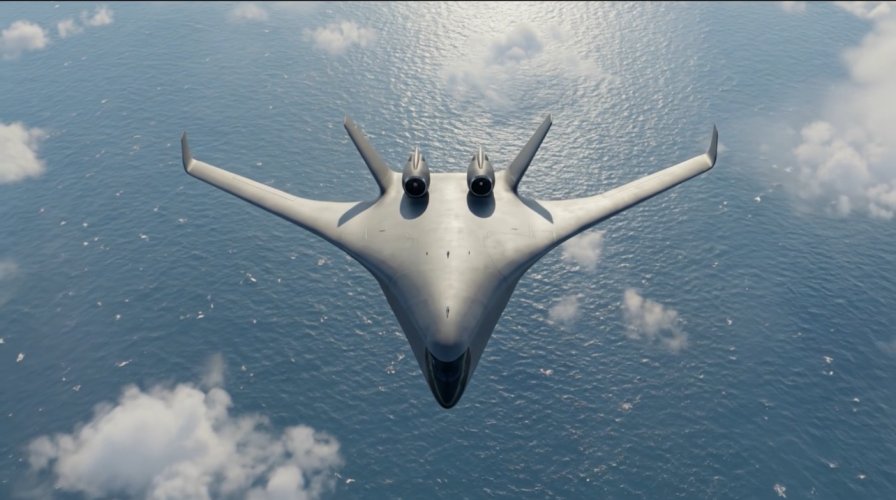
Those images are very close to a cranked-kite (X-47B) shape, which is pretty solidly LO.

Keep the canted ruddervators, shift to non-tapering wings, bury the engines, and sharpen some chines. That should give you 4 major glint angles in the front arc, plus another glint off the ruddervators abeam the aircraft.
Buried engines will cost you a big chunk of interior volume, however. Could an inlet spike work for RCS at subsonic speeds?

Unless there's some black magic shenanigans in the relationship between the two major angles per side that causes the fuselage chine glint and wing glint to collapse into a single glint at range due to constructinve/destructive interference? That would be fun. Way above my paygrade to figure out, however. Who on the forum understands radar or sound well enough to help figure that out? @stealthflanker is that your interest?
 
They said in the AvWk article that they moved the tails to the "Fuselage" because they offered better yaw control (longer lever arm from the center of mass) and they shielded the noise from the engines. I would add that it would undoubtedly make the wings lighter/more efficient, by not having the rudders at the tips.
 
This is probably not the same thing, but Boeing pulled the trigger on the NGAD facility expansions in STL before they got the NGAD EMD contract. One could call that forcing the issue but one could also say they were making a down payment based off strong customer signals.

If the investment is there, this may or may not be any different although its certainly much more risky to bet so much on a startup than a prime. To me while it does seem surprising, this could be something similar - bullish downpayment based entirely upon investor signals. It could also be that investors / customers found their tech at a state of maturity and value that could be worth the amount invested as well.

It seems fiscally irresponsible (in both the Boeing case and here in the Jet zero case) to make such an investment unless either the customers involved were giving strong signals and support already.
Having worked at Boeing for many years, I can only say that their fiscal planning has been iffy at best. If this case relied on "investor signals" then they simply got lucky. For example:

I was sitting in the auditorium (usually a cafeteria, but dual use, with projectors and a stage) when the JSF contract winner was announced. As it happened, I was right next to our program manager, since we'd worked on a prior program and I'd taken a seat in the front row before the big wheels got there. A huge screen was showing how great our "One Team JSF" was going to be, and the clock was ticking toward the official announcement time when someone emerged from behind the screen in front of us and motioned our PM to come back. He disappeared for a minute or two, and when he emerged he looked absolutely crushed. Obviously he'd been given the news that we'd lost to Lockheed. But the point is that everything we'd heard from the customer side was so positive. I don't know who remembers the whole Darlene Druyun business, where she (USAF's top procurement officer at the time) was on record as having lectured Lockheed about getting their act together because they were, she said, so far behind Boeing in the JSF program. Those of us actually working in the trenches, so to speak, knew that we didn't have a chance because of our STOVL variant's shortcomings, but senior program and Company management refused to accept that. They were certain of a win and profoundly shocked when we didn't. They had mapped out a plan for rebuilt and new facilities at the airport "when" we won, but fortunately that time hadn't actually knocked down the old buildings and gotten ready to build new ones, unlike the NGAD case.

Someday I imagine someone will be able to figure out the entire story. Or maybe not, now that we've entered the era when any unemployed person with a computer and a basement with a green screen can call themselves "investigative journalists."
 
I'm guessing BWBs will be windowless, with people only seeing outside through OLED screens. That would help make up for the penalties of a non-cylindrical fuselage and since such a small portion of the seats could be provided windows anyway, it won't be a big loss.
 
https://aviationweek.com/aerospace/aircraft-propulsion/jetzero-outlines-z4-engine-selection-plan

JetZero expects to select an engine for its Z4 production aircraft within the next year as assembly of its demonstrator continues toward a late-2027 first flight.
“The aircraft evolved to a point where 40,000 lb. thrust, which is what we are using for the demonstrator, didn't seem like enough, so we're definitely into a higher-thrust category,”
Potential candidates include updated versions of the GE Aerospace CF6 and Pratt & Whitney PW4000.
 

Similar threads

Back
Top Bottom