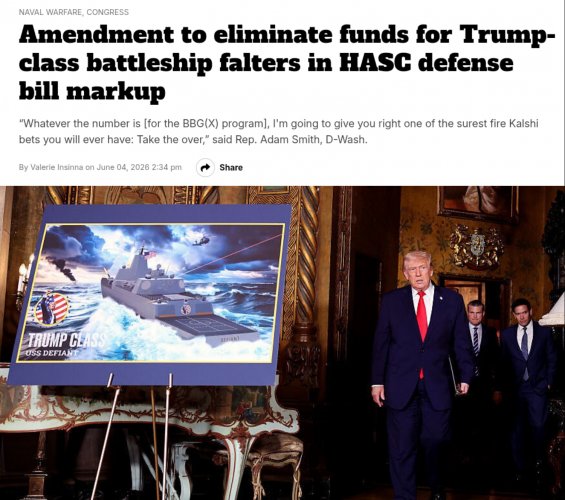
BBG(X) - DISCUSSION ONLY

You seriously believe that? Christ, I've got a bridge to sell you

You evidently don't understand. To add hypersonic weapons was a "we'd like to do this down the track", not a dealbreaker. The priority was/should still be pushing multirole combatants to fleet as soon the USN will begin to lose 3-5 Arleigh Burkes a year while lacking the capacity to replace them 1:1.

You're seriously comparing AGS to a 5in Mk 45??? Ridiculous

Very, very incorrect, but hey what's new in this place.
Lasers are currently largely constrained only by the amount of power ships can dedicate to them. Indeed lasers are currently operational aboard a few vessels

The US does have ships with guided gun rounds.

Keep going, yall are coming out looking like absolute paragons of naval knowledge right now
Lasers have been tested aboard a few ships. They are not a mature capability. If they were, they’d be getting added to current vessels, particularly the zumwalts which have massive power generation capability compared to the any nonnuclear vessels we have, and the CVNs would be perfect candidates to have had them installed if they were mature tech, but they’re not, so that hasn’t happened.

Please elucidate me. It has been 11 years since I was a GM so maybe I missed an update, but afaik we have no guided gun rounds that can be used in this role. We’ve looked into/tested some, but none have been adopted last I checked.
 
Kinda washed my hands of this topic, but Perun just did a video about what the budget request says about force structure and how the BBGNX would fit into that. Short version: it would probably actually shrink the fleet size, in terms of numbers, even with FFX, despite being drastically more money that the 2025 request and force structure.

View: https://m.youtube.com/watch?v=GXlQb8xBcvM&ra=m
 
Kinda washed my hands of this topic, but Perun just did a video about what the budget request says about force structure and how the BBGNX would fit into that. Short version: it would probably actually shrink the fleet size, in terms of numbers, even with FFX, despite being drastically more money that the 2025 request and force structure.
He really soft-pedaled the fact that BBGN means bumping a carrier out of the production schedule.

Or else the USN is going to spend a crapton of money getting a shipyard like HII in Pascagoula nuclear-qualified. Edit: Actually, that may well be why the BBGNs are so expensive.
 
Last edited:
I also feel like ranting about the planned production numbers for BBGX are way too low.

1 per carrier? grumble, should have 2 per carrier, filling in as the CGs. Plus 8 more making up the Surface Action Groups. Plus 7 more as Numbered Fleet Flagships. That's a production run of ~37 ships.
 
If it was a CG replacement. At a CG cost.
Except for size, they are CGs. They're a CG in mission (most importantly).

And even the size thing may be arguable, given the size growth of every other ship type in the time from WW2 to today. Since the last cruiser in WW2 was 17ktons, and destroyers grew from 2700t (Gearing) to 5600t (Norfolk) to 3600t (Mitscher) to 3200t (Coontz) to 3300t (CFAdams) to 8000t (Spruance) to 8400t (Burke 1) to 8500t (Burke 2) to 9700t (Burke 2A) to 9900t (Burke 3) to 16,000t (Zumwalt).
 
So basically the USN's current crop of destroyers are really light-cruisers pretending to be destroyers.
 
Designation systems are not fit for purpose now. Designation by role would be better.
But as roles evolve, that would create an inflexible system. For example, some future ships might have a primary role of aggregating sensor data from unmanned systems.
 
They would need a role designation fit for purpose. We don't have to stick to generational designations and progress accelerates beyond those anyway.

How many carrier designations? Drone carrier etc? Some nations for example, have vessels better designated as small, medium and large targets as we have seen recently.
 
I also feel like ranting about the planned production numbers for BBGX are way too low.

1 per carrier? grumble, should have 2 per carrier, filling in as the CGs. Plus 8 more making up the Surface Action Groups. Plus 7 more as Numbered Fleet Flagships. That's a production run of ~37 ships.

1 battleship per carrier is fine once you take into account they will be pumping out so many brand new Arleigh-Burke Flight IIIs.

Each carrier will most likely have two Arleigh-burkes Flight III with their huge 37 RMA radar and probably two older Arleigh-burkes with their 24 RMA radars.

The battleship then becomes the command and control ship for the battlegroup. All the unmanned sensors pass the info to the battleship. The Arleigh-burkes provide perimeter defense in a formation. FF(X) would then be the ship that does the boring job of dropping off and collecting the drones.
 
The battleship then becomes the command and control ship for the battlegroup. All the unmanned sensors pass the info to the battleship. The Arleigh-burkes provide perimeter defense in a formation. FF(X) would then be the ship that does the boring job of dropping off and collecting the drones.
I suggest its not the most resilient plan to have a single ship in the group capable of hosting the AAW flag. Does that put a deputy commander on the same ship?
 
I suggest its not the most resilient plan to have a single ship in the group capable of hosting the AAW flag. Does that put a deputy commander on the same ship?
There's a reason the Cold War fleet org had a pair of CGs per carrier group.
 
Should "command and control" even be a thing? With hypersonic spam (now in popup submarine/stealth aircraft form!), machine time frames is at play, and automated distributed thinking systems have to do the fighting.

The humans should just be there to fix stuff.
 
I suggest its not the most resilient plan to have a single ship in the group capable of hosting the AAW flag. Does that put a deputy commander on the same ship?
I suggest it's not the most resilient plan to have a single ship in the group capable of hosting fighter jets. The Navy also put the commander of the entire carrier battlegroup on the aircraft carrier.

The battleship will allow high end capabilities to be split among two high end ships. This is an improvement compared to having everything on the carrier.
 
Should "command and control" even be a thing? With hypersonic spam (now in popup submarine/stealth aircraft form!), machine time frames is at play, and automated distributed thinking systems have to do the fighting.

The humans should just be there to fix stuff.
The commanders are there to plan stuff and ensure the machines are where they need to be. Not enough assets in theatre? Commanders need to respond to that. I think your comment does show that we have to think about how commmand functions in an unmanned era, and where it should be based.
 
I suggest it's not the most resilient plan to have a single ship in the group capable of hosting fighter jets. The Navy also put the commander of the entire carrier battlegroup on the aircraft carrier.
Is there not a thread for CVV "drone carrier" ships? Anyway, a CBG doesn't need to be limited to a single CVN, an extra one can be added for high threat environments. Having said that, the AAW escorts protect the carrier and are more numerous than the carrier, so should be able to take attrition wihout collapsing the AAW defence.
 
If stealth for surprise first strike is not on the table, the logical taskforce is just to pack as many ships as practical. More firepower means better defenses and better offense. TF58 had, like, 17 carriers and 6 battleships.

If offensive firepower is so superior to defense as to make massing a bad idea (like in modern land warfare), major surface ships would just be kept at port and let the stealthy and cheap attrit it out like in modern land warfare.
 
Anyway, a CBG doesn't need to be limited to a single CVN, an extra one can be added for high threat environments.
A CBG doesn't need to be limited to a single battleship, an extra one can be added for high threat environments.
 
1 battleship per carrier is fine once you take into account they will be pumping out so many brand new Arleigh-Burke Flight IIIs.

Each carrier will most likely have two Arleigh-burkes Flight III with their huge 37 RMA radar and probably two older Arleigh-burkes with their 24 RMA radars.

The battleship then becomes the command and control ship for the battlegroup. All the unmanned sensors pass the info to the battleship. The Arleigh-burkes provide perimeter defense in a formation. FF(X) would then be the ship that does the boring job of dropping off and collecting the drones.
The USN cant build a single bloody frigate and you expect them to be pumping out ships like nothing?

Also has no one addressed the fact that ASW capabilities for these future CVBGs are almost nonexistent?
 
If stealth for surprise first strike is not on the table, the logical taskforce is just to pack as many ships as practical. More firepower means better defenses and better offense. TF58 had, like, 17 carriers and 6 battleships.

If offensive firepower is so superior to defense as to make massing a bad idea (like in modern land warfare), major surface ships would just be kept at port and let the stealthy and cheap attrit it out like in modern land warfare.
The various open wargame/studies have suggested that massing ships together makes "shooting enough AShBMs at them to overwhelm the defenses" a lot more viable.
 
That's news to me.
I'm not surprised. As I said it's nearly a full time job trying to keep up with all these new systems.

The new missile is called LRAW. Funding already allocated.

LRAW will be compatible with the Northrop Modular Payload system.

View: https://youtu.be/NZV3MHKyMnA?si=2-XWqNOvX7XflM4u

FF(X) and the small unmanned ships can have one of these shipping containers on their flexible weapon station.

The command and control center inside the Trump class battleship will be controlling multiple layers. The shipping containers on the FF(X) to the shipping container on the unmanned surface vessels. Then it goes right down to the smaller underwater drones and the tiny sonobuoy style sensors.

The US Navy even has a new underwater communication system so the underwater sensors can pass data to the battleship. It doesn't have infinite transmission range so it's further reason to justify the battleship. The communication system was originally developed by DARPA and BAE 10 years ago to allow unmanned underwater subs to find and dock with the latest Virginia class subs.
 
I feel like it is worth pointing out again that this will be cancelled (likely along with FFX). Congress will never fund it. It probably would not even matter that the idea is stupid or that Trump put his name on it; it is a sufficiently expensive program that lowers fleet numbers and reduces carrier production such that it is DOA from a funding point of view regardless. This is will happen regardless of the elections in 2026 or 2028: there will be no additional money for what is a high risk, far more expensive naval strategy. And of course a democratic Congress or Whitehouse would kill it out of spite even if it didn’t burn money like a blast furnace.
 
there will be no additional money for what is a high risk, far more expensive naval strategy.
It's not like there's much of a choice, because the current naval strategy of the USN puts them firmly at a severe disadvantage against the PLAN. And the US is completely incapable of playing the numbers game either, where you have numerous low cost vessels. Because there is no such thing as low cost military procurement under the star spangled banner.

So might as well take a completely different approach and not try to beat fire with fire, instead throwing a battleship sized boulder at the issue and catching up to China in the missile domain.
 
There are options other than concentrating all resources into the least efficient basket. The US does not need to equal PRC production rates to hold PLAN units at risk. A collection of large USVs with containerized strike munitions (LCCM, PrSM Incr4, Blackbeard, etc) and soft kill self defenses with a smattering of SM-6s here and there to make a wide area dangerous for high value air units could create a vastly more problematic targeting and attack problem compared to single ships with the firepower of 2-3 Burke’s at most. XLUUVs seem like a better idea still, along with semi submersibles along the lines of what Ukraine uses. Long ranged cruise missiles from air refueled aircraft can make the CSG viable as well. Long ranged hypersonics can be placed on land or auxiliary vessels in far greater numbers for vastly less money.

You do not need to out produce, you just need to hold opposing high value units at risk in an asymmetrical fashion. It takes a lot more USVs and UUVs to hunt down an opponent under water system than it does to just lay mines or pop up and fire short ranged ordnance. There are numerous options that are far less resource intensive, and more importantly involve far less time to produce, than a ridiculously easy to target “battleship”.
 
Last edited:
It does unless you managed to cancel enough CVNs to pay for them and free up some reactors.
That's not necessarily the case.

There are now spare A1B reactors due to the construction of the hulls being years behind schedule.

Huntington Ingalls Industries makes the Ford class aircraft carriers in Virginia with the America class LHD and Antonio class LPD in Mississippi.

Assuming the ship has full IEP then the A1B reactor has an electricity connection with no steam to the prop shafts. The ships could be built in Mississippi and taken to Virginia for reactor fitment. The work in Virginia would then be similar to a refueling and overhaul.

Australia had their 27,000 ton LHDs hulls built in Spain and transported to Australia on a transport ship.

How does that make sense? A short range communication protocol means your UUV has to link with a USV or manned ship nearby before radio can be transmitted to a manned ASW asset.
Short range still means 100+ miles. It depends on the size of the receiver. The Virginia class subs have the biggest and most sensitive sonar so they can communicate a much longer distance.
 
Short range still means 100+ miles. It depends on the size of the receiver. The Virginia class subs have the biggest and most sensitive sonar so they can communicate a much longer distance.
Subs may not be keen on being close to surface just to relay comms from a UUV, they tend to deploy their own UUVs.
The ships could be built in Mississippi and taken to Virginia for reactor fitment.
Not sure how big your transport ships are but CVNs would hopefully catch up with reactor production, and you still have to compete with that. You could argue there are too many CVNs already, but adding an alternative massive target may not be the solution. We are still debatiing it because there are obvious disadvantages.
 
You do not need to out produce, you just need to hold opposing high value units at risk in an asymmetrical fashion.
Indeed, however the US fails and for the forseeable future will fall short in holding PLAN, PLAAF and PLARF assets at risk. As the USN and the fraction of the USAF that would be relevant are outranged, outgunned, outproduced, pushed further and further out.

BBG(X) is an asymmetrical approach, UUVs and USVs are the symmetrical approach, the approach that can easily be accounted for and countered by far more numerous and arguably more advanced Chinese equivalent systems (friendly reminder that China is world leading with regards to the development and deployment of unmanned systems). BBG(X) is meant to boast a comically capable radar, be able to defend itself even from ABMs while dishing out pain itself as well through the usage of long range missiles on a large, well defended hull that's going to include a powerful sensor suite.

The UUV/USV approach is exactly what I was referring to earlier when I said that this is the game the US won't win, because China plays that game better. BBG(X) will at least provide the opportunity to strike as hard if not harder than an SSGN while also being able to contribute to ABM and AAW efforts. Functioning as a flag vessel for a task force. It's as if you're putting a high performance radar and ABM capability on a Virginia-SSN with VPMs.
 
Indeed, however the US fails and for the forseeable future will fall short in holding PLAN, PLAAF and PLARF assets at risk. As the USN and the fraction of the USAF that would be relevant are outranged, outgunned, outproduced, pushed further and further out.

I disagree with that assessment, especially with regards to the PLAN. Public war games indicate there would be catastrophic surface ship losses on both sides.


BBG(X) is an asymmetrical approach, UUVs and USVs are the symmetrical approach, the approach that can easily be accounted for and countered by far more numerous and arguably more advanced Chinese equivalent systems (friendly reminder that China is world leading with regards to the development and deployment of unmanned systems). BBG(X) is meant to boast a comically capable radar, be able to defend itself even from ABMs while dishing out pain itself as well through the usage of long range missiles on a large, well defended hull that's going to include a powerful sensor suite.

The problem with defending against ballistic and hypersonic missiles is magazine size and interceptor inventory, not radar size envy. BBGN sticks two Burks worth of mk41 on one hull, and can be expected to run out of interceptors in the same amount of time. BBGX is the same strategy as a Burke III in a much more obvious package at far greater expense then a task force of Burke IIIs. If the current surface force is out ranged and outgunned, then all BBGX does is simplify targeting. It is in no way a new paradigm; it is simply more of the old paradigm minus the reach, security, and organic ISR of an air wing.

The UUV/USV approach is exactly what I was referring to earlier when I said that this is the game the US won't win, because China plays that game better. BBG(X) will at least provide the opportunity to strike as hard if not harder than an SSGN while also being able to contribute to ABM and AAW efforts. Functioning as a flag vessel for a task force. It's as if you're putting a high performance radar and ABM capability on a Virginia-SSN with VPMs.

You are going to ha To prove to me that China “plays that game better”. Has it been running a USV task force for half a decade? Does it have ocean going USVs used in an operational capacity currently? And regardless of the current state of the art, it takes far more effort to find small USVs and UUVs than it does for those platforms to find their targets. You would need a huge fleet of defensive USVs and UUVs to sanitize an area even if the opposing force was an order of magnitude smaller. See the battle of the Atlantic: a vast amount of resources was needed to counter a small cheap, rapidly producible threat. For a more modern reference, see the Black Sea fleet.

That is the very definition of asymmetric. And it can be achieved in several years instead of decades.
 
The UUV/USV approach is exactly what I was referring to earlier when I said that this is the game the US won't win, because China plays that game better. BBG(X) will at least provide the opportunity to strike as hard if not harder than an SSGN while also being able to contribute to ABM and AAW efforts. Functioning as a flag vessel for a task force. It's as if you're putting a high performance radar and ABM capability on a Virginia-SSN with VPMs.
An SSGN will have far more firepower while being far more survivable as it requires no ABM/AAW defenses, it can spam CPS at ranges far beyond the vast bulk of China's ASW capabilities and if you don't want an expensive sub, there's plenty of cheap ways to spam CPS that don't involve 17 billion dollar capital ships.

BBG(X) is merely the latest case of putting all your eggs into one basket.
 
The various open wargame/studies have suggested that massing ships together makes "shooting enough AShBMs at them to overwhelm the defenses" a lot more viable.
If a large grouping of air defense gets overwhelmed by AShBM, small grouping would also get overwhelmed by AShBM. I don't think hiding even a small grouping is practical when sensors have moore's law-d and all those fancy radars is blasting MWs.

Which is to say, the ships would just do distant blockade and escort convoys in rear areas (like...east of pearl).

I'd think it is a good time to build transport submarines for resupply when AShBMs can overfly Japan.

Yes because it is a low end ship with mature, low risk, off the shelf systems.

The previous frigate failed because the Navy listened to suggestions similar to members on here. It needs nore VLS cells.....

Now the ships too heavy. You've just tried to make a destroyer using a frigate hull.

The Navy will not make the same mistake.
Perhaps, the role of the surface navy itself is a mistake. Does the world actually need the USN to police somalia? Can't the Europeans or the Indians or even the Chinese whose trade that actually go there take care of the problem.

Indeed, however the US fails and for the forseeable future will fall short in holding PLAN, PLAAF and PLARF assets at risk. As the USN and the fraction of the USAF that would be relevant are outranged, outgunned, outproduced, pushed further and further out.

BBG(X) is an asymmetrical approach, UUVs and USVs are the symmetrical approach...
Well, the IJN had the same problem in the same theater of operations. The choices for development was torpedoes, carrier aircraft, Yamato class battleships.

I do find it funny that that BBGX is considered asymmetric when the Chinese would likely steal the plans and finish the Chinese BBG fleet before the Americans are done. I mean Americans got the Soviets to build the space shuttle, for example.

Actual asymmetrics is building something that the other side can't build, like space, or irrelevant to their task, like a underwater sonar system in the Taiwan straits.
 
If a large grouping of air defense gets overwhelmed by AShBM, small grouping would also get overwhelmed by AShBM. I don't think hiding even a small grouping is practical when sensors have moore's law-d and all those fancy radars is blasting MWs.
It's more that a concentration was worth expending enough AShBMs, while a lone ship still takes almost as many birds at the same time to overwhelm.


I'd think it is a good time to build transport submarines for resupply when AShBMs can overfly Japan.
Hard to keep an Abrams-sized hatch watertight.
 
Actual asymmetrics is building something that the other side can't build, like space, or irrelevant to their task, like an underwater sonar system in the Taiwan straits.

No, asymmetrical responses are responding with different opposing platforms, generally with lower cost points.

In the case of the US vs PRC, part of that is the US can exploit local basing to make relatively short ranged systems engage PLAN fleet units where they live. Unfair, but that is the point: the USN is interested in semi submersible platforms with a 500-1000 mile range and ~40 knot sprint speed. That tells you everything you need to know about the deployment and target scenario: it’s Black Sea Fleet with Chinese characteristics.

China can out produce the US in USVs and UUVs if it wants to. But that in and of itself does not protect its fleet units in a blockade or its transport units in an invasion. Similarly, if any B-52 or B-1 can fling 20-24 thousand mile range missiles at PLAN formations, landing ships, landing zones, or potentially even embarkation points, that is asymmetrical.

Building a ship three times as large with ten times the price is not asymmetrical. It arguably is the exact opposite.

Carriers make sense because 1). They rule in every other geographical environment outside PLARF range 2). They can extend the range of their strike ability just with a change of ordnance, fighters, and tanker capacity 3) they exert their own ISR and counter air/ISR bubble around themselves and 4) they already exist and are paid for.
 
You do understand what assymetrical warfare means? Fighting a more powerful force using tactics and resources that are difficult to ccounterby simply using more forces. It allows a small force to fight a larger one, hence the asymmetry.
Yes, and building a smaller force of much bigger ships is an assymetrical approach. The concept itself is not directly linked with "smaller, cheaper units". It merely indicate that you are not trying to seek parity with enemy in number and classes of units, instead searching for the way to parry his forces cheaper.
 
Is this a rebuke of that recent hasc proposal to stop funding bbgx until tech and design is proven mature?

Or is it something else, and bbgx still has to prove maturity to get funding?
Congress told them that BBGX still needed to prove its maturity before it could receive funding.
 
Yes, and building a smaller force of much bigger ships is an assymetrical approach. The concept itself is not directly linked with "smaller, cheaper units". It merely indicate that you are not trying to seek parity with enemy in number and classes of units, instead searching for the way to parry his forces cheaper.
Sure but it did not work out well for either the Japanese nor the Germans in WWII.

Asymmetry would be to go with a US strength against a Chinese weakness, ie sub, lots of subs.
 
Back
Top Bottom