FlyGuy369
Flying is fantastic
- Joined
- 15 June 2023
- Messages
- 576
- Reaction score
- 1,693
Messaged youBoth NGAP vendors are continuing beyond an airframe selection.

Messaged youBoth NGAP vendors are continuing beyond an airframe selection.
I apologize for the confusion caused by my unclear wording. What I intended to state was that NAPTC demolished test facilities 4W and 5W and relocated them to AEDC.To my knowledge, the NAPTC altitude test cells in Trenton were decommissioned. Wikipedia says in the mid-1990s. As far as I know, Tullahoma Arnold AFB has the only functional altitude test cells in the US.
You are correct - the B-21 propulsion system has been kept very close, with the only information released is that the engines are produced by P&W. GE is just as capable of security, so it is possible they have developed an advanced F110 without any public disclosure.
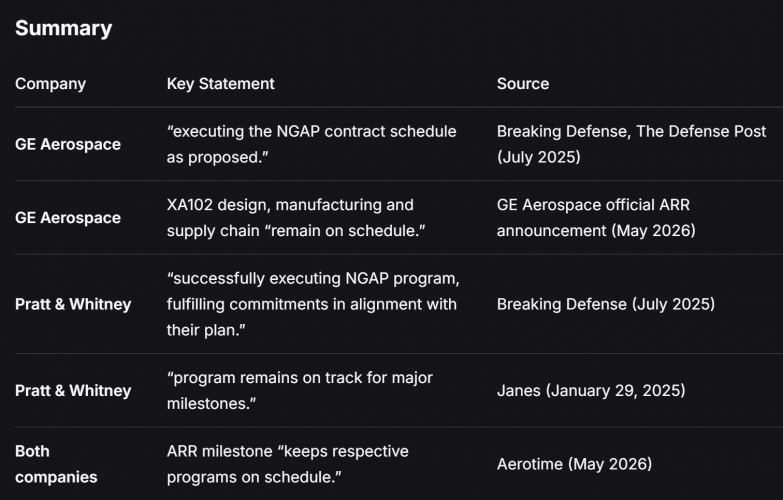
The issue with the F-47 is that the USAF appears to have a 2028 first flight schedule, while the NGAP engine schedule is 2030-2031 for flight engines. On schedule for NGAP doesn’t support the first flight schedule, thus the speculation for an interim engine.
The USAF can make a down select between the XA102 and 103 at any time, but it looks like they are waiting until the first engines are built and completed at least initial test before entering EMD.
I mentioned this 6 months. My explanation is that the XA102 and XA103 engine were resized to suit the smaller Boeing F-47. I expect Lockheed Martin was the clear front runner to win the USAF NGAD contract up to the NGAD pause in July 2024.Yet for some reason, one year after NGAP completed its DDR, it has only finished ARR to date, and the next phase contract hasn’t been awarded. Maybe, the priority or original plan for NGAP has been adjusted.
I have 2 points.I mentioned this 6 months. My explanation is that the XA102 and XA103 engine were resized to suit the smaller Boeing F-47. I expect Lockheed Martin was the clear front runner to win the USAF NGAD contract up to the NGAD pause in July 2024.
The Lockheed design from the start was designed to use three stream adaptive engines. The Boeing design was to use existing F110 engines as the baseline option with three stream engines as a potential upgrade. The engine manufacturers with their three stream engines would have been preparing for a Lockheed win. Boeing winning the NGAD and the USAF then selecting the upgraded engine would totally explain that gap in time.
The last two Boeing prototypes the T-7 and MQ-28 they looked 99% identical to the production versions. I expect the Boeing demostrator to be very close to the F-47. I expect it to be closer than the YF-22 and F-22 where its wing sweep was reduced from 48 to 42 degrees.I have 2 points.
1. The X-plane and the EMD are completely different. Equipping the X-plane with existing engines is acceptable, as it only serves to demonstrate technical feasibility, especially aerodynamic design.
The Boeing demonstrator was for the Navy so it can use non-adaptive engines. The USAF can easily estimate the performance of the demonstrator if it used adaptive engines.If the USAF initially set adaptive engines as the EMD’s baseline propulsion system, formally submitted designs cannot use non-adaptive engines unless the USAF changes its requirements.
The F110 engine already has the highest bypass ratio of any western fighter engine. So it is already quite large for its level of thrust. A new adaptive engine should easily be able to produce 10-20% more thrust without increasing in size. The reason why the Boeing design might need smaller adaptive engines would be because it is overall smaller than the Lockheed design.2. I think the idea that adaptive engines are inevitably larger than conventional ones needs further checking. GE confirms the XA100 fits the F-35A/C engine bays perfectly, so its size is roughly the same as the F135-PW-100.
At the demonstrator stage I don't think it should be called a carrier-based design. I would instead use the word carrier compatible design. This means the overall dimensions and low speed handling characteristics are compatible with a carrier. This shouldn't have any negative effects on performance for the USAF. The Rafale family shows there can be very little performance lost between a carrier and land based design.Personal questions for discussion. Suppose B’s X-plane has completed flight tests powered by the F110 engine, indicating its design leans more toward the Navy’s F/A-XX program. Would the USAF accept an F-47 design derived from a carrier-based fighter?
If all the fans and combustors are 100% identical I don't know why the engine would need full-envelope testing.Based on available information, the existing F110 engine cannot satisfy the F-47’s power and cooling demands. Even if the experimental F110-GE-129, which has undergone megawatt-class power extraction trials, is selected, it will still need full-envelope testing to obtain flight approval. Furthermore, the F110-GE-129 only delivers approximately 29,000 pounds of thrust.

Would the USAF accept an F-47 design derived from a carrier-based fighter?
What type of design changes will need to be done in order for the USAF to go with an interim engine? There are design differences between F-16s even though it can accept either F110 or F100 engines. The intakes are larger for the GE equipped F-16s, for example.That still leaves me with the question of what will Incr1 F-47 fly with?
The XA102/XA103 engines won't necessarily give significantly more afterburning thrust than an uprated F110. The F110 with it's higher bypass ratio has excellent afterburning thrust due to that bypass air feeding the afterburner. The F110 has fairly low dry thrust but excellent cruise fuel burn. Max airflow would be similar so they could share a common air intake.What type of design changes will need to be done in order for the USAF to go with an interim engine? There are design differences between F-16s even though it can accept either F110 or F100 engines. The intakes are larger for the GE equipped F-16s, for example.

Erm.. NO?The last two Boeing prototypes the T-7 and MQ-28 they looked 99% identical to the production versions. I expect the Boeing demostrator to be very close to the F-47. I expect it to be closer than the YF-22 and F-22 where its wing sweep was reduced from 48 to 42 degrees.

The Rafale and Eurofighter both supercruise with 4th generation engines.You won't get a supersonic cruising speed with a fourth-generation engine, but if that's not your goal, the F110 is a good choice

That "roughly" is doing a lot of lifting.2. I think the idea that adaptive engines are inevitably larger than conventional ones needs further checking. GE confirms the XA100 fits the F-35A/C engine bays perfectly, so its size is roughly the same as the F135-PW-100.
Good thing there's an F110-GE-132, making ~32klbs.Furthermore, the F110-GE-129 only delivers approximately 29,000 pounds of thrust.
I also remember those needing larger fans.F110-class engines are fundamentally limited by their ability to maintain fan RPM at supersonic speeds due to elevated temperatures from flow compression.
As for the proposed 36,000 lbf thrust variants, I recall that those were pitched as potential JSF powerplants at one point and may require an enlarged fan.
The third stream doesn't need a greater diameter.But my assumption has been roughly 1" greater radius/2" greater diameter to give the 3rd stream of air someplace to flow.

No, I know the voices in my head aren't real.I am glad that every forum has its resident schizo. Theres zero informational value to be had but the entertainment value is unparalleled.
Increasingly this thread reminds me of reading tweets from kanye.

This. Im lurking for the laughs.I am glad that every forum has its resident schizo. Theres zero informational value to be had but the entertainment value is unparalleled.
Increasingly this thread reminds me of reading tweets from kanye.


Little late to this, but key items are subsystems routing (bleed air routing, fuel interfaces, secondary power/APU routing), Inlet and seal compatibility, engine mounts, and overall engine envelope.What type of design changes will need to be done in order for the USAF to go with an interim engine?
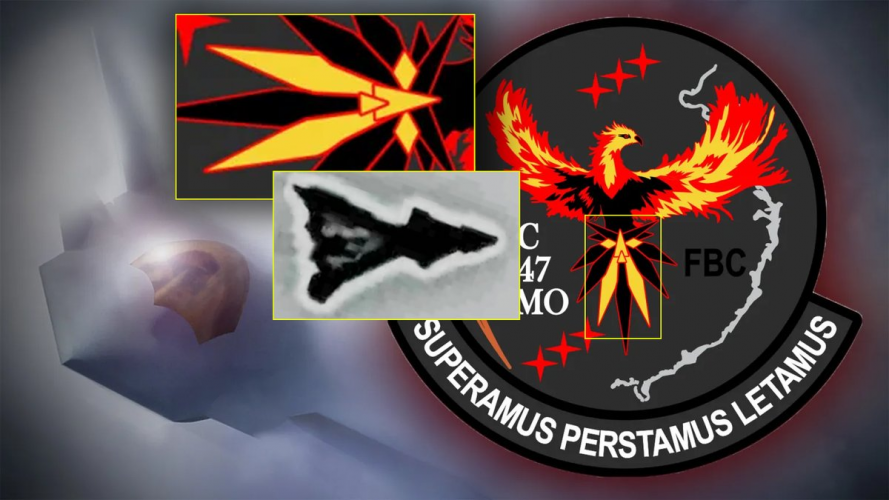
Say it louder for the folks in the back.Again, it's not F-47 because it will not fly till 2028.


And for systems development. The question is, is it flying in support of the F-47, the upcoming down select for the F/A-XX, or both?Yall think they’re still flying one or both of the demonstrators, maybe just for flight sciences purposes?
You're gonna summon him againFor both?
Ehhh..... ehhhhhhhhhhh it depends but its usually because of having to support legacy systems or having too much technical debt and not enough manpower / money to fix it all.Military software isn't bloated
yes, the database tail is certainly large but information security drives limitation on function access to the data as much as possible. That's how they can operate on just a megabyte level of RAM.Ehhh..... ehhhhhhhhhhh it depends but its usually because of having to support legacy systems or having too much technical debt and not enough manpower / money to fix it all.
agreed, the easiest way to swap engines is by having space for the manifolds etc to change between the interim and 3-stream.Little late to this, but key items are subsystems routing (bleed air routing, fuel interfaces, secondary power/APU routing), Inlet and seal compatibility, engine mounts, and overall engine envelope.
Given the engines are clean sheet, the OEMs would work with B and LM (up until award at least) to try and find interfaces that suit both to reduce the magnitude of changes needed.
I doubt many changes, if any, would be allowed for inlet and seals since they are generally much more invasive. Especially for an LO inlet which requires a painful amount of extra verification and design. Subsystems are slightly more flexible, but you're still playing with fractions of an inch worth of flexibility, if that.
Envelope is probably the most important as you have to meet all the same clearance requirements to nearby components and structure as before. HXs, Condensers, valves, tubing, sensors, inlet ducting, etc. all can surround the engine, so you don't really have much wiggle room with envelopes.