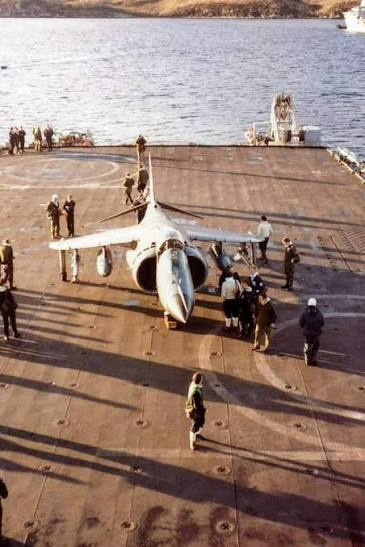
MiG-21MF/bis vs Sea Harriers ?

  • Sea Harriers would have complete air superiority.

  • Sea Harriers would have had some losses.

  • Sea Harriers would have been blasted out of the sky.

  • None of the two aircraft would have gained air superiority.


Results are only viewable after voting.
Wasn't there a rumour there was a Soviet SSN down south? Though I suspect Splendid's crew would have had little problem identifying its signature had it been a Victor.
I suspect had it been a Brazilian or Chilean Oberon then some diplomatic ire might have resulted (or they might have had the sense to get the hell out of there).
It's possible it was just a biologic.

ASW is a tricky business, especially with the technology back then and as already pointed out, some of that kit was aging even then.
Yes...Rússian submarines!!!
 
Wasn't there a rumour there was a Soviet SSN down south? Though I suspect Splendid's crew would have had little problem identifying its signature had it been a Victor.
Rumors, yes.

Back then, each of the Soviet sub classes had a distinctive tonal caused by stamped screw blades, and some of them were very loud.


It's possible it was just a biologic.
Not if it was a MAD contact. That's 100% a chunk of steel in the water.
 
What do the RN SSNs do if there were Soviet subs in the area? Do the merely note them and continue to chase the Argentinians and conduct their other Falklands War tasks?

For their part, would the Soviets try to track the RN SSNs to the extent it would impede their operations?
 
Last edited:
"A Carrier at Risk" by Mariano Sciaroni, charted the movements of the 25th De Mayo as it retired to Argentinian waters on 3rd May and then ran north. He noted

"In all anti-submarine operations carried out by the Trackers, the sonobuoy was the main sensor used for sub-aquatic searches. These were placed with consideration to their range of effective detection, and other factors such as time, place, and meteorological conditions.

The SSN Splendid's first contact with the Argentinian TF was its ESM detection of a Tracker's radar emissions in the early hours of 4th May while it was near the surface communicating with London. As the signal closed she dived. But the Argentinians detected nothing from their sonobuoy pattern. This they put down to the Tracker not being able to monitor all the sonobuoys laid simultaneously.

Splendid then detected a target on its sonar initially classified as a warship, but when it got close enough for a periscope inspection it turned out to be a merchantman.

At 0743 5th May 0743 a Tracker visually spotted then confirmed by radar a sub snorkel (complete with exhaust trail) and launched a Mk.44 torpedo and passive sonobuoy. No explosion. 25th De Mayo then launched a Sea King around 0805 and another at 0847 both armed with 2 x Mk.44 and then another Tracker. Sonar used in passive mode by first and proved U/S in second. Sea King detected a faint signal classified as a possible sub. On that occasion the Tracker used its MAD gear. Altogether some 12 passes with smoke bombs dropped on what seemed to be a moving target but which could not be confirmed. As the search continued a further probable sub contact was prosecuted and another Mk.44 dropped.

Meanwhile Splendid had detected a sub contact to its NNE! That evening Splendid was forced to withdraw due to mechanical problems. It was the only British sub in the area.

So on 5th May both sides detected an unknown sub, and the Argentinians attacked it with no result.

As 25th De Mayo moved north in Argentine territorial waters over coming days, the Trackers continued searching, gaining further contacts and making attacks on 6th & 7th May (last using depth charges). No British sub was in the vicinity of these attacks.

As for Onyx, she was detected by an Argentinian Boeing 707 Reece aircraft while en route Ascension to the Falklands on 21st May (about 1,200 miles from Beunos Aires). She suffered bow damage after she ran aground during a special forces mission on 5th June.

Strangely enough, the Argentines had better luck with bombs than with homing torpedoes against British subs. With emphasis on luck.:

"On 23 May, Valiant suffered minor damage while submerged off Rio Grande when an Argentine fighter coming back from a mission jettisoned its bombs near the submarine in order to secure a safe landing."

See:

https://en.wikipedia.org/wiki/HMS_Valiant_(S102)#Operational_history
 
Strangely enough, the Argentines had better luck with bombs than with homing torpedoes against British subs. With emphasis on luck.:

"On 23 May, Valiant suffered minor damage while submerged off Rio Grande when an Argentine fighter coming back from a mission jettisoned its bombs near the submarine in order to secure a safe landing."

See:

https://en.wikipedia.org/wiki/HMS_Valiant_(S102)#Operational_history

Well that answers the question of when the SSNs moved to a close blockade of the coast and monitoring of the Air Force communications. They were on station by the time of the San Carlos landings more or less.
 
What do the RN SSNs do if there were Soviet subs in the area? Do the merely note them and continue to chase the Argentinians and conduct their other Falklands War tasks?
I'd expect that the RN subs would try to drive away the Soviet subs. Lots of active pinging saying "If I wanted you dead, you would be". More precisely, a stealthy approach to the Soviet sub then "one ping only Vassily", possibly followed by opening outer doors on the torpedo tubes so that the Soviets could hear it. And closed with a call on the Gertrude, "Go home, Ivan. I'd hate to have to kill you here."


For their part, would the Soviets try to track the RN SSNs to the extent it would impede their operations?
I suspect that the Soviets were trying to track the UK surface forces, not subs.
 
There is a very good chapter on the British subs in Operation Corporate in "The Silent Deep. The Royal Navy Submarine Service since 1945" by Peter Hennessy & James Jinks.

In it is the following exchange:-

Peter Wright a Foreign Office official asked Admiral Leach "to what extent our SSNs would be able to distinguish Argentine from other, including Soviet, submarines". Leach's recorded response was

"He said that he could give me no watertight assurance unless submarines were to fortuitously give away, by underwater telephone conversation, which nationality they were. There might also be indications from the nature of sonar use, and he commented that Soviet submarines were likely to remain passive while the Argentines might have an operational need to transmit. In brief, it is possible, but by no means certain, that reliable identification could be made. I said that this was a point which was likely to be of considerable interest to Ministers."

Worth remembering that the SSNs were controlled from London (Northwood) and not the TF commander Adm Sandy Woodford, something that caused some disagreement.

The SSN were also operating under their usual North Atlantic rules. That meant that they were allocated a patrol area by London and were not supposed to stray beyond that. This was to avoid "blue on blue" incidents. Even then London would from time to time issue instructions for SSN to move here or there in accordance with intelligence they had, which wasn't always accurate. Two of the subs that occasionally "tresspassed" on the other's patch, had a "gentleman's agreement" not to attack any nuclear sub detected at those times. Later, on 26th May, Valiant which went South with a towed array sonar, held a contact that turned out to be Splendid.

The overriding consideration was not to lose a nuclear reactor in the South Atlantic due to the political ramifications. Similarly sinking a Soviet sub would have its own political ramifications.

Then we have the Rules of Engagement issued, which limited what SSN could actually do and which were changed as time went on. But those were affected by political considerations not just military or naval. The first set issued read as follows.

a. Any vessels positively identified inside the (Maritime) Exclusion Zone as being Argentine warships, submarines and naval auxiliaries may be attacked. [That meant visual identification required]
b. After the first successful attack, withdraw from the scene of action and report. Having reported or, if unable to clear report after 12 hours, continue patrol.
c. Situation Reports are to be made at your discretion as soon as possible after any subsequent successful attacks and on all Argentine units detected.
d. Additionally, if attacked you are authorised to retaliate as necessary for your self defence both inside and outside the exclusion zone.

When the MEZ became the Total Exclusion Zone, the ROE were expanded to civilian shipping.

Splendid, which had been sent out of the MEZ to hunt 25th De Mayo, had her ROE changed did on 21st April to allow her to sink her, but she did not find her at that time. Conqueror had her ROE changed to allow her to sink the Belgrano just a few hours before she did.

On 7th May a warning was issued via the Swiss authorities that any Argentine warship or aircraft found more than 12 nautical miles from the Argentinian coast would be regarded as hostile and dealt with accordingly. That effectively extended the Total Exclusion Zone to the Latin American coastline.That again changed the ROE.

One thing that is clear is that the British SSN experienced great difficulties with identifying ships, subs and biologicals in the waters around the Falklands. Added to that Splendid had to withdraw for a while to fix mechanical problems, thereby losing any chance of intercepting 25th De Mayo, while Conqueror had communication problems after her communications mast was damaged by heavy seas before the Belgrano attack.

Another issue was that the legal advice received by the British Govt from the Attorney General was very clear. The SSN could not sink Argentine ships within Argentine territorial waters.

There are a few other interesting pieces. One British SSN was reported to have left Gibraltar in late March bound for the Falklands. It in fact went to chase Soviet subs in the Atlantic. No enlightening statement was issued by the MOD. The Argentinian press were reporting a British sub operating 250 miles off the coast. Again this was false but the MOD did not correct. All useful propaganda to hide the true movements.

The TF also ran a defensive AS war that included the unsuccessful prosecution of an Argentinian Type 209 sub, San Luis, in inshore waters that involved frigates & helicopters with many weapons dropped. I've commented about this before on this or another Falklands thread.

This unidentified sub was detected by both navies close to the Argentinian coast. Warnings had previously been issued to everyone, including the Soviets, that any sub, vessel or aircraft approaching aircraftthe TF would be treated as hostile.
 
Last edited:
a. Any vessels positively identified inside the (Maritime) Exclusion Zone as being Argentine warships, submarines and naval auxiliaries may be attacked. [That meant visual identification required]

This sounds like a hassle, but given the only anti-ship weapon these SSNs had at the time was the WW2 era Mk8 torpedo these SSNs would likely have to use the periscope to attack ships anyway.
One thing that is clear is that the British SSN experienced great difficulties with identifying ships, subs and biologicals in the waters around the Falklands.

I read something once, probably in a novel, that an SSN needs/ed to get to an area 12 hours before a planned ambush to familiarise itself with the acoustic environment of the area. This makes sense, a crew familiar with the background noise of a new area can then discern what new and unusual noises appear.
 
This sounds like a hassle, but given the only anti-ship weapon these SSNs had at the time was the WW2 era Mk8 torpedo these SSNs would likely have to use the periscope to attack ships anyway.
Nope. They went South with a MIX of WW2 vintage Mk.VIII and the modern wire guided Mk.24 Tigerfish. IIRC Conqueror loaded 3 Mk.8 and 3 Mk.24 into her six tubes ahead of sinking the General Belgrano. Her captain chose to use the Mk.8 because of known reliability problems with some of the Mk.24 manufactured to that point.

HMS Courageous was the first RN SSN to be equipped with the Sub-Harpoon missile and took an unknown number south when she deployed to the Falklands during the war.
 
Nope. They went South with a MIX of WW2 vintage Mk.VIII and the modern wire guided Mk.24 Tigerfish. IIRC Conqueror loaded 3 Mk.8 and 3 Mk.24 into her six tubes ahead of sinking the General Belgrano. Her captain chose to use the Mk.8 because of known reliability problems with some of the Mk.24 manufactured to that point.

HMS Courageous was the first RN SSN to be equipped with the Sub-Harpoon missile and took an unknown number south when she deployed to the Falklands during the war.

IIUC the anti-ship version of the Mk24 Tigerfish wasn't in service in 1982, only the ASW version. The tigerfish didn't get anti-ship capability until 1983.
 
IIUC the anti-ship version of the Mk24 Tigerfish wasn't in service in 1982, only the ASW version. The tigerfish didn't get anti-ship capability until 1983.
From the Navweaps site on the Tigerfish:-

Service entry
Mod 0 1980
Mod 1 1979
Mod 2 1986

"Mod 0 was an ASW torpedo. When this entered service trials in 1973, the reliability was very poor, about 40% on average functioning as intended. This torpedo depends heavily on data provided by the firing submarine, but the torpedo tended to dip and break the guidance wires during launch. Mod 0 failed provisional fleet acceptance trials in 1979 but was issued to the fleet starting in 1980. Mod 1 had an anti-ship seeker, but experienced problems with the shipboard tactical-data system and with actual torpedo control. During this time, the Royal Navy Torpedo Factory (RNTF) was closed and production passed to Plessey. The redesigned Mod 1 version passed trials in 1978 and was issued to the fleet the following year.

However, in a test performed in 1982 immediately after the Falklands War, two out of five Mod 1 torpedoes fired at a target hulk failed to function because of bad batteries and none of the others even hit the target. This unreliability was well known in the Fleet, which is why ancient Mark 8 torpedoes were used to sink the Argentine cruiser General Belgrano."
 
Nope. They went South with a MIX of WW2 vintage Mk.VIII and the modern wire guided Mk.24 Tigerfish. IIRC Conqueror loaded 3 Mk.8 and 3 Mk.24 into her six tubes ahead of sinking the General Belgrano. Her captain chose to use the Mk.8 because of known reliability problems with some of the Mk.24 manufactured to that point.

HMS Courageous was the first RN SSN to be equipped with the Sub-Harpoon missile and took an unknown number south when she deployed to the Falklands during the war.

Another type of weapon went south with the task force that got less publicity:

UK deployed 31 nuclear weapons during Falklands war

"A Ministry of Defence (MoD) minute, dated 6 April 1982, referred to
“huge concern” that some of the “nuclear depth bombs” could be
“lost or damaged and the fact become public”. The minute added:
“The international repercussions of such an incident could be very
damaging”."

See:

https://www.declassifieduk.org/uk-deployed-31-nuclear-weapons-during-falklands-war/
 
This sounds like a hassle, but given the only anti-ship weapon these SSNs had at the time was the WW2 era Mk8 torpedo these SSNs would likely have to use the periscope to attack ships anyway.
Even with ADCAPs we practiced periscope attack runs. Against a sufficiently-large surface target you have plenty of standoff range from where you can positively ID the target to where you can effectively attack them.


I read something once, probably in a novel, that an SSN needs/ed to get to an area 12 hours before a planned ambush to familiarise itself with the acoustic environment of the area. This makes sense, a crew familiar with the background noise of a new area can then discern what new and unusual noises appear.
Probably depends on which type of sonar contact you're getting, but yes.

For example, the old, mid-1980s-and-before Soviet subs had consistent narrowband tonals (specific hz I don't know because they were 15 years before my time). Or, for another example, a P-3 has a 68hz tonal from the props. You hear one of those specific tones and it's obvious what's up.

But if you have to piece things together on the broadband sonar picture, well, you need a lot more data to say what's what.
 
Another type of weapon went south with the task force that got less publicity:

UK deployed 31 nuclear weapons during Falklands war

"A Ministry of Defence (MoD) minute, dated 6 April 1982, referred to
“huge concern” that some of the “nuclear depth bombs” could be
“lost or damaged and the fact become public”. The minute added:
“The international repercussions of such an incident could be very
damaging”."

See:

https://www.declassifieduk.org/uk-deployed-31-nuclear-weapons-during-falklands-war/
You can find the official version of those events, including the reasoning, along with a schedule showing the movements of these weapons around the fleet, here:-
https://falklandstimeline.wordpress...iage-of-nuclear-weapons-by-the-task-force.pdf
 
Helicoptero-do-destroier-HMS-Antrim-atacou-alvo-submarino-desconhecido.jpeg


https://www.naval.com.br/blog/2024/...ms-antrim-atacou-alvo-submarino-desconhecido/

Five minutes after takeoff, and 10.5 nautical miles ahead of the ships, the helicopter lowered its sonar transducer to a depth of 180 feet (55 meters) and began transmitting. The active sonar immediately detected a promising contact at 3,000 yards. The observer, Lieutenant Chris Parry, urgently reported to Antrim: “X-Ray, FIVE, Uniform, this is Zulu Trail FOUR Foxtrot 4140 with bearing 145, distance 30, heading 090, speed 4, classified POSSUB LOW 2.”

The helicopter then raised its sonar and moved to a position about 1,000 yards ahead of the POSSUB. Upon diving again, contact was re-established and was described by the observer as a “sausage-shaped” contact, with good definition. After prolonged analysis by Lieutenant Parry and Sergeant Fitzgerald, they ruled out that the contact was a whale or other form of marine life, as no whale sounds were heard in Passive mode. The sonar display showed the correct size and shape for a submarine. This meant the confidence level was raised to POSSUB HIGH 3 and then POSSUB HIGH 4. Lt. Parry radioed HMS Antrim that he would proceed with the launch of a Mk 46 torpedo.

Once launched, the torpedo began its zigzag search pattern towards the target at 3,400 yards – but at the end of its trajectory, no explosion was detected. By lowering the sonar transducer again, which had been raised when the torpedo entered the water so as not to affect it, the helicopter regained contact once more. Now, the contact was violently changing speed, reaching 28 knots, and rising and falling below the thermal layer. Furthermore, three decoys producing bubbles were detected.

Contact was maintained for about 50 minutes. Even so, the Plymouth's Wasp was already airborne in support and was now authorized to launch a second torpedo. “Humphrey,” the Wessex, needed to refuel and rearm and therefore needed to return to the Antrim, so contact was lost, as the Wasp had no sonar or other means to continue the contact.

Contrary to what one might imagine, Lieutenant Parry received a reprimand from the Antrim's Commander for wasting a torpedo on their return. The ship considered the contact to be nothing more than a whale. According to the crew's debriefing:

Although Command considered this target to be marine life, both the Observer and the Sonar Operator were convinced that a submarine had been detected during this action. Although intelligence indicated that the Argentine threat was low in this area, the contact seemed to meet all the criteria for a submarine. It was possibly a submarine from another Navy.

The pilot flying the Wessex that day, Sub-Lieutenant Stewart Cooper, also wrote in his log:

I encountered what I thought was a submarine on the afternoon mission. I fired a Mk 46 at it. No success. The ship didn't think much of it and the commander said it was a whale. I hope it was. The Mk 46 didn't explode. The 'whale' we encountered was, of course, a submarine, but the ship didn't tell us it was because that would compromise safety. An interesting situation and a lesson learned (I hope) – tell the crew what you know! After all, whose submarine was it? We found out later.

The last comment suggests that Royal Navy commanders were aware of the presence of submarines from other nations operating in the area, but did not necessarily wish to share this information with those in charge of ASW tasks.

 
One thing that regularly pops into my mind when talking about the Falklands is the glacial pace of the VC10 tanker conversion project. These tankers could offload vastly more fuel than a Victor and would have transformed the RAF's long-range missions in the Falklands even if a couple were available.

By the end of 1977 there were 4 ex East African Airways Super VC10 Combis and 5 ex Gulf VC10s in Britain doing nothing. In 1978 the RAF announced they would convert VC10s into dedicated tankers but the first flight didn't occur until 22 June 1982 and flight testing stopped in June 1983 when a crack was discovered in the tail of the test aircraft. In the end the final of 9 aircraft didn't get converted to a tanker until 1987.

Apparently the VC10s had to have the front of the fuselage removed to fit the tank, whereas the Super VC1 Combi could have it fitted through the big cargo door. Still, 4 years from announcement to first flight when the aircraft were available seems excessive, as does the 5 years to covert 9 aircraft after the first flight.
 
One thing that regularly pops into my mind when talking about the Falklands is the glacial pace of the VC10 tanker conversion project. These tankers could offload vastly more fuel than a Victor and would have transformed the RAF's long-range missions in the Falklands even if a couple were available.

By the end of 1977 there were 4 ex East African Airways Super VC10 Combis and 5 ex Gulf VC10s in Britain doing nothing. In 1978 the RAF announced they would convert VC10s into dedicated tankers but the first flight didn't occur until 22 June 1982 and flight testing stopped in June 1983 when a crack was discovered in the tail of the test aircraft. In the end the final of 9 aircraft didn't get converted to a tanker until 1987.

Apparently the VC10s had to have the front of the fuselage removed to fit the tank, whereas the Super VC1 Combi could have it fitted through the big cargo door. Still, 4 years from announcement to first flight when the aircraft were available seems excessive, as does the 5 years to covert 9 aircraft after the first flight.
You can find a full description of the work that needed to be carried out to convert these aircraft. And that would be after the conversion had been designed from from scratch, which I would assume happened after RAF acquisition in 1978. It went well beyond just fitting extra tanks in the fuselage. It included major structural works to wings and fuselage. ZA141 needed a new tail after the incident during flight test

https://www.vc10.net/History/tanker_conversions.html
 
You can find a full description of the work that needed to be carried out to convert these aircraft. And that would be after the conversion had been designed from from scratch, which I would assume happened after RAF acquisition in 1978. It went well beyond just fitting extra tanks in the fuselage. It included major structural works to wings and fuselage. ZA141 needed a new tail after the incident during flight test

https://www.vc10.net/History/tanker_conversions.html

Yes, its a reasonable list, but they didn't have to design the plane from scratch or anything, they used airworthy examples. The BA planes they started converting from the mid 80s were in much worse condition.

My question is, from an April 1982 start could the RAF get any VC10 tankers into service in 6 months in a maximum effort like other Falklands War crash programs?
 
Yes, its a reasonable list, but they didn't have to design the plane from scratch or anything, they used airworthy examples. The BA planes they started converting from the mid 80s were in much worse condition.

My question is, from an April 1982 start could the RAF get any VC10 tankers into service in 6 months in a maximum effort like other Falklands War crash programs?
Well the answer to that has to be no since the first, ZA141, didn't fly for the first time in its tanker configuration until 22nd June 1982. And as with any new type (and these K2/3 were a new type regardless of the RAF having VC.10 C.1 in service from the 1960s) there had to be a full test programme.

Had they been as near completion as you would like, there would have been no need for the 6 Vulcan K.2 tanker conversions nor the 4(6?) Hercules C.1K tanker conversions that were pushed through starting in April 1982.

The conversion of the first Vulcan to K.2 standard at BAe Woodford was initially estimated to take 3 weeks. It took 7 for what was a quick & dirty conversion to a single point tanker. The first aircraft didn't fly again until 18th June 1982, (just 4 days before ZA141 flew) and then had to undergo trials to get an interim CA by 23rd when the first was delivered to the RAF. Five more followed.
https://www.key.aero/article/how-avro-vulcan-was-reinvented-tanker

But note the comment in that article that these conversions used Mk.17 Hose Drum Units intended for the VC.10 tanker programme. If the VC.10 programme was as near completion as you would like, then there wouldn't have been any HDU for the interim Vulcan tankers. So it clearly wasn't that far advanced. Those HDU had to be pulled from the Vulcans starting in May 1983 to allow completion of the VC 10 K2/3 conversions.

Another 6 Mk.17 HDU were installed on the 4 (6? Edit- I think it was an initial 4 plus 2 later) rush Hercules C.1K tanker conversions carried ot by Marshalls of Cambridge. But again the war was over before rush the first of those was completed.
https://www.key.aero/article/raf-hercules-air-air-refuelling-falklands

There were only a few dozen centreline Mk.17 HDU produced. Initially installed on the Victor K.1/1A in the 1960s, IIRC these were recycled onto the K.2 conversions in the 1970s.
 
The crash conversions using Mk17s on Vulcans and Hercs fits the rushed nature of the British response to the Falklands. In that scenario it's a great idea to take the Mk17s from the slow VC10 program and fit them to conversions that will get fast results.

However if it became clear early on that retaking the islands couldn't happen for 6 months, until the southern spring, would the same decision be made? Or might it be possible to get a couple of VC10s ready by then? After all, they'd provide a huge advantage over the likes of the Victor, Hercules and Vulcan tankers.
 
...Contrary to what one might imagine, Lieutenant Parry received a reprimand from the Antrim's Commander for wasting a torpedo on their return. The ship considered the contact to be nothing more than a whale...
One thing that regularly pops into my mind when talking about the Falklands is the glacial pace of the VC10 tanker conversion project. These tankers could offload vastly more fuel than a Victor and would have transformed the RAF's long-range missions in the Falklands even if a couple were available...
You can find a full description of the work that needed to be carried out to convert these aircraft. And that would be after the conversion had been designed from from scratch, which I would assume happened after RAF acquisition in 1978. It went well beyond just fitting extra tanks in the fuselage. It included major structural works to wings and fuselage. ZA141 needed a new tail after the incident during flight test

Inspired by Admiral Christopher J. Parry's recent YouTube interview, I was moved to read his interesting book Down South: A Falklands War Diary, the (only minimally edited, Parry promises) journal he had kept during the South Atlantic campaign. Then-Lieutenant Parry was the Flight Observer (responsible for sensors and weapons) in the four-man crew of the Westland Wessex helicopter aboard destroyer HMS Antrim. The book has no index. Here are a few excerpts that Forum members might find interesting:

15 April 1982 (pp49-50): "Highlight of the day was the arrival of a Nimrod with our operations order for the recovery of South Georgia. The Nimrod was way out on the limits of its endurance and I did wonder why it was necessary to deliver the order, which presumably could have come by signal. Perhaps the secret nature of the operation, the need for surprise and operational security mean that it has to be delivered in this way... The Nimrod did a couple of practice runs and on a third dropped a parachute with a canister attached on a final low-level pass, before waggling its wings and departing to the north... Those of us on the upper deck waved. The aircraft, with its distinctive shape and familiar fuselage markings, seemed like a hint of home and normality in the vastness of the South Atlantic. One almost felt a twinge of sentiment about the RAF!"
[A boat from Antrim successfully retrieved the canister.]

20 April 1982 (p64): "The RAF also made an appearance today, in the form of a Victor [K.2 tanker aircraft], conducting at long range and vast expense a maritime reconnaissance of the area between us and [South Georgia], to check for bergs and Arg ships. I am not sure how effective the [H2S] radar is at the height that they would have been flying, or their ability to classify contacts anyway. The Wardroom banter is that the RAF is worried that, if South Georgia falls and the Args give up on the Falklands, they will not be seen to have contributed very much."

25 April 1982: [Parry's Wessex finds Argentine submarine Santa Fe leaving South Georgia for home on the surface, and he drops two Mark XI depth charges (170 lbs of Torpex each) which bracket the sub, crippling her. Further RN helicopters attack as Santa Fe limps back to South Georgia. Parry is, as he writes, the first airman to attack a hostile submarine since WW2.]

1 May 1982 (p128): "The discussion in the Wardroom posed the very reasonable question of why it was necessary to alert the Args with the Vulcan attack by waking them up and thoroughly pissing them off before the SHars [Sea Harriers] arrived... [Antrim's Principal Warfare Officer] Pat Brown and most of the warfare team think that the Vulcan raid is an RAF plot to ensure the Crabs get the glory for the first attack, to make up for the fact that they can't deploy their Phantoms or attack aircraft anywhere. No one will have them, although we are hopeful about the Chileans. I cannot see that happening somehow; the Chileans have to live with the Args after the conflict...".
[Crabs = Naval Service slang for Royal Air Force personnel]

2 May 1982 (p129): "There is no evidence that the Args have extended the runway or enabled it to be used for combat jets—what on earth were they doing all the while we were coming down to get them? Any sensible military precautions would have included making sure that A4s and Mirages could operate from Stanley."
 
15 April 1982 (pp49-50): "Highlight of the day was the arrival of a Nimrod with our operations order for the recovery of South Georgia. The Nimrod was way out on the limits of its endurance

Off the top of my head I suspect this would have been an unrefulled mission.
 
The MiG-23MF started to be exported with R-23 and R-13M or R-60 (depending on the country) in the late 70s. It is therefore possible that Argentina received them before 1982.
Especially, if the Soviet Union might have seen more potential South American sales and geopolitical gains, as a consequence.....perhaps.

Regards
Pioneer
 
Would make little difference extending the runway given the Argentine pilot’s inexperience in dogfighting.

Argie fliers were totally untrained and inexperienced in the tactics needed to confront RN aircraft and pilots. After the first few attempts they withdrew their fast-movers in most cowardly fashion, leaving their attack aircraft unprotected.

Their initial aggressive air to air tactics consisted of trying to lob Shaffirs from up high and outside their range at the Sea Harriers does not speak highly for their tactical competence in all honesty.
 
Would make little difference extending the runway given the Argentine pilot’s inexperience in dogfighting.

Argie fliers were totally untrained and inexperienced in the tactics needed to confront RN aircraft and pilots. After the first few attempts they withdrew their fast-movers in most cowardly fashion, leaving their attack aircraft unprotected.

Their initial aggressive air to air tactics consisted of trying to lob Shaffirs from up high and outside their range at the Sea Harriers does not speak highly for their tactical competence in all honesty.

Given their extreme lack of fuel, to the point were several aircraft were lost on missions due to running out, the FAA/COAN had almost no opportunity to utilise any tactical skill they may have possessed. Indeed Mirage IIIs lobbing out-of-envelope missiles from high altitude shows enough tactical sense to stay up where the Mirage is good rather than come down to lower levels which better suit the Sea Harrier. Daggers were so short on fuel they could only approach from a single attack vector, to the point where Sea Harriers would just loiter there and ambush them.
 
Last edited:
Given their extreme lack of fuel, to he point were several aircraft were lost on missions due to running out, the FAA/COAN had almost no opportunity to utilise any tactical skill they may have possessed. Indeed Mirage IIIs lobbing out-of-envelope missiles from high altitude shows enough tactical sense to stay up where the Mirage is good rather than come down to lower levels which better suit the Sea Harrier. Daggers were so short on fuel they could only approach from a single attack vector, to the point where Sea Harriers would just loiter there and ambush them.
Oh I agree with that but often they had between 10 and 15 minutes over the islands, depending on the approach and return flight path, weather conditions, and so on

People often overstate the usefulness of the AIM-9L too.

The tactics and doctrine employed by the inexperienced Argentine pilots meant that the AIM-9L was only another nail in the coffin. All the engagements would have gone to the Brits even without it.

The Argentine pilots were NOT trained in modern tactics—obviously—nor in the use of available countermeasures.

On May 1, several Argentine fighter jets attempted to attack the Harriers with cannons and missiles, but quickly discovered they lacked the necessary capability to do so effectively. That same day, two Argentine Mirage fighters attempted to engage the Harriers, and both were destroyed.
 
Oh I agree with that but often they had between 10 and 15 minutes over the islands, depending on the approach and return flight path, weather conditions, and so on

People often overstate the usefulness of the AIM-9L too.

The tactics and doctrine employed by the inexperienced Argentine pilots meant that the AIM-9L was only another nail in the coffin. All the engagements would have gone to the Brits even without it.

The Argentine pilots were NOT trained in modern tactics—obviously—nor in the use of available countermeasures.

On May 1, several Argentine fighter jets attempted to attack the Harriers with cannons and missiles, but quickly discovered they lacked the necessary capability to do so effectively. That same day, two Argentine Mirage fighters attempted to engage the Harriers, and both were destroyed.

The Argentine planes didn't have 10-15 minutes 'spare' time over the islands in which attack aircraft could pick a good attack approach, drop their bombs and then turn around to face the Sea Harriers if intercepted. Similarly the few times Mirage IIIs did fly over the islands they didn't have 10-15 minutes time on a CAP station plus a fuel allowance for combat, like the Sea Harriers did.

This is why the airfield gets so much attention, even if only for minimum viable capability, as it transforms the FAA/COAN fuel situation under combat conditions. The (majority of?) missions that never encountered a Sea Harrier would happen as they did historically, but in the event of an interception an A4 or Dagger could turn and defend itself with guns to at least frustrate the interception, knowing that they could land at Port Stanley and with a quick turn-around leave before the RN could lay on naval gunfire or a bombing mission.

The same applies to Mirage III 'escort' or 'decoy' missions, if the opportunity came they could engage at high speed to frustrate the Sea Harriers and then do a quick turn-around at Port Stanley. Indeed this is exactly how the Sea Harriers used 'Sids Strip' once it became available, as well as that one time where they landed on Fearless and Intrepid after an interception ran their fuel down.

1783195467624.png
Facebook.
 
Last edited:
The Argentine planes didn't have 10-15 minutes 'spare' time over the islands in which attack aircraft could pick a good attack approach, drop their bombs and then turn around to face the Sea Harriers if intercepted. Similarly the few times Mirage IIIs did fly over the islands they didn't have 10-15 minutes time on a CAP station plus a fuel allowance for combat, like the Sea Harriers did.

This is why the airfield gets so much attention, even if only for minimum viable capability, as it transforms the FAA/COAN fuel situation under combat conditions. The (majority of?) missions that never encountered a Sea Harrier would happen as they did historically, but in the event of an interception an A4 or Dagger could turn and defend itself with guns to at least frustrate the interception, knowing that they could land at Port Stanley and with a quick turn-around leave before the RN could lay on naval gunfire or a bombing mission.

The same applies to Mirage III 'escort' or 'decoy' missions, if the opportunity came they could engage at high speed to frustrate the Sea Harriers and then do a quick turn-around at Port Stanley. Indeed this is exactly how the Sea Harriers used 'Sids Strip' once it became available, as well as that one time where they landed on Fearless and Intrepid after an interception ran their fuel down.

View attachment 817012
Facebook.
Mirages effective combat radius was 450nm (830km), giving it approximately ten minutes over the islands.

In short, the FAA simply didn't know how to fight air-to-air. In this type of combat, bombers are always accompanied by fighter jets, acting in the fighter role, and this is something the high command failed to provide. Instead of developing new tactics they abandoned the fight, leaving the Skyhawks to their fate.

Keep in mind the logistics that would likely be involved not only in doing something like "lengthening" an airstrip but also what would likely be entailed in supporting any additional aircraft, aircrew, support personnel, support equipment, and other general support issues that would likely be required. As I understand it Argentina had a fair amount of issues just adequately supporting the troops that they had on shore at the time.

Adding even a small number of jets would likely add a significant enough logistics stream, especially with regards to fuel, munitions, and support equipment and personnel to make it probably a non-starter given the state of Argentina's air and sea transport capabilities at the time.

Plus the Argentines just have a few weeks to do this, under frequent bombardment from Harriers and naval gunfire, before their disgraceful early surrender. It wasn't on the cards.
 
Keep in mind the logistics that would likely be involved not only in doing something like "lengthening" an airstrip but also what would likely be entailed in supporting any additional aircraft, aircrew, support personnel, support equipment, and other general support issues that would likely be required. As I understand it Argentina had a fair amount of issues just adequately supporting the troops that they had on shore at the time.

Adding even a small number of jets would likely add a significant enough logistics stream, especially with regards to fuel, munitions, and support equipment and personnel to make it probably a non-starter given the state of Argentina's air and sea transport capabilities at the time.

Plus the Argentines just have a few weeks to do this, under frequent bombardment from Harriers and naval gunfire, before their disgraceful early surrender. It wasn't on the cards.

The realities of this aspect is well established in this thread. I don't think anyone believes the Argentine would work miracles, but the alternative to this isn't nothing, there are things that could have been done with some planning (which is the real problem for every Falklands scenario) and effort.

Mirages effective combat radius was 450nm (830km), giving it approximately ten minutes over the islands.

In short, the FAA simply didn't know how to fight air-to-air. In this type of combat, bombers are always accompanied by fighter jets, acting in the fighter role, and this is something the high command failed to provide. Instead of developing new tactics they abandoned the fight, leaving the Skyhawks to their fate.

The devil is in the details. To reach the islands FAA Mirage IIIs used the big 'ferry' drop tanks on long pylons as opposed to the smaller, slim 'supersonic' drop tanks which used short pylons with vastly less drag, meaning half the fuel in these tanks was used to push the pylon and tank through the air. There isn't little point in having 10 minutes over the islands if you can't use the afterburner to fight; you need 10 minutes over the islands plus a few minutes at full throttle and afterburner for combat, which they most certainly did not have and as such could not employ any tactical skills they did posses.

On the levels of strategy and operations the Argentines were bad, while the may have had an idea of strategy they most certainly didn't put together air operations to increase their chances of success. For example the sqns appeared to operate independently and not as a wing all arriving over the target together, let alone as an entire force with some Mirages flying top cover and other planes as decoys etc.

However, when in the air the pilots themselves didn't appear to have no grasp on tactics, IIUC they flew 'welded wing' formation which is how the USAF flew their Phantoms in the 70s, as opposed to 'loose deuce' used by the USN, Israel and the RN-FAA. Maybe this isn't the best formation and I doubt the pilots were nearly as good as the RN-FAA which up to a third of the active deployment force consisted of former or current instructors (QFIs/AWIs), but they were not simply clueless cannon fodder for the Sea Harriers.
 
The fast dash toward the british ships launching the bombs or the missiles and then turning and running home, without trying to engage in air combats, was the best solution for the argentines in the given situation. The Harriers were not very effective in stopping the attacking argentinian aircrafts.

6 major ships were sunk while almost 20 were damaged and taken out of action at least for a time for the loss of around 30 fighters. Many British ships escaped being sunk because of ammunition problems/faulty bomb fuzes. To avoid the highest concentration of British air defences, Argentine pilots released bombs at very low altitude, and hence those bomb fuzes did not have sufficient time to arm before impact.
https://en.wikipedia.org/wiki/Falklands_War#Casualties

https://www.naval-history.net/F62-Falklands-British_ships_lost.htm

An exchange ratio of several fighters lost for each major ship sunk gives an extremely favorable exchange ratio for the argentinian pilots.
 
Last edited:
The fast dash toward the british ships launching the bombs or the missiles and then turning and running home, without trying to engage in air combats, was the best solution for the argentines in the given situation. The Harriers were not very effective in stopping the attacking argentinian aircrafts.

6 major ships were sunk while almost 20 were damaged and taken out of action at least for a time for the loss of around 30 fighters. Many British ships escaped being sunk because of ammunition problems/faulty bomb fuzes. To avoid the highest concentration of British air defences, Argentine pilots released bombs at very low altitude, and hence those bomb fuzes did not have sufficient time to arm before impact.
https://en.wikipedia.org/wiki/Falklands_War#Casualties

https://www.naval-history.net/F62-Falklands-British_ships_lost.htm

An exchange ratio of several fighters lost for each major ship sunk gives an extremely favorable exchange ratio for the argentinian pilots.
The cost of sinking just 6 ships, for the FAA was paid for in a total decimation of their air power which they still haven't recovered from, all these years later.

They targeted warships mostly and only flew a couple of CAS missions and one that targeted transports (when they hit the LSLs), so the RN would have lost 2-3 more frigates which would have been replaced with older ships from home.

Had those fuses worked Argentine losses to their own bombs would have been significant, or would have forced attacks to be even more piecemeal or scattered, driving up losses from surface ships' weapons.
 
From the Argentine perspective knocking out more British warships would have been worth the terrible price they paid.
Simply put the RN a few more losses would have rendered them combat ineffective .
For all some the posters here have mocking the abilities of the Argentine Airforce and Naval aviation.
Make no mistake about they were learning and they were becoming increasingly more effective. Worse they becoming inventive
The shore based exocet kludged from assorted spare parts. And modifying the Pucara to drop old Mk 13 anti shipping torpedoes.
it was a a British victory no doubt but it's like more then a few military victories in history it was a near run thing .
 
Last edited:
The argentinians could have resupplied the troops from the island even if they only remained with a handful of fighters. The british could have not done it without a significant presence of landing, logistic and warships.
 
Where were they going to base these fighters? Port Stanley wasn't long enough.
 
They could have continued to use them from the mainland as they did before and continue to use the Pucaras and the Aermacchis from the local airfield, in order to attack the landed british troops and the eventual resupply ships. One MB-339 even attacked and damaged a british frigate while surviving.
https://en.mercopress.com/2023/12/24/argentine-airplane-from-1982-to-be-restored-and-shown-at-museum
Bear in mind the logistics that would likely be involved not only in doing something like "lengthening" an airstrip but also what would likely be entailed in supporting any additional aircraft, aircrew, support personnel, support equipment, and other general support issues that would likely be required. As I understand it Argentina had a fair amount of issues just adequately supporting the troops that they had on shore at the time.

Adding even a small number of Super Entendards and A-4 would likely add a significant enough logistics stream, especially with regards to fuel, munitions, and support equipment and personnel to make it probably a non-starter given the state of Argentina's air and sea transport capabilities at the time.

An A4 holds 800 gallons of internal fuel, how much fuel will your airfield hold? How much digging do you need to do to build fuel tanks?
 
Bear in mind the logistics that would likely be involved not only in doing something like "lengthening" an airstrip but also what would likely be entailed in supporting any additional aircraft, aircrew, support personnel, support equipment, and other general support issues that would likely be required. As I understand it Argentina had a fair amount of issues just adequately supporting the troops that they had on shore at the time.

Adding even a small number of Super Entendards and A-4 would likely add a significant enough logistics stream, especially with regards to fuel, munitions, and support equipment and personnel to make it probably a non-starter given the state of Argentina's air and sea transport capabilities at the time.

An A4 holds 800 gallons of internal fuel, how much fuel will your airfield hold? How much digging do you need to do to build fuel tanks?

My guess is that if Argentina was so well organised that they could expand the runway etc enough to operate fighters at the minimal operational level they'd be organised enough to supply it to minimal operational level.

Historically they flew transport aircraft over with full fuel tanks and drained the surplus out to fly back with the minimum fuel required.
 
The A-4 specifically could do a very special and usefull trick.
View: https://www.youtube.com/watch?v=JtfHxnJz78E


If the argentinians would have taken care to obtain in advance the buddy stores, some "tanker" A-4 could have operated from the mainland in order to support the forward deployed A-4. These tankers would have been almost imposible to be intercepted by the british Harriers.

The A-4 had also sufficient performance in the air-to-air role to fight the british Harriers on decent terms, if armed with decent missiles.
 
The A-4 specifically could do a very special and usefull trick.
View: https://www.youtube.com/watch?v=JtfHxnJz78E


If the argentinians would have taken care to obtain in advance the buddy stores, some "tanker" A-4 could have operated from the mainland in order to support the forward deployed A-4. These tankers would have been almost imposible to be intercepted by the british Harriers.

The A-4 had also sufficient performance in the air-to-air role to fight the british Harriers on decent terms, if armed with decent missiles.
The Argentinian Navy had some Sargent Fletcher buddy packs for its A-4Q Skyhawks on the 25th De Mayo. Skyhawk 3-A-302 was so equipped during April 1982 when the squadron was on the carrier, in case another Skyhawk couldn't land back on the carrier and had to divert to the mainland. It was clearly seen as a "stop me ditching and get me home safe" option.

The buddy packs do not seem to have followed the Skyhawks ashore on 9th May, as they also used the KC-130H later in the war. Just what was their fuel offload capability compared to a KC-130H?

But there were only 10 A-4Q Skyhawks in April 1982, and the squadron suffered with serviceability issues. Couple that with only being able to refuel one aircraft at a time compared to two at a time for the pair of KC-130H tankers which each flew 20 missions during the war. Strikes were generally comprising 3-6 aircraft. Then figure in that using the buddy packs would have reduced the numbers of strikers.
 
The Argentinian Navy had some Sargent Fletcher buddy packs for its A-4Q Skyhawks on the 25th De Mayo. Skyhawk 3-A-302 was so equipped during April 1982 when the squadron was on the carrier, in case another Skyhawk couldn't land back on the carrier and had to divert to the mainland. It was clearly seen as a "stop me ditching and get me home safe" option.

The buddy packs do not seem to have followed the Skyhawks ashore on 9th May, as they also used the KC-130H later in the war. Just what was their fuel offload capability compared to a KC-130H?

But there were only 10 A-4Q Skyhawks in April 1982, and the squadron suffered with serviceability issues. Couple that with only being able to refuel one aircraft at a time compared to two at a time for the pair of KC-130H tankers which each flew 20 missions during the war. Strikes were generally comprising 3-6 aircraft. Then figure in that using the buddy packs would have reduced the numbers of strikers.

FWIW tactical aircraft don't fly until they're empty and then refuel from the tanker. The textbook tanker use is to top off the tanks of aircraft before they reach 'bingo' point so they can turn back if the refueling fails, which it does often enough.

A buddy equipped A4 could realistically have topped off 2 lightly loaded A4s, which at best only slightly increases the weight of an attack. A KC130 could service 6-8 A4s with larger payloads, which provides a decent sized attack wave.

Perhaps if Argentina had undertaken significant planning in the years leading up to the war the best use of the buddy pods might have been by their Canberras, as they carry more fuel than the A4 and might also be equipped with a long-range fuel tank in the bomb bay. A Canberra might be able to service 2 A4s with large bomb-loads and 3 with smaller loads, and 2 Canberra could support a reasonable attack.
 
Back
Top Bottom