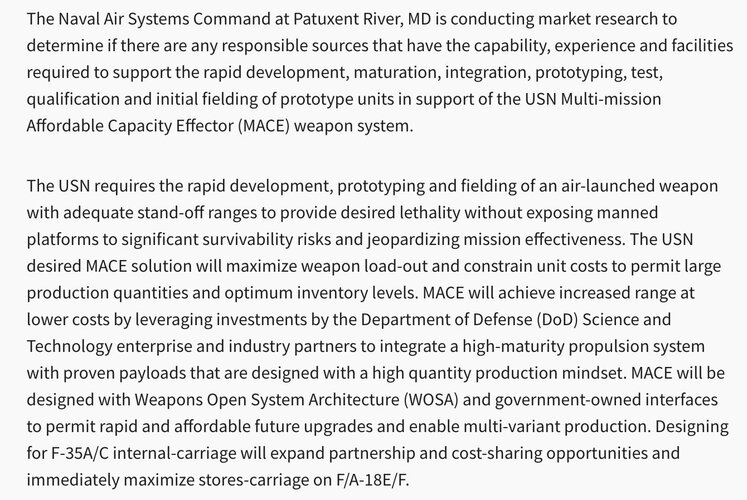
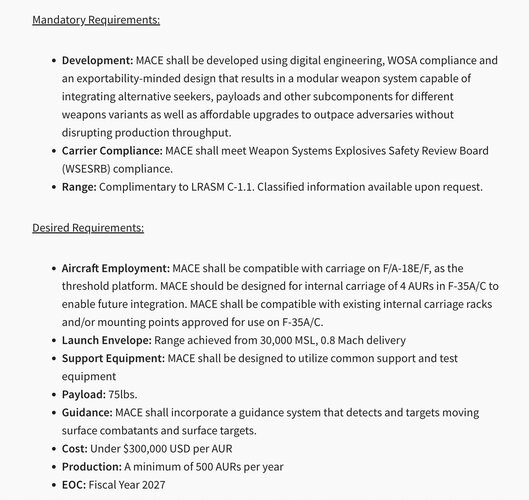
US Navy MACE (Multi-Mission Affordable Capacity Effector)

Forest Green

ACCESS: USAP
Joined
11 June 2019
Messages
14,535
Reaction score
31,606
Something I just picked up on when this was mentioned in the F-35 thread is that the MACE warhead is tiny in comparison to JSM/NSM, Harpoon and LRASM. 35Kg vs 120Kg, 220Kg and 456Kg respectively. Which puts MACE more in scaled-up SPEAR 3 territory than scaled down NSM/Harpoon/LRASM.

If you're not going to get within about 200NM of the target, why not just opt for JSM with the NSM guidance section and carry two in the bay and two-four underwing.
 
Something I just picked up on when this was mentioned in the F-35 thread is that the MACE warhead is tiny in comparison to JSM/NSM, Harpoon and LRASM. 35Kg vs 120Kg, 220Kg and 456Kg respectively. Which puts MACE more in scaled-up SPEAR 3 territory than scaled down NSM/Harpoon/LRASM.

If you're not going to get within about 200NM of the target, why not just opt for JSM with the NSM guidance section and carry two in the bay and two-four underwing.
Cost probably.
 
Something I just picked up on when this was mentioned in the F-35 thread is that the MACE warhead is tiny in comparison to JSM/NSM, Harpoon and LRASM. 35Kg vs 120Kg, 220Kg and 456Kg respectively. Which puts MACE more in scaled-up SPEAR 3 territory than scaled down NSM/Harpoon/LRASM.

If you're not going to get within about 200NM of the target, why not just opt for JSM with the NSM guidance section and carry two in the bay and two-four underwing.

I do not think the USN exclusively has ships in mind as the target set, or explosives as the only payload. But as noted JSMs cost something like 2 million; navy is proposing $300,000 target. Also internal carriage preserves stealth on the F-35.
 
Something I just picked up on when this was mentioned in the F-35 thread is that the MACE warhead is tiny in comparison to JSM/NSM, Harpoon and LRASM. 35Kg vs 120Kg, 220Kg and 456Kg respectively. Which puts MACE more in scaled-up SPEAR 3 territory than scaled down NSM/Harpoon/LRASM.

If you're not going to get within about 200NM of the target, why not just opt for JSM with the NSM guidance section and carry two in the bay and two-four underwing.
I mean, it really says it all right there in the name:
Multi-Mission (more than just an AShM) Affordable Capacity (Can produce large quantities for far less $ than our current high-end AShM's) Effector (a super heterosexual and manly way to say missile)..!
DoD have realized watching Ukraine play out, that the flashy/expensive weapons are really just for breaking the door down, that initial breach. After that it's all about affordable mass, you need to have mass quantities of munitions constantly harassing the enemy in order to run their air defense munitions dry, allowing real breakthroughs in progress to be made on a stale/attritional battlefield..!
 
DoD have realized watching Ukraine play out, that the flashy/expensive weapons are really just for breaking the door down, that initial breach. After that it's all about affordable mass, you need to have mass quantities of munitions constantly harassing the enemy in order to run their air defense munitions dry, allowing real breakthroughs in progress to be made on a stale/attritional battlefield..!

The efforts to field 'affordable mass' have been in the works for years. No doubt many things are being validated, crossed off based on current Ukraine-Russia conflict, but a lot of this stuff has been in the works at some scale for many years.
 
Even before Ukraine, most wargames saw the U.S. exhausteing almost all its SOW in a matter of a few weeks in a Sino-American war. There have been numerous efforts to create new technology and work arounds for inexpensive cruise missiles, though none of these efforts ever entered production to my knowledge.

At this point I think there is enough interest and enough industry investment by start ups/mid sized companies that we will see a number of flexible inexpensive solutions that are an order of magnitude cheaper to produce. JSM is still a $2 million missile; you are not saving much over LRASM. Something like Baracuda likely costs low-mid hundreds of thousands with more range, though perhaps less capable with lower HE content in kinetic versions. But modern surface ships are realistically very vulnerable to individual precise hits. I suspect a delayed fuse 155mm well placed in the forward super structure is enough for a DDG mission kill. One thing I noticed about DDGX is that it splits its arrays and funnels (and presumably engine rooms) across two superstructures to allow for some combat capability even after a precise hit. I think I also ready somewhere that it will have some kind of auxiliary fire control in the rear of the ship as a CIC backup.
 
The Baracuda 500 which had its initial flight tests last year, is competing for the program that's shooting for a $150,000 AUR cost for the basic air vehicle.

$150,000 is the ETV goal? I had not heard that number before. What is the desired payload mission if it is an AUR?
 
$150,000 is the ETV goal? I had not heard that number before. What is the desired payload mission if it is an AUR?


Yes the $150K goal was confirmed by Anduril. I have not seen what the payload mission is but its basically expected to come at $150K or below, be launched off of cargo aircraft using a similar approach as demonstrated by JASSM/Rapid Dragon demonstrations. There are probably payload and performance specs in the public but I haven't seen them. Barracuda 500 which appears to be have been designed around those requirements is stated to have a 100+ lb warhead or similarly size non kinetic payload.
 
Last edited:
Effector is a word used in many other technical contexts to describe nodes in a web, chain or network that ultimately “effect” the end result. For example, CD8+ T cells or NK cells could be called effectors, as could antibodies.
 
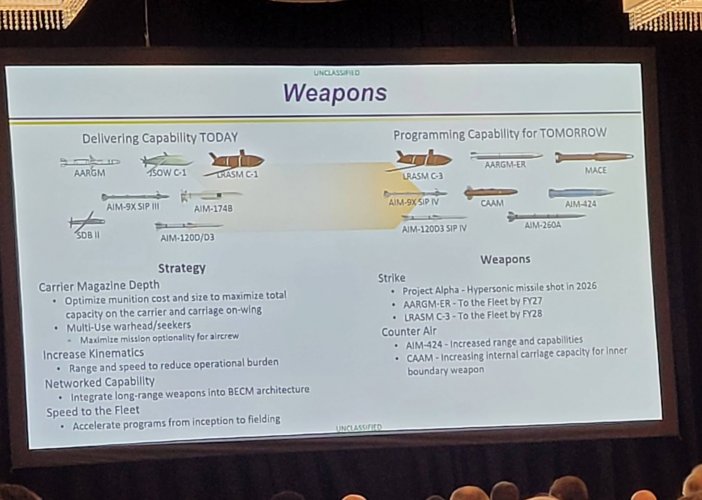
View attachment 776706

Navy 'High Speed Long Range Maritime Strike Weapon' as a line item in FY 26 budget.

Existing propulsion with existing weapon, multiple variants, and integration plan on F/A-18E/F.

There was a USN paper that called for an ‘ACME’ platform (do not think it was even an RFI?); perhaps related to that. Though I struggle to think of could already be “existing” propulsion or weapon wise.
 
I had thought MACE subsonic previously? Did I just remember wrong or did the program requirement change?
 
Yeah, it morphed when the Navy killed HALO in 2025, I think.

But I thought the HALO requirements were rescoped and that this program was also active? I guess we will just see what they end up buying. It kinda looks like GBU-75 might fill the space of the original MACE requirement, although as a larger weapon.
 
Blackbeard is stated to fall within current range category currently occupied by the AGM-158C Long Range Anti-Ship Missile (LRASM), with the stealthy air launched anti-ship having a stated range of greater than 200 nautical miles, (with a potential range of up to 500 nautical miles). Despite falling within the same range bracket, Blackbeard offers a fundamentally different capability at a much greater scale, with smaller warhead of 95lbs and a greater emphasis on striking time-sensitive targets.

U.S. Navy fixed winged fighters in the shape of the F/A-18E/F Super Hornet and F-35C Lightnings will be the primary launch platforms. In regards to the F-35C Lightnings, Blackbeard is small enough to enable carriage of 4 rounds the internal weapons bays, providing the stealth-fighter’s first hypersonic strike capability whilst keeping a reduced radar cross section. As such, Blackbeard will also likely represent the hypersonic munition with the most single flight magazine depth on a Navy aircraft.”


Pretty darn interesting. One wonders how many F/A-XX might carry or Blackbeard could be quad packed into a VLS.

I’d be curious if anyone has more info on the Blackbeard seeker
 
In retrospect, there was nothing in the MACE RFI that explicitly stated it had to be subsonic, and it seems like Blackbeard otherwise fits the requirements. So perhaps nothing changed at all.
 
In retrospect, there was nothing in the MACE RFI that explicitly stated it had to be subsonic, and it seems like Blackbeard otherwise fits the requirements. So perhaps nothing changed at all.

I don't see how four Blackbeards fit internally in an F-35C with that booster stage.
 
You are right that four AURs internally is a "should" not a "shall" which I think makes it an Objective requirement.

Its vaguely possible MACE is skinny enough to fit two side by side in a bay?
 
I don't see how four Blackbeards fit internally in an F-35C with that booster stage.
I assume sans booster, plus I thought two missiles in one bay was an objective, not threshold requirement?
You are right that four AURs internally is a "should" not a "shall" which I think makes it an Objective requirement.

Its vaguely possible MACE is skinny enough to fit two side by side in a bay?
The upper stage and booster together are about the same size as an AARGM-ER/SIAW.
 
I would not think so; I assume they sized that booster to fill up an MLRS pod with two complete missiles. PrSM is 17-18” diameter IIRC? Two of those are not fitting side by side inside an F-35 bay.
 
I would not think so; I assume they sized that booster to fill up an MLRS pod with two complete missiles. PrSM is 17-18” diameter IIRC? Two of those are not fitting side by side inside an F-35 bay.
It is clearly much skinnier than a PrSM, regardless of whether it is 4 m long to fit in an MFOM pod or ~4.2 m long to fit in a carrier weapons elevator or F-35A/C bay. If it is short enough to fit in an MFOM pod, then the pod would probably fit 4 missiles.

The missile in the Castelion Blackbeard pictures has an attachment rail running from the rear of the upper stage vehicle along the dorsal side of the booster, so it appears to be designed for carriage from the top as an integrated vehicle with the booster. My weight estimate was 472 kg, but the hardpoint in a CTOL F-35's bay is rated for 1,200 kg, which could accommodate two missiles and a rack.

The biggest issue with fitting two in each bay would be volume. The GBU-31 has a fin span of 25 inches and body diameter of 18 inches or so and can be carried alongside an AIM-120 in the weapons bay. The Blackbeard's upper stage is about half the body diameter and the booster is about half the fin span, but the Blackbeard's fins have a span of about 20 inches by themselves. My fin measurement is probably the least accurate because that part of the picture is black-on-black. It may be possible to stagger the Blackbeards so the fins aren't interfering, though I would be worried about the possibility of needing to intrude into the space that the door-mounted AMRAAM takes up.

An air-launched PrSM would be a pretty good 1-to-1 replacement for a GBU-31 type weapon in an F-35's internal bay. If it actually does have a 500 km range right now, it could easily get over 800 to 1,000 km when air-launched from an F-35.
 
So you think the diameter of the booster is in the 9-10 inch range? That would make the second stage absolutely tiny. It’s hard to imagine a 95# payload, guidance, and SRM on that.

Fair argument on attachment points though; I would not think the podded version would need that. Although if that is the case, I would expect the air and ground launched versions to have different boosters with different burn profiles.

Alternatively - maybe it’s both? Single stage and two stage air launch? That probably would not be challenging with air launch.

ETA: I bet @quellish could settle the debate.
 
Last edited:
So you think the diameter of the booster is in the 9-10 inch range? That would make the second stage absolutely tiny. It’s hard to imagine a 95# payload, guidance, and SRM on that.

Fair argument on attachment points though; I would not think the podded version would need that. Although if that is the case, I would expect the air and ground launched versions to have different boosters with different burn profiles.

Alternatively - maybe it’s both? Single stage and two stage air launch? That probably would not be challenging with air launch.

ETA: I bet @quellish could settle the debate.

Here are my estimates for the size and mass based on the published images. My first guess for warhead size was 25 - 50 kg, and the MACE's 75 lbs warhead falls right in the middle of that range.
My estimates for vehicle dimensions:

Assuming the Remove Before Flight tag on the vehicle is 120 mm long and inclined at an angle of 20 degrees from vertical, its vertical height is 112 mm.

Length overall: 4227 mm (13.87 ft)
Vehicle length: 2126 mm (6.98 ft)
Vehicle height: 237 mm (9.3 in)
Booster length: 2101 mm (6.89 ft)
Booster diameter: 326 mm (12.8 in)

Fin height: 386 mm (15.2 in)
Fin span: 546 mm (21.5 in)

Overall length likely indicates that the weapon is designed to fit on Navy weapon elevators and in F-35A and F-35C internal bays. Fin span is smaller than the GBU-31 fins.

Vehicle volume: 0.095 m^2
Booster volume: 0.175 m^3

Assuming a bulk density of 1.75 tons per m^3 and not accounting for the non-circular shape of the upper-stage vehicle:

Vehicle mass: 166 kg
Booster mass: 306 kg

Overall mass: 472 kg

Based on the size of the upper-stage vehicle, I would estimate a warhead mass between 25 and 50 kg. For comparison, the PrSM supposedly carries a 90 kg warhead.
 

Similar threads

Back
Top Bottom