Power sources for Ships, nuclear, gas turbines, solar, etc .

Can you provide a value for the absolute efficiency of this chart?

Which propulsion unit reached 50 gl%efficiency in the 79 th?? I don't see that information anywhere in your postings.

With 20 g load yoyr dorn to 50 g of the peak efficiency acvording to your chart, that were you will end up.with system which needs to operate in a vide power range and this is in line with ship generators.

BTW Diesel generators are cheap standart systems and you can easily use 1,2 ,3 or.more of them for this kind of job, which will keep the partvload efficiency even higher (even when a minimum number of two are operating in parallel .

So smaller your system is, so earlier you need to switch tio a big gas turbine which than operates uneconomically at part load.

The given example of 51 % efficiency of the MAN and Waertsilae is also not the end of the line, when truck Diesels can even reach almost 54 %.

Most important, it's not about building the.most efficient part load system for a cruiser, but finding a practical solution which brings a giant step in energy savings. It almost doesn't matter if a system is 2 percent more efficient in a very narrow load range or not. You can choose between a standart modular solution of Dieselgenerators or a high end mega advanced hyphothetical waste heat steam system with multiple reaheating, staged feedwater preheating and so on. Gues who wins?

As said, so more sophisticated the steam system is, so more sensitive it gets to changing parameters. When the turbine exhaust temperature drops at part load, the whole multiple reheating doesn't work anymore.
 
This only applies if you have a single gas turbine generator that is sized to the maximum power output. The Arleigh-Burke has three gas turbine generators. So it is optimised at 3 points. The gas turbines are then at peak efficiency at 3 MW, 6 MW and 9 MW of power output. This means the gas turbines will never throttle down below 50% of maximum power output. They remain fairly efficient.

Cruising on 20° Celsius day there would be just the single generator running with great efficiency.
Note, we are talking about the replacement for one of these turbines by a Diesel or alternativly a small combined power system (with the power of about one gas turbine)
 
Note, we are talking about the replacement for one of these turbines by a Diesel or alternativly a small combined power system (with the power of about one gas turbine)
That’s absolutely not what I’m talking about. If we have an AB you would replace a 20mw turbine with a 10mw combined cycled system not a 20mw system. I have stated many times that the combined cycled system needs to be sized appropriately.

Can you provide a value for the absolute efficiency of this chart?

Which propulsion unit reached 50 gl%efficiency in the 79 th?? I don't see that information anywhere in your postings.

With 20 g load yoyr dorn to 50 g of the peak efficiency acvording to your chart, that were you will end up.with system which needs to operate in a vide power range and this is in line with ship generators.

BTW Diesel generators are cheap standart systems and you can easily use 1,2 ,3 or.more of them for this kind of job, which will keep the partvload efficiency even higher (even when a minimum number of two are operating in parallel .

So smaller your system is, so earlier you need to switch tio a big gas turbine which than operates uneconomically at part load.

The given example of 51 % efficiency of the MAN and Waertsilae is also not the end of the line, when truck Diesels can even reach almost 54 %.

Most important, it's not about building the.most efficient part load system for a cruiser, but finding a practical solution which brings a giant step in energy savings. It almost doesn't matter if a system is 2 percent more efficient in a very narrow load range or not. You can choose between a standart modular solution of Dieselgenerators or a high end mega advanced hyphothetical waste heat steam system with multiple reaheating, staged feedwater preheating and so on. Gues who wins?

As said, so more sophisticated the steam system is, so more sensitive it gets to changing parameters. When the turbine exhaust temperature drops at part load, the whole multiple reheating doesn't work anymore.
If you actually read the y axis its fractional efficiency vs efficiency at nominal rating.

How many times do I have to say this. The racer system attached to a LM2500 (70s design) for the ABs reached ~50% efficiency in testing but wasn’t installed due to likely erroneous maintenance concerns (despite having space set aside on the first few ABs), due to basing it off of ship wide steam steam heating cogeneration on other ships.

These systems are not at all exotic. Thousands of combined cycle systems have been built for non military non naval use. With commercial ships also considering combined cycle systems now

If you read the chart correctly assuming a 60% efficiency system, at 1/3 load you’re still at 50% efficiency comparable to deisels. This means you’re more efficient across nearly 100% of realistic usage scenarios with a 10mw system.

Energy savings are nice to have but don’t matter that much in peacetime. You need to size the system for wartime such that you have longer range and fewer required refueling. This means you never have a turn everything off stationary situation where you’re using less than 3mw.

You also still don’t understand there’s other standard turbines for rapid ramp loads. Until you understand this I’m not sure there much reason to keep engaging with you.
 
Last edited:
A huge reason for shifting to turbines was to minimize volume needed for power. It kept the beam width down. Diesels tend to grow a design, which is why there will not likely be an all diesel design for a 30+ knot destroyer.
 
You are comparing an experimental system with a power system which is on the market since ten years. There is no small gas/steam turbine system available and there might be reasins for it.

The realistic mean power output for such a auxillary power system will be around 25 %, which means only half of the max efficiency can be reached. A good Diesel will be still above 40 %.

Again, Dieselgenerators are available in all sizes and further modularisation by replacing one main turbine by four Diesels is easily possible. In fact most large container vessels have at least four independant gensets on board.

Again, you are right and me & the navies of the world are wrong?

Also as said, when you.make the system smaller (like half of the power of one main turbine), you reducing the benefit. You will more often run of the main turbines with 50 % part load.
 
Last edited:
A huge reason for shifting to turbines was to minimize volume needed for power. It kept the beam width down. Diesels tend to grow a design, which is why there will not likely be an all diesel design for a 30+ knot destroyer.
Combined gas/steam power is neither leight nor compact
 
Note, we are talking about the replacement for one of these turbines by a Diesel or alternativly a small combined power system (with the power of about one gas turbine)
My post still applies. It is true that the diesel's will be more efficient than a gas turbine when running at 25% load. The gas turbines generators on the Arleigh Burke would never run at 25%.

With just a single gas turbine generator running the ship lighting, water production, ventilation and kitchen will see the generator running within it's efficiency band. Then with all the radar and weapon systems running the second gas turbine turns on and they are now both within their efficiency band. It is very rare for the Arleigh-Burke to run all three generators unless it is in Arctic conditions.
 
The point is, that especially in the low load range, the power output is highly variable. The minimum will be when the ship is moured in a harbour at night during peace time in a moderate clima. Under these circomstances, the required power will.be less than 10 percent of the maximum sub system power. A combined power plant is not a favourable solution for this application.

A combines gas/steam turbine systembis also not suuted for fast load changes, eg during manouvering.
 
Still lighter than a diesel of equal power
Do you have any evidence for this?

Of course, the power to weight ratio of Diesel engines can be very different, but even for commercial gensets I highly doubt that. The other extreme would be a MTU dieselelectric drive for tanks and other military applications where the Diesel is below 1kg/kW...

This is not a heavy duty application, so you can use engines with a high power output. I wouldn't recomend a tank engine, but a yacht engine could do the job very well. These have much better power to weight ratios than heavy duty Diesels.
 
Last edited:
Do you have any evidence for this?

Of course, the power to weight ratio of Diesel engines can be very different, but even for commercial gensets I highly doubt that. The other extreme would be a MTU dieselelectric drive for tanks and other military applications where the Diesel is below 1kg/kW...

This is not a heavy duty application, so you can use engines with a high power output. I wouldn't recomend a tank engine, but a yacht engine could do the job very well. These have much better power to weight ratios than heavy duty Diesels.

High speed marine diesels like you might see on a big sport fisherman are more like 2kg/kW, and they last about 10,000 hours. That's a bit over a year running 24/7 like it might providing base load on a warship. This is why ships use low and medium speed diesels, not high speed.

If they spent as much money engineering a warship optimized medium speed diesel as it would take to make a warship gas turbine combined cycle plant, I bet they could improve their power density significantly though. Something like bigger turbos and water injection should allow for significantly higher power output for a few hours at a time. It would probably lose a lot of efficiency at high output, but it could still be ~50% at normal output.
 
Last edited:
When it comes to electrical generation it makes sense to put diesel generators in locations that can be swapped out. While 10k hours is perhaps a bit low, it is not bad if you spend the majority of your time at a 10-15% capacity and have multiple units to spread the load across. Redundancy doesn't happen with quantities of one. While I would prefer ships with a base load at a high efficiency, I also want ways to recover from near catastrophic blows and remain functional at some significant level. That is why I think battery technology on warships is critical in the future, and to generate significant power is multiple ways. It may be prudent to have peak energy generation targeted for 300% of full combat loads. In a crisis only a small fraction may be available.
 
If they spent as much money engineering a warship optimized medium speed diesel as it would take to make a warship gas turbine combined cycle plant, I bet they could improve their power density significantly though.
Pretty sure some reasonably optimised diesel would already be out there, they tend to get matched to the design load. If they put that effort into improving an updated Rankine or Sterling engine that could intercept waste heat without excessive space/weight, you probably would have a pretty good solution too.
That is why I think battery technology on warships is critical in the future, and to generate significant power is multiple ways. It may be prudent to have peak energy generation targeted for 300% of full combat loads. In a crisis only a small fraction may be available.
Its also a nice strategy to eliminate the combining gears and shafts being big and potentially vulnerable single points of failure in a fixed location next to the engine rooms. Maybe with Burke you can't move GT generators around to give propulsion redundancy across different parts of the ship (but batteries maybe). Still having a chance to eliminate much of the shaft and having both smaller gensets and main GTs feeding a power grid could give a different level of redundancy. Different kind of damage control too.
 
Its also a nice strategy to eliminate the combining gears and shafts being big and potentially vulnerable single points of failure in a fixed location next to the engine rooms. Maybe with Burke you can't move GT generators around to give propulsion redundancy across different parts of the ship (but batteries maybe). Still having a chance to eliminate much of the shaft and having both smaller gensets and main GTs feeding a power grid could give a different level of redundancy. Different kind of damage control too.
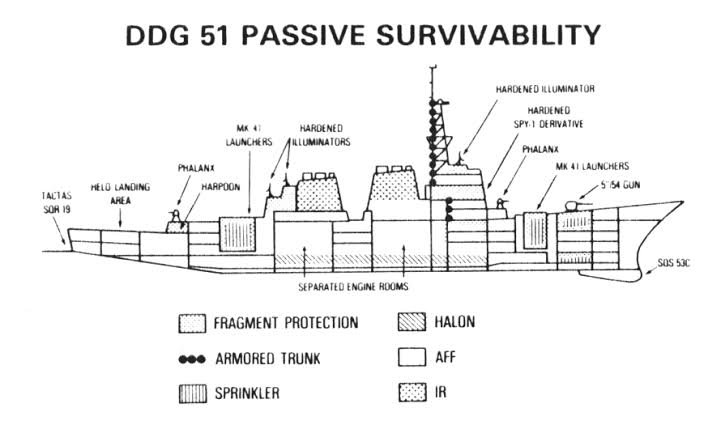
You don't know what you are talking about. The Arleigh-Burke class already has two engine rooms for redundancy. There is no single point of failure. One prop shaft per engine room. One set of combining gears per engine room. Each engine room has generator providing redundancy.

images (5).jpeg
 
Do you have any evidence for this?

Of course, the power to weight ratio of Diesel engines can be very different, but even for commercial gensets I highly doubt that. The other extreme would be a MTU dieselelectric drive for tanks and other military applications where the Diesel is below 1kg/kW...

This is not a heavy duty application, so you can use engines with a high power output. I wouldn't recomend a tank engine, but a yacht engine could do the job very well. These have much better power to weight ratios than heavy duty Diesels.
Except that we're talking a 20 megawatt ish need for baseline load. That's not a small engine. A 20MW diesel is around 125 tons, right? A 20MW GT is 25 tons. Which means even if the cogeneration engine is 100 tons it's the same weight.
 
A 20MW diesel is around 125 tons, right? A 20MW GT is 25 tons.
Your weights are off by a factor of three. You are clearly doing quick AI searches to try and win arguments on this forum and you are posting AI slop. Please use the manufacture PDF files.

A Wärtsilä 16V38 diesel generator are used on the Elizabeth class aircraft carrier. It puts out 11.6 MW electricity and weighs 200 tons. It is 13 metres long 5 metres tall and 4 metres wide. 260 cubic metres of volume.

Source: https://www.dieselduck.info/machine/01 prime movers/Wartsila 38 project guide.pdf

The latest GE LM2500 generator puts out 36.8 MW electricity at 39% efficiency and weighs 72 ton. 17 metres long, 3 m wide 4 metre tall. 204 cubic metres excluding exhaust.

Source: https://www.gevernova.com/gas-power/products/gas-turbines/lm2500

Power densities of Diesel versus Gas turbine

Diesel:
17.2 ton per MW.
22.4 cubic metres per MW

Gas turbine
2 ton per MW
5.5 cubic metres per MW.

Diesels are 8 times the weight and 4 times the volume for the same power output.

The gas turbines take up less space and weight so it allows greater fuel capacity. That more than offsets any efficiency difference.If you took an engine room that could fit three Wärtsilä 16V38 generators you could fit a single LM2500 generator of similar power in an engine room a third of the size. An extra 500 ton of fuel volume/capacity can be carried in the space saved. That extra fuel would see the gas turbine ship travelling much further.

Note the GE link above has specs for the LM2500 with combined cycle where exhaust heat produces more power from an extra generator. Power goes from 36.2 MW to 51.4MW. Efficiency goes from 39% to 55.4%. The weight and volume approximately doubles. It is still ahead of the diesel's.

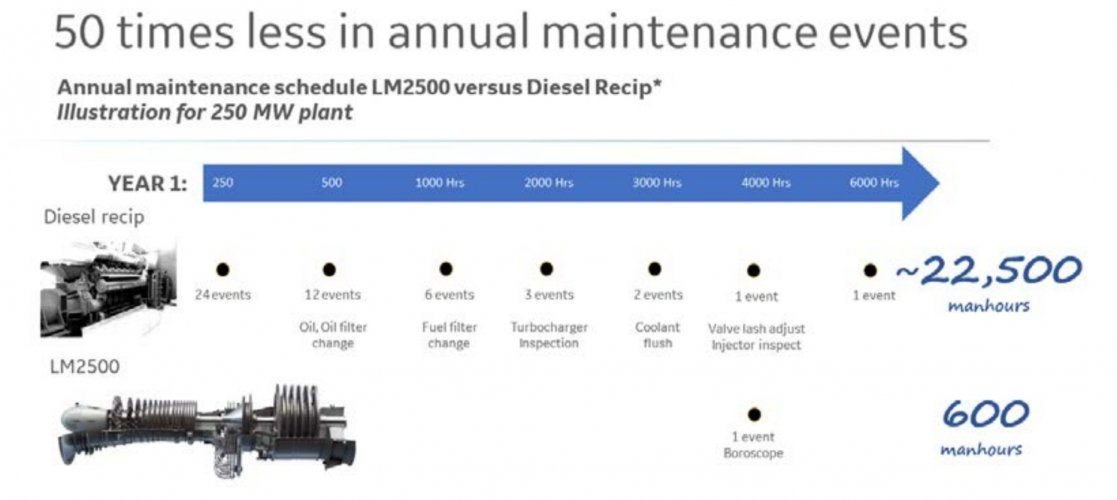
The gas turbines also have significantly less maintenance. Though the GE image below is probably optimistic.

Screenshot_20260421_092447_Chrome.jpg
 
Last edited:

The Valar Atomics Ward 250 microreactor might beat the Westinghouse eVinci reactor into service. Both are 5MW electricity generation.

The Ward 250 micro reactor consists of 8 modules that each can be transported on a truck. It is about a third of the power density of a diesel generator. That is excellent when you take into account the fuel required for the diesel's.
 

The Valar Atomics Ward 250 microreactor might beat the Westinghouse eVinci reactor into service. Both are 5MW electricity generation.

The Ward 250 micro reactor consists of 8 modules that each can be transported on a truck. It is about a third of the power density of a diesel generator. That is excellent when you take into account the fuel required for the diesel's.

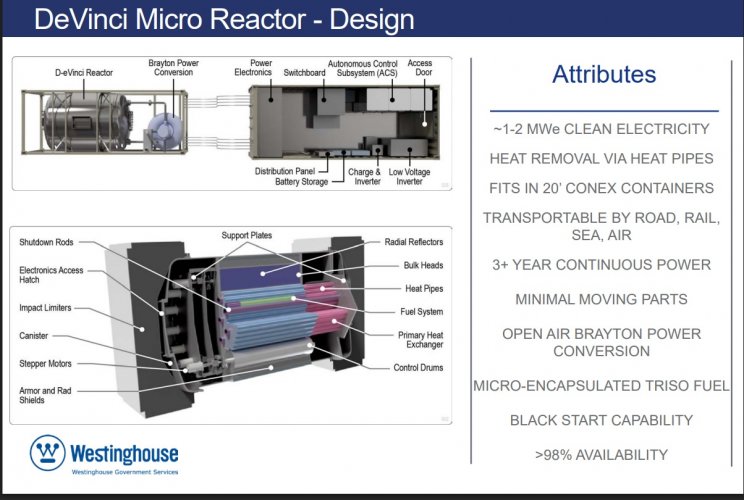
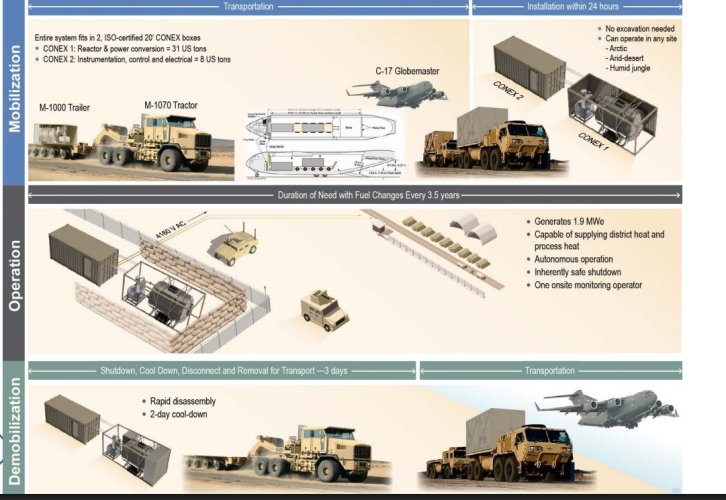
I really like the defense-eVinci (DeVinci) design if it can work reliably for a couple years without ever touching touching the reactor container. All the spicy stuff including the turbine fit in a single 8'x8'x20' box, and the only connections to the rest of the ship would be electrical. Stick four of them (8MWe total) on the back or sides of the fan tail and have them plug in like a giant hot swap server power supplies. If there is a problem with one of them, you jettison it off the back of the ship. If there is a bigger problem like battle damage that prevents the normal jettison from working, have shaped charges that cut the rearmost frame of the ship housing all the reactors clean off. No one on the ship needs to know nuclear, they are just black boxes that plug in; if a rad alarm goes off you press a button and it goes to the bottom of the ocean. The modules get easily swapped with fresh units at dock and sent back to the factory for repair/refuel.

https://www.nationalacademies.org/cdn/materials/9fba0a7b-4efa-4c07-89df-7ab30dda2e99


de1.jpg de2.jpg
 
Last edited:
I really like the defense-eVinci (DeVinci) design if it can work reliably for a couple years without ever touching touching the reactor container. All the spicy stuff including the turbine fit in a single 8'x8'x20' box, and the only connections to the rest of the ship would be electrical. Stick four of them (8MWe total) on the back or sides of the fan tail and have them plug in like a giant hot swap server power supplies.

The reactor is so small it could fit in the space of a dozen VLS launch tubes or half of a helicopter bay. 1.9 MW of electricity happens to be the exact size of the electric motor fitted to the Arleigh-burke test ship and it could reach 12 knots on that motor.

That small reactor would be ideal for a frigate sized ship. Take the FREMM frigates that has two electric motors on the props. 1.9 MW would be enough for the essential systems and a cruising speed of 8-10 knots. In peace time cruising around slowly it could essentially run without any fuel usage. It would still use fuel in combat or when travelling at higher speeds but the lifetime fuel consumption of the ship would easily be halved.

Military ships spend a huge amount of time loitering, with just a single generator running. A surprising amount of time could be spent entirely nuclear with just 1.9MW of electricity for a 5,000 ton frigate.

Such a small reactor is ideal for a high end autonomous submarine that is around 1,000 ton displacement.

I still think the US Navy will go with reactors between 5-10 MW of electricity. The reactor modules can still be swapped out they are simply much larger than a standard shipping container.
 
Your weights are off by a factor of three. You are clearly doing quick AI searches to try and win arguments on this forum and you are posting AI slop. Please use the manufacture PDF files.

A Wärtsilä 16V38 diesel generator are used on the Elizabeth class aircraft carrier. It puts out 11.6 MW electricity and weighs 200 tons. It is 13 metres long 5 metres tall and 4 metres wide. 260 cubic metres of volume.

Source: https://www.dieselduck.info/machine/01 prime movers/Wartsila 38 project guide.pdf

The latest GE LM2500 generator puts out 36.8 MW electricity at 39% efficiency and weighs 72 ton. 17 metres long, 3 m wide 4 metre tall. 204 cubic metres excluding exhaust.

Source: https://www.gevernova.com/gas-power/products/gas-turbines/lm2500

Power densities of Diesel versus Gas turbine

Diesel:
17.2 ton per MW.
22.4 cubic metres per MW

Gas turbine
2 ton per MW
5.5 cubic metres per MW.

Diesels are 8 times the weight and 4 times the volume for the same power output.

The gas turbines take up less space and weight so it allows greater fuel capacity. That more than offsets any efficiency difference.If you took an engine room that could fit three Wärtsilä 16V38 generators you could fit a single LM2500 generator of similar power in an engine room a third of the size. An extra 500 ton of fuel volume/capacity can be carried in the space saved. That extra fuel would see the gas turbine ship travelling much further.

Note the GE link above has specs for the LM2500 with combined cycle where exhaust heat produces more power from an extra generator. Power goes from 36.2 MW to 51.4MW. Efficiency goes from 39% to 55.4%. The weight and volume approximately doubles. It is still ahead of the diesel's.

The gas turbines also have significantly less maintenance. Though the GE image below is probably optimistic.

View attachment 809761
Also keep in mind the base lm2500 design is ancient. With a clean sheet design efficiency will be higher and likely around 60%
 
Last edited:
I really like the defense-eVinci (DeVinci) design if it can work reliably for a couple years without ever touching touching the reactor container. All the spicy stuff including the turbine fit in a single 8'x8'x20' box, and the only connections to the rest of the ship would be electrical. Stick four of them (8MWe total) on the back or sides of the fan tail and have them plug in like a giant hot swap server power supplies. If there is a problem with one of them, you jettison it off the back of the ship. If there is a bigger problem like battle damage that prevents the normal jettison from working, have shaped charges that cut the rearmost frame of the ship housing all the reactors clean off. No one on the ship needs to know nuclear, they are just black boxes that plug in; if a rad alarm goes off you press a button and it goes to the bottom of the ocean. The modules get easily swapped with fresh units at dock and sent back to the factory for repair/refuel.

https://www.nationalacademies.org/cdn/materials/9fba0a7b-4efa-4c07-89df-7ab30dda2e99


View attachment 809764View attachment 809765
I greatly doubt the amount of shielding inside that "cargo container" is adequate.
 
I greatly doubt the amount of shielding inside that "cargo container" is adequate.
... the funny thing is that we've got materials like High-Z Steel Metal Foam, meaning that we've got more rad protection for less weight. There's a LOT to take advantage of when you use modern metalergy for things like radiation protection, structure, and protection. Remember, metal foams have all the strength of the unfoamed metal but at a fraction of the weight.
 
I greatly doubt the amount of shielding inside that "cargo container" is adequate.
Using common sense. The majority of shielding would be built into the ship. It doesnt need to built into the removable reactor module. The reactor module only needs enough shielding so it is safe to transport while the reactor is off.

The microreactor only has a power connection and there are no steam pipes driving the props. This opens up the possibilities in terms of reactor location. I would install the microreactor under the helicopter deck.
 
... the funny thing is that we've got materials like High-Z Steel Metal Foam, meaning that we've got more rad protection for less weight. There's a LOT to take advantage of when you use modern metalergy for things like radiation protection, structure, and protection. Remember, metal foams have all the strength of the unfoamed metal but at a fraction of the weight.
It's still not enough thickness, and that whole cargo container will be radioactive after first criticality.
 
It's still not enough thickness, and that whole cargo container will be radioactive after first criticality.

It looks like the reactor vessel is all the shielding required. If it wasn't then you wouldn't be able to shut it down and then load it on a C-17 two days later like Westinghouse claims. The key thing with this design is that there is no primary coolant loop and pumps, just sealed heatpipes. The secondary loop to the turbine wouldn't be exposed to the neutron flux and so its working fluid wouldn't be activated. Nothing outside the reactor vessel would ever get irradiated unless there is a major failure, and short of the reactor getting shot up the only thing I could think of would be one of the heatpipes rupturing. Even that would be a minor leak as the fluid inside it still isn't exposed to fission products from the core, it would just be neutron activated like the water in a normal reactor's primary coolant loop. It should be safe to handle in or out of a container after a couple days of shutdown, and even that time is likely only needed for decay heat to reach safe levels.

I still don't trust it for a surface combatant unless you have a reliable way to press a button and make it fall off the ship though. Without that, the first time a USV or suicide boat ruptures the reactor vessel and half the crew dies like Hisashi Ouchi, it will be the end of the nuclear navy.
 
Last edited:
It looks like the reactor vessel is all the shielding required. If it wasn't then you wouldn't be able to shut it down and then load it on a C-17 two days later like Westinghouse claims. The key thing with this design is that there is no primary coolant loop and pumps, just sealed heatpipes. The secondary loop to the turbine wouldn't be exposed to the neutron flux and so its working fluid wouldn't be activated. Nothing outside the reactor vessel would ever get irradiated unless there is a major failure, and short of the reactor getting shot up the only thing I could think of would be one of the heatpipes rupturing. Even that would be a minor leak as the fluid inside it still isn't exposed to fission products from the core, it would just be neutron activated like the water in a normal reactor's primary coolant loop. It should be safe to handle in or out of a container after a couple days of shutdown, and even that time is likely only needed for decay heat to reach safe levels.

I still don't trust it for a surface combatant unless you have a reliable way to press a button and make it fall off the ship though. Without that, the first time a USV or suicide boat ruptures the reactor vessel and half the crew dies like Hisashi Ouchi, it will be the end of the nuclear navy.
It's still lower risk than the magazines on the ship going off and missile farms/ammo is distributed around more places on the ship.
 
It's still lower risk than the magazines on the ship going off and missile farms/ammo is distributed around more places on the ship.

Maybe, but while you can't have an effective warship without weapon systems, you can have one without nuclear power, so that risk is avoidable.

I just don't think nuke power as we have been doing it is viable on surface warships under 50k tons or so. The effort you have to put into running it safely is massive, and the last thing the navy wants is to add a full nuke dept to every DDG's crew.

If you can figure out a way to make the risk of the reactor negligible by making it external to the ship and designing it to be jettisoned in an emergency, then you don't need to build as much safety into the rest of the ship and its crew. The d-evinci looks interesting to me because we might be able to install it in such a way that the reactor and turbine don't need to exchange any fluid or air with the ship, it would only need external air for the turbine and electrical connections into the ship. We could hang them off the back of the boat, and while they might leak some contamination into the air when they have a problem, the boat and crew are already prepared for CBRN threats and can handle external contamination. You could also put 4+ of them across the stern so if one develops a problem and needs to be shutdown, you still have most of your nuke generator output.
 
If you can figure out a way to make the risk of the reactor negligible by making it external to the ship and designing it to be jettisoned in an emergency, then you don't need to build as much safety into the rest of the ship and its crew.
This will never happen. You have improved the safety of the crew if a reactor fails but you have massively increased the chance of a reactor failing. This goes against every survivability design study. Small drones and small arms fire could easily see the external reactor get damaged.

My recommendation would be for the micro reactor to be located internally under the helicopter deck at the very back of the ship.
The ships rear bulkhead then provide additional radiation shielding to the crew at the front of the ship. A solid steel box can be integrated into the rear of the ship to provide armour and additional shielding. If the enemy manages to penetrate the reactor then it is highly likely the radar and ammunition would also be hit.

However let's say the reactor suddenly fails for no reason and begins to leak radiation. The ship could continue to cruise with the gas turbines and most of the radiation would then trial behind the ship. This gives plenty of time for the crew to evacuate.
 
Your weights are off by a factor of three. You are clearly doing quick AI searches to try and win arguments on this forum and you are posting AI slop. Please use the manufacture PDF files.

A Wärtsilä 16V38 diesel generator are used on the Elizabeth class aircraft carrier. It puts out 11.6 MW electricity and weighs 200 tons. It is 13 metres long 5 metres tall and 4 metres wide. 260 cubic metres of volume.

Source: https://www.dieselduck.info/machine/01 prime movers/Wartsila 38 project guide.pdf

The latest GE LM2500 generator puts out 36.8 MW electricity at 39% efficiency and weighs 72 ton. 17 metres long, 3 m wide 4 metre tall. 204 cubic metres excluding exhaust.

Source: https://www.gevernova.com/gas-power/products/gas-turbines/lm2500

Power densities of Diesel versus Gas turbine

Diesel:
17.2 ton per MW.
22.4 cubic metres per MW

Gas turbine
2 ton per MW
5.5 cubic metres per MW.

Diesels are 8 times the weight and 4 times the volume for the same power output.

The gas turbines take up less space and weight so it allows greater fuel capacity. That more than offsets any efficiency difference.If you took an engine room that could fit three Wärtsilä 16V38 generators you could fit a single LM2500 generator of similar power in an engine room a third of the size. An extra 500 ton of fuel volume/capacity can be carried in the space saved. That extra fuel would see the gas turbine ship travelling much further.

Note the GE link above has specs for the LM2500 with combined cycle where exhaust heat produces more power from an extra generator. Power goes from 36.2 MW to 51.4MW. Efficiency goes from 39% to 55.4%. The weight and volume approximately doubles. It is still ahead of the diesel's.

The gas turbines also have significantly less maintenance. Though the GE image below is probably optimistic.

View attachment 809761

You are very very wrong yourself! As said, this is not a heavy duty aoolication. The MTU 1163 engine for marine application requires only 3 3 tons per Megawatt.

20V 1163 M94:

7400 kW
24.48 t
200 kW/cubin meter

The Diesel will work with a much higher avarage efficiency due ti the low avarage load. If I remeber it right, we can read somewere in this thread (not time to search it right now) that the given example of the combined power system was working on steam only alt low power outputs, which results in very low efficiency.

The Emma Maersk with combined Diesel/Steam propulsion reached 55% max effiency. Generally, Diesel engines require much smaller steam systems because they contribute less to the total power.
 
Last edited:
You are very very wrong yourself! As said, this is not a heavy duty aoolication. The MTU 1163 engine for marine application requires only 3 3 tons per Megawatt.

20V 1163 M94:

7400 kW
24.48 t
200 kW/cubin meter
You are providing dry weight figures of a bare engine. No fluids. No cooling. No engine mounts. No external hardware. No starter motor. No electronics.

I compared directly apple to apple. The best and most popular stand alone diesel generator against the best and most popular gas turbine generator. Both with identical mounting systems, all fluids, all electronics. A perfect comparison.

All the ship's under discussion are using electric motors on the props so all the engines need generators. Their land based equivalents become the perfect comparison.

If you want to be silly and compare bare engines.

20V 1163 M94 Diesel 24.48 ton 7400 kW

TP400-D6 gas turbine 1.94 ton 7971 kW

The bare diesel engine is more than 10 times heavier than the bare gas turbine engine of similar power.
 
Just take a look on the engines, the coolers are allready a part of the package and the weight of the engine electronics is laughable compared to the total weight. Starter motors are not required in a genset and a pneumatic starter engibe would add only 0.05 t to an engine....

Bare engines without electronics and heat exchager are usually only sold for CHP applications.

Do turbines not require any mountings, fuel lines, electronics?

The weight of the generators should be about equal, so the relative difference will be much smaler. Despite that, it is the absolute weight difference and the related fuel quatity which matters. The engine will use 3.3 t less fuel than a gas turbine (44 % vs 40 % efficiency) within just 6 days. So even if the turbine has no weight at all the ship will allways be heavier when cruising longer than a week!

Did you consider the very large exhaust and intake ducting for the turbines as well?
 
Last edited:
Did you consider the very large exhaust and intake ducting for the turbines as well?
A diesel engine producing 4 MW intakes and exhausts a similar volume of air as a gas turbine engine producing the same 4 MW.

The intake and exhaust appears larger on the gas turbine only because the gas turbine is so small relative to its high power output.

Did you consider the weight of having to make the engine room 5 times bigger to fit diesels of comparable power level to the smaller gas turbine?

If an Arleigh-burke destroyer wanted to be entirely powered by diesels, 80 MW of diesels would require the ship to be extended by 20-30 metres. An extra 2,000 ton of displacement. Or the VLS tubes and helicopter hanger would have to be removed to free up space to fit such large diesel engines.

The MTU website has diesel generators and their 3,000 KW generator is 25 ton. The LM2500 generator is more than 10 times the power and less than 3 times the weight. It doesn't matter what size or brand of diesel engine.
 
At no point, I was talking about replacing all gas turbines with Diesel, it was only one Diesel for a single gas turbine.

Gas turbines operate with much higher AFR /lambda ratios (the relation of air to fuel) and are much more sensitive to back pressure due to their lower total pressure ratio. That's the reason why you need at least twice the size for air and exhaust piping.

In turbines you need almost the same space, since people need to be able to walk around and climp over them

The size and weight of Dieel engines depend on the application, the 1163 is especially for military applications and fast ferries. It is totally suitable for a destroyer, but there are other applications were weight matters less and efficiency matters more.

Iths the same like in a combined cycle, you cannot optimize a system in all directions....
 
Last edited:
Iths the same like in a combined cycle, you cannot optimize a system in all directions....
Absolutely.

Thing is, the electrical demands of a ship are pretty well defined. You know what the slow cruise EMCON power demands are. You know what the slow cruise normal emissions power demands are. You know what the high speed cruise EMCON power demands are. You know what the high speed cruise normal emissions power demands are. And you know what the full battle power demands are.

So you size one engine for that slow cruise EMCON. The next genset up gives you power for your radars and/or sonars. If the error bars on your generator for efficient running are wide enough the first engine can handle both EMCON and normal emissions. Same for high speed operations. And obviously full battle power you don't care about engine efficiency, but IIRC turbines are most efficient at high power settings anyways.

You just flat don't care about the bare minimum power needed, for docking/pulling into port. That's only ~8 hours every ~21 days or more, all of 1.5% of your operating time. It's fine to be operating inefficiently then.

So call it 6x LM2500s plus an equal number of T56s for backup/margin generators. Fit maybe 2 of those LM2500s with cogeneration rigs to use for low power days.

Or fit all the generators with cogen for stealth.
 
At no point, I was talking about replacing all gas turbines with Diesel, it was only one Diesel for a single gas turbine.

Gas turbines operate with much higher AFR /lambda ratios (the relation of air to fuel) and are much more sensitive to back pressure due to their lower total pressure ratio. That's the reason why you need at least twice the size for air and exhaust piping.

In turbines you need almost the same space, since people need to be able to walk around and climp over them

The size and weight of Dieel engines depend on the application, the 1163 is especially for military applications and fast ferries. It is totally suitable for a destroyer, but there are other applications were weight matters less and efficiency matters more.

Iths the same like in a combined cycle, you cannot optimize a system in all directions....

The 1163 is ~195 g/kWh vs an MT30 at ~207g/kWh. That's only a 6% improvement. To get to the 50%+ efficiency numbers that keep getting thrown around in this thread you need a far less power dense engine like the 93 ton 9.76 MW Wärtsilä 16V31.
 
As said before, a system cannot be optimized in all directions. Despite the still very relevant 7 % advantage at peak, the Diesel has the big advantage, that it reaches it maximum efficiency not at peak power, but at about 70 % with loosing comparable little efficiency when operated with 100 % or 25 % max power.

Note, the efficiency of gas turbines depend on their size and the MT30 is allready too big for the purpose we are discussing. a turbine with a similar power like any 6311 would much less efficient.

Instead of using one Diesel, several of them could be used for even better partload fuel consumption with only a moderate impact on weight and almost none on the peak efficiency.
 
Last edited:
Any microreactor should install through something like a well deck. In an emergency it should be jettisoned out through the same hole. Access to diesel installation/refit should also be through the same portal, to simplify long term operations. Most diesel engine blocks can be maintained for the life of the ship, which is why they use such heavy and robust versions. But with the ability to mitigate failed engines then higher efficiency engines can be an option. Turbines do not need to be located as far down as diesels if they are not mechanically connected to transmissions and solely provide thermal and electrical power. The downside of locating turbines too far off the center of mass/gravity is that they have much stronger gyroscopic effects than diesels. The location of the microreactor obviously would not.
 
As said before, a system cannot be optimized in all directions. Despite the still very relevant 7 % advantage at peak, the Diesel has the big advantage, that it reaches it maximum efficiency not at peak power, but at about 70 % with loosing comparable little efficiency when operated with 100 % or 25 % max power.

Note, the efficiency of gas turbines depend on their size and the MT30 is allready too big for the purpose we are discussing. a turbine with a similar power like any 6311 would much less efficient.

Instead of using one Diesel, several of them could be used for even better partload fuel consumption with only a moderate impact on weight and almost none on the peak efficiency.

A 40 MW peak power MT30 maintains ~40% efficiency from 25-35MW. I like hybrid battery electric power partly because it enables you to run a powerful engine like an MT30 intermittently at an efficient setting. A solid state 400wh/kg battery pack weighing 100t for 40MWh of storage could allow you to draw 5MW for 8 hours, and then run an MT30 at 25MW for two hours to take the load and recharge the pack. If you also have a small ~5MW generator (probably a diesel, they do make sense at that size), then you can cruise at 8MW propulsion 2MW systems cycling the turbine every ~10 hours like that. Or you can go faster when the turbine is on and run it longer than two hours per cycle.

That 100t battery pack weighs about as much as two of the three AG1960 turbine gensets on a Flight III Burke. Ships have three generator sets because they need two running at all times to avoid a loss of power, but sufficient battery power can replace that need. You can split the pack into two 50t 20MWh units and now you have redundant power from the batteries alone so you can get away with a single ~5MW genset plus generators on your main turbine engine(s).
 
Any microreactor should install through something like a well deck. In an emergency it should be jettisoned out through the same hole. Access to diesel installation/refit should also be through the same portal, to simplify long term operations. Most diesel engine blocks can be maintained for the life of the ship, which is why they use such heavy and robust versions. But with the ability to mitigate failed engines then higher efficiency engines can be an option. Turbines do not need to be located as far down as diesels if they are not mechanically connected to transmissions and solely provide thermal and electrical power. The downside of locating turbines too far off the center of mass/gravity is that they have much stronger gyroscopic effects than diesels. The location of the microreactor obviously would not.

The equivalent of a "well deck" on a DDG is the fan tail, which is what I proposed earlier. Have 4-5 of them slot in from the rear of the fan tail like big hot swap power supplies. The deck right under the helipad could be for towed sonar arrays and decoys, and then under that is the reactors in 8x8x20ft boxes. You can "soft" jettison those reactor boxes out the back of the ship one at a time, or in a big emergency you can blow charges and separate the entire aft ~20ft of the ship, or maybe just the bottom deck and hull housing the reactors. The ship would need azipod propulsion as this area is normally occupied with the steering gear. Alternatively you might be able to extend the tail out longer, but now you are putting heavy reactors on a long lever arm.

Five reactors across the stern would be 40ft wide and 8ft tall. That rear face could be easily armored against low caliber autocannons and basic AT shaped charges. The sides of the reactors would be protected by the hull and some void space that you can put more protection in if needed. The top is protected by the deck above it, and the helipad above that. The reactor boxes themselves can be lined with lightweight ballistic fiber for spall/shrapnel protection.
 
Last edited:

Similar threads

Back
Top Bottom